When you click on links to various merchants on this site and make a purchase, this can result in this site earning a commission. Affiliate programs and affiliations include, but are not limited to, the eBay Partner Network.
2025 c3 ('74-'82) of the Year Finalist - Unmodified
2024 C3 of the Year Finalist - Unmodified
2023 C3 of the Year Finalist - Unmodified
In my native UK and here in France the law requires yellow turn signals, not white. When we first bought our '78 (in 1990) it was a fairly common practice to add another bulb holder into the original (later, larger) front parking/turn signal units. Some people put a divider into the unit by putting a cut in and adding a thin sheet of plastic etc. The wires for turn signal or side lights were moved to the new bulb holder. It was an acceptable solution, but I in fact added a second light behind the grilles for turn signals. However, now a lot of people use the "switchback" LED bulbs. But as bmotojoe notes, resisters are needed with the stock bi-metal flasher units. Also at that time in the UK, the side markers were not legal, being yellow, or red at the rear, so I took the bulbs out of all of them. Now they are legal, but should be yellow all round. But, I have replaced the bulbs and run the red side markers at the rear. But at the front I have removed them from the side light circuit and added them into the turn signals, so they flash with the turn signals, not alternately with the turn signals as they did originally. I am still tempted to go down the LED route and Bmotojoe's wiring is one of the neater solutions I have seen. I'll have to investigate that! I run LED side lights (front) and stop and tail at the rear, but the turn signals are still old style bulbs.
At the moment, DLR lights are not required on all cars here.
I believe that the original light units attach to the grilles with screws and those captive "spring" nut-type things. The grills are attached to the car in the same way.
You have done well with the work on the car over the months!
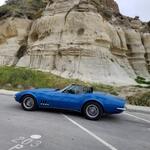
That's interesting; one would think that these regulations would be unified within the EU... In addition to what I mentioned, here in Czech Republic there is the mandatory red rear fog light. Again, not a problem nowadays, but I recall that in the past, there used to be a relatively large number of more expensive/modern cars imported from abroad, mainly US, with an additional rear fog light mounted below rear bumper. It looked terrible
Yes, yes, those captive nuts on the grille brackets you mention are still there! I think they are the only ones that survived the removal of the front bumper and everything else. I had to cut them all off the valance panel / air dam with an angle grinder, along with the rusty broken bolt remnants!
As I mentioned in the introduction, most, if not all, of the suspension parts were original from the factory.
Most of the bushings were cracked, and overall, it looked... well, like the chassis of a 50-year-old car that's never been touched. The biggest challenge was loosening the individual bolts. Most of them were still as tight as when they were installed in Bowling Green at the end of the Vietnam War!
The worst were the smaller bolts, roughly equivalent to M6-M8 sizes, which should be around 1/4" to 5/16". I had to be very careful with these—they had a tendency to break. And I couldn't always afford to just snap them off not giving a damn... I spent quite a bit of time on some of them. The larger bolts weren’t as much of a problem—just clean them, spray some bolt release, smoke a cigarette, and then pick up the ratchet with the right leverage! If they were accessible, that is… The large bolts holding the lower control arms were particularly problematic in this regard. I had to figure out how to lock the nuts from the top so I could loosen the bolts from below... Used a ratchet with a right extension for that...
I'm going to digress here a bit: working with imperial bolt sizes written in fractions—can you make sense of that in any reasonable or natural way? I don’t think I could ever get used to it. If I pick up a metric screw, I can easily tell if it's a six, an eight, or a ten… whatever. But these sizes written in fractions are just terrible. It goes like: "Can you hand me a socket / wrench? What size? I don’t know… seven-twentieths, maybe? Ah, fu*k it, just give me something like an 8mm.
Anyway, as I mentioned, the biggest issue was probably removing the springs—and then putting them back in. I had to use a spring compressor for that, but honestly, I really hate dealing with springs, and I don't trust those compressors... As you can see on the pictures below, I've updated my DYI workbench over time & painted the wise too!
The control arms, springs, and front wheel hub assemblies were sandblasted and repainted.
And then, of course, cleaning everything! The front of the chassis around the radiator was in the worst condition. It was covered with a thick layer of dust, dirt, and ATF oil leaking from the transmission cooling line connections and all the power steering components.
I eventually managed to clean the frame as thoroughly as possible. I started with a wire brush, followed by several stages of heavy engine degreaser, and finished with brake cleaner. Once cleaned, I applied a corrosion inhibitor and then painted it with anti-corrosion additives.
I also removed the front sway bar, as the bushings were due for replacement, and replaced the sway bar links entirely, including all the bushings.
Additionally, I replaced the tie rod ends, along with the sleeves, as they were completely done for. I also installed a new idler arm.
All the replacement parts were from Moog’s Problem Solver series, except for the sway bar links, for which Moog was unavailable. In that case, I opted for Mevotech, if I recall correctly.
In the end, the entire front suspension, including the power steering, brakes, radiator, and other components, was overhauled. Every replaceable or consumable part was replaced with a new one. The control arms, springs, and front wheel hub assemblies were sandblasted and repainted. It was a hell of a job, but it’s finally done
Regarding the control arms bushing replacement: I had a shop handle that job for me since I don't have the necessary equipment (a press), and buying one didn’t make sense. It would mostly just take up space in my garage.
After assembling everything, I drove the car around the block and torqued all the bolts, including the leaf spring bolts that go into the differential cover. I carefully measured everything to ensure the bolts do not go through the cover. There's only one thing left: I still need to figure out how to torque the upper control arm bushings in the front, especially with the fan shroud in place. Even getting a small wrench in there is a challenge, and I don't have enough leverage to torque them properly...
2025 c3 ('74-'82) of the Year Finalist - Unmodified
2024 C3 of the Year Finalist - Unmodified
2023 C3 of the Year Finalist - Unmodified
Wow! That is quite a transformation! I've contemplated doing the A-arm bushes for years, but I think the whole thing is probably too much for me now.😀 Ours is OK, but not super like yours.👍
Thank you, Stephen!
I must say, I've really enjoyed this job—putting together new and clean parts. It's also quite rewarding to see the step-by-step transformation from the original condition!
Actually, as they say, it's more difficult to put something back together than to take it apart - so with a 50 year old Corvette it's exactly the other way around
For an update, I've fitted a freshly painted Air Dam and Valance Panel. You might notice in the photo that one hole for the larger bolt on the Valance Panel is missing. This is due to the area being damaged, which I have been re-glassing and filling. I'll be drilling the hole, once it's alligned with the front clip - as you can see it's misaligned by approximately 5mm. It still requires some fine-tuning, along with the front bumper. The front bumper has sagged slightly, about a millimetre down the sides.
I believe this is because I was hesitant to further tighten the bolts securing the bumper to the front clip. It's also possible that the car's front end naturally settled after being supported by jack stands for an extended period, during which I nearly completely disassembled and reassembled the entire front section.
For the time being, I've decided to leave it as is since I couldn't figure it out somewhat quickly during the installation. My main goal was to install those parts and clear the garage floor. I hate having parts lying around on the garage floor It wouldn't fit on the shelf.
I'm getting ready to make some repairs inside my car during the winter. I decided to start with a thorough cleaning of the carpet and the entire interior to eliminate that "storage smell," even though it wasn't visibly dirty. After removing the seats, I got to work! I used a shop vac with Karcher attachment for wet cleaning, and it performed quite well
Upon seeing this bolt, I braced myself for another tough job, already thinking which power tools might be useful for it To my surprise, it was quite simple—the bolt loosened easily. Subsequently, I cleaned all the bolts and applied few coats of anti-corrosion paint, since it's location on the floor...
The seats are in perfect condition, foam included. My initial plan was to dismantle the rails, sandblast, and repaint them, but that would have required complete disassembly, so I opted against it. Remember - if it works, don't tamper with it! Furthermore, I've fitted new floor mats, choosing plain black for their easier maintenance and because I favor simplicity. I'm not fond of embroidered logos...
Overall, there wasn't a dramatic change from the original state since the interior wasn't visibly dirty. My main goal was to remove all the dust and the characteristic smell of older cars that have been sitting in a garage for an extended period.
In addition to that, here is my checklist for winter interior works:
1. Replace the turn signal lever.
2. Replace the lights control ****.
3. Install new astro vents and center vent grilles.
4. Inspect the turn signal flasher - if LED DRL lights replacement wouldn't work out.
5. Address the gap left by the original stereo.
6. Consider replacing the steering wheel with the original stock one.
7. Adjust some of the panels a bit.
8. Get a leather boot for the automatic transmission shifter.
9. Adjust windows.
10. Have a look at the speedometer and tachometer - the needles are moving but displaying inaccurately. Also, the battery and oil pressure gauges are not functioning at all, nor is the clock, of course
That should cover everything... Looking forward to it
I'd like to share a fuckup with you (happened couple months ago).
Two things: I was again hesitant to tighten something properly, and I was tinkering with something that had previously worked
I decided to change the the valve covers gaskets - just as a precaution, even though they sealing and I hadn't spotted any leaks. But I couldn't resist, so I ordered new gaskets, FelPro, I believe. So, I removed the old cork gaskets, cleaned the valve covers, ensured they were straight, and reinstalled them with the new gaskets. I was cautious not to overtighten the bolts.
Everything seemed perfect until I began pouring in new oil. After a while, I heard splashing and dripping, only to discover that almost all the oil had leaked between the gasket and the block
I spent about an hour and a half cleaning up everything... So that was the job for the day... Then, I had to do it all over again...
On the second try, I glued the gasket to the valve covers with black high-temperature silicone to prevent it from moving during installation and to ensure a perfect fit. I also ditched the "fancy" T-Bolts and replaced them with load spreaders and standard bolts. So far, all is well and there are no leaks. Well, so much for trying to improve something that's already functioning as it should...
Next, I took the hood off today with the help of my kind and beautiful wife.
Good news! The non original bolts were slightly smaller than the original ones. When tightened, they had some resistance but didn't fit properly. Therefore, removing the broken pieces was not an issue... Even better, when I tried the correct bolts, they went in nicely, indicating the threads are intact.
Now, I just need to get the right bolts, four in total. I'm hoping they're in stock at my preferred fastener store, even though it's a drive across entire city. With the hood now down, I plan to tweak a few things - some cable management, further cleaning engine compartement, etc. Additionally, I will likely be replacing the spark plugs along with the cables, as I have a new set prepared already. Indeed, the wires are blue; I didn't notice that when placing the order. However, they can easily be replaced with black ones if needed, so...
I've recently been addressing issues with the lights on my car. The rear right lamp was dimming, then eventually stopped working altogether, and the turn signal remained static instead of flashing.
With the help of members of this forum, I've started to troubleshoot possible causes and addressing them, one by one...
The first issue identified was with the sockets in the turn signal/parking lamps (located at the edge of the bumper). These sockets had been previously replaced, and the wires were failing at the crimped connectors, with one wire even detaching during handling. To fix this, I cut off all these crimped connectors, stripped the wires, and temporarily replaced them with Wago 221 connectors.
It was time for some electrical repairs—a nice change after all the heavy, dirty work! As you can see, the original sockets were in poor condition, affected by corrosion. So, I decided to replace all four rear sockets with new ones. Fortunately, I was able to source them locally; otherwise, I would have had to wait until the end of the month for parts ordered from the US While I was at it, I also replaced all the exterior bulbs.
I soldered the new sockets to the original wires and secured the connections with waterproof heat-shrink tubing. In my opinion, this is a much better solution than the previous crimped connectors. Additionally, I cleaned the grounding point for the rear lights. Although I forgot to take a picture of the original state, I’m sure many of you can imagine how it looked. I sanded the surface down to bare metal, removed the old eyelet, stripped the wire, crimped on a new eyelet, and replaced the bolt and washers with new ones. I even tested the rear lights with the ground disconnected—they didn't work until I reconnected it. So, this way, I've checked that they were grounded as they should and not elsewhere.
With the rear lights fully functional again, the turn signal issue still persisted. All bulbs were new, the grounding point was fixed, and the rear sockets were replaced. The next suspect was the turn signal flasher located behind the interior panel in front of the passenger seat. This flasher was a factory-original Tung-Sol 224 type.
Luckily, while cleaning the interior (and removing seats and such), I discovered another flasher—a heavy-duty HD 552 type—connected to the harness in the storage box behind the passenger seat. This flasher was part of an alarm system that was no longer needed since I had removed the alarm horn earlier. Honestly, I didn't see much use for an old alarm system that may not even work. An old electrical device that is plugged in is more likely to cause problems, which is why I removed the horn.
I figured there was nothing to lose by testing it, so I swapped the original flasher with the one I found, and the turn signals started working again! I had a brand-new electronic flasher on hand, but I would have missed the old-school clicking sound when the turn signals are on. It was a nice bonus to reuse a factory-original part that would have otherwise been discarded. I've also replaced the broken bulb in the passenger side courtesy light. Cool, another thing, albeit small, fixed in the process!
I also purchased a new set of rear lamps. The original ones were dull, and some had cracks. These old lamps would have stood out like a sore thumb installed in the new and freshly painted rear bumper.
Now, all the rear lights and turn signals work as they should! I’ve essentially replaced or fixed almost everything in that section: new lamps, new sockets, new bulbs, cleaned grounding point, and all fasteners replaced. I've also installed new licence plate light which was missing altogether... Just another small detail
Thanks bmotojoe, and for your assistance with that light issue too!
With the right interior panel removed, I’ve started working on the interior-related tasks, moving from the passenger side to the driver side.
First up was the dash vent. It was dirty, had some scratches here and there, and one of the grilles was broken. I had new grilles from ZIP on hand, so I thought it’d be a good opportunity to reduce the number of new parts waiting in the box to be installed
I began by disassembling the vent and cleaning it with an engine cleaner/degreaser:
Next, I applied two coats of structured matte black paint over the original finish to maintain the texture. My main goal was just to conceal the scratches. I considered sanding everything down and applying a completely new layer of paint, but I wasn’t sure the final result would be much better. While I was at it, I also corrected the lettering above the lever. It’s no longer “WIPEP” but “WIPER,” along with a few other touch-ups. For this job, I used my wife’s white nail polish—turned out to be quite handy!
EDIT: I just looked up some pictures of the new dash vent and noticed that the letters OFF, I, II, III / PUSH were also white. That makes sense. Now, how should I proceed with this? I’m thinking of covering that section with masking tape, sanding it lightly to expose the embossed letters, and then painting them white with a small brush... That could work...
I also planned to continue with the center console. I removed the screws on the left and flipped it over to see what I was dealing with. My reaction? “Oh, ****…” And I promptly put it back As I’ve mentioned before, car electrics are not my strong suit. I can handle basic fixes, like wiring for that rear lights and such, but anything beyond that requires clear instructions.
Tomorrow, I’ll proceed with labeling the connectors, so at least I'll know what was connected where and removing the center console. Then I’ll dismantle it, clean everything (including the electric terminals), and take it from there. This is not just about aesthetics; I also need to fix a few gauges, namely the ammeter, oil pressure, and clock, none of which are working. The lights are broken too—only the “Fasten Seatbelts” indicator is lit. That alone will probably keep me occupied for a while.
Once everything is cleaned and reconnected, I’ll test it to see if any of the gauges start working. I can already see that the oil pressure sensor connector is loose and not connected. The question is, why? Looking at the wiring, particularly the non-factory connectors, it’s clear that someone has worked on it in the past.
On a brighter note, I managed to buy a new set of correct bolts for the hood hinges. The store where I get imperial fasteners had five left in stock, so I grabbed all of them. One extra won’t hurt, if not needed now, maybe next time! I also picked up new screws with the correct heads for the interior panels. Just look at the screws I pulled out of the passenger panel—quite the assortment
The center console is out. I spent about ten minutes examining it, thinking about the next steps...
It's clear that the original radio won't fit back in. I checked out some images of the center console fitted with an aftermarket radio and wasn't impressed by that either.
I figured that if someone has already fucked up the console to this extent, there's little chance I could make it worse. It can only improve from here!
Thus, I decided to have at it with my trusty angle grinder!
Now, the plan is to reinforce the hole in the lower section (need to think it thru), followed by applying fiberglass putty to make it flush with the surrounding area. Afterward, the process will be to sand, paint, and make the center console great again! Without Radio installed at all.
I'm eager to see the outcome as well. If it fails, purchasing a new one is always an option
Yes, I'm aware of this option. However, approximately 220 USD equates to about 360 USD delivered here, which doesn't seem justifiable for just a delete plate, at least to me... Nevertheless, let's see how this specific modification turns out!
EDIT: Another question is whether this radio delete kit can even be installed on such a molested console, even before I've 'adjusted' it...
Originally Posted by bmotojoe
And we call that disk you are using a skinny wheel...
Safety Glasses & leather gloves Required!
A skinny wheel? Interesting. Actually, it's a grinding wheel I've used. Albeit a sleeker one. I chose it over a cutting wheel because it enables more control. It also alowed a finer finish on the upper corners, although not as much on the lower section, too little space... As can be seen in the picture...
No worries, safety always comes first when I work with power tools!
I also wear ear plugs when using an angle grinder; they're just not visible in the picture
Some friends came to visit us yesterday. And they wanted to see the Corvette too. So, I immediately got one of them to hold the hood along with my wife, who is already quite experienced with it The hood is now back on the car, including the correct hinge bolts. I’ll just need to tweak it here and there, so it's more flush with the fenders
I also finally replaced the light switch **** and the plastic cover beneath it. As you can see, the previous condition was dismal and the plastic grip was completely missing from the ****, and it was bugging the hell out of me!
Disassembly was relatively annoying. There wasn’t much room to work, so I had to drop the steering column a biy by removing two bolts underneath ataching it to the support. Only then could I pull the panel back enough to fit my hand in. There wasn’t much visibility either, but luckily, I had two LED lights, as you can see in the pic below The bolt was tricky too; I didn’t have a large enough flathead screwdriver, so I had to use small pliers - I hate having to do something like this Putting the bolt back on was kinda frustrating—it didn’t want to catch the thread because I couldn’t apply enough pressure with those pliers. In the end, drop of WD-40 helped
I also wanted to replace the Astro Vent ball and retainer, since I have new parts on hand. It's wiggling in there and the ball itself doesn't look much nice either. I suspect the retainer is either broken or missing altogether - unfortunately, I couldn’t see much in there. However, replacing it wasn’t possible without completely removing the panel. I didn’t want to go that far just for this job, so I reassembled everything and left it for another time.
That said, I may not be able to avoid a full panel disassembly anyway. My tach and speedometer are acting up. The needles move, but they behave oddly—they’re too slow, get stuck, or sometimes drop below zero. The speedometer shows the wrong speed inconsistently, so I need to diagnose this first. Once that’s sorted, we’ll see about the vent.
As for fixing the radio hole in the center console, I have a plan. I’m going to use leftover material from the fiberglass repair kit I bought to repair the Valance Panel.
I’ll glue the fabric around the perimeter of the aluminum frame using two-component metal glue. Then, I’ll tape the front with aluminum tape to shape it and glass it from the back. After that, I’ll fill and paint the front.
The only thing I’m still thinking thry is which putty to use. Polyester putty would be easier to work with and sand, which is nice given the shape. Fiberglass putty is stronger. Alternatively, I’m considering applying a first coat of fiberglass putty followed by a top coat of polyester putty. Any thoughts?
The most likely reason your vent ball(s) feel loose is because the felt strips are either worn out or missing completely...
On this drawing you can see Item #5 in 2 places, GM called them a Seal.
I believe one side of the felt had some thin double back tape just to keep it in place during assembly of the outlet duct...
I have a new set of these seals if you need measurements, let me know...
And Yes, they make a tool to remove that nut...lol
Last edited by bmotojoe; Nov 22, 2024 at 06:51 AM.
Thaks bmotojoe.It would actually be nice if you could provide the dimensions of these seals. That possibility hadn't crossed my mind, and I didn't even know there were any. Just a couple of days ago, I placed an order with Bair's. Anyway, with the approximate dimensions, it shouldn't be too difficult to find a local substitution
Also, I wanted to share some progress on the center panel radio delete. Honestly, it’s one of those jobs I thought would be easy but turned out to be more challenging than expected. The fiberglassing part came out well—it’s not pretty from the back, but it holds firmly. I used a two-component epoxy glue for metals to secure the fiberglass mat around the perimeter. That worked really great!
As shown in the attached pictures, I used leftover Evercoat fiberglass putty for its strength to build up the first two thicker layers. Then I finished with polyester putty to fill in the remaining dents. However, it was a bit challenging. Due to the curvature, spreading the putty evenly was difficult, which meant a lot of sanding. And all the sanding had to be done manually since no tool could fit in the space. I have to admit, after a some time of the fill-sand-repeat cycle, I’d had enough So, there are some flaws. I’ll see if I can find suitable attachments for the Dremel tool and possibly redo it. But honestly, it’s still a significant improvement over how it was originally, that is true








 In addition to what I mentioned, here in Czech Republic there is the mandatory red rear fog light. Again, not a problem nowadays, but I recall that in the past, there used to be a relatively large number of more expensive/modern cars imported from abroad, mainly US, with an additional rear fog light mounted below rear bumper. It looked terrible


 If they were accessible, that is… The large bolts holding the lower control arms were particularly problematic in this regard. I had to figure out how to lock the nuts from the top so I could loosen the bolts from below... Used a ratchet with a right extension for that...


 It wouldn't fit on the shelf.


 So that was the job for the day... Then, I had to do it all over again...










 While I was at it, I also replaced all the exterior bulbs.