When you click on links to various merchants on this site and make a purchase, this can result in this site earning a commission. Affiliate programs and affiliations include, but are not limited to, the eBay Partner Network.
It's been kicked around, but I can't find the old thread. Another discussion where nobody is wrong. I recall when I was 14 and looking at a the first 1963 StingRay Corvette at the dealer in Santa Fe, it was a big deal that the new Corvette was a mid engine car, which was great for weight distribution. It was classified a a mid engine car because the mass of the engine was between the axles. I've heard that repeated many times over the years, as the chassis really didn't change much for the C3.
Seems now that there is a different school of thought... That says the engine must be behind the cabin, but still in front of the rear axle for it to be considered a mid engine car.
No, the C-2 and C-3 are not mid-engine cars. A mid-engine car engine sits behind the driver forward of the rear wheels. My NSX is a mid-engine car. The engine sits transverse behind the seats. The passenger cabin and engine compartment are separated by a small interior window and an aluminum wall. The car also has functional trunk in the rear. Jerry
No, the C-2 and C-3 are not mid-engine cars. A mid-engine car engine sits behind the driver forward of the rear wheels. My NSX is a mid-engine car. The engine sits transverse behind the seats. The passenger cabin and engine compartment are separated by a small interior window and an aluminum wall. The car also has functional trunk in the rear. Jerry
Technically Incorrect... The actual definition, as the OP suggested, is that mid-engine cars feature an engine positioned behind the front axle but in front of the rear axle. You are defining a rear-engine car.
This topic could be debated to death because everyone, as demonstrated, has their own view.
Technically Incorrect... The actual definition, as the OP suggested, is that mid-engine cars feature an engine positioned behind the front axle but in front of the rear axle. You are defining a rear-engine car.
This topic could be debated to death because everyone, as demonstrated, has their own view.
EXACTLY! That’s why it’s a case of “nobody is wrong”. To us old timers, it’s the classical definition. Even Chat GPT supports it. Then again, if you leave out the word “classic”, it’s saysNo, the C3 is not a mid-engine car. So now we even have AI arguing with itself😂😂😂.
From CharGPT:The classical definition of a mid-engine car is:
A vehicle in which the engine is mounted between the front and rear axles, typically behind the passenger compartment but ahead of the rear axle line.
Here’s a more detailed breakdown:
🔹 Key Points
Engine placement:
The engine sits within the wheelbase, not ahead of the front axle or behind the rear axle.
Drivetrain layout:
Usually rear-wheel drive — the engine’s power goes to the rear wheels through a short transaxle or gearbox.
Weight distribution:
Because the mass of the engine is centralized, the car achieves near-ideal front-to-rear balance, improving handling, traction, and cornering.
🔹 Variants
Rear mid-engine (RMR):
Most sports cars use this — the engine is behind the seats but in front of the rear axle (e.g., Ferrari 488, Porsche 718 Cayman, Corvette C8).
Front mid-engine (FMR):
Less common term — the engine is behind the front axle but ahead of the cabin (e.g., some Mercedes-AMG GTs, Mazda RX-7, and even C7 Corvettes).
These cars are still front-engined by convention but have “mid-front” balance characteristics.
So, classically, “mid-engine” refers to the engine’s position between the axles, usually behind the driver, whereas front- and rear-engine cars have their engines outside the wheelbase.
And the search without “classic”:No — C3 Corvettes (1968–1982) are not mid-engine cars.
They are front-engine, rear-wheel-drive vehicles, meaning the engine is mounted ahead of the passenger compartment, under the long hood, and power is delivered to the rear wheels through a driveshaft.
Here’s a quick breakdown for context:
C1 (1953–1962) → Front-engine
C2 (1963–1967) → Front-engine
C3 (1968–1982) → Front-engine (same basic layout as C2)
C4 through C7 (1984–2019) → All front-engine
C8 (2020–present) → The first and only mid-engine Corvette, with the engine mounted behind the seats but ahead of the rear axle.
Interestingly, Chevrolet engineers did experiment with mid-engine Corvette prototypes in the late 1960s and 1970s (e.g., the XP-882 and XP-895 concepts), but none reached production until the C8.
1963 Corvette does not have a mid-engine, BUT 1963 thru 1967 (C2) were-are routinely referred to as "mid-year"
no, I do not understand why that convention is or how it became.
Corvette mid-engine serial production first commenced with present day corvette generation (C8).
long defunct pontiac fiero (MY1984-1988) have a mid-engine (transverse L4 or V6)
The tiny SMART cars also have transverse engine at rear axle, but they're essentially a RWD; I've seen one covertly-fitted with a turbo Suzuki Hayabusa motorcycle engine.
In my regional oval track race rules, a defining point is that at least one spark plug is forward of a front ball joint,
If I had my mid-engine druthers, I think I'd like a genuine eighties Renault R5 Turbo.
Last edited by Rebelyell; Oct 7, 2025 at 03:11 AM.
2025 c3 ('68-'73) of the Year Finalist - Unmodified
2024 C3 of the Year Finalist - Unmodified
Well when there were only 3 generations, 63-67 were “mid year” cars. C1, C2 and C3 weren’t used back in the day.
Originally Posted by Rebelyell
1963 Corvette does not have a mid-engine, BUT 1963 thru 1967 (C2) were-are routinely referred to as "mid-year"
no, I do not understand why that convention is or how it became.
Corvette mid-engine serial production first commenced with present day corvette generation (C8).
long defunct pontiac fiero (MY1984-1988) have a mid-engine (transverse L4 or V6)
The tiny SMART cars also have transverse engine at rear axle, but they're essentially a RWD; I've seen one covertly-fitted with a turbo Suzuki Hayabusa motorcycle engine.
In my regional oval track race rules, a defining point is that at least one spark plug is forward of a front ball joint,
In the broadest sense of the term, any car with the engine placed between the axles qualifies as a "mid engine" car. Every 63 up Corvette fits that description. The Corvette's engine placement low in the frame and behind the front axle, as well as the rearward placement of the seating position gives the Corvette an excellent weight balance that rivals that of many rear mounted "mid engine" cars.
I always have to laugh when people try to claim that big block Corvettes are nose heavy. By mounting the engine low and behind the front axle, even big block Corvettes average a near perfect 51/49 to 52/48 weight balance depending on options. Big block Camaro's and Chevelles, with the engine mounted high in the frame and over the front crossmember are nose heavy, but not big block Corvettes.
Are Corvettes mid engine cars, maybe not in the commonly accepted definition of the term, but they are in the truest or broadest sense of the term. At least as I understand the term.
2025 c3 ('74-'82) of the Year Finalist - Unmodified
2024 C3 of the Year Finalist - Unmodified
2023 C3 of the Year Finalist - Unmodified
Originally Posted by Rebelyell
1963 Corvette does not have a mid-engine, BUT 1963 thru 1967 (C2) were-are routinely referred to as "mid-year"
no, I do not understand why that convention is or how it became.........
.
At that time, the 60's, the Corvette now called a C2 was produced in the middle years of the 60's, hence "Mid Year" cars. At that time the earlier cars were referred to as solid or straight-axle cars. The '68 on cars became "Sharks", due to the connection with the Mako Shark II Concept. When what is now called the C4 was introduced it was generally called a "late model".
In his excellent book "The Complete Corvette" Richard Langworth, actually splits the straight axle cars into two "generations", the 53 - 55s being the first, the 56-62s the second. He also splits the "Sharks," into two; the Chrome Bumper cars and the rubber bumpers. By his definition we were well into the generations when Chevy released what it called the C5, throwing a lot of people off balance! Personally, I dislike the retrospective application of generations, to me they are still Straight axles, Mid-Years, and Sharks.😀
As for the Mid-Engine. I remember talking to Dave James about that in the pit-lane at Le Mans, just before the C8R appeared on the scene. I said that I wasn't a big fan of the mid-engine look and DJ replied that the C7R was a mid-engine car! We discussed the number 63 car in front of us and it was hard to argue!😀
But in my book a "mid engined" car has the engine behind the driver, in front of the rear axle. A rear engine car has the engine behind the rear axle. That's just my thinking.🙂
For the younger guys, here is a picture of my 1988 FIERO Mid Engine Car. I tried to park with the C8 at my Cars & Coffee, but they said NO! 1988 Pontiac FIERO GT
For the younger guys, here is a picture of my 1988 FIERO Mid Engine Car. I tried to park with the C8 at my Cars & Coffee, but they said NO! 1988 Pontiac FIERO GT
1988, THE best year !
For the Not so young, I certainly recall Fiero road race campaigns; especially the late Georgia native Clay Young in IMSA GTO, GTU et al.
Herman Clay Young 1947-2014 RIP +




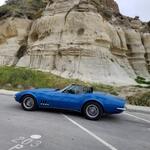






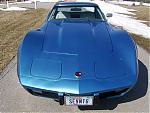
 Is the C3 A Mid-Engine Car?




 ..
..