When you click on links to various merchants on this site and make a purchase, this can result in this site earning a commission. Affiliate programs and affiliations include, but are not limited to, the eBay Partner Network.
I am getting battery voltage on the positive side of the coil engine running. In a points style distributor in the run position engine running the battery voltage should drop down to 9 volts. The wiring diagram I have chevy service manual says yellow wire from the starter to the positive side of the coil and the resistor with that runs to the bulkhead connector under the master cylinder booster. On this car I have 2 wires black and orange with white sheathing (resistor wire) that feed into the factory harness and route under the windshield wiper motor. I have 12 v key on engine not running and with the engine running its still battery voltage . Does the voltage drop down immediately or does it take a couple minutes?
When you are cranking the engine, the yellow (sometimes red) wire from the starter solenoid provides 12v to the coil. As soon as the engine starts (and you release the key to the run position), the solenoid is de-energized and that yellow wire no longer supplies voltage to the coil. The resistance wire supplies 9V to the coil with the key in the On position. Technically, it still provides 9V when cranking, but the 12V from the solenoid overwhelms it. You should have 9V to the coil with engine running. If you have 12V, your points will burn out soon.
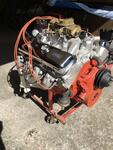
This car is pretty stock. I have no wire from the starter going to the coil. It's a black wire in the engine harness loom on the same terminal as the resistor wire on the positive side of the coil. I cut the black wire and put a jumper wire on it and as soon as the car started it had 12.7 volts. I removed the jumper opening the circuit on the black wire and the car died. The resistor wire orange in white sheath wire still on the positive side coil. I will post a picture shortly.
I am getting battery voltage on the positive side of the coil engine running. In a points style distributor in the run position engine running the battery voltage should drop down to 9 volts. The wiring diagram I have chevy service manual says yellow wire from the starter to the positive side of the coil and the resistor with that runs to the bulkhead connector under the master cylinder booster. On this car I have 2 wires black and orange with white sheathing (resistor wire) that feed into the factory harness and route under the windshield wiper motor. I have 12 v key on engine not running and with the engine running its still battery voltage . Does the voltage drop down immediately or does it take a couple minutes?
I'm not an electrician nor ignition expert. But we have a bon fide ignition expert here: CF member 69427
The points systems' resistance wire (aka ballast) will Limit CURRENT aka Amperage during RUN; while a typical VOM won't display the voltage delta.
@robertea has drawn some stunning wiring diagrams for the 1969 but I am reasonably sure your 72 has the same basic design. You never know how much bubba impacted any old car so I would look at his diagrams and see what you can glean.
By any chance, did your car ever have the K66 transistorized ignition? Look at the front of the left inner wheel well and see if you can see 2 holes that would have mounted the TI unit.
On this car I have 2 wires black and orange with white sheathing (resistor wire)
Originally Posted by sameold01
I have no wire from the starter going to the coil.
First - to answer your question - when not cranking it should immediately revert to ~9V via the resistor wire from the bulkhead.
So I'm a little confused with your posts... you state that you have two(2) wires on the Coil +. You state that you do NOT have a wire from the starter to the Coil +.
So that begs a question - where does that 2nd wire come from since it does not come from the starter?
I recommend you temporarily remove both wires from the coil and check their voltage independently with key in ON position and key in START position. Engine doesn't need to be running. Report back.
I can only guess that perhaps that 'mystery' wire that does not go to the starter (as it should) may be hooked to switched battery source somewhere perhaps...?
Ok I did verify this wire on the R terminal of the starter solenoid. This wire at the positive side of the coil has 0 volts run position and 9.7 cranking. The black wire I did find out is the resistor wire and has 12.1 volts key on and 9.7 cranking.
I spent some time looking at 1972 wiring diagrams online and from what you describe, seem to match what you have. I can’t explain why there appears to be a wire running from the solenoid to the heater motor though. Going to need an electrical guru to chime in.
Ok I did verify this wire on the R terminal of the starter solenoid. This wire at the positive side of the coil has 0 volts run position and 9.7 cranking. The black wire I did find out is the resistor wire and has 12.1 volts key on and 9.7 cranking.
I would expect system-wide cranking voltage may be about 9-10 volts.
Sounds to me as though your points ignition is RUNNING on Both full voltage & full current. I expect that May negatively affect points life; perhaps same for coil / condenser.
With the key in START you should be getting full battery voltage at the coil + post, with the key in RUN it'll be less - about 9v. Two wires on the coil + post.
This is from memory and I don't have access to the car or the service guide wiring diagrams at the moment (so naturally someone will highlight my wrongness) but IIRC the full battery volts is off the one of the starter solenoid posts, the other is the 'resistive wire' that's in the harness coming through the firewall on the driver side. In my case on a '69 that wire was destroyed and used regular wire to splice in one of these that accomplished the same thing. They were used on C2s.
Ok I did verify this wire on the R terminal of the starter solenoid. This wire at the positive side of the coil has 0 volts run position and 9.7 cranking. The black wire I did find out is the resistor wire and has 12.1 volts key on and 9.7 cranking.
For some reason this seems to confuse me more... When you say things like "this wire" or "the wire" it's not always clear to me which wire you are referring to or where it leads to...
Usually there are two wires are co-terminated at a single crimped connector at the Coil+. Depending on year and options installed there may also be a 3rd wire at Coil+. So I'm curious how you are establishing the source of voltages on these two wires unless they have separate crimped terminals at the Coil+. I'm going to ask a series of questions if you can answer these I think it would clarify some of the confusion created in your posts and help identify and isolate potential sources of the inverted voltage conditions at Coil+.
1. Are the two(2) wires at the Coil+ co-crimped with a SINGLE connector? Or does each wire have it's own separate crimped connector?
2. Is there a 3rd wire connected to Coil+ leading leading a few inches to a capacitor also mounted on the coil? (Your car may not have originally been equipped with this - let's eliminate potential confusion is all)
3. Please clarify specifically WHERE the BLACK wire connects to?
4. Please clarify specifically WHERE the BLACK-ORANGE w/ WHITE Sheath wire connects to? (Also let's clarify this is in fact a BLACK wire w/ an ORANGE Stripe inside the sheath? I ask because that's the way you've written it - the second color is the minor color or stripe color in wiring)
5. Measure the resistance (Ohms) of the wire between bulkhead under the M/C and the Coil+.
6. Measure the resistance (Ohms) of the wire between the solenoid and the Coil+.
7. Disconnect the wire temporarily from the starter solenoid and measure voltages with key in RUN position at these four(4) locations:
7a: Starter solenoid post wire 'was' connected to
7b: Disconnected wire now dangling at solenoid
7c: Coil+ post
7d: Bulkhead connector (you'll need to insert a pin or probe to get a reading inside the connector)
8. optional - you could check voltages in START position at some of the above locations too - but that would require an assistant - so let's skip that for the moment...
I spent some time looking at 1972 wiring diagrams online and from what you describe, seem to match what you have. I can’t explain why there appears to be a wire running from the solenoid to the heater motor though. Going to need an electrical guru to chime in.
That diagram you posted doesn't make a lot of sense to me. GREEN wire to Solenoid? My '71 AIM and FSM diagrams don't show a GREEN wire here but maybe the '72 wiring changed significantly...? But still it contradicts the OPs colors.
My '71 diagram doesn't show a fan motor hooked into the solenoid circuit so I can't speak to this particular diagram. It's a bit blurry but I don't see the motor clearly in the solenoid circuit in your diagram - but again it's a bit blurry. Generically speaking..., the reason a wire might run from the solenoid to a high draw components like a motor (fan, wiper, headlight, etc.) is to interrupt power to high-draw components during starting/cranking. E.g. the wipers or the fan briefly STOP working while the engine (starter and solenoid) is cranking. But this might more likely be done w/ a relay interrupt.
That diagram you posted doesn't make a lot of sense to me. GREEN wire to Solenoid? WTF? My '71 FSM or AIM diagram doesn't match this - but maybe the '72 wiring changed significantly...?
I can't speak to this particular diagram - but generically speaking..., the reason a wire might run from the solenoid to a high draw components like a motor (fan, wiper, headlight, etc.) is to interrupt power to high-draw components during starting/cranking. E.g. the wipers or the fan briefly STOP working while the engine (starter and solenoid) is cranking.
I spent about 6 months working with forum member @robertea helping him validate the wiring diagrams he’s drawn for the 69. That experience revealed a LOT of issues with the original GM diagrams so it’s a crapshoot for anyone to get 100% reliable ones for any year.
I can’t vouch for the 72 I posted to help the OP but I think you nailed it with your explanation for the wire from the solenoid to the heater. No such wires on my 69.
I spent about 6 months working with forum member @robertea helping him validate the wiring diagrams he’s drawn for the 69. That experience revealed a LOT of issues with the original GM diagrams so it’s a crapshoot for anyone to get 100% reliable ones for any year.
I can’t vouch for the 72 I posted to help the OP but I think you nailed it with your explanation for the wire from the solenoid to the heater. No such wires on my 69.
I've got that 69 diagram you helped on - that's awesome work - I'm jealous I don't have the same for my '71! But I keep the 69 version to double check sometimes - so nice and easy to read.
I agree on the errors - Wish I had a list of known issues w/ my '71 diagrams! Sometimes it's age too. For example my diagram says I should have a WHITE-RED-BLACK resistor wire between my bulkhead and coil+. Mine is solid Orange w/ a White Sheath. Maybe the sheath counts as white? My red wire probably faded to orang-ish? And the black stripe rubbed off...? But my '71 diagram also says I'm supposed to have a YELLOW wire between the starter solenoid and Coil+. Mine is black and appears to be original.
I've got that 69 diagram you helped on - that's awesome work - I'm jealous I don't have the same for my '71! But I keep the 69 version to double check sometimes - so nice and easy to read.
But my '71 diagram also says I'm supposed to have a YELLOW wire between the starter solenoid and Coil+. Mine is black and appears to be original.
Resistance on the black factory resistance wire from coil positive to bulkhead connector reads 1.5 ohms. Voltage on resistance wire key on running is 12.1 volts and 13.7 on alternator post. Black resistance wire and red wire from starter r terminal share the same post terminal and there is a small radio capacitor mounted on the coil bracket going to the positive post on coil.
Should I leave this alone car runs great or should i run a new wire from the bulkhead connector with a ballast resistor in line to the positive side of coil?
Resistance on the black factory resistance wire from coil positive to bulkhead connector reads 1.5 ohms. Voltage on resistance wire key on running is 12.1 volts and 13.7 on alternator post. Black resistance wire and red wire from starter r terminal share the same post terminal and there is a small radio capacitor mounted on the coil bracket going to the positive post on coil.
Should I leave this alone car runs great or should i run a new wire from the bulkhead connector with a ballast resistor in line to the positive side of coil?
Based on your post it sounds like the resistor wire is in place and with 1.5 Ohm resistance, while engine running it drops alternator voltage of 13.7 drops voltage down to 12.1 at Coil+. I wouldn't change the wire or add a ballast.
During CRANKING the Coil+ should see full Battery voltage (not alternator voltage) at the Coil+ from the starter solenoid. But remember Battery voltage (during cranking) is lower than alternator voltage (running) - should be around 12.6 battery voltage under cranking.
On my '71 as best I recall when I had the key ON (pretty sure it was battery voltage, engine not running) I saw 12.6V at the bulkhead. My resistor wire measured to 1.35 Ohms. I saw 9.8V at the Coil+. Again - that's w/ the Key ON but the engine NOT running - e.g. battery voltage, not alternator voltage.
IF someone can add to this and get a reading for me please. With a Conventional GM point ignition set-up can someone take a reading volts at the positive side of the coil engine running and let me know.
Here's what AI had to say when I asked "what are the volts at the positive side of the coil with the engine running on a 1972 gm points distributor". FWIW.







 72 corvette ignition delimma