




calling ALL 383's

Thread Starter
Instructor

Joined: Nov 2003
Posts: 203
Likes: 0
From: harrisonburg (JMU) va
 calling ALL 383's
i kno there are a bunch of you on here, list your setup, specs, numbers, times, sound clips, video clips, pictures, anything....as some of you may know we're in the market for a 383 and just wanted to get some specs on the ones already runnin around.
Thanks guys
Thanks guys

Team Owner

Joined: Jul 2001
Posts: 182,997
Likes: 88
From: Lakeland, FL
Cruise-In IV-V-VI-VII-VIII Veteran
St. Jude Donor '03, '06, '17
I got a 406 now, but I had a 383 before that:
AR Racing built 383
Dart Iron Eagle 215cc heads - ported
Custom Solid cam with 238/248 degree .050 duration and .525/.540 lift
speedpro hyperutectic pistons 10:1 compression
HP output: 465 crank HP and 365 RWHP/410 RWTQ
Best time at the track: 11.67 @ 119.79
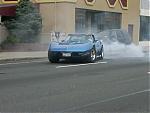
here's one of my passes... That was a slower pass but with a nice bunout.. Got videos of 11 second passes but they are in .mov format which cannot be hosted on forum webspace..
http://www.corvetteforum.net/c3/gran...urnoutpass.wmv
AR Racing built 383
Dart Iron Eagle 215cc heads - ported
Custom Solid cam with 238/248 degree .050 duration and .525/.540 lift
speedpro hyperutectic pistons 10:1 compression
HP output: 465 crank HP and 365 RWHP/410 RWTQ
Best time at the track: 11.67 @ 119.79
here's one of my passes... That was a slower pass but with a nice bunout.. Got videos of 11 second passes but they are in .mov format which cannot be hosted on forum webspace..
http://www.corvetteforum.net/c3/gran...urnoutpass.wmv
Thread Starter
Instructor
Joined: Nov 2003
Posts: 203
Likes: 0
From: harrisonburg (JMU) va
grandsport, did you actually dyno the motor at the crank to verify AR racing? i dont see how we're getting a quote of about 430 crank hp from a motor with forged pistons, rods, dart pro 1 aluminum heads, solid roller valve train, full alum. roller rockers, msd ignition, etc. and AR's iron headed hypereutectic piston motor is supposedly making 465 horsepower, the builder of the latter motor will dyno it right in front of our face and is turnkey...
Team Owner
Joined: Jul 2001
Posts: 182,997
Likes: 88
From: Lakeland, FL
Cruise-In IV-V-VI-VII-VIII Veteran
St. Jude Donor '03, '06, '17
Originally Posted by 71vetteLT-1
grandsport, did you actually dyno the motor at the crank to verify AR racing? i dont see how we're getting a quote of about 430 crank hp from a motor with forged pistons, rods, dart pro 1 aluminum heads, solid roller valve train, full alum. roller rockers, msd ignition, etc. and AR's iron headed hypereutectic piston motor is supposedly making 465 horsepower, the builder of the latter motor will dyno it right in front of our face and is turnkey...
What size intake runner does the 430 HP engine have? If it's a 200 cc intake runner head - that's the reason for less HP. You need bigger runners and valves to flow more air/fuel. My valves were 2.05/1.60's. The intake also makes a huge difference.. A POS dual plane will cost you HP.. I got 20 more peak RWHP with the Edelbrock TM-1 (Tarantula) vs. The Performer RPM.
That was within a few days in similar conditions.
A good way to tell is to chassis dyno your 430 HP rated engine and see how many RWHP you'll get... My old Chassis dyno sheet is in my signature
Just click on
365 RWHP/410 ft/lbs RWTQ in the sig!!
BTW - forged vs. hyperutectic won't make a performance difference.. The main difference is strength.. Forged pistons take a lot more abuse.. The main criteria is piston weight. Lighter piston = more power!
Last edited by GrandSportC3; Jan 31, 2005 at 12:34 PM.

Melting Slicks


Joined: Jul 2002
Posts: 3,128
Likes: 3
From: Deltona (son of Deland and DAYTONA) FL
Originally Posted by GrandSportC3
The actual engine was not dynoed but they dynoed a mule engine with the same specs.. The numbers seem to be very accurate considering the RWHP numbers.. The HP loss through the drivetrain is usually about 15% for transmission, rear end etc. and about 7 - 12% for accessories (alternator, water pump, fuel pump etc..). If I assume a very low accessory loss of 7% - I still come up with approx. 465 crank HP...

Also if you try the math calculators on smokemup.com, assuming Olivier's car weighs 3300 with him in it, a run of 11.6 would be 465 flywheel hp. It might even be more than that if his car is not that heavy.
Olivier, is that link in your sig to a dyno run once you had my motor in your car right? You said it shut down early, so that would proably drop the HP rating. Figuring 20% loss for drivetrain puts the TQ over 500 ftlbs. Figuring in humidity and temp puts the flywheel hp at 465 or better.
Melting Slicks

Joined: Jan 2004
Posts: 2,672
Likes: 1
From: New Cumberland PA
Forged pistons, rods, and aluminum heads does not per say add any horse power. However, they cost more and typically used in higher output engines.
I will be assembling my engine sometime this week. I would like to have it on an engine dyno but I don't have the cash or means to get it to a shop. I do paln on running it on a chassis dyno over the summer.
My setup is a .060 over 4 bolt with Caliles steel billet caps
Speedpro hyperutectic pistons 10:4 compression
Scat cast crank and 5.7" rods
GMPP Vortec heads with some porting work on the exhaust side
GMPP aluminum Intake
Roller rockers
Lunati hyd cam .458" 218 degrees at .050
Holley 770cfm street avenger
I am hoping for around 370 to 390hp, close to 300hp at the wheels.
I will be assembling my engine sometime this week. I would like to have it on an engine dyno but I don't have the cash or means to get it to a shop. I do paln on running it on a chassis dyno over the summer.
My setup is a .060 over 4 bolt with Caliles steel billet caps
Speedpro hyperutectic pistons 10:4 compression
Scat cast crank and 5.7" rods
GMPP Vortec heads with some porting work on the exhaust side
GMPP aluminum Intake
Roller rockers
Lunati hyd cam .458" 218 degrees at .050
Holley 770cfm street avenger
I am hoping for around 370 to 390hp, close to 300hp at the wheels.
Team Owner
Joined: Jul 2001
Posts: 182,997
Likes: 88
From: Lakeland, FL
Cruise-In IV-V-VI-VII-VIII Veteran
St. Jude Donor '03, '06, '17
Originally Posted by isosceles
Also if you try the math calculators on smokemup.com, assuming Olivier's car weighs 3300 with him in it, a run of 11.6 would be 465 flywheel hp. It might even be more than that if his car is not that heavy.
Olivier, is that link in your sig to a dyno run once you had my motor in your car right? You said it shut down early, so that would proably drop the HP rating. Figuring 20% loss for drivetrain puts the TQ over 500 ftlbs. Figuring in humidity and temp puts the flywheel hp at 465 or better.

Team Owner


Joined: Apr 1999
Posts: 21,953
Likes: 1,445
From: Reno Nevada
2024 C3 of the Year Finalist- Modified
As of May 2001 I installed a 383 cubic inches which is 3.750 stroke and 4.030 bored 397010 4-bolt block. I only went with a 383 because of time delays to get a high end 3.875 stroker crank. I had blown two 355 ci motors in 3 months and I was in a hurry to get back on the road. I went to great lengths to make this my best high tech motor. It is deburred, screened, balanced and blue printed. Ultra lite hollow drilled 40 lbs internally balanced 4340 forged crank, Which was nitrided and treated with oil repellant. SFI 6.25 inch Fluid dampner, Moroso 8 quart road racing pan, Manley 6 inch 685 gram H-beam bushed rods good for up to 850 hp, JE flat top pistons, Lots of Ceramic thermal coated parts. 11.21 C.R. Crane custom mech. roller cam 236/244 degrees @.050 .635/.644 112 LCA. Race ported Dart Pro1 227 cc aluminum heads with titanium 2.08 intakes 1.625 exhaust valves 64 cc angle plugs 1.55 dual springs with 195 pound closed pressure with rev kit. Ported Weiand Team G. man with Speed Demon 750 CFM twin squirter carb. Hooker 1 ¾ Super Comp headers into 3 true duals with 3 inch in out race mufflers. The good power band is from 3000 -7500 rpm.
If I could change anything it would be some kind of 1000+ cfm 4 barrel type sequential single plane manifold.
If I could change anything it would be some kind of 1000+ cfm 4 barrel type sequential single plane manifold.
Corvette Stories
The Best of Corvette for Corvette Enthusiasts

Top 10 Most Expensive Corvettes Ever Sold on Bring A Trailer
Brett Foote
10 Things Every Corvette Owner Needs (2026 Edition)
Michael S. Palmer
8 Most "Only Corvette Owners Understand" Quirks and Problems
Pouria Savadkouei
10 Reasons the C6 Z06 is Still A Performance Benchmark After 20 Years
Joe Kucinski
How Much Horsepower Every Corvette Engine "LOST" in 1972
Joe Kucinski
Top 10 DOs and DON'Ts for Protecting Your Convertible Top!
Michael S. Palmer
Top 10 Most Explosive Corvettes Ever Made: Power-to-Weight Ratio Ranked!
Joe Kucinski
150 hp to 1,250 hp: Every Corvette Generation Compared by the Specs That Matter
Joe Kucinski
8 Coolest Corvette Pace Cars (and Replicas) of All Time
Verdad Gallardo
Thread Starter
Instructor
Joined: Nov 2003
Posts: 203
Likes: 0
From: harrisonburg (JMU) va
the engine shop we talked to (building NASCAR engines for 25 years, have built motors for nemecheck and other nascar drivers) said that forged pistons give you "free" horsepower from the less friction they create as opposed to hyper. cause they expand more with heat...the heads are dart pro 1 with 215cc runners, 2.08 intake valve and 1.60 exhaust valve, Rpm air gap intake mani., JE flat top forged pistons (10.33:1 CR), forged i beam rods (6 inch as opposed to 5.7, causes less piston to wall pressure=less friction and more hp), scat cast steel crank (internally balanced), comp cams solid roller cam (our specification, we want the ticking  not sure of the exact specs on the cam), full roller rockers, true dual roller timing set....i think thats it, they made 415 hp and 470 tq on a motor with hypereutectic pistons and hyd. flat tappet cam, they say we will pick up some hp and tq going with solid roller and forged pistons...
oh yeah, the block is hand cleaned and everything blueprinted...
not sure of the exact specs on the cam), full roller rockers, true dual roller timing set....i think thats it, they made 415 hp and 470 tq on a motor with hypereutectic pistons and hyd. flat tappet cam, they say we will pick up some hp and tq going with solid roller and forged pistons...oh yeah, the block is hand cleaned and everything blueprinted...



Team Owner
Joined: Apr 1999
Posts: 21,953
Likes: 1,445
From: Reno Nevada
2024 C3 of the Year Finalist- Modified
You can't put an 1205 gasket intake like the air gap on bigger heads like the 215cc.
If you engine builder is up on things they should know that.
Installation Notes: Use #8504 Edelbrock bolt kit. Recommended intake gasket: Edelbrock #7201. Manifold height: A-4.20", B-5.25" (same as #7101), see manifold selection page. Port exit dimensions: 1.14" x 1.95".
Dart 215 cc port dimensions 1.190 X 2.15
Not even close to the Air Gap. Any engine builder that knows what they are doing should know that you can't run bigger head ports than intake manifold.
If you engine builder is up on things they should know that.
Installation Notes: Use #8504 Edelbrock bolt kit. Recommended intake gasket: Edelbrock #7201. Manifold height: A-4.20", B-5.25" (same as #7101), see manifold selection page. Port exit dimensions: 1.14" x 1.95".
Dart 215 cc port dimensions 1.190 X 2.15
Not even close to the Air Gap. Any engine builder that knows what they are doing should know that you can't run bigger head ports than intake manifold.
Thread Starter
Instructor
Joined: Nov 2003
Posts: 203
Likes: 0
From: harrisonburg (JMU) va
hmmm, i never thought of that, would be good to introduce to them, what intake should be used for those heads then? they have used that intake on a previous motor they have built and acheived 415 hp, there is a video of the motor on the dyno, we even went and saw their facility this weekend, they looked VERY legit, although they are new to street motors, just getting out of nascar after all the big companies like Rousch have taken over the engines in nascar...they say an "Aluminum air gap design intake manifold" we could either get the actual edelbrock air gap in aluminum finish or an off brand (same exact thing just polished alum.)
what is a 1205 gasket intake?
just verified ur info on the edelbrock website, this may not even be the RPM airgap as it says performer air gap which has port size of 1.14 by 1.88
so i guess thats port matching? but ur supposed to match to the intake i guess, so you port the heads not the intake??
what is a 1205 gasket intake?
just verified ur info on the edelbrock website, this may not even be the RPM airgap as it says performer air gap which has port size of 1.14 by 1.88
so i guess thats port matching? but ur supposed to match to the intake i guess, so you port the heads not the intake??
Last edited by 71vetteLT-1; Jan 31, 2005 at 01:38 PM.

Race Director

Joined: Apr 2000
Posts: 17,676
Likes: 201
From: Who says "Nothing is impossible" ? I've been doing nothing for years.
Run a Vic Jr. single plane (1206 gasket intake) 240deg @.050" duration .575" lift solid roller cam with 11:1 compression and you will be close to 500HP with street manners 
Thread Starter
Instructor
Joined: Nov 2003
Posts: 203
Likes: 0
From: harrisonburg (JMU) va
just did a little more research, we would need intake gasket 1206 correct?
dart recommends a single plane intake with 1.100 x 2.000 ports...and 5.500, thats still smaller than the heads but i guess .150 is a lot better than .270??? and plus, dont i want a dual plane for more torque?
dart recommends a single plane intake with 1.100 x 2.000 ports...and 5.500, thats still smaller than the heads but i guess .150 is a lot better than .270??? and plus, dont i want a dual plane for more torque?
Last edited by 71vetteLT-1; Jan 31, 2005 at 01:48 PM.
Thread Starter
Instructor
Joined: Nov 2003
Posts: 203
Likes: 0
From: harrisonburg (JMU) va
Originally Posted by MotorHead
Run a Vic Jr. single plane (1206 gasket intake) 240deg @.050" duration .575" lift solid roller cam with 11:1 compression and you will be close to 500HP with street manners
Team Owner
Joined: Apr 1999
Posts: 21,953
Likes: 1,445
From: Reno Nevada
2024 C3 of the Year Finalist- Modified
This or the 7532 and use a 1/2 wood open spacer.
http://www.holley.com/HiOctn/ProdLin...AMSM/7530.html
http://www.holley.com/HiOctn/ProdLin...AMSM/7530.html
Team Owner
Joined: Jul 2001
Posts: 182,997
Likes: 88
From: Lakeland, FL
Cruise-In IV-V-VI-VII-VIII Veteran
St. Jude Donor '03, '06, '17
IMHO - single plane intakes are the way to go for a performance engine... I picked up HP and torque with the 30 year old single plane intake vs. the Performer RPM throughout the RPM range... (Picked up 20 HP on 2 different dyno runs within a week)
Team Owner

Joined: Feb 2003
Posts: 30,183
Likes: 313
From: Lake Norman NC
i have heard nothing but positive things from people who have actually run single planes on the street. I'm running a victor jr. port matched to 1205 on AFR 195s. According to my engine builder, my 383 is pumping 480HP at 6300rpm from another customer engine with the exact same specs that was dynoed.
Drifting

Joined: Jan 2002
Posts: 1,500
Likes: 0
From: N.Y
390 on a chassis Dyno and I was running rich. check out the specs below. I should get a 1/4 time of about 11.60 after I do my tranny and converter. 3600 with me in it and 370 gears. Already went 12..11 on a 245/60/15 radial.


Burning Brakes

Joined: Jun 2003
Posts: 1,022
Likes: 6
From: CT
78Vette:
Those cam specs look like the XR288HR comp roller cam, is it? If so, how do you like, how rough is the idle, and what rpm does it start pulled at?
I'm planning on building a 383 or 396 stroker next summer and that is the cam I'm probably going to get. My combo should be similiar to yours except I'll probably have to use my old World sportsman II heads, due to a low budget.
Thanks
Those cam specs look like the XR288HR comp roller cam, is it? If so, how do you like, how rough is the idle, and what rpm does it start pulled at?
I'm planning on building a 383 or 396 stroker next summer and that is the cam I'm probably going to get. My combo should be similiar to yours except I'll probably have to use my old World sportsman II heads, due to a low budget.
Thanks