









Best Mpg
Thread Starter
Drifting

Joined: Sep 2004
Posts: 1,307
Likes: 1
From: Milford Haven Pembrokeshire
 Best Mpg
OK, who gets the best - or worst - mpg on the open road, and at what speed?
Are there any tricks to saving your pocket ???????
As I have said before , changing the 4.11 diff to a 2.75 in my 429SCJ upped the gentle driving mpg from 10 / 11 ish to a measured 23 !!
Car was so powerful that it made little to no difference with road driving performance.
Are there any tricks to saving your pocket ???????
As I have said before , changing the 4.11 diff to a 2.75 in my 429SCJ upped the gentle driving mpg from 10 / 11 ish to a measured 23 !!
Car was so powerful that it made little to no difference with road driving performance.

Intermediate

Joined: Oct 2004
Posts: 47
Likes: 0
From: Beaufort South Carolina
LOL I was at a gas station not long ago and someone asked me 2 of the funniest questions. Does it get good gas mileage and is it comfortable LOL. I just laughed and said if I was worried about that i would be driving something else 

Race Director


Joined: Feb 1999
Posts: 19,659
Likes: 34
From: Lenoir City Tennessee
Ci 6, 8 & 10 Veteran
St. Jude Donor '05-'06-'07-'08-'09-'10-'11-'12-'13-'14-'15
Never have checked mine. I have never really driven it long enough to see it how hard it is on gas. Usually I do back roads cruising with slow curvy roads. I need to take the long way around the block one day, for about a 100 miles or so. 
Corvette Stories
The Best of Corvette for Corvette Enthusiasts

Top 10 Most Expensive Corvettes Ever Sold on Bring A Trailer
Brett Foote
10 Things Every Corvette Owner Needs (2026 Edition)
Michael S. Palmer
8 Most "Only Corvette Owners Understand" Quirks and Problems
Pouria Savadkouei
10 Reasons the C6 Z06 is Still A Performance Benchmark After 20 Years
Joe Kucinski
How Much Horsepower Every Corvette Engine "LOST" in 1972
Joe Kucinski
Top 10 DOs and DON'Ts for Protecting Your Convertible Top!
Michael S. Palmer
Top 10 Most Explosive Corvettes Ever Made: Power-to-Weight Ratio Ranked!
Joe Kucinski
150 hp to 1,250 hp: Every Corvette Generation Compared by the Specs That Matter
Joe Kucinski
8 Coolest Corvette Pace Cars (and Replicas) of All Time
Verdad Gallardo
Race Director

Joined: Nov 2000
Posts: 11,872
Likes: 12
From: Waterloo ontario Canada
Originally Posted by 81' Corvette Guy
Didn't know vette owners were interested in gas milage...new one to me. Don't think that gas milage and corvette go in the same sentence. 
Besides saving money it means my bigblock is running leaner and cleaner then a gas guzzler. Cars spitting raw fuel out the tail pipe beside polluting are washing the cylinders for shorter engine life. They also smell bad.
I love performance but if it isn't well done it is just Bubba at work.
Anyone can throw a cam, a big carb, headers and call it a hot rod but the skill comes in making it work well, get good mileage and a leaner motor will produce more power then the washed down poorly tuned ones.
The old gualify engines for places like Daytona use to run leaner and hotter then the actual race motors because they produced more power but life expectance was lower. It was eventually outlawed.

Burning Brakes

Joined: Dec 2002
Posts: 1,205
Likes: 1
From: "Too Low, Too Fast, Too Loud" TX
Originally Posted by norvalwilhelm
The old gualify engines for places like Daytona use to run leaner and hotter then the actual race motors because they produced more power but life expectance was lower. It was eventually outlawed.

Team Owner

Joined: Jun 2004
Posts: 20,216
Likes: 4
From: Smile, it's just the internet.
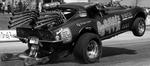
I've got a friend that works with John Force Racing...
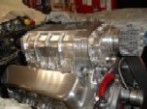
F/A ratio is 1.7:1 at idle and 1.2:1 at WOT. That means for every pound of air burned it burns 1.2 lbs of nitro. Fuel is injected in three places, on top of the blower, beneath the blower at the intake ports and right above the valve. No jet sizes, rather nozzle sizes.
Fuel pressure: anywhere from 550 to 600psi.
Torque: this is measured by a crush sleeve on the driveshaft, the last one I saw was over 6800 lbs/ft. Bulldozer territory.
Horsepower: this is torque and speed calculated. Anywhere from 6,000 to 8200 depending on conditions.
Boost: from 48 to 56 lbs is what the 18-71 huffers make.
"Mileage": Ha, in optimal conditions they will burn about 14 gallons in about 4.7 seconds, in poor conditions this will drop to about 10-11 gallons, Cars have a 17 gallon tank.
Ignition timing: this is changed 16 times during the quarter mile. It is generally from 24 to 56 degrees during the run with max of 48 to about 56 degrees BTDC.
Clutch packs: four abrasive disc and five sliders...$9000. Sliders last ONE run. The clutch 'slips' anywhere from 700 to 1100 ft before it goes 1:1.
Engines: usually 8 complete for each car with four short blocks. About 45K per engine. NOTE : pro stock is the most $$ at about 90 - 130K a shot.
$$ per run: approx. $5-6000 without salaries, hotels, food, transporter expenses about $8000 a run if you factor this in. Bottom line is you best have 2.5-4.5million
per car, per season.
Fuel pressure: anywhere from 550 to 600psi.
Torque: this is measured by a crush sleeve on the driveshaft, the last one I saw was over 6800 lbs/ft. Bulldozer territory.
Horsepower: this is torque and speed calculated. Anywhere from 6,000 to 8200 depending on conditions.
Boost: from 48 to 56 lbs is what the 18-71 huffers make.
"Mileage": Ha, in optimal conditions they will burn about 14 gallons in about 4.7 seconds, in poor conditions this will drop to about 10-11 gallons, Cars have a 17 gallon tank.
Ignition timing: this is changed 16 times during the quarter mile. It is generally from 24 to 56 degrees during the run with max of 48 to about 56 degrees BTDC.
Clutch packs: four abrasive disc and five sliders...$9000. Sliders last ONE run. The clutch 'slips' anywhere from 700 to 1100 ft before it goes 1:1.
Engines: usually 8 complete for each car with four short blocks. About 45K per engine. NOTE : pro stock is the most $$ at about 90 - 130K a shot.
$$ per run: approx. $5-6000 without salaries, hotels, food, transporter expenses about $8000 a run if you factor this in. Bottom line is you best have 2.5-4.5million
per car, per season.
Race Director
Joined: Nov 2000
Posts: 11,872
Likes: 12
From: Waterloo ontario Canada
Originally Posted by 81' Corvette Guy
That's a thought..lets ask those racers how many miles to the gallon they get!
If your car smells of gas even when pulling it into the garage and your eyes burn then you are too rich. Wasting fuel and power.

Burning Brakes
Joined: Oct 2001
Posts: 1,185
Likes: 0
From: New Wilmington PA
Originally Posted by norvalwilhelm
It's important to me. If the vet gets terrible mileage I won't drive it as often.
I love my car but to be honest... I'm on the lower end of being able to afford it. The difference between 10 mpg and 20 mpg is the difference between storage and driving.
With the RoadDemon I got 20mpg driveing sanely and about 12 getting on it. With the FI I'm getting around 18 (sane) and 14 (on it). It's still not fully tuned yet and I just got the wideband O2 upgrade so things should improve from there.


Burning Brakes

Joined: Dec 2002
Posts: 1,069
Likes: 2
From: Sherwood Park AB
Originally Posted by norvalwilhelm
My point was that just because a motor gets poor mileage and runs like crap doesn't mean it is producing it's maximum power. Leaning out can produce more power then flooding an engine. I run mine at 15-1 air fuel ratio and use the power valve to drop it to 13-1 when called upon.
If your car smells of gas even when pulling it into the garage and your eyes burn then you are too rich. Wasting fuel and power.
If your car smells of gas even when pulling it into the garage and your eyes burn then you are too rich. Wasting fuel and power.

6 mpg last summer.
 160 km and one tank of gas.
I blame it on my lead foot and poor tuning.
78 4 spd 3.70 rear 400 sbc.
Burning Brakes
Joined: Mar 2002
Posts: 803
Likes: 0
From: South San Francisco CA
Originally Posted by hensen1954
OK, who gets the best - or worst - mpg on the open road, and at what speed?
Are there any tricks to saving your pocket ???????
As I have said before , changing the 4.11 diff to a 2.75 in my 429SCJ upped the gentle driving mpg from 10 / 11 ish to a measured 23 !!
Car was so powerful that it made little to no difference with road driving performance.
Are there any tricks to saving your pocket ???????
As I have said before , changing the 4.11 diff to a 2.75 in my 429SCJ upped the gentle driving mpg from 10 / 11 ish to a measured 23 !!
Car was so powerful that it made little to no difference with road driving performance.

Drifting
Joined: May 2003
Posts: 1,414
Likes: 2
From: Barrie
Some ways to get better fuel economy:
-Taller rear tires, going from 26” to a 28”
-3.08 or numerically lower rear gear
-Automatic overdrive transmission with lockup converter
-Sequential fuel injection running as lean as possible without pinging
-modern cylinder heads with heart shaped combustion chamber
-Removal of belt driven accessories (AC, pwr steering, mechanical fan)
-aftermarket multiple spark ignitions
-smaller motor 327, 305, 302…
-motor swap with Displacement On Demand technology
-Taller rear tires, going from 26” to a 28”
-3.08 or numerically lower rear gear
-Automatic overdrive transmission with lockup converter
-Sequential fuel injection running as lean as possible without pinging
-modern cylinder heads with heart shaped combustion chamber
-Removal of belt driven accessories (AC, pwr steering, mechanical fan)
-aftermarket multiple spark ignitions
-smaller motor 327, 305, 302…
-motor swap with Displacement On Demand technology