




Free mods?

Thread Starter
Instructor

Joined: May 2005
Posts: 183
Likes: 0
From: Shelby TWP MI
 Free mods?
Ok frankly guys, I know you're mostly all older gentlemen who value your cars as cruisers, but I'm 18. And i chose the car cause of the style, and cause of the looks you get when cruising. But honestly, the horsepower is a little, pathetic (though, i understand the times didn't allow for a lot more). I wanted to know if there are any "free mods", anything that can increase hp for little or no money (at little is like 100 bucks here) if you could help me it would be greatly appreicated.
1982 (not collectors edition)
1982 (not collectors edition)

Melting Slicks


Joined: May 2005
Posts: 2,143
Likes: 0
From: San Diego California
if all you have is 100 bucks best thing you could do is try to make the car lighter by taking out allot of crap(jack, spare tire, etc) and get some headers
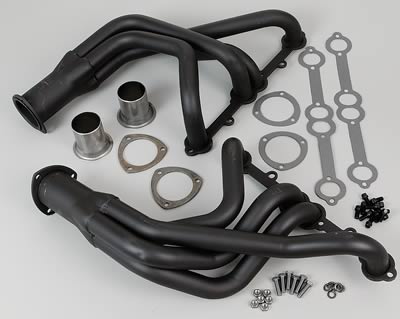
they are $86.50+ shipping from www.summmitracing.com
they are $86.50+ shipping from www.summmitracing.com
Last edited by Empatho; Jul 5, 2005 at 01:54 AM.

Racer
Joined: Dec 2001
Posts: 328
Likes: 0
From: Dallas County Texas
Sonny, this ole geezer ain't no gentleman!

My interest is "pro-touring" - extreme modifications to have it all - great off line takeoff but especially high speed real road performance (think of the stupidity of using a C3 as a platform to build a Bugatti killer for under $125K and you pretty much have it...) Frankly I wish my car had a cloaking shield so the revenuers couldn't see it, so the "getting looks" aspect is pretty much anethema to me.

Taking a look at your baseline is a good place to start, but $100/week for a season is a more realistic entry budget than $100 flat.
http://www.corvetteactioncenter.com/.../82engine.html
I see your year was a lot better than mine, the weakest ever at 160hp, and your car was several hundred pounds lighter.
I second the other geezers
 suggestions - scrap the crap so you have less to move with what you have then fix the restrictive exhaust as best as possible.
 After that I would take it to a vettes only shop to get it fully diagnosed, especially the problematic, but not useless, crossfire system. While you're having a high-cost expert look over the mill in depth make sure he looks over the rear end, brakes and suspension - your weakpoints on a quarter century old IRS design with live piston calipered brakes. (IRS is independent rear suspension - the third greatest design feature of most vettes.) You need to find all serious problems and make sure your engine is at least putting out as much as it can.
Don't forget things than may keep your car from passing the damned inspection oppression you probably have to go through with a newmobile like an '82.

If you are on an extreme budget, avoid any thoughts of basic engine mods. You have forged rods, but all else is cast. On this old an engine with cast pistons and crank put the idea of nitrous out on the doorstep. You could do a cam swap, but they are pretty involved with the nightmare radiator removal and such and your crossfire system may have some real specifications there. (Some shops will charge more to swap a cam than swap an engine!)
If money beocmes available, don't waste it on some silly rims and tires. You can get excellent V rated tires for your not too bad aluminum wheels. You can improve your handling to better than any ricer you can buy and up to the level of the C4's. With all the parts newish and working on the stock suspension, your '82 handles better than nearly any new thing you see on the street day to day under $30K anyhow, especially if you later get some 16 or 17" cheapies with rigid sidewall tires.
Many dump the crossfire system and go with a standard intake and either carburetion (cheaper and simpler) or a later fuel injection system, either GM or aftermarket. You have computer issues to deal with on some of such a conversion, but they are not insurmountable.
A whole top end upgrade (although your heads may be usable with some porting and maybe milling a bit to up your compression ratio) with intake and cam is $500ish - $1750 (with new heads.) That would gain you somewhere around 100hp and 50ftlbs - which is a lot at this level.
Now a whole crate motor putting out 75+% more hp and 35+% more torque is in the $3K range. (350/375)
See? This stuff gets pricey in a hurry - but not unlimited pricey unless you want envelope stuff.
With a low budget, the biggest thing is to make sure it's reliable and to not waste what little money you have on impulse "upgrades" and junk from "speedshops" which do not enhance your car significantly and drain money from building to get useful upgrades. Don't forget the non-performance upgrades like stereo systems, interior trim, etc. - in a cruiser these are an essential facet.
Learn what you can about what's available, determine the exact condition of all the systems in your car, make detailed but flexible plans for what you wish to do, keep some planning for money in reserve for some of the older things that may breakdown in a while and don't waste what limited resources you have.

Race Director


Joined: Dec 1999
Posts: 16,945
Likes: 9
The specifications on the site are wrong in some areas.
The L83 shares the bare block w/ the late L82 casting, it's a 2 bolt mains block. The crank is cast, the rods are the cheezy X-rods and the pistons are the forged L82 piston, made by TRW # 464664 w/ single large valve relief (until recently they were still available new from GMPP).
The cam specs you see there are way off also, I don't remember the exact specs but the duration is a lot lower than the 300+ seat figures you see there. The heads are 462624 76cc smog heads w/ 1,96&1,5 valves open chamber design and frankly they are junk heads, they are thin lightweight castings, they crack easily, don't make good power and can't be modified, without breaking trough the casting, to any significant degree. There's a huge bottleneck restriction behind the valve seat, the casting flash is terrible and the ports can't even be port matched without epoxying studs in the cover bolt holes (not that port matching would do any good without working on the rest)
The single best thing you can do to your CFI is keeping it a crossfire, going to a carb will give problems w/ torque converter lockup (and without the TCC the tranny will burn up very quickly)
Your CFI can easily be modified for better performance, all it takes is a little work, some tools and a bit of ingenuity. You can modify the manifold to a certain degree, rework the throttle bodies (overbore/sleeve, space the injector tower, thin out the throttle shafts) use a spacer to give more room over the runner tops so the charge can turn the corner under the TB more easily, remove the swirl paltes (they're pretty much useless, especially in warmer climates).
The best thing to do w/ a budget of a little over 100$ is getting a new cam, a 2040 or 2030 compu cam would be a nice improvement over stock (these cams are now called something different, look through the comp cams listings they are marked as being prev. known as 2030/2040 and 2050)
The exhaust is a 2-1-2 system (not duals like stated on before mentioned site) and is stainless (309, the kind that surface rusts) and is actually not all that bad for a low to med. performance car, the shorty headers are a bit on the small side but not too bad for the cfi engine characteristics, being low end and not top end. You can grind the air tubes flush, clean up some of the ugly welding inside the starter tubes (they are welded on the inside to a flat flange) but don't cut straight through the welds. Same can be done in the collector, there are some serious ugly welds in there. A high flow cat. con. is a good idea also or you can remove all of the AIR stuff (keep it, the switching valves and crossover tubes are actually worth good money, into the hundreds of dollars..maybe a good way to finance some more mods?? 82s are packed w/ 1 only year stuff)
go to http://www.crossfire.homeip.net for more info, there are so many little things you can do, it's just too much to list here.
The L83 shares the bare block w/ the late L82 casting, it's a 2 bolt mains block. The crank is cast, the rods are the cheezy X-rods and the pistons are the forged L82 piston, made by TRW # 464664 w/ single large valve relief (until recently they were still available new from GMPP).
The cam specs you see there are way off also, I don't remember the exact specs but the duration is a lot lower than the 300+ seat figures you see there. The heads are 462624 76cc smog heads w/ 1,96&1,5 valves open chamber design and frankly they are junk heads, they are thin lightweight castings, they crack easily, don't make good power and can't be modified, without breaking trough the casting, to any significant degree. There's a huge bottleneck restriction behind the valve seat, the casting flash is terrible and the ports can't even be port matched without epoxying studs in the cover bolt holes (not that port matching would do any good without working on the rest)
The single best thing you can do to your CFI is keeping it a crossfire, going to a carb will give problems w/ torque converter lockup (and without the TCC the tranny will burn up very quickly)
Your CFI can easily be modified for better performance, all it takes is a little work, some tools and a bit of ingenuity. You can modify the manifold to a certain degree, rework the throttle bodies (overbore/sleeve, space the injector tower, thin out the throttle shafts) use a spacer to give more room over the runner tops so the charge can turn the corner under the TB more easily, remove the swirl paltes (they're pretty much useless, especially in warmer climates).
The best thing to do w/ a budget of a little over 100$ is getting a new cam, a 2040 or 2030 compu cam would be a nice improvement over stock (these cams are now called something different, look through the comp cams listings they are marked as being prev. known as 2030/2040 and 2050)
The exhaust is a 2-1-2 system (not duals like stated on before mentioned site) and is stainless (309, the kind that surface rusts) and is actually not all that bad for a low to med. performance car, the shorty headers are a bit on the small side but not too bad for the cfi engine characteristics, being low end and not top end. You can grind the air tubes flush, clean up some of the ugly welding inside the starter tubes (they are welded on the inside to a flat flange) but don't cut straight through the welds. Same can be done in the collector, there are some serious ugly welds in there. A high flow cat. con. is a good idea also or you can remove all of the AIR stuff (keep it, the switching valves and crossover tubes are actually worth good money, into the hundreds of dollars..maybe a good way to finance some more mods?? 82s are packed w/ 1 only year stuff)
go to http://www.crossfire.homeip.net for more info, there are so many little things you can do, it's just too much to list here.
Racer
Joined: Dec 2001
Posts: 328
Likes: 0
From: Dallas County Texas
Great! TT - I forgot yours was based on an '82...
....I was thinking it was an 80 for some reason!
Some great information available on this forum! Yeah - I noticed some of the facts were wrong on the '75 page too, mainly exceptions/options. Was there an "L48" type engine also in '82 or at least a high end and low end? I can't find my little Corvette comparison book (I think it was an '01 edition anyhow)...
What do you think he can get out of a CFI with the easiest of those mods and maybe some REAL duals, which, if you put on the second cat, you usually get away with? (Assuming no lower engine work and that nothing serious is wrong anyhow, of course.)
Some great information available on this forum! Yeah - I noticed some of the facts were wrong on the '75 page too, mainly exceptions/options. Was there an "L48" type engine also in '82 or at least a high end and low end? I can't find my little Corvette comparison book (I think it was an '01 edition anyhow)...
What do you think he can get out of a CFI with the easiest of those mods and maybe some REAL duals, which, if you put on the second cat, you usually get away with? (Assuming no lower engine work and that nothing serious is wrong anyhow, of course.)

Race Director


Joined: Dec 1999
Posts: 19,610
Likes: 778
From: Forked River NJ
Whoa there young whipper snapper. Not all of us are ready for a rocking chair. I'm 42 and enjoy autoX and drag racing as much as anybody. I'd rather be sideways at 6500 rpm then cruising at 2000 rpm anyday. The highways just don't allow that.
Seriously if you got into a Corvette and think you are going to get away cheapyou are sadly mistaken. You can get away by spending your money wisely but HP cost money. How fast you want to go is how much money you can spend. Spend your money wisely and do your research.
Seriously if you got into a Corvette and think you are going to get away cheapyou are sadly mistaken. You can get away by spending your money wisely but HP cost money. How fast you want to go is how much money you can spend. Spend your money wisely and do your research.

Team Owner

Joined: Jul 2001
Posts: 182,997
Likes: 88
From: Lakeland, FL
Cruise-In IV-V-VI-VII-VIII Veteran
St. Jude Donor '03, '06, '17
For about $100, you can get a 2950 cfm Permacool electric fan...and you can get rid of the mechanical fan. That's over 10 HP...
Corvette Stories
The Best of Corvette for Corvette Enthusiasts

Top 10 Most Expensive Corvettes Ever Sold on Bring A Trailer
Brett Foote
10 Things Every Corvette Owner Needs (2026 Edition)
Michael S. Palmer
8 Most "Only Corvette Owners Understand" Quirks and Problems
Pouria Savadkouei
10 Reasons the C6 Z06 is Still A Performance Benchmark After 20 Years
Joe Kucinski
How Much Horsepower Every Corvette Engine "LOST" in 1972
Joe Kucinski
Top 10 DOs and DON'Ts for Protecting Your Convertible Top!
Michael S. Palmer
Top 10 Most Explosive Corvettes Ever Made: Power-to-Weight Ratio Ranked!
Joe Kucinski
150 hp to 1,250 hp: Every Corvette Generation Compared by the Specs That Matter
Joe Kucinski
8 Coolest Corvette Pace Cars (and Replicas) of All Time
Verdad Gallardo
Safety Car


Joined: Nov 2002
Posts: 4,182
Likes: 1,178
From: out of nowhere
My advice would be to start seeking out an outside sales job (sell roofing, windows, alarms, etc.). Most companies will train you and in no time you'll be making over $1,000 a week. Assuming you aren't married, you'll be able to build that baby up nicely before long at all! Also, keep your eyes on the parts for sale section here. You might find some good deals on the parts you are seeking.

Drifting

Joined: Apr 2005
Posts: 1,323
Likes: 3
From: I KNOW JESUS... HE'S MY GARDENER
Originally Posted by litevette
Assuming you aren't married, you'll be able to build that baby up nicely before long at all!
That is the quote of the day! I suggest they print that on a warning label and affix to the window-sticker of all performance cars.


Le Mans Master

Joined: Jul 2000
Posts: 6,664
Likes: 162
From: columbia city in
i have to diagree
Originally Posted by I'm Batman
Twin Turbo, I have to disagree. The best thing you can do with a Cease-Fire injection system is to yank the whole thing and replace it with a TPI manifold and computer. 
Team Owner
Joined: Jul 2001
Posts: 182,997
Likes: 88
From: Lakeland, FL
Cruise-In IV-V-VI-VII-VIII Veteran
St. Jude Donor '03, '06, '17
You could also get a Summit cam and lifter kit (should be less than $200). Pull off the heads and intake and do some porting work on them... There are books etc. That show you how to do it right... A felow forum member with a C4 got his C4 into the low 12's by porting his heads himself (Arisa)

Race Director

Joined: Feb 2005
Posts: 16,100
Likes: 17
Originally Posted by El_Cid
Ok frankly guys, I know you're mostly all older gentlemen who value your cars as cruisers, but I'm 18. And i chose the car cause of the style, and cause of the looks you get when cruising. But honestly, the horsepower is a little, pathetic (though, i understand the times didn't allow for a lot more). I wanted to know if there are any "free mods", anything that can increase hp for little or no money (at little is like 100 bucks here) if you could help me it would be greatly appreicated.
1982 (not collectors edition)
1982 (not collectors edition)


Melting Slicks
Joined: Feb 2003
Posts: 3,053
Likes: 4
St. Jude Donor '03,'11
Originally Posted by litevette
My advice would be to start seeking out an outside sales job (sell roofing, windows, alarms, etc.). Most companies will train you and in no time you'll be making over $1,000 a week. Assuming you aren't married, you'll be able to build that baby up nicely before long at all! Also, keep your eyes on the parts for sale section here. You might find some good deals on the parts you are seeking.
Race Director
Joined: Dec 1999
Posts: 16,945
Likes: 9
Originally Posted by I'm Batman
Twin Turbo, I have to disagree. The best thing you can do with a Cease-Fire injection system is to yank the whole thing and replace it with a TPI manifold and computer.
If you swap cams and heads on the CFI you can actually get pretty decent performance, I know someone that only used hedman headers, true duals, a compu 2040 and TFS G2 heads and his setup netted 340 HP, that's a full 140 over standard, with a reworked manifold, TBs and other little mods it could have been even more. I don't know how much HP I had but it was a whole lot more than the standard engine (also had a 82 CE for a short while, that thing was slow) I didn't even have very crazy mods, just a 274/274 cam, reworked heads, reworked manifold, modifed tb's, true duals, no cat, no air, headers, reworked lid, later model fuel pump, adjustable fuel pressure regulator, no swirl plates, sapced injector towers, tight adjsuted lifters, nothing too crazy jsut simple stuff.
There's actually a lot you can do w/ port velocity on a street car, not everything has to be big to make decent power that is very streetable and cruises nicely.
But since you disagree you must have outweighed and tested both options otherwise there's no way you can disagree with something you have never tested. Inquiring minds want to know.
Last edited by Twin_Turbo; Jul 5, 2005 at 01:34 PM.