



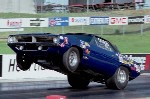



Drag Race suspension question..

Thread Starter
Team Owner

Joined: Jul 2001
Posts: 182,997
Likes: 88
From: Lakeland, FL
Cruise-In IV-V-VI-VII-VIII Veteran
St. Jude Donor '03, '06, '17

Originally Posted by red79vette454
Okay. Paint some 4" wide stripes on your slicks, from the wheel to the ground and have someone watch the rear tires closely when you launch the car. I bet when the front end drops the tires will spin slightly breaking traction then grabbing again. That is the rear suspension unloading causing your porpiose problem. You probably don't need to change the front suspension other than to get the car fairly level. Oh and by the way as you come into more power the problem will get worse, and you might find yourself aiming toward the wall. The very same reason that we haven't used the nitrous yet, because we want to be sure the tires are planted before hitting the spray.
 I'll try that. However, I highly doubt that I get more than 1/2 inch travel in the rear.and 1/2 inch unloading won't cause the car to break loose... I watched several videos of launches of my car and there basically is no noticable travel at the rear suspension. All the travel and weight transfer happens in front..

Pro


Joined: Aug 2005
Posts: 704
Likes: 2
From: Cincinnati OH
Originally Posted by GrandSportC3
I have NO issues with traction.. The rear tires stick perfectly.. The tires never break loose on a good track... I'm getting 1320 - 1340 hook factor.. so it can't be too bad... I might get a little softer rear spring at one point but for now I'm going to stick with my 550 lbs/inch spring..
I think that the bounce might mostly go away if I lower the front.. If it doesn't, I'll change the spring rate in the rear.. I'm definetely not going with a stiff front spring.. I'd actually prefer even softer springs for the front... I want to get most of my weight transfer in front and limit travel in the rear..
I think that the bounce might mostly go away if I lower the front.. If it doesn't, I'll change the spring rate in the rear.. I'm definetely not going with a stiff front spring.. I'd actually prefer even softer springs for the front... I want to get most of my weight transfer in front and limit travel in the rear..
Thread Starter
Team Owner
Joined: Jul 2001
Posts: 182,997
Likes: 88
From: Lakeland, FL
Cruise-In IV-V-VI-VII-VIII Veteran
St. Jude Donor '03, '06, '17
Originally Posted by TheMongoose
You may find when you lower the front that you lose some of that traction oyu have. I raised my front end 1-1/2" (I ran HAL QA1 adjustables front and rear so I could raise and lower the car in addition to changing the shock settings) and I picked up a hair over 0.1 sec in the quarter mile. Much better weight transfer to the rear tires. If you do lower the front try and do it after a baseline run so you can really tell if it makes a difference.

Race Director


Joined: Jan 2000
Posts: 13,018
Likes: 2,262
From: Corsicana, Tx
2020 C2 of the Year - Modified Winner
2020 Corvette of the Year (performance mods)
C2 of Year Winner (performance mods) 2019
2017 C2 of Year Finalist
*IF* the front end is coming down and then back up bouncing, that is exactly what is happpening, the rear is unloading and not keeping the front end up. Shock abosrbers on Vette's are major tuning aids.
If you do the snubbers and let it come down hard against them, you can keep things planted. You might even want to try 60/40 setting on the front to slow down front end rise and keep nose down some so it doesn't lift and allow rear to unload.
Either way, I don't think it's costing you much either at this point..it's relatively mild, but as power goes up it could become a handful later on.
BTW..was that the 2-3 shift I head on that short video? Sounded like it made two shifts very quickly.
You gotta get that thing over 7000 rpm in each of the lower gears.
BTW- I've still got VBP 550 lb short fat little springs on the front of mine!
JIM
If you do the snubbers and let it come down hard against them, you can keep things planted. You might even want to try 60/40 setting on the front to slow down front end rise and keep nose down some so it doesn't lift and allow rear to unload.
Either way, I don't think it's costing you much either at this point..it's relatively mild, but as power goes up it could become a handful later on.
BTW..was that the 2-3 shift I head on that short video? Sounded like it made two shifts very quickly.
You gotta get that thing over 7000 rpm in each of the lower gears.
BTW- I've still got VBP 550 lb short fat little springs on the front of mine!
JIM
Thread Starter
Team Owner
Joined: Jul 2001
Posts: 182,997
Likes: 88
From: Lakeland, FL
Cruise-In IV-V-VI-VII-VIII Veteran
St. Jude Donor '03, '06, '17
Originally Posted by 427Hotrod
*IF* the front end is coming down and then back up bouncing, that is exactly what is happpening, the rear is unloading and not keeping the front end up. Shock abosrbers on Vette's are major tuning aids.
If you do the snubbers and let it come down hard against them, you can keep things planted. You might even want to try 60/40 setting on the front to slow down front end rise and keep nose down some so it doesn't lift and allow rear to unload.
Either way, I don't think it's costing you much either at this point..it's relatively mild, but as power goes up it could become a handful later on.
BTW..was that the 2-3 shift I head on that short video? Sounded like it made two shifts very quickly.
You gotta get that thing over 7000 rpm in each of the lower gears.
BTW- I've still got VBP 550 lb short fat little springs on the front of mine!
JIM
If you do the snubbers and let it come down hard against them, you can keep things planted. You might even want to try 60/40 setting on the front to slow down front end rise and keep nose down some so it doesn't lift and allow rear to unload.
Either way, I don't think it's costing you much either at this point..it's relatively mild, but as power goes up it could become a handful later on.
BTW..was that the 2-3 shift I head on that short video? Sounded like it made two shifts very quickly.
You gotta get that thing over 7000 rpm in each of the lower gears.
BTW- I've still got VBP 550 lb short fat little springs on the front of mine!
JIM
You can see the shifting RPM in this video
http://www.corvetteforum.net/c3/gran...desoto1114.wmv
If you run 550 lbs/inch front springs, you are getting all the weight transfer from the rear.. You have enough power to lift the front end up without needing soft front springs. I have a lot less power and I really want to get 95% of the weight transfer in front to reduce stress to the rear end component... I've seen too many C3 rear end components break due to squatting... The tight rear also keeps the front from twisting.. Both front wheels are off the ground by about the same height which is good.. With softer rear springs, the left side usually comes up higher than the right side...
I'm gonna try the transbrake soon and if the bouncing doesn't cause any issues for me, I'll just leave everything the way it is right now. I'm sure that I'm not loosing traction during the bounce..so for now, I'm ok..but we will see what is going to happen with the transbrake...
Melting Slicks


Joined: Jan 2004
Posts: 2,672
Likes: 1
From: New Cumberland PA
Originally Posted by GrandSportC3
If you run 550 lbs/inch front springs, you are getting all the weight transfer from the rear.. You have enough power to lift the front end up without needing soft front springs.
Thread Starter
Team Owner
Joined: Jul 2001
Posts: 182,997
Likes: 88
From: Lakeland, FL
Cruise-In IV-V-VI-VII-VIII Veteran
St. Jude Donor '03, '06, '17
Originally Posted by mandm1200
I still don't see the relationship between the spring rate of the front springs and weight transfer. Granted, the softer the front springs the more the front end will pick up. However, that does not mean it is transferring more weight. A softer spring will allow for more travel. Once the front end is off the ground the front springs don't mean a thing, they're not being used.
Just check any catalog that sells drag race springs.. You won't find a stiffer spring than 275 lbs/inch.. Most of them are 250 lbs/inch or less.. There's a reason for that.. Moroso Trick front springs are one example..
I'm getting 60' times in the low 1.50's right now... I doubt that I'd get those with stiff front springs...
Corvette Stories
The Best of Corvette for Corvette Enthusiasts

Top 10 Most Expensive Corvettes Ever Sold on Bring A Trailer
Brett Foote
10 Things Every Corvette Owner Needs (2026 Edition)
Michael S. Palmer
8 Most "Only Corvette Owners Understand" Quirks and Problems
Pouria Savadkouei
10 Reasons the C6 Z06 is Still A Performance Benchmark After 20 Years
Joe Kucinski
How Much Horsepower Every Corvette Engine "LOST" in 1972
Joe Kucinski
Top 10 DOs and DON'Ts for Protecting Your Convertible Top!
Michael S. Palmer
Top 10 Most Explosive Corvettes Ever Made: Power-to-Weight Ratio Ranked!
Joe Kucinski
150 hp to 1,250 hp: Every Corvette Generation Compared by the Specs That Matter
Joe Kucinski
8 Coolest Corvette Pace Cars (and Replicas) of All Time
Verdad Gallardo
Race Director

Joined: Nov 2000
Posts: 11,872
Likes: 12
From: Waterloo ontario Canada
If you have not traction problems why do you want the front end in the air?? Looks?? I ran into handling problems off the line with 90-10 shocks. Your car will have a minimum of 1 1/4 inch toe in on launch. I know your front end is in the air but it has to come down , that's when the toe and your inability to settle will really screw up your alignment.
I would think that getting the front end settled down ,and again you are not having a traction problem, that settling the front end down would be better for top end.
A few years ago I posted alot on out of the hole problems with 90-10 shocks. Going to a stiffer street friendly set really help out of the hole handling.
I know you have the video Got Traction. Look at the handling problems he ran into with his loose front end.
I would think that getting the front end settled down ,and again you are not having a traction problem, that settling the front end down would be better for top end.
A few years ago I posted alot on out of the hole problems with 90-10 shocks. Going to a stiffer street friendly set really help out of the hole handling.
I know you have the video Got Traction. Look at the handling problems he ran into with his loose front end.
Thread Starter
Team Owner
Joined: Jul 2001
Posts: 182,997
Likes: 88
From: Lakeland, FL
Cruise-In IV-V-VI-VII-VIII Veteran
St. Jude Donor '03, '06, '17
Originally Posted by norvalwilhelm
If you have not traction problems why do you want the front end in the air?? Looks?? I ran into handling problems off the line with 90-10 shocks. Your car will have a minimum of 1 1/4 inch toe in on launch. I know your front end is in the air but it has to come down , that's when the toe and your inability to settle will really screw up your alignment.
I would think that getting the front end settled down ,and again you are not having a traction problem, that settling the front end down would be better for top end.
A few years ago I posted alot on out of the hole problems with 90-10 shocks. Going to a stiffer street friendly set really help out of the hole handling.
I know you have the video Got Traction. Look at the handling problems he ran into with his loose front end.
I would think that getting the front end settled down ,and again you are not having a traction problem, that settling the front end down would be better for top end.
A few years ago I posted alot on out of the hole problems with 90-10 shocks. Going to a stiffer street friendly set really help out of the hole handling.
I know you have the video Got Traction. Look at the handling problems he ran into with his loose front end.
I also got a new best 60' time without using the transbrake.. (1.539)
Last edited by GrandSportC3; Aug 15, 2005 at 02:47 PM.
Race Director
Joined: Jan 2000
Posts: 13,018
Likes: 2,262
From: Corsicana, Tx
2020 C2 of the Year - Modified Winner
2020 Corvette of the Year (performance mods)
C2 of Year Winner (performance mods) 2019
2017 C2 of Year Finalist
The front spring rate is used in racing to help the 'rate of rise" during the launch. If you compress a relatively tall smaller wire spring a whole lot, then it has more stored energy and will "unload" quicker and help front end lift. That's what the Moroso style stuff does.
But often, the rate of rise is too quick and you end up hitting tires too hard and causing the unload situation. It can even be a case of converter stall/flash not being optimum and after initial flash/hit, it can't maintain the rpm and the engine isn't in peak power which allows car to unload and bounce. Happens to me when I try to bog motor on launch..it pulls rpm low and I can get some wild stuff going on as it loads and unloads tires.
The amount of travel or lift has nothing to do with front springs..it's all about the snubbers or limiters on the frame under the upper control arms, and how low you started with. Once they contact the arm, all front end lift is over other than the ability to completely lift the front end off the ground. If you keep front tires just barely kissing the ground, you have all the weight on the rear tires and anymore won't gain much.
But hey, I love pics of mine with daylight showing too!
You can try to stiffen front shocks to control rebound and see if it helps. There are no hard fast rules...that's why everything is adjustable.
Norval has a good point. I've yet to go through it all on my Vette yet, but I can tell you that spending a couple of weekends working out camber change and toe-in issues during launch gave me almost .2 on my old Camaro. No other changes and it really helped things. The tires were going the right direction finally!
I also know if a high 8 sec NMCA Malibu that went from Moroso style springs to stock 305 A/C springs, which jacked front of car up a lot compared to Moroso's and it really helped. All the bad boy street race guys told him to try it even if it didn't make sense...and wham..instant quickest 60's ever. Who'd of thought it...
The point is to keep trying new stuff.
"If you always do what you've always done...you always get what you always got"
See ya,
JIM
But often, the rate of rise is too quick and you end up hitting tires too hard and causing the unload situation. It can even be a case of converter stall/flash not being optimum and after initial flash/hit, it can't maintain the rpm and the engine isn't in peak power which allows car to unload and bounce. Happens to me when I try to bog motor on launch..it pulls rpm low and I can get some wild stuff going on as it loads and unloads tires.
The amount of travel or lift has nothing to do with front springs..it's all about the snubbers or limiters on the frame under the upper control arms, and how low you started with. Once they contact the arm, all front end lift is over other than the ability to completely lift the front end off the ground. If you keep front tires just barely kissing the ground, you have all the weight on the rear tires and anymore won't gain much.
But hey, I love pics of mine with daylight showing too!
You can try to stiffen front shocks to control rebound and see if it helps. There are no hard fast rules...that's why everything is adjustable.
Norval has a good point. I've yet to go through it all on my Vette yet, but I can tell you that spending a couple of weekends working out camber change and toe-in issues during launch gave me almost .2 on my old Camaro. No other changes and it really helped things. The tires were going the right direction finally!
I also know if a high 8 sec NMCA Malibu that went from Moroso style springs to stock 305 A/C springs, which jacked front of car up a lot compared to Moroso's and it really helped. All the bad boy street race guys told him to try it even if it didn't make sense...and wham..instant quickest 60's ever. Who'd of thought it...
The point is to keep trying new stuff.
"If you always do what you've always done...you always get what you always got"
See ya,
JIM
Thread Starter
Team Owner
Joined: Jul 2001
Posts: 182,997
Likes: 88
From: Lakeland, FL
Cruise-In IV-V-VI-VII-VIII Veteran
St. Jude Donor '03, '06, '17
Originally Posted by 427Hotrod
The front spring rate is used in racing to help the 'rate of rise" during the launch. If you compress a relatively tall smaller wire spring a whole lot, then it has more stored energy and will "unload" quicker and help front end lift. That's what the Moroso style stuff does.

But often, the rate of rise is too quick and you end up hitting tires too hard and causing the unload situation. It can even be a case of converter stall/flash not being optimum and after initial flash/hit, it can't maintain the rpm and the engine isn't in peak power which allows car to unload and bounce. Happens to me when I try to bog motor on launch..it pulls rpm low and I can get some wild stuff going on as it loads and unloads tires.
The amount of travel or lift has nothing to do with front springs..it's all about the snubbers or limiters on the frame under the upper control arms, and how low you started with. Once they contact the arm, all front end lift is over other than the ability to completely lift the front end off the ground. If you keep front tires just barely kissing the ground, you have all the weight on the rear tires and anymore won't gain much.
But hey, I love pics of mine with daylight showing too!
You can try to stiffen front shocks to control rebound and see if it helps. There are no hard fast rules...that's why everything is adjustable.
The amount of travel or lift has nothing to do with front springs..it's all about the snubbers or limiters on the frame under the upper control arms, and how low you started with. Once they contact the arm, all front end lift is over other than the ability to completely lift the front end off the ground. If you keep front tires just barely kissing the ground, you have all the weight on the rear tires and anymore won't gain much.
But hey, I love pics of mine with daylight showing too!
You can try to stiffen front shocks to control rebound and see if it helps. There are no hard fast rules...that's why everything is adjustable.
Norval has a good point. I've yet to go through it all on my Vette yet, but I can tell you that spending a couple of weekends working out camber change and toe-in issues during launch gave me almost .2 on my old Camaro. No other changes and it really helped things. The tires were going the right direction finally!
considering that I'm hooking perfectly right now..
On a car that has traction issues, it can make a huge difference indeed....
