






Fuel Return System Installed - with photo

Thread Starter
Tech Contributor


Joined: Aug 1999
Posts: 14,382
Likes: 6,402
From: At my Bar drinking and wrenching in Lafayette Colorado
 Fuel Return System Installed - with photo
The CCC (Colorado Corvette Crazies – the Ultimate Corvette Tuning and Beer Drinking Fraternity) got together over the weekend to fabricate and install a fuel return system on Kurt’s ’66 427.
With the high vapor pressure of modern fuels and the big bowls on Holley and BG carbs, vapor lock and fuel boiling is a big problem with our old cars. A good reflective heat shield will often solve the problem of fuel boiling in the accelerator pump well and float bowl, but it will not solve the problem of fuel vaporizing in the fuel line.
A good solution to this problem, if a “numbers-matching” appearance is not a concern, is to install a fuel return/circulation system. A good system will continuously circulate cool fuel past the carb inlet, returning unused fuel to the tank. To further improve the system, a top-notch system typically employs the use of an electric pump close to the fuel tank in order to keep the entire fuel line between pump and carb under pressure to eliminate fuel vaporization in the line.
The system we designed and fabricated utilizes a Holley electric pump (7 psi) back at the tank with an in-line filter. All tubing/hose connections are 37-degree screw-on connections, eliminating all hose clamps and unsafe connections. We used Aeroquip fittings and hose to assure a top quality installation, and installed an oil pressure cutoff switch in the pump circuit to kill the pump in event of an accident and/or engine failure. The regulator is a Mallory return-style regulator that installs on the return side of the system: It continuously bleeds fuel off and returns it to the tank to control pressure. A ¼” Aeroquip line returns the fuel to the tank through a 90-degree bulkhead fitting installed in the top of the tank.
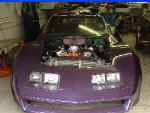
Photo shows the completed installation in the engine compartment – Note regulator attached to the rear of the carb bleeding fuel off through the steel ¼” line. Pressure gauge at the inlet allows the pressure to be set to any desired level. Polished stainless steel line (not shown in photo) runs up to the gauge. Oil pressure safety switch is installed in a “T” installation at the oil pressure line attach point in the block – hidden very well. Car is also equipped with a small under dash momentary switch, allowing the pump to be operated to circulate cool fuel through the system prior to startup:

With the high vapor pressure of modern fuels and the big bowls on Holley and BG carbs, vapor lock and fuel boiling is a big problem with our old cars. A good reflective heat shield will often solve the problem of fuel boiling in the accelerator pump well and float bowl, but it will not solve the problem of fuel vaporizing in the fuel line.
A good solution to this problem, if a “numbers-matching” appearance is not a concern, is to install a fuel return/circulation system. A good system will continuously circulate cool fuel past the carb inlet, returning unused fuel to the tank. To further improve the system, a top-notch system typically employs the use of an electric pump close to the fuel tank in order to keep the entire fuel line between pump and carb under pressure to eliminate fuel vaporization in the line.
The system we designed and fabricated utilizes a Holley electric pump (7 psi) back at the tank with an in-line filter. All tubing/hose connections are 37-degree screw-on connections, eliminating all hose clamps and unsafe connections. We used Aeroquip fittings and hose to assure a top quality installation, and installed an oil pressure cutoff switch in the pump circuit to kill the pump in event of an accident and/or engine failure. The regulator is a Mallory return-style regulator that installs on the return side of the system: It continuously bleeds fuel off and returns it to the tank to control pressure. A ¼” Aeroquip line returns the fuel to the tank through a 90-degree bulkhead fitting installed in the top of the tank.
Photo shows the completed installation in the engine compartment – Note regulator attached to the rear of the carb bleeding fuel off through the steel ¼” line. Pressure gauge at the inlet allows the pressure to be set to any desired level. Polished stainless steel line (not shown in photo) runs up to the gauge. Oil pressure safety switch is installed in a “T” installation at the oil pressure line attach point in the block – hidden very well. Car is also equipped with a small under dash momentary switch, allowing the pump to be operated to circulate cool fuel through the system prior to startup:
Thread Starter
Tech Contributor
Joined: Aug 1999
Posts: 14,382
Likes: 6,402
From: At my Bar drinking and wrenching in Lafayette Colorado
Always -
Same concept and principle using a return-style regulator on your system. As you show in your photos, there are 2 ways to install the reg on a return-style system: You can install it prior to the carb and bleed off fuel to control carb inlet pressure (very similar to what Chevy did on their return-style fuel filters), or it can be installed after the carb, controlling pressure in the feed line to the carb. We elected to do the latter installation in order to keep the cool fuel circulating through the carb inlet line, as close to the carb inlets as possible. On the Nova racecar, we have installed fuel fittings on the driver's side of the float bowls, and we are circulating the fuel right over the tops of the bowls and back to the tank. This keeps cool fuel right at the needle/seat assembly for maximum effect.
Same concept and principle using a return-style regulator on your system. As you show in your photos, there are 2 ways to install the reg on a return-style system: You can install it prior to the carb and bleed off fuel to control carb inlet pressure (very similar to what Chevy did on their return-style fuel filters), or it can be installed after the carb, controlling pressure in the feed line to the carb. We elected to do the latter installation in order to keep the cool fuel circulating through the carb inlet line, as close to the carb inlets as possible. On the Nova racecar, we have installed fuel fittings on the driver's side of the float bowls, and we are circulating the fuel right over the tops of the bowls and back to the tank. This keeps cool fuel right at the needle/seat assembly for maximum effect.

Burning Brakes


Joined: Mar 2001
Posts: 1,171
Likes: 0
From: Thornton Co
Originally Posted by lars
On the Nova racecar, we have installed fuel fittings on the driver's side of the float bowls, and we are circulating the fuel right over the tops of the bowls and back to the tank. This keeps cool fuel right at the needle/seat assembly for maximum effect.
Thread Starter
Tech Contributor
Joined: Aug 1999
Posts: 14,382
Likes: 6,402
From: At my Bar drinking and wrenching in Lafayette Colorado
The Holley HP carbs and the Dominator carbs have the ports drilled and tapped on both sides of the carb - they come from the factory with threaded plugs installed on the driver's side. This makes it easy and slick to install a full flow "crossover" fuel system (and it looks very cool...).
Thread Starter
Tech Contributor
Joined: Aug 1999
Posts: 14,382
Likes: 6,402
From: At my Bar drinking and wrenching in Lafayette Colorado
There's no copper line anywhere. It's all hard-line stainless steel and Aeroquip flex line. The carb inlet line is braided stainless steel.
Corvette Stories
The Best of Corvette for Corvette Enthusiasts

Every 2027 Corvette Engine Explained
Joe Kucinski
Designer Imagines A Corvette That Looks More Like a Corvette Than the Corvette
Verdad Gallardo
10 Ugly Corvettes That We Still Kinda Love
Joe Kucinski
Top 10 Most Expensive Corvettes Ever Sold on Bring A Trailer
Brett Foote
10 Things Every Corvette Owner Needs (2026 Edition)
Michael S. Palmer
8 Most "Only Corvette Owners Understand" Quirks and Problems
Pouria Savadkouei
10 Reasons the C6 Z06 is Still A Performance Benchmark After 20 Years
Joe Kucinski
How Much Horsepower Every Corvette Engine "LOST" in 1972
Joe Kucinski
Top 10 DOs and DON'Ts for Protecting Your Convertible Top!
Michael S. Palmer
Thread Starter
Tech Contributor
Joined: Aug 1999
Posts: 14,382
Likes: 6,402
From: At my Bar drinking and wrenching in Lafayette Colorado
The fuel boiling issue is most common on Holley and BG carbs, and the boiling will normally occur in the accelerator pump well - not in the actual bowl. These carbs have the accelerator pump well located on the bottom of the float bowl(s), and the surface of the accel pump well is the closest point to the intake manifold.
What happens is that radiant heating off the engine/manifold will heat up the fuel in the accelerator pump well. This can happen while at steady state cruising/idling/driving, but most commonly occurs after engine shutdown. The fuel in the accel pump starts to vaporize, and this high vapor pressure pressurizes the accelerator pump area to the point that the accel pump actually starts to discharge and squirt fuel out of the discharge nozzles just as if you were pumping the gas pedal. Once the fuel has discharged, the accel pump, through the checkvalve, will re-fill itself, and the cycle continues to repeat. This results in an engine that is flooded out upon hot start, and that will die several times after starting since the float bowl(s) will have emptied themselves through the accel pump.
The electric pump/circulation system addresses this problem by allowing you to fill the bowls with cool fuel prior to starting the engine, and by always feeding cool fuel to the carb while driving to reduce or eliminate the discharge problem while idling in traffic or while at slow cruise. A reflective heat shield should be used in conjunction with the circulation system to keep radiant heat away from the accel pump well(s).
What happens is that radiant heating off the engine/manifold will heat up the fuel in the accelerator pump well. This can happen while at steady state cruising/idling/driving, but most commonly occurs after engine shutdown. The fuel in the accel pump starts to vaporize, and this high vapor pressure pressurizes the accelerator pump area to the point that the accel pump actually starts to discharge and squirt fuel out of the discharge nozzles just as if you were pumping the gas pedal. Once the fuel has discharged, the accel pump, through the checkvalve, will re-fill itself, and the cycle continues to repeat. This results in an engine that is flooded out upon hot start, and that will die several times after starting since the float bowl(s) will have emptied themselves through the accel pump.
The electric pump/circulation system addresses this problem by allowing you to fill the bowls with cool fuel prior to starting the engine, and by always feeding cool fuel to the carb while driving to reduce or eliminate the discharge problem while idling in traffic or while at slow cruise. A reflective heat shield should be used in conjunction with the circulation system to keep radiant heat away from the accel pump well(s).

Team Owner


Joined: Jul 2004
Posts: 40,422
Likes: 792
From: Redondo Beach, California
I was looking at the photo posted by AlwaysWave.
He has what looks like a Holley regulator. He's feeding it fuel from the bottom port, the upper left port goes to the carb, and the upper right port is the fuel return line (I think).
I have a Holley regulator and so far it's plumbed like this: fuel comes in from the bottom port, the upper left port is connected to the rear fuel bowl, and the upper right port is connected to the front fuel port. I don't have a fuel return line. Did I plumb my regulator incorrectlfy??
Thanks
He has what looks like a Holley regulator. He's feeding it fuel from the bottom port, the upper left port goes to the carb, and the upper right port is the fuel return line (I think).
I have a Holley regulator and so far it's plumbed like this: fuel comes in from the bottom port, the upper left port is connected to the rear fuel bowl, and the upper right port is connected to the front fuel port. I don't have a fuel return line. Did I plumb my regulator incorrectlfy??
Thanks
Thread Starter
Tech Contributor
Joined: Aug 1999
Posts: 14,382
Likes: 6,402
From: At my Bar drinking and wrenching in Lafayette Colorado
The reg shown in Always' photos is, in fact, a non-return style regulator. The two top ports are both outlet ports for feeding multiple systems (like dual carbs, etc) - you are correct as you noted.
You can make a reg like this work as a return-style reg by installing a smaller fitting (creating a restriction) on the one port and feeding it back to the tank. The reg will attempt to hold a constant fuel pressure as set, but fuel will "bleed" out of the one outlet back to the tank. As long as the bleed-off orifice is not too big, adequate pressure will be maintained on the carb side of the reg.
You can make a reg like this work as a return-style reg by installing a smaller fitting (creating a restriction) on the one port and feeding it back to the tank. The reg will attempt to hold a constant fuel pressure as set, but fuel will "bleed" out of the one outlet back to the tank. As long as the bleed-off orifice is not too big, adequate pressure will be maintained on the carb side of the reg.
Last edited by lars; Oct 13, 2005 at 12:01 PM.
Thread Starter
Tech Contributor
Joined: Aug 1999
Posts: 14,382
Likes: 6,402
From: At my Bar drinking and wrenching in Lafayette Colorado
...but you're better off using a "real" return-style reg if you're going to build a return system.
You can make a poor-man's return system without a reg at all by simply installing a "T" fitting close to the carb or in the carb feed line, installing a fitting with a small bleed hole (like the fittings used in the mechanical oil pressure sensing lines), and running a line back to the tank. This will bleed off enough fuel to cause circulation without dropping pressure or volume significantly.
You can make a poor-man's return system without a reg at all by simply installing a "T" fitting close to the carb or in the carb feed line, installing a fitting with a small bleed hole (like the fittings used in the mechanical oil pressure sensing lines), and running a line back to the tank. This will bleed off enough fuel to cause circulation without dropping pressure or volume significantly.
Burning Brakes
Joined: Apr 2004
Posts: 847
Likes: 0
From: Des Allemands LA
Lars, good looking installation. I have a comp 140 pump and mallory regulator. I was initially going to install my return as yours is set up with the regulator after the carb, however I was informed the regulator would "fail closed" if it failed. With the regulator installed after the carb, this would allow fuel to continue to flow and come out the vents if the regulator did fail. Was I misinformed or is the difference in the pump that you used being only 7psi as opposed to the comp 140 which is I think 30psi? If the difference is in the pump then what is the advanyage of using a regulator at all for the 7psi pump. I'm assuming it just smoothes flow out and therefore lets the pump run smoother?
Thanks,
ltlevil
Thanks,
ltlevil
Thread Starter
Tech Contributor
Joined: Aug 1999
Posts: 14,382
Likes: 6,402
From: At my Bar drinking and wrenching in Lafayette Colorado
No regulator is really needed with a 7psi pump. However, by running a reg with the 7psi pump and setting the pressure to 6psi, the recirculation system functions and the reg returns fuel to the tank while maintaining smooth and steady fuel pressure & flow.
 Just wanted to make sure I wasn't missing something else, thanks again.
Thread Starter
Tech Contributor
Joined: Aug 1999
Posts: 14,382
Likes: 6,402
From: At my Bar drinking and wrenching in Lafayette Colorado
In the racecar, we're running the Holley Blue pump at 14 psi and regulating the pressure down to 7 using the same Mallory return-style regulator. This has operated trouble-free for several years - the reg has never failed. The failure mode would be a broken spring, causing the reg to stop all bypass fuel and going to max pressure; it's not too often that springs like those break.




Le Mans Master

Joined: Feb 1999
Posts: 6,807
Likes: 0
From: Hoosier
Cruise-In III Veteran
Originally Posted by lars
The reg shown in Always' photos is, in fact, a non-return style regulator. The two top ports are both outlet ports for feeding multiple systems (like dual carbs, etc) - you are correct as you noted.
You can make a reg like this work as a return-style reg by installing a smaller fitting (creating a restriction) on the one port and feeding it back to the tank. The reg will attempt to hold a constant fuel pressure as set, but fuel will "bleed" out of the one outlet back to the tank. As long as the bleed-off orifice is not too big, adequate pressure will be maintained on the carb side of the reg.
You can make a reg like this work as a return-style reg by installing a smaller fitting (creating a restriction) on the one port and feeding it back to the tank. The reg will attempt to hold a constant fuel pressure as set, but fuel will "bleed" out of the one outlet back to the tank. As long as the bleed-off orifice is not too big, adequate pressure will be maintained on the carb side of the reg.
 I can open the fill cap at idle and see the flow waves of the return.