

Paint Type Question
Thread Starter
Pro

Joined: Nov 2004
Posts: 585
Likes: 0
From: Royal Oak MI
 Paint Type Question
I was talking to the paint store my buddy gets his paint from to get the fillers I need to prep the car, and asked about the paint I will be needing.
This particular store only sells PPG produsts, and I can get a discount through my buddy, but PPG only sells my color (Bryer Blue) in Laquer of Enamel. Now I know I probably don't want laquer but what is the difference between Enamel and Base/Clear, I know Enamel dosen't get cleared, but is it just as good and so forth? The fellow at the paint store says a lot of folks still use Enamel.
Thanks in advance for the input.
This particular store only sells PPG produsts, and I can get a discount through my buddy, but PPG only sells my color (Bryer Blue) in Laquer of Enamel. Now I know I probably don't want laquer but what is the difference between Enamel and Base/Clear, I know Enamel dosen't get cleared, but is it just as good and so forth? The fellow at the paint store says a lot of folks still use Enamel.
Thanks in advance for the input.
Last edited by 72-LT1; Mar 28, 2006 at 10:35 AM.
Instructor


Joined: Dec 2005
Posts: 246
Likes: 1
From: Concord NC
I didn't know you could still by lacquer. I used it on my first and only attempt at playing auto body shop. Turned out great because of the lacquer, but that was (yikes) 15 years ago. Lacquer allowed me to color sand before the clear and get rid of some runs, sags and drips as I attempted to master my new found hobby. By the time I got to the clear I was able to lay it down smooth and fairly wet. Sanded down the peel and a couple drips and buffed out a great paintjob. Used Ditzler/PPG back then and wish I could do it again today.
Good luck.
Good luck.

Melting Slicks

Joined: Jul 2005
Posts: 2,545
Likes: 3
From: 406ci SB, AFR 180 Heads - 490 HP @5,600 RPM 529 lb-ft @ 4,100 RPM
Base/Clearcoat, is just that. The base is the color you pick (no shine), and you clearcoat to make it shine. Very easy to use, enamel is fine also, just takes months to set up, and will show up on your rag when you wax it, I'm sure you have seen this. I'm sure others will be of more help.

Drifting


Joined: Jan 2006
Posts: 1,944
Likes: 22
From: Yooperville MI
Originally Posted by PEPTO77
I didn't know you could still by lacquer.
You can still buy lacquer in Michigan!

[QUOTE] but PPC only sells my color (Bryer Blue) in Laquer of Enamel.[QUOTE]
I assume you are dealing with Painters Supply? I would go to the store and ask again, and show them the paint code from the chip catalog, so they can see the code as it is listed there. They should be able to mix it in Deltron 2000 (basecoat) which I have found no problem so far getting old mixes for back into the 60's. Lacquer is old school, and not as durable as todays resin based paints, but if I had to choose between Lacquer or enamel, I would choose lacquer due to the show finish you can achieve. If PPG has no mix for your color, you may want to try Dupont, R&M or other popular brands.

Drifting
Joined: Jan 2006
Posts: 1,944
Likes: 22
From: Yooperville MI
Originally Posted by 72-LT1
So getting a little discount is not worth, not going with base/clear for ease of application and durability?
This is what I typically use over DPLF primer and either Kondar or K36 sandable primers.

Instructor
Joined: Dec 2005
Posts: 246
Likes: 1
From: Concord NC
Originally Posted by ahoover
Probably not in my opinion. If you have never painted before or have little experience, enamel is absolutely not the way to go. Lacquer, is the easiest to use, rather foolproof, can be buffed to a show shine, but like I said not as durable and chip resistant as todays resin based paints. Lacquer requires more upkeep than base/clear to retain the gloss. PPG Deltron 2000 is a resin base coat, 2 coats are recommended (very easy to spray and flows very well) and can be followed with PPG Concept 2000 clear for instance.
This is what I typically use over DPLF primer and either Kondar or K36 sandable primers.
This is what I typically use over DPLF primer and either Kondar or K36 sandable primers.
 again as I strain to remember what I did in my early and impressionable 20's, lacquer made us look like pros, with alot of elbow grease. Paint was 11 years old when I got rid of the car and still looked drop dead smoooooooth. Stayed in the garage and out of the sun when not being driven, rarely in the rain and never saw any snow or salt. Basically a fun, limited use car.
Corvette Stories
The Best of Corvette for Corvette Enthusiasts

Top 10 Most Explosive Corvettes Ever Made: Power-to-Weight Ratio Ranked!
Joe Kucinski
150 hp to 1,250 hp: Every Corvette Generation Compared by the Specs That Matter
Joe Kucinski
8 Coolest Corvette Pace Cars (and Replicas) of All Time
Verdad Gallardo
Top 10 Corvette Engines RANKED by Peak Torque (70+ Years of Muscle!)
Joe Kucinski
Corvette ZR1X Will Be Pacing the Indy 500, And Could Probably Race, Too!
Verdad Gallardo
Top 10 Corvettes Coming to Mecum Indy 2026!
Brett Foote
Top 10 C9 Corvette MUST-HAVES to Fix These C8 Generation Flaws!
Michael S. Palmer
10 Revolutionary 'Corvette Firsts' Most People Don't Know
Joe Kucinski
5 Reasons to Upgrade to an LS6-Powered Corvette; 5 Reasons to Stay LT2
Michael S. Palmer
Le Mans Master


Joined: Apr 2000
Posts: 5,202
Likes: 10
From: cincinnati ohio
St. Jude Donor '09
Originally Posted by PEPTO77
I didn't know you could still by lacquer. I used it on my first and only attempt at playing auto body shop. Turned out great because of the lacquer, but that was (yikes) 15 years ago. Lacquer allowed me to color sand before the clear and get rid of some runs, sags and drips as I attempted to master my new found hobby. By the time I got to the clear I was able to lay it down smooth and fairly wet. Sanded down the peel and a couple drips and buffed out a great paintjob. Used Ditzler/PPG back then and wish I could do it again today.
Good luck.
Good luck.
These people can mix you up any of the old formulas from days gone by. I just ordered a gallon of "74 Corvette Bright Yellow" in PPG DDL
 In my opinion NOTHING looks better than a properly done Lacquer paint job
Thread Starter
Pro
Joined: Nov 2004
Posts: 585
Likes: 0
From: Royal Oak MI
Originally Posted by turtlevette
PPC ????
What is hard about spraying Enamel paint? I don't have any problem using Laquer paint and the car is not going to see a lot of weather, here in MI anyway, might see a lot of sun down the road when I move though.
Laquer does take a lot of buffing to get and keep nice and I don't know if my lazy arsh wants to do that.
Last edited by 72-LT1; Mar 28, 2006 at 10:40 AM.
Le Mans Master
Joined: Apr 2000
Posts: 5,202
Likes: 10
From: cincinnati ohio
St. Jude Donor '09
Originally Posted by 72-LT1
C G they look the same right, OK I fixed it.
What is hard about spraying Enamel paint? I don't have any problem using Laquer paint and the car is not going to see a lot of weather, here in MI anyway, might see a lot of sun down the road when I move though.
Laquer does take a lot of buffing to get and keep nice and I don't know if my lazy arsh wants to do that.
What is hard about spraying Enamel paint? I don't have any problem using Laquer paint and the car is not going to see a lot of weather, here in MI anyway, might see a lot of sun down the road when I move though.
Laquer does take a lot of buffing to get and keep nice and I don't know if my lazy arsh wants to do that.
Drifting
Joined: Jan 2006
Posts: 1,944
Likes: 22
From: Yooperville MI
[QUOTE=72-LT1]What is hard about spraying Enamel paint? QUOTE]
Acrylic enamel is not really meant for show finishes, mainly it is/was a fleet car/truck or old fashion fast Earl Shieb type of paint job. Enamel takes some "finess" to perfect, and the way enamel looks after application, is pretty much how it will always look. It can be buffed, but it remains soft for a long time. If you are comfortable with lacquer, by all means use it. A lacquer job can last many years, my car still has most of the original paint after 30 years, however it's getting thin in a few spots, so I limit the waxing now. If you decide on lacquer, you'll need to tell the PPG guy whether you plan to use clear or not, so he can choose the correct base formula. If you use clear, don't over due it, apply enough coats to wet sand and polish. Clear lacquer will crack over time if applied too heavily, especially in our cold climate. If you choose not to clear, you'll need to apply enough color to sand and polish. I would still use an epoxy primer (DPLF) to seal the fiberglass if you decide on lacquer topcoats.
Acrylic enamel is not really meant for show finishes, mainly it is/was a fleet car/truck or old fashion fast Earl Shieb type of paint job. Enamel takes some "finess" to perfect, and the way enamel looks after application, is pretty much how it will always look. It can be buffed, but it remains soft for a long time. If you are comfortable with lacquer, by all means use it. A lacquer job can last many years, my car still has most of the original paint after 30 years, however it's getting thin in a few spots, so I limit the waxing now. If you decide on lacquer, you'll need to tell the PPG guy whether you plan to use clear or not, so he can choose the correct base formula. If you use clear, don't over due it, apply enough coats to wet sand and polish. Clear lacquer will crack over time if applied too heavily, especially in our cold climate. If you choose not to clear, you'll need to apply enough color to sand and polish. I would still use an epoxy primer (DPLF) to seal the fiberglass if you decide on lacquer topcoats.
Instructor
Joined: Dec 2005
Posts: 246
Likes: 1
From: Concord NC
This sure is great info. I thought lacquer was long gone due to all the E.P.A. regulations. We did my lacquer paint in a garage, well cleaned and with a damp (not wet) floor to try and keep the dust down. I also used a lacquer based primer back then. I recall putting down (3) consecutive coats of color and (5) or (6) coats of clear. I don't think we left alot of "flash" time between coats either, just kept pounding on the paint then the clear the next day. Wet sanded and buffed it once about a week after the spraying was done. Never touched it with a buffer again but did wax it with a non-cleaner wax as much as I could.A good lacquer job has incredible depth, a great lacquer job is unreal in depth and richness of color.
Glad its still out there.
Instructor
Joined: Dec 2005
Posts: 246
Likes: 1
From: Concord NC
Oh, by the way. Why so much clear???? If you painted in a garage you will have a good bit of wet sanding to get rid of the skeeters, dandelion fluffs and dust. Most of that clear will be on the floor! 
Drifting
Joined: Jan 2006
Posts: 1,944
Likes: 22
From: Yooperville MI
Originally Posted by PEPTO77
Oh, by the way. Why so much clear???? D

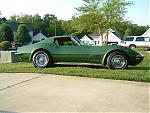
This is a laquer job I did about 4 years ago before I completely converted to modern paint. You can see the reflection of the leaves in the hood.