




Torque Thrust Wheels
Race Director


Joined: Sep 2002
Posts: 10,362
Likes: 5
From: San Diego - Deep Within The State of CONFUSION!

No they will not fit. No do not use spacers if the car is a 'driver.'
If it's a garage queen -- and only then, wheel spacers make sense. Find another wheel or a reproduction of the original. Sorry ... that original Torque Thrust would be MY first choice on alloys too...but not for a C3.


If it's a garage queen -- and only then, wheel spacers make sense. Find another wheel or a reproduction of the original. Sorry ... that original Torque Thrust would be MY first choice on alloys too...but not for a C3.

Melting Slicks


Joined: Oct 1999
Posts: 2,581
Likes: 14
From: Tolar Texas
Check out the Vintage Wheel Works V40's. They look like the original Torque Thrust D wheels.
http://www.vintagewheelworks.com/products/wheels/v40
My 17x8" V40's clear the calipers just fine. Call them to see if the 15x8" V40's will clear.
http://www.vintagewheelworks.com/products/wheels/v40
My 17x8" V40's clear the calipers just fine. Call them to see if the 15x8" V40's will clear.

Race Director


Joined: Jan 2000
Posts: 13,017
Likes: 2,261
From: Corsicana, Tx
2020 C2 of the Year - Modified Winner
2020 Corvette of the Year (performance mods)
C2 of Year Winner (performance mods) 2019
2017 C2 of Year Finalist
The "D"s will not clear....you have to use the "TTII's" to clear with no spacers or grinding.
But in reality there is way too much bad info on spacers. Spacers are fine IF you do them right and get the right nuts. I used "D"'s on my '67 for years with spacers with absolutely NO issues. I can guarantee you I "work" mine with a 540" motor in it much more than most folks. I've routinely run to 140-150+ mph speeds with no problems.
What happens is people install spacers on stock studs and use the same lug nuts. That gets you way too little thread engagement. The nuts get loose and the spacers get blamed.
MY "D's" used shank type nuts and that went through the lug hole and centered wheel on the shank of nuts. I just made sure the nuts were slightly longer than the thickness of the wheels and they extended into the spacer to get plently of thread engagement.
The later "D's" and "TTII's" use conical nuts similar to stock. You will likely need to install longer studs to use the spacers with the "D's" to get enough engagement. The TTII's as I mentioned work fine with stock studs and no spacers.
I also use spacers with my "race" wheels on the front at the track. Again...just use the right nuts. I'm going through the traps over 140mph and never worry about them.
JIM
But in reality there is way too much bad info on spacers. Spacers are fine IF you do them right and get the right nuts. I used "D"'s on my '67 for years with spacers with absolutely NO issues. I can guarantee you I "work" mine with a 540" motor in it much more than most folks. I've routinely run to 140-150+ mph speeds with no problems.
What happens is people install spacers on stock studs and use the same lug nuts. That gets you way too little thread engagement. The nuts get loose and the spacers get blamed.
MY "D's" used shank type nuts and that went through the lug hole and centered wheel on the shank of nuts. I just made sure the nuts were slightly longer than the thickness of the wheels and they extended into the spacer to get plently of thread engagement.
The later "D's" and "TTII's" use conical nuts similar to stock. You will likely need to install longer studs to use the spacers with the "D's" to get enough engagement. The TTII's as I mentioned work fine with stock studs and no spacers.
I also use spacers with my "race" wheels on the front at the track. Again...just use the right nuts. I'm going through the traps over 140mph and never worry about them.
JIM
Race Director
Joined: Jan 2000
Posts: 13,017
Likes: 2,261
From: Corsicana, Tx
2020 C2 of the Year - Modified Winner
2020 Corvette of the Year (performance mods)
C2 of Year Winner (performance mods) 2019
2017 C2 of Year Finalist
Hmmnn..that's good to know lowbuck 72.......
Weve had 3 sets on midyears and we had to use thin spacers on all. maybe they've redesigned them lately? Ours were maybe 7-8 years ago. The TTII's have all cleared fine...that's the difference..the curvature of the spokes plus they are a 2 piece wheel.
Thanks for the info...
JIM
Weve had 3 sets on midyears and we had to use thin spacers on all. maybe they've redesigned them lately? Ours were maybe 7-8 years ago. The TTII's have all cleared fine...that's the difference..the curvature of the spokes plus they are a 2 piece wheel.
Thanks for the info...
JIM

Melting Slicks

Joined: May 2000
Posts: 2,125
Likes: 9
From: Crescent City, CA
I am using 15x7 Appliance Wheels on my car with NO spacers.
It seems the difference is Appliance beveled the rear mounting plate and probably made the plate thicker. As you can see in the pic that Appliance wheels have a sunken lug nut hole.
I added a pic of the Appliance wheel and a TTD wheel, front and back.

Hope this helps.
Terry
It seems the difference is Appliance beveled the rear mounting plate and probably made the plate thicker. As you can see in the pic that Appliance wheels have a sunken lug nut hole.
I added a pic of the Appliance wheel and a TTD wheel, front and back.
Hope this helps.
Terry
Corvette Stories
The Best of Corvette for Corvette Enthusiasts

Top 10 Most Expensive Corvettes Ever Sold on Bring A Trailer
Brett Foote
10 Things Every Corvette Owner Needs (2026 Edition)
Michael S. Palmer
8 Most "Only Corvette Owners Understand" Quirks and Problems
Pouria Savadkouei
10 Reasons the C6 Z06 is Still A Performance Benchmark After 20 Years
Joe Kucinski
How Much Horsepower Every Corvette Engine "LOST" in 1972
Joe Kucinski
Top 10 DOs and DON'Ts for Protecting Your Convertible Top!
Michael S. Palmer
Top 10 Most Explosive Corvettes Ever Made: Power-to-Weight Ratio Ranked!
Joe Kucinski
150 hp to 1,250 hp: Every Corvette Generation Compared by the Specs That Matter
Joe Kucinski
8 Coolest Corvette Pace Cars (and Replicas) of All Time
Verdad Gallardo


Race Director
Joined: Jan 2000
Posts: 13,017
Likes: 2,261
From: Corsicana, Tx
2020 C2 of the Year - Modified Winner
2020 Corvette of the Year (performance mods)
C2 of Year Winner (performance mods) 2019
2017 C2 of Year Finalist
Oh...so you have TTII's? That's what the difference is...they WILL clear.
I have the 8.5x15's TTII's on the rear of my '67...they clear fine.
JIM
I have the 8.5x15's TTII's on the rear of my '67...they clear fine.
JIM
Burning Brakes


Joined: Oct 2002
Posts: 914
Likes: 14
From: Aberdeen, Scotland
Torque Thrust D's .. 16" fit
I have a set of 16" x 8" or is it 8.5" ..? Anyhow they fit without any spacers. I run 235/50/16's up front with 255/50/16's out back. I wish I could find some 255/55's for the back ..
Off the topic ... 427 HotRod ... is there any chance that you could show me how to set up the points on my 71 LS-5? They need to be replaced and it would be my first time doing it myself. I live in Houston and could pay a visit to the Woodlands. I would supply the beer or BBQ as required.
Thanks
carbster
Off the topic ... 427 HotRod ... is there any chance that you could show me how to set up the points on my 71 LS-5? They need to be replaced and it would be my first time doing it myself. I live in Houston and could pay a visit to the Woodlands. I would supply the beer or BBQ as required.
Thanks
carbster


Drifting

Joined: Nov 2002
Posts: 1,665
Likes: 1
From: Ontario
Originally Posted by 427Hotrod
What happens is people install spacers on stock studs and use the same lug nuts. That gets you way too little thread engagement. The nuts get loose and the spacers get blamed.
JIM
JIM
 Longer wheel studs are a very good idea for wheel spacers, only if you like safety that is...
Race Director
Joined: Jan 2000
Posts: 13,017
Likes: 2,261
From: Corsicana, Tx
2020 C2 of the Year - Modified Winner
2020 Corvette of the Year (performance mods)
C2 of Year Winner (performance mods) 2019
2017 C2 of Year Finalist
Maybe we're getting confused...or maybe just me. The 16" and 17" ones that are being made I believe are a two piece wheel and are based on the TTII's.
The original old D's are the 15" ones and are a one piece cast wheel and they have always required a small spacer on the ones I've seen.
Maybe there's a new version of the 15" D's out that clears?
JIM
The original old D's are the 15" ones and are a one piece cast wheel and they have always required a small spacer on the ones I've seen.
Maybe there's a new version of the 15" D's out that clears?
JIM
Race Director
Joined: Jan 2000
Posts: 13,017
Likes: 2,261
From: Corsicana, Tx
2020 C2 of the Year - Modified Winner
2020 Corvette of the Year (performance mods)
C2 of Year Winner (performance mods) 2019
2017 C2 of Year Finalist
Carbster09...
Sure I can help....we have a group that gets together every once in awhile to work on all the cars. We just did a TKO trans swap in a 454 C-3 on July 3rd. We called it an official "3rd of July Party" and had a great time!
We're do for another soon or we could just meet up.
Have you decided on brand of points yet? From my experience, I would call Jegs/Summit ot hit AutoZone and get a set of Accel points and condensor. They will last forever. Much better than anything you can get from regular parts sources. I don't even think Delco makes the good ones anymore.
Is your motor basically stock or will you want to do any dist tuning while we're at it??
JIM
Sure I can help....we have a group that gets together every once in awhile to work on all the cars. We just did a TKO trans swap in a 454 C-3 on July 3rd. We called it an official "3rd of July Party" and had a great time!
We're do for another soon or we could just meet up.
Have you decided on brand of points yet? From my experience, I would call Jegs/Summit ot hit AutoZone and get a set of Accel points and condensor. They will last forever. Much better than anything you can get from regular parts sources. I don't even think Delco makes the good ones anymore.
Is your motor basically stock or will you want to do any dist tuning while we're at it??
JIM

Team Owner

Joined: Oct 2004
Posts: 23,831
Likes: 10
From: Springfield MO
St. Jude Donor '07
Originally Posted by 427Hotrod
Maybe we're getting confused...or maybe just me. The 16" and 17" ones that are being made I believe are a two piece wheel and are based on the TTII's.
The original old D's are the 15" ones and are a one piece cast wheel and they have always required a small spacer on the ones I've seen.
Maybe there's a new version of the 15" D's out that clears?
JIM
The original old D's are the 15" ones and are a one piece cast wheel and they have always required a small spacer on the ones I've seen.
Maybe there's a new version of the 15" D's out that clears?
JIM

Advanced

Joined: May 2005
Posts: 95
Likes: 0
From: '70 Coupe - SoCal
The original Torque Thrust D's were made because of the introduction of disc brakes in '65 & the regular torque thrust wheels would not clear.
The following is from Dave Mann's W/S & it has great info. Note - the original D's fit better than the new ones bacause the backside was designed better to clear the caliper.
________________________________________ ______________
From Dave Mann at www.roadsters.com/wheels/#TT
The original Torq-Thrust "D" was released around 1965, and was configured to provide disc brake caliper clearance on then-current Corvettes. The hub of the wheel was moved outward a half-inch, and the spokes curved inward at the ends.
The aluminum Torq-Thrust "D" was made in 15 by 6 and 15 by 7.
The wheels that are pictured here were originally made as 15 by 6s and then narrowed on the inside to 15 by 4 1/2s.
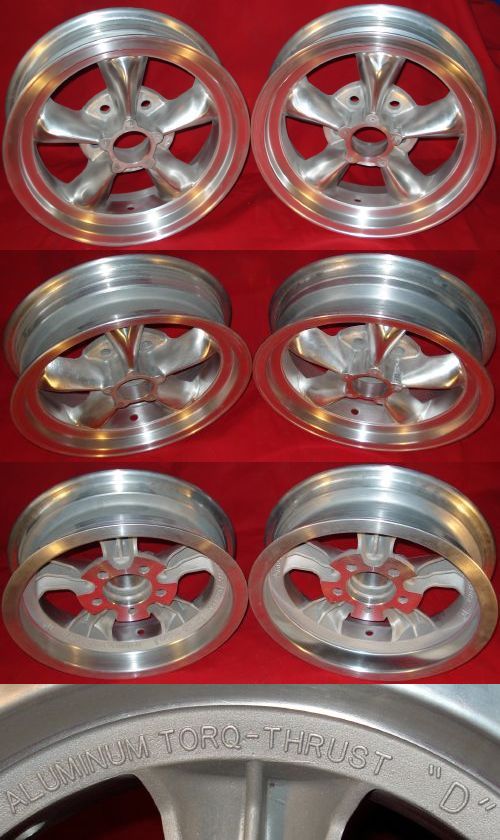
Magnesium versions of Torq-Thrust "D" and Torq-Thrust wheels were produced in a variety of styles. Sizes ranged from 15 by 4 to 16 by 13 bolt-on for bolt-on wheels, as well as a 15 by 3 1/2 spindle-mount that was often used on Funny Cars. They had either straight or "dog-leg" spokes, the latter being made for race cars with disc brakes, and known as the Torq-Thrust D. Straight-spoked wheels were offered with spokes that were peaked along the center, or rounded. Early magnesium rear wheels are most commonly found with straight spokes, and about equally divided in popularity between peaked and rounded spokes.
Although American Racing hasn't made magnesium wheels for decades, and no longer makes the original Torq-Thrust, the company currently produces several modern versions of the aluminum Torq-Thrust wheel. The Torq-Thrust "D" and the newer TTO are the only ones that are one-piece castings.
The only vintage racing wheels that American Racing Equipment ever made without casting their name into them were made out of magnesium.
If you are looking at the inside of an old aluminum wheel, unless the name "American Racing Equipment" is cast into the wheel (along with the wheel's size and offset), it was made by someone else.
A newer version of the Torq-Thrust "D" was introduced in the 1980s, with spokes that are completely curved. Regardless of whether you like the shape of the curved spokes of the current Torq-Thrust "D", it remains a classic wheel that is somewhat faithful to its original version.
However, to make room for larger wheel bearings on cars built after 1983, the company decided to change the bolt pattern of the center caps, which had been an industry standard for about thirty years. The move to the larger bolt pattern meant moving the bosses that are cast into the wheel for the cap mounting screws outward. This in turn created clearance problems for the wheel's lug nut washers, which now fit into machined recesses that are created by the end mill that provides the seats for them. The result is a truly classic design that was changed into something that just doesn't look right. But they're available in 15 by 4 1/2, 15 by 6, 15 by 7, 15 by 8 1/2, and 15 by 10-inch sizes, in 4 1/2 and 4 3/4-inch bolt patterns (with a few of those sizes also available in a five-inch bolt pattern), from most any speed shop or tire store.
--------------------------------------------------------------------------------
American Racing introduced the Torq-Thrust "Original", also called the TTO, in April of 2004. The TTO wheels have several changes compared to the ones from the 1960s. The new product announcement on page 26 of the June, 2004 issue of Street Rodder says that "Instead of reissuing the disc-brake-unfriendly design, American Racing retro-engineered the original design and re-released it under the TTO (Torq-Thrust Original) banner."
The first visual difference that you may notice is that the holes for the lug nut washers are recessed more than the company's early wheels were, like they were recessed on the old Appliance wheels as well as the way they are on American Racing's other current wheels.
Also, the wheel pictured in the ad for them on page 22 of the same magazine shows that the cast-in recess that is found between the inner-most area of the machined lip and the outside edges of the spokes on the original aluminum Torq-Thrust and Torq-Thrust D has been eliminated.
A further difference is that the center cap is American's late-style cap, which has a larger bolt circle than the original wheels that American made. This was done to allow the center holes to be larger, to fit later-model cars.
In June of 2004, American Racing sent me the following message. Quote:
"The Torq-Thrust Original (part number AR309), like all of our later-generation vintage wheels, uses a conically-seated lug fastener, not a mag shank with washer. The TTO is a one-piece, low-pressure casting of aluminum alloy, which is heat-treated. The original Torq-Thrust wheel featured backspacing of 3.5", while the new TTO offers a backspacing of 3.75". By using a .75" head lug nut with a thin-wall socket, there is no contact or clearance problem with the hub area or center cap footprint of any Torq-Thrust."
The following is from Dave Mann's W/S & it has great info. Note - the original D's fit better than the new ones bacause the backside was designed better to clear the caliper.
________________________________________ ______________
From Dave Mann at www.roadsters.com/wheels/#TT
The original Torq-Thrust "D" was released around 1965, and was configured to provide disc brake caliper clearance on then-current Corvettes. The hub of the wheel was moved outward a half-inch, and the spokes curved inward at the ends.
The aluminum Torq-Thrust "D" was made in 15 by 6 and 15 by 7.
The wheels that are pictured here were originally made as 15 by 6s and then narrowed on the inside to 15 by 4 1/2s.
Magnesium versions of Torq-Thrust "D" and Torq-Thrust wheels were produced in a variety of styles. Sizes ranged from 15 by 4 to 16 by 13 bolt-on for bolt-on wheels, as well as a 15 by 3 1/2 spindle-mount that was often used on Funny Cars. They had either straight or "dog-leg" spokes, the latter being made for race cars with disc brakes, and known as the Torq-Thrust D. Straight-spoked wheels were offered with spokes that were peaked along the center, or rounded. Early magnesium rear wheels are most commonly found with straight spokes, and about equally divided in popularity between peaked and rounded spokes.
Although American Racing hasn't made magnesium wheels for decades, and no longer makes the original Torq-Thrust, the company currently produces several modern versions of the aluminum Torq-Thrust wheel. The Torq-Thrust "D" and the newer TTO are the only ones that are one-piece castings.
The only vintage racing wheels that American Racing Equipment ever made without casting their name into them were made out of magnesium.
If you are looking at the inside of an old aluminum wheel, unless the name "American Racing Equipment" is cast into the wheel (along with the wheel's size and offset), it was made by someone else.
A newer version of the Torq-Thrust "D" was introduced in the 1980s, with spokes that are completely curved. Regardless of whether you like the shape of the curved spokes of the current Torq-Thrust "D", it remains a classic wheel that is somewhat faithful to its original version.
However, to make room for larger wheel bearings on cars built after 1983, the company decided to change the bolt pattern of the center caps, which had been an industry standard for about thirty years. The move to the larger bolt pattern meant moving the bosses that are cast into the wheel for the cap mounting screws outward. This in turn created clearance problems for the wheel's lug nut washers, which now fit into machined recesses that are created by the end mill that provides the seats for them. The result is a truly classic design that was changed into something that just doesn't look right. But they're available in 15 by 4 1/2, 15 by 6, 15 by 7, 15 by 8 1/2, and 15 by 10-inch sizes, in 4 1/2 and 4 3/4-inch bolt patterns (with a few of those sizes also available in a five-inch bolt pattern), from most any speed shop or tire store.
--------------------------------------------------------------------------------
American Racing introduced the Torq-Thrust "Original", also called the TTO, in April of 2004. The TTO wheels have several changes compared to the ones from the 1960s. The new product announcement on page 26 of the June, 2004 issue of Street Rodder says that "Instead of reissuing the disc-brake-unfriendly design, American Racing retro-engineered the original design and re-released it under the TTO (Torq-Thrust Original) banner."
The first visual difference that you may notice is that the holes for the lug nut washers are recessed more than the company's early wheels were, like they were recessed on the old Appliance wheels as well as the way they are on American Racing's other current wheels.
Also, the wheel pictured in the ad for them on page 22 of the same magazine shows that the cast-in recess that is found between the inner-most area of the machined lip and the outside edges of the spokes on the original aluminum Torq-Thrust and Torq-Thrust D has been eliminated.
A further difference is that the center cap is American's late-style cap, which has a larger bolt circle than the original wheels that American made. This was done to allow the center holes to be larger, to fit later-model cars.
In June of 2004, American Racing sent me the following message. Quote:
"The Torq-Thrust Original (part number AR309), like all of our later-generation vintage wheels, uses a conically-seated lug fastener, not a mag shank with washer. The TTO is a one-piece, low-pressure casting of aluminum alloy, which is heat-treated. The original Torq-Thrust wheel featured backspacing of 3.5", while the new TTO offers a backspacing of 3.75". By using a .75" head lug nut with a thin-wall socket, there is no contact or clearance problem with the hub area or center cap footprint of any Torq-Thrust."
Last edited by Zimo; Jul 24, 2006 at 09:52 PM.
