






Detonation: How to tell?
Thread Starter
Race Director


Joined: Dec 1999
Posts: 19,610
Likes: 778
From: Forked River NJ
 Detonation: How to tell?
I don't think I am getting any detonation but how do I know. The car is quite loud at 5 to 6600 rpm and there is no way to hear it. The fuel is runing rich right now at about 11.5 to 12 AF ratio so it should not be leaning out. Is there any other way other than broken/melting pistons that yo know. All the plugs look good and clean. Only running 10.5 to 1 compression with aluminum heads and the cranking compression is 180 pounds. Just want to make sure I'm not breaking pistons.
Thread Starter
Race Director
Joined: Dec 1999
Posts: 19,610
Likes: 778
From: Forked River NJ
Originally Posted by SpyderD
Check your plugs carefully for little tiny specs of metal, that is a sign of detonation.
You can also buy an aftermarket knock sensor.
You can also buy an aftermarket knock sensor.

Le Mans Master


Joined: Jul 2005
Posts: 5,752
Likes: 4
From: Austin Texas
Twin Turbo had a schematic on this site a while back. Very simple circuit and you may be able to hook it up to a bright light to alert you. Hmmm, I may try to interface it to my shift-light.

Tech Contributor

Joined: Jun 2004
Posts: 20,910
Likes: 962
From: I tend to be leery of any guy who doesn't own a chainsaw or a handgun.
Originally Posted by Gordonm
This is why I question this. I have/did see small specs on the plugs. Took it to the engine builder to have a look. He looked at the plugs and said it looked like it was leaning at the top end. Possible detonation? Looking at al possibilities. He was not worried about engine damage but said to get it fixed shortly!
Corvette Stories
The Best of Corvette for Corvette Enthusiasts

Top 10 Most Expensive Corvettes Ever Sold on Bring A Trailer
Brett Foote
10 Things Every Corvette Owner Needs (2026 Edition)
Michael S. Palmer
8 Most "Only Corvette Owners Understand" Quirks and Problems
Pouria Savadkouei
10 Reasons the C6 Z06 is Still A Performance Benchmark After 20 Years
Joe Kucinski
How Much Horsepower Every Corvette Engine "LOST" in 1972
Joe Kucinski
Top 10 DOs and DON'Ts for Protecting Your Convertible Top!
Michael S. Palmer
Top 10 Most Explosive Corvettes Ever Made: Power-to-Weight Ratio Ranked!
Joe Kucinski
150 hp to 1,250 hp: Every Corvette Generation Compared by the Specs That Matter
Joe Kucinski
8 Coolest Corvette Pace Cars (and Replicas) of All Time
Verdad Gallardo
Tech Contributor
Joined: Jun 2004
Posts: 20,910
Likes: 962
From: I tend to be leery of any guy who doesn't own a chainsaw or a handgun.
Originally Posted by big_G
Twin Turbo had a schematic on this site a while back. Very simple circuit and you may be able to hook it up to a bright light to alert you. Hmmm, I may try to interface it to my shift-light.
Instructor

Joined: Feb 2005
Posts: 188
Likes: 0
From: Kearney Nebraska
I was asking the same question several months ago:
http://forums.corvetteforum.com/show....php?t=1416241
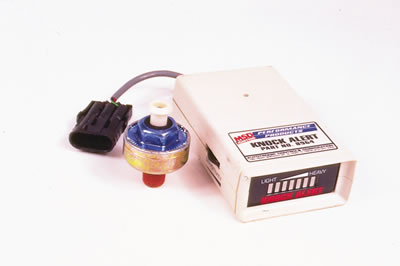
I ended up buying one of these:
Standalone knock sensor.
http://store.summitracing.com/partde...5&autoview=sku
http://forums.corvetteforum.com/show....php?t=1416241
I ended up buying one of these:
Standalone knock sensor.
http://store.summitracing.com/partde...5&autoview=sku

Racer

Joined: Apr 2006
Posts: 477
Likes: 43
From: Millbrae California
i hear one of the aftermarket companies is doing research on detonation /knock detection, the problem is not every engine has a knock in the same frequency range. different cylinder bores and engine combustion chamber design change the freqency a sensor will need to look at to hear the detonation, plus you also need to factor in the sounds from a mechanical lifter or suspension rattles.the technology is coming but there is still a ways to go, present knock sensor tecnology is designed around a new modern car. we have had problems with cars where the knock sensor was picking up outside noises and retarding the timing. on this car when the knock sensor was insulated from the noise it had a ton of power but when it was mounted to the engine the engine power was way down.
i am on the conservitive side in my advance curves because i have had to tune to many engines that were just rebuilt again because of damage from detonation where the driver swears they never heard a ping.
hope this helps some henry @ oles carb
i am on the conservitive side in my advance curves because i have had to tune to many engines that were just rebuilt again because of damage from detonation where the driver swears they never heard a ping.
hope this helps some henry @ oles carb

Instructor
Joined: Nov 2004
Posts: 194
Likes: 0
From: Appleton Wi.
Don't know if this is a good theory or not. I'm sure somebody will chime in and let me know. Mine rattled a little bit at low rpm's when it was jetted overly rich, now that I've jetted down and put in IFR's, the detonation is gone. I'm thinking that the extra fuel was able to find It's way into the nooks and crannies of the combustion chamber, or the quench area of the head/block gap, and creating a knock. Now with it leaned to the proper mix it doesn't do it at all. My 2 cents worth.
TJ
TJ
Tech Contributor
Joined: Jun 2004
Posts: 20,910
Likes: 962
From: I tend to be leery of any guy who doesn't own a chainsaw or a handgun.
Originally Posted by olescarb
...................... the problem is not every engine has a knock in the same frequency range. different cylinder bores and engine combustion chamber design change the freqency a sensor will need to look at to hear the detonation, plus you also need to factor in the sounds from a mechanical lifter or suspension rattles.the technology is coming but there is still a ways to go, present knock sensor tecnology is designed around a new modern car. we have had problems with cars where the knock sensor was picking up outside noises and retarding the timing..............
henry @ oles carb
henry @ oles carb

Henry, you are absolutely correct!
Tech Contributor
Joined: Jun 2004
Posts: 20,910
Likes: 962
From: I tend to be leery of any guy who doesn't own a chainsaw or a handgun.
Originally Posted by TJ76
Don't know if this is a good theory or not. I'm sure somebody will chime in and let me know. Mine rattled a little bit at low rpm's when it was jetted overly rich, now that I've jetted down and put in IFR's, the detonation is gone. I'm thinking that the extra fuel was able to find It's way into the nooks and crannies of the combustion chamber, or the quench area of the head/block gap, and creating a knock. Now with it leaned to the proper mix it doesn't do it at all. My 2 cents worth.
TJ
TJ
I've seen a (possibly) similar phenomenon (sp?) before with FI engines that were running extremely rich under load, usually during some sort of test sequence. There was a strange noise, eventually labeled "combustion rumble" under this condition. It sounded very similar to knock, but given the A/F ratio and spark timing we were running, we concluded it couldn't actually be real detonation. I'm wondering if perhaps you had a "real world" experience similar to our development experience?

Race Director

Joined: Dec 1999
Posts: 16,945
Likes: 9
aftermarket schmaftermarket. GM has solved it for you, there are 2 easy ways to build a knock detection led system, 1 uses the old standalone ESC box (like on 81 & 82 vettes), the other requires you to take apart a weatherpack ecm's calpak. Do a search, I posted how to do it not that long ago. Takes a little soldering...that's all.
Instructor
Joined: Nov 2004
Posts: 194
Likes: 0
From: Appleton Wi.
What ever it is called, I'm glad It's gone. I knew my c.r. wasn't too high, so I was thinking I would reduce the quench area to try and get rid of it. Then I leaned out the carb, and it went away. All is well. Don't want to hijack this string, I'll get out of here. Thanks.
TJ
TJ

Race Director
Joined: Mar 2001
Posts: 11,322
Likes: 1
From: Living in the Hartland
Might have trouble with the solid cam and knock sensor, seems solid cams state not be used with OEM knock sensors or you might get retarded timing from false signals from the cam
Since it will not be hooked to your timing it might provide info but I would think you would need to be able to distiguish cam knock from detonation somehow
Since it will not be hooked to your timing it might provide info but I would think you would need to be able to distiguish cam knock from detonation somehow
Racer
Joined: Apr 2006
Posts: 477
Likes: 43
From: Millbrae California
one other way you can "see" detonation is with a portable 5 gas exhaust gas analyzer, the 5th gas is NOx. A high NOx reading can be a indicator of detonation, a 5-gas analyzer is not cheap but it is a great tuning tool. the proper use of a exhaust gas analyzer can help you find what air/fuel mixture and ignition advance a motor wants/needs for the gasoline being used.
thanks for a interesting question and also the interesting answers
henry @ oles carb
thanks for a interesting question and also the interesting answers
henry @ oles carb
