







"Return" fuel line clarification

Team Owner


Joined: Jul 1999
Posts: 26,545
Likes: 46
From: Huntersville NC

Here is a pic of a 68 fuel tank and you can see where the fuel return line gets attached, at the top of the tank.

I have asked the question many times, and asked some very knowledgeable folks, about the function of the fuel return line. So whatever the answer, whatever reason you give for the existence and function of the fuel return line, my follow up question is, OK, then why is a fuel return line NOT needed for a Holley carb, while it is needed on a QJet? So a holley can handle more fuel at idle than a Qjet? A holley can handle hot fuel?
I have asked the question many times, and asked some very knowledgeable folks, about the function of the fuel return line. So whatever the answer, whatever reason you give for the existence and function of the fuel return line, my follow up question is, OK, then why is a fuel return line NOT needed for a Holley carb, while it is needed on a QJet? So a holley can handle more fuel at idle than a Qjet? A holley can handle hot fuel?
Team Owner
Joined: Jul 1999
Posts: 26,545
Likes: 46
From: Huntersville NC
Originally Posted by SIXFOOTER
I don't know why Holly says it isn't needed, but I wouldn't run a fuel system without it.
Just to carify, I am talking about how the 68 - 72 corvettes came from the factory, not the recommendations of the carb manufacturers. Every corvette that had a Qjet also had a fuel return line. In 68-69 the fuel return line split off from the fuel filter. 70 - 72 it came from the fuel pump. But every corvette that had a Holley (With the possible exception of the 71 LS-6) did NOT have a fuel return line from the factory. In 68-69 the Holley equipped vettes had no inline fuel filter, and in 70-72 they either had a different fuel pump with no return line or else it was plugged (I just don't know which it was).

Team Owner
Joined: Aug 2006
Posts: 24,125
Likes: 15
From: Columbia Missouri
Originally Posted by S489
Durango_boy, did you just plug or cap the return line at the tank? or near the fuel pump?
Thanks again
Thanks again
The return line, when I got the car, was plugged at the frame rail where the rubber line would attach to it. Since I was leaving the electric setup in place, and it has a shut off, I decided not to re-open the return line. If I were using any other setup I would have reinstalled it along with a new mechanical pump.
Thread Starter
Burning Brakes

Joined: Feb 2006
Posts: 1,024
Likes: 1
From: AL
SIXFOOTER, sounds like you hit on the answer i was looking for: an orifice! i ran some numbers this morning and this seems plausible even though i don't have good physical properties of gasoline here. the orifice would be pretty darn small and looks like the return line would flow at a fairly constant rate for differing engine demands assuming the pump maintains a constant deltaP. (the orifice on my pump must have been clogged for me to not see any return flow as DARROW reported).
PRNDL great info. seems like i read somewhere that the Holley would hold the needle against the seat at a higher pressure than a qjet, but can't remember values. could something like that be one reason why there was no return line with holley's?
Those of us who are/will be running an electric fuel pump without a regulator could consider adding a branch with an orifice and use the existing return line. it's just a matter of sizing the orifice.
thanks all
PRNDL great info. seems like i read somewhere that the Holley would hold the needle against the seat at a higher pressure than a qjet, but can't remember values. could something like that be one reason why there was no return line with holley's?
Those of us who are/will be running an electric fuel pump without a regulator could consider adding a branch with an orifice and use the existing return line. it's just a matter of sizing the orifice.
thanks all
Team Owner
Joined: Aug 2006
Posts: 24,125
Likes: 15
From: Columbia Missouri
You know...going electric is easy and cheap. A frame mounted bellows electric pump from JCW.com, $45 after shipping. Run a relay and a hot wire to the pump, switched by ignition. Simple. Then, when the key is turned on, the pump will prime the bowls for you, so when you crank the engine you already have fuel in the carb.
If it switches on or off automatically based on fuel usage, a return line isn't as important.
If it switches on or off automatically based on fuel usage, a return line isn't as important.

Race Director

Joined: May 2006
Posts: 16,528
Likes: 53
From: Dayton, Ohio
Durango-you would appreciate a return line next summer to keep your fuel cool-also you really should put an oil pressure safety switch on your electric fuel pump-your family would thank you. 
Corvette Stories
The Best of Corvette for Corvette Enthusiasts

Top 10 Most Expensive Corvettes Ever Sold on Bring A Trailer
Brett Foote
10 Things Every Corvette Owner Needs (2026 Edition)
Michael S. Palmer
8 Most "Only Corvette Owners Understand" Quirks and Problems
Pouria Savadkouei
10 Reasons the C6 Z06 is Still A Performance Benchmark After 20 Years
Joe Kucinski
How Much Horsepower Every Corvette Engine "LOST" in 1972
Joe Kucinski
Top 10 DOs and DON'Ts for Protecting Your Convertible Top!
Michael S. Palmer
Top 10 Most Explosive Corvettes Ever Made: Power-to-Weight Ratio Ranked!
Joe Kucinski
150 hp to 1,250 hp: Every Corvette Generation Compared by the Specs That Matter
Joe Kucinski
8 Coolest Corvette Pace Cars (and Replicas) of All Time
Verdad Gallardo
Team Owner
Joined: Aug 2006
Posts: 24,125
Likes: 15
From: Columbia Missouri
Originally Posted by DWncchs
Durango-you would appreciate a return line next summer to keep your fuel cool-also you really should put an oil pressure safety switch on your electric fuel pump-your family would thank you.
Heh, good call, and I already have the link to order one. I liked the idea. I already have a manual cut-off switch, but want to add the pressure switch. The fuel temp I can live with because I usually won't drive on sweltering days. I like the AC in my Durango.
Race Director
Joined: May 2006
Posts: 16,528
Likes: 53
From: Dayton, Ohio
Originally Posted by S489
DWncchs, please clarify; is that
aprox. 0.065 for the carb and
apox. 0.240 for the return?
thanks
aprox. 0.065 for the carb and
apox. 0.240 for the return?
thanks
Last edited by ...Roger...; Sep 18, 2006 at 04:38 PM.
Race Director
Joined: May 2006
Posts: 16,528
Likes: 53
From: Dayton, Ohio
The largest hole is the intake,the next largest(the one in the bottom of can-.240)goes to the carb-the tiny hole .065 sitting on top of tube is the return. 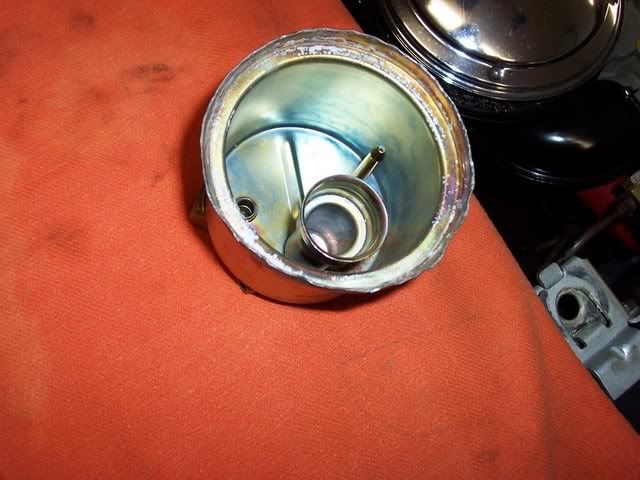
Last edited by ...Roger...; Sep 18, 2006 at 08:39 PM.
Pro

Joined: Sep 2006
Posts: 551
Likes: 2
From: Clovis CA
Hey carb guru's, you all got me thinking about the return line. Mine is capped off also, I'm using a Edelbrock 1722 fuel pump, 6-7 psi..A Edelbrock 1813 800cfm carb and Edelbrock Torker II intake. Installed a vented gas cap, I would like to hook up the return, any ideas how?
Team Owner
Joined: Aug 2006
Posts: 24,125
Likes: 15
From: Columbia Missouri
Originally Posted by 68RATVT
Hey carb guru's, you all got me thinking about the return line. Mine is capped off also, I'm using a Edelbrock 1722 fuel pump, 6-7 psi..A Edelbrock 1813 800cfm carb and Edelbrock Torker II intake. Installed a vented gas cap, I would like to hook up the return, any ideas how?
Use the stock return line. If the pump is electric, buy a T for the fuel line to the carb. Make sure the T has a smalled outlet and use that to return the stock line on the frame. As long as the T is smaller than the diameter of the fuel inlet, the fuel will flow when needed unless there is an overage, in which case it will go through the return.
If you have a mechanical pump, it might have a fitting for a return line. If not, use the above method.
Last edited by Durango_Boy; Sep 20, 2006 at 10:41 AM.

Melting Slicks


Joined: Mar 2005
Posts: 2,838
Likes: 10
From: Austin TX
The reason q-jets received the return line and Holleys didn't is, q-jets had a hot-start problem. When a warm enigne was shut down, the residual pressure from the pump would over-power the big needle and seat and create a flooding condition aggravated by underhood temps. Holleys, with their two N&S's didn't suffer from this malady.
Race Director
Joined: May 2006
Posts: 16,528
Likes: 53
From: Dayton, Ohio
Originally Posted by 73, Dark Blue 454
The reason q-jets received the return line and Holleys didn't is, q-jets had a hot-start problem. When a warm enigne was shut down, the residual pressure from the pump would over-power the big needle and seat and create a flooding condition aggravated by underhood temps. Holleys, with their two N&S's didn't suffer from this malady.

Thread Starter
Burning Brakes
Joined: Feb 2006
Posts: 1,024
Likes: 1
From: AL
i think you'll need an orifice in the return line to maintain sufficient pressure at the carb; it doesn't look like the resistance of the return line alone will do it. 0.065 in dia is what DWncchs measured. by some rough calcs, it looks like it could be even smaller.
Team Owner
Joined: Aug 2006
Posts: 24,125
Likes: 15
From: Columbia Missouri
Originally Posted by S489
i think you'll need an orifice in the return line to maintain sufficient pressure at the carb; it doesn't look like the resistance of the return line alone will do it. 0.065 in dia is what DWncchs measured. by some rough calcs, it looks like it could be even smaller.
Yeah,
 , the smaller the better. Obviously don't choke it, but you just need to create a path the extra fuel can take.
