


Shimming rotor help


Pro


Joined: Apr 2006
Posts: 647
Likes: 22
From: Norwalk CT and Boynton Beach FL

Originally Posted by happiedazs
Where can you get the shims and is there any thread or website that tells you how to do this. I think I have the same issue with the brakes on my 75 ---- thanks
Thanks to all for your suggestions and info --- You are all VERY HELPFUL !!!

Team Owner


Joined: Oct 2004
Posts: 23,831
Likes: 10
From: Springfield MO
St. Jude Donor '07
Originally Posted by Ironcross
And by the way all rotors should be cut at every pad change to make sure they are straight. 
Tech Contributor


Joined: Aug 1999
Posts: 15,156
Likes: 3,965
From: Connecticut, USA
In reply to the questions on the way I set them up. First, this is how I do them, doesn't mean it's set in stone. My brakes work and I don't use anything fancy like DOT5 fluid or O rings.
Front rotors used to come as an assembly with the hub years ago but that ended. So now you have to remove the rivets and old rotors front or back and setup new ones. New rotors will not, in most cases, run true. Rotors turned on a brake lathe will run true with the fronts but not the rears. Once the original rotor is removed from the spindle or hub it will not be the same.
For many years it was common practice to remove a rear rotor, turn it then install. They looked great on the lathe, but they are not concentric with the spindle center line and in most cases the runout was worse then before. This is how the corvette disc brake system got a bad name,runout and leaking calipers. Dealers would and still will throw new brakes systems and a $1,000 bill at unknowing customer, telling them how good the brakes are. That lasts a short time then the brake pedal gets spongy in a week or two and the nasty cycled starts again. I've witnessed this for the past 30 years.
Since in most cases it is impractical to turn rotors while riveted to the rear spindles shimming up the low spots in 360* of rotation will bring them back within tolerence. I have been able to dial them in to less then .001" in some cases. Bolting them on will set them in place and keep them there. If the rotor ever needs to be replaced then it's an easy task to remove them,unlike with the rivets. Using the lug nuts only will not give you consistant results, as the nuts are torqued it will clamp the rotor in a different position almost every time I checked them.
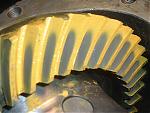
If you bolt the fronts on and then kiss cut them they should be good, if that's the way you want to go. I don't turn rotors unless they are grooved or slightly warped and even then it may be wiser to replace them given the cost of about $50. I do use a 100 grit DA on them to break any glaze and to seat the new pads.The front rotor in the picture is setup like this. I don't use metallic pads, only organic for street cars.
Hope that clears up things, good luck. All my vettes stop on a dime.
Bleed them once a year or every two years if you drive them frequently and you should be ok.
Gary
Front rotors used to come as an assembly with the hub years ago but that ended. So now you have to remove the rivets and old rotors front or back and setup new ones. New rotors will not, in most cases, run true. Rotors turned on a brake lathe will run true with the fronts but not the rears. Once the original rotor is removed from the spindle or hub it will not be the same.
For many years it was common practice to remove a rear rotor, turn it then install. They looked great on the lathe, but they are not concentric with the spindle center line and in most cases the runout was worse then before. This is how the corvette disc brake system got a bad name,runout and leaking calipers. Dealers would and still will throw new brakes systems and a $1,000 bill at unknowing customer, telling them how good the brakes are. That lasts a short time then the brake pedal gets spongy in a week or two and the nasty cycled starts again. I've witnessed this for the past 30 years.
Since in most cases it is impractical to turn rotors while riveted to the rear spindles shimming up the low spots in 360* of rotation will bring them back within tolerence. I have been able to dial them in to less then .001" in some cases. Bolting them on will set them in place and keep them there. If the rotor ever needs to be replaced then it's an easy task to remove them,unlike with the rivets. Using the lug nuts only will not give you consistant results, as the nuts are torqued it will clamp the rotor in a different position almost every time I checked them.
If you bolt the fronts on and then kiss cut them they should be good, if that's the way you want to go. I don't turn rotors unless they are grooved or slightly warped and even then it may be wiser to replace them given the cost of about $50. I do use a 100 grit DA on them to break any glaze and to seat the new pads.The front rotor in the picture is setup like this. I don't use metallic pads, only organic for street cars.
Hope that clears up things, good luck. All my vettes stop on a dime.
Bleed them once a year or every two years if you drive them frequently and you should be ok.
Gary
Last edited by gtr1999; Sep 28, 2006 at 08:31 AM.

Melting Slicks

Joined: Jan 2006
Posts: 3,028
Likes: 2
From: North NJ
Never heard of someone cutting the rotors at every pad change, only if the rotors are grooved or warped, which I hope isn't every pad change unless you autocross.
Gary, where do you get those flat head allen bolts you use to secure your rotors to the hubs? they are very clean and nice.
Anyone have a pic of a dial indicator setup on a rotor?
Just so we can have a good visual.
I would recommend gettng a decent indicator as new rotors aren't a one-time ordeal depending if you expect to own this car a while, and the whole stopping concept is not something I would cut corners on. Keep the car in the garage for a weekend and use that gas money towards quality measuring tools.
Gary, where do you get those flat head allen bolts you use to secure your rotors to the hubs? they are very clean and nice.
Anyone have a pic of a dial indicator setup on a rotor?
Just so we can have a good visual.
I would recommend gettng a decent indicator as new rotors aren't a one-time ordeal depending if you expect to own this car a while, and the whole stopping concept is not something I would cut corners on. Keep the car in the garage for a weekend and use that gas money towards quality measuring tools.
Team Owner
Joined: Oct 2004
Posts: 23,831
Likes: 10
From: Springfield MO
St. Jude Donor '07
Originally Posted by gtr1999
In reply to the questions on the way I set them up. First, this is how I do them, doesn't mean it's set in stone. My brakes work and I don't use anything fancy like DOT5 fluid or O rings.
Front rotors used to come as an assembly with the hub years ago but that ended. So now you have to remove the rivets and old rotors front or back and setup new ones. New rotors will not, in most cases, run true. Rotors turned on a brake lathe will run true with the fronts but not the rears. Once the original rotor is removed from the spindle or hub it will not be the same.
For many years it was common practice to remove a rear rotor, turn it then install. They looked great on the lathe, but they are not concentric with the spindle center line and in most cases the runout was worse then before. This is how the corvette disc brake system got a bad name,runout and leaking calipers. Dealers would and still will throw new brakes systems and a $1,000 bill at unknowing customer, telling them how good the brakes are. That lasts a short time then the brake pedal gets spongy in a week or two and the nasty cycled starts again. I've witnessed this for the past 30 years.
Since in most cases it is impractical to turn rotors while riveted to the rear spindles shimming up the low spots in 360* of rotation will bring them back within tolerence. I have been able to dial them in to less then .001" in some cases. Bolting them on will set them in place and keep them there. If the rotor ever needs to be replaced then it's an easy task to remove them,unlike with the rivets. Using the lug nuts only will not give you consistant results, as the nuts are torqued it will clamp the rotor in a different position almost every time I checked them.
If you bolt the fronts on and then kiss cut them they should be good, if that's the way you want to go. I don't turn rotors unless they are grooved or slightly warped and even then it may be wiser to replace them given the cost of about $50. I do use a 100 grit DA on them to break any glaze and to seat the new pads.The front rotor in the picture is setup like this. I don't use metallic pads, only organic for street cars.
Hope that clears up things, good luck. All my vettes stop on a dime.
Bleed them once a year or every two years if you drive them frequently and you should be ok.
Gary
Front rotors used to come as an assembly with the hub years ago but that ended. So now you have to remove the rivets and old rotors front or back and setup new ones. New rotors will not, in most cases, run true. Rotors turned on a brake lathe will run true with the fronts but not the rears. Once the original rotor is removed from the spindle or hub it will not be the same.
For many years it was common practice to remove a rear rotor, turn it then install. They looked great on the lathe, but they are not concentric with the spindle center line and in most cases the runout was worse then before. This is how the corvette disc brake system got a bad name,runout and leaking calipers. Dealers would and still will throw new brakes systems and a $1,000 bill at unknowing customer, telling them how good the brakes are. That lasts a short time then the brake pedal gets spongy in a week or two and the nasty cycled starts again. I've witnessed this for the past 30 years.
Since in most cases it is impractical to turn rotors while riveted to the rear spindles shimming up the low spots in 360* of rotation will bring them back within tolerence. I have been able to dial them in to less then .001" in some cases. Bolting them on will set them in place and keep them there. If the rotor ever needs to be replaced then it's an easy task to remove them,unlike with the rivets. Using the lug nuts only will not give you consistant results, as the nuts are torqued it will clamp the rotor in a different position almost every time I checked them.
If you bolt the fronts on and then kiss cut them they should be good, if that's the way you want to go. I don't turn rotors unless they are grooved or slightly warped and even then it may be wiser to replace them given the cost of about $50. I do use a 100 grit DA on them to break any glaze and to seat the new pads.The front rotor in the picture is setup like this. I don't use metallic pads, only organic for street cars.
Hope that clears up things, good luck. All my vettes stop on a dime.
Bleed them once a year or every two years if you drive them frequently and you should be ok.
Gary










