



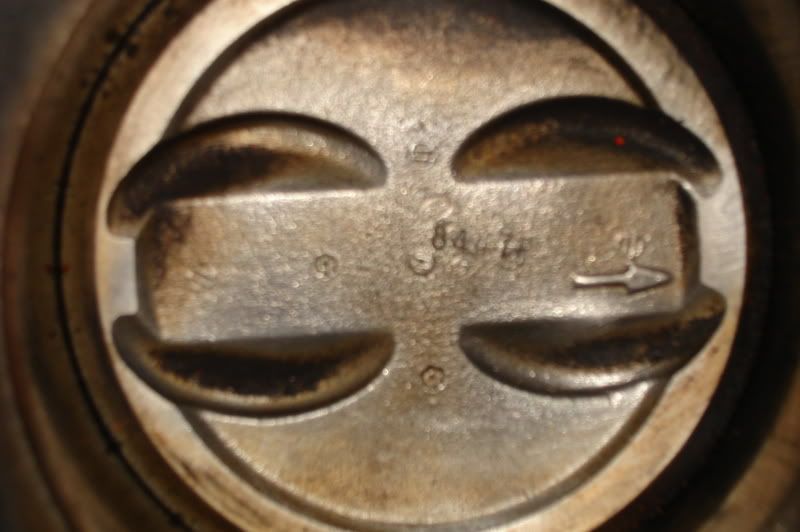

Piston questions

Thread Starter
Drifting


Joined: Apr 2002
Posts: 1,716
Likes: 4
From: New Baden Illinois
 Piston questions
I just brought home a 2-bolt shortblock today. It was originally a 327, but was converted to a 350 about 5,000 miles ago. Everything still looks to be in very good condition. I was planning on putting some aftermarket 64cc heads, but was not looking to get more than 350-400hp out of the engine with my Crane Powermax 272.
However, I have some piston questions:
1) The pistons are .030 over with the stamp "8447P" on all of the pistons. Does anyone know what brand or volume these pistons are? They are dish 4-valve relief pistons.
2) When measuring the piston to deck clearance, what points do you measure. With a dished piston, you have a raised ring on the top of the piston, and the outside of the piston tapers to the cylinder wall and the inside of the pistons is dished. How do I measure the piston to deck clearance?
I am trying to get a decent CR, so I need to determine these measurements so that I can choose the correct head gasket.
However, I have some piston questions:
1) The pistons are .030 over with the stamp "8447P" on all of the pistons. Does anyone know what brand or volume these pistons are? They are dish 4-valve relief pistons.
2) When measuring the piston to deck clearance, what points do you measure. With a dished piston, you have a raised ring on the top of the piston, and the outside of the piston tapers to the cylinder wall and the inside of the pistons is dished. How do I measure the piston to deck clearance?
I am trying to get a decent CR, so I need to determine these measurements so that I can choose the correct head gasket.

Race Director


Joined: Feb 1999
Posts: 16,978
Likes: 7
From: In Dreams There Is Truth Ohio
You need a dial indicator with a magnet base...you can get one on the cheap at Harbor Freight. Adjust the dial to 0 then swing the dial into the bore. Raise the piston and make sure the indicator rod is on the flat surface of teh piston, not the valve relief and not the dome...just the flat part near the edge...rotate the crank, and the lowest number is your deck height...if the lowest reading is .07, that means the piston is .07 into the hole. most stock blocks that have not been decked will have pistons that are .03-.07 in the hole.
Thread Starter
Drifting
Joined: Apr 2002
Posts: 1,716
Likes: 4
From: New Baden Illinois
I did not see a dial indicator with a magnetic base from Harbor Freight. Do you have a link to it?
Anybody have any ideas on the volume of these pistons?
Thanks for the help.
Anybody have any ideas on the volume of these pistons?
Thanks for the help.

Le Mans Master


Joined: Jan 2006
Posts: 6,506
Likes: 139
From: Butler Pa
Originally Posted by dgruenke
1) The pistons are .030 over with the stamp "8447P" on all of the pistons. Does anyone know what brand or volume these pistons are? They are dish 4-valve relief pistons.

Le Mans Master

Joined: Jan 2006
Posts: 9,192
Likes: 27
From: Boca Raton Florida
Thread Starter
Drifting
Joined: Apr 2002
Posts: 1,716
Likes: 4
From: New Baden Illinois
Originally Posted by SIXFOOTER
Thread Starter
Drifting
Joined: Apr 2002
Posts: 1,716
Likes: 4
From: New Baden Illinois
Originally Posted by bashcraft
I beleive that's a Sealed Power number.
That's what I thought at first also, but I haven't been able to track down that part number.
Maybe tonight I can post a picture of the top of the piston and see if that helps.
Corvette Stories
The Best of Corvette for Corvette Enthusiasts

Top 10 Most Expensive Corvettes Ever Sold on Bring A Trailer
Brett Foote
10 Things Every Corvette Owner Needs (2026 Edition)
Michael S. Palmer
8 Most "Only Corvette Owners Understand" Quirks and Problems
Pouria Savadkouei
10 Reasons the C6 Z06 is Still A Performance Benchmark After 20 Years
Joe Kucinski
How Much Horsepower Every Corvette Engine "LOST" in 1972
Joe Kucinski
Top 10 DOs and DON'Ts for Protecting Your Convertible Top!
Michael S. Palmer
Top 10 Most Explosive Corvettes Ever Made: Power-to-Weight Ratio Ranked!
Joe Kucinski
150 hp to 1,250 hp: Every Corvette Generation Compared by the Specs That Matter
Joe Kucinski
8 Coolest Corvette Pace Cars (and Replicas) of All Time
Verdad Gallardo

Thread Starter
Drifting
Joined: Apr 2002
Posts: 1,716
Likes: 4
From: New Baden Illinois
Originally Posted by gofastvette
I wouldn`t worry about a head gasket, With a dish that deep, it`s lucky to be even 8-1 as are most flat top pistons with eyebrows
Last edited by dgruenke; Oct 10, 2006 at 09:32 AM.

Le Mans Master
Joined: Sep 2001
Posts: 7,739
Likes: 630
From: Unreconstructed, South Carolina
Originally Posted by bashcraft
I beleive that's a Sealed Power number.

I think so too ... enter 8447P into Clevite interchange & it ID's it as a Sealed Power part ... and returns Clevite equivalent P/N 229-2694 ... looked that up & only info was (light duty, recessed head, 4VR, 1.540" compression distance). I don't find 8447P in my sealed power piston book ... but book may be too new/number too old. Chances are it's about -10cc and about 0.045" down in hole of stock deck ... LOW comp. Based on above assumptions ... with FP1094 shim about 9.4:1 SCR ... with Victor 5746 comp about 9.2:1. Evidenced by the grain inside dish (your picture) ... your piston is not forged. Based on the above ... suggest you might just make 350hp w/ CP272 & am64cc heads. Regardless which gasket ... at 0.045" down in hole, you'll have crappy/no quench.
Last edited by jackson; Oct 10, 2006 at 10:40 AM.
Thread Starter
Drifting
Joined: Apr 2002
Posts: 1,716
Likes: 4
From: New Baden Illinois
Originally Posted by jackson
I think so too ... enter 8447P into Clevite interchange & it ID's it as a Sealed Power part ... and returns Clevite equivalent P/N 229-2694 ... looked that up & only info was (light duty, recessed head, 4VR, 1.540" compression distance). I don't find 8447P in my sealed power piston book ... but book may be too new/number too old. Chances are it's about -10cc and about 0.045" down in hole of stock deck ... LOW comp. Based on above assumptions ... with FP1094 shim about 9.4:1 SCR ... with Victor 5746 comp about 9.2:1. Evidenced by the grain inside dish (your picture) ... your piston is not forged. Based on the above ... suggest you might just make 350hp w/ CP272 & am64cc heads. Regardless which gasket ... at 0.045" down in hole, you'll have crappy/no quench.
Le Mans Master
Joined: Sep 2001
Posts: 7,739
Likes: 630
From: Unreconstructed, South Carolina
You'll find different numbers/ranges ... but I like between 0.030" & 0.045" quench. Too little & piston expansion will slap bottom of head's wedge ... too much & the effect is lost ... by about 0.060" the effect is all but lost. You'll find other explanations of effect too ... but I understand quench effect is when AF charge is squeezed between top of piston & bottom of the head's wedge ... if the two surfaces are close enough together ... that squeeze creates sufficient turbulance to inhibit the propagation of a pre-ignition. Quench is related to compression but they are not equivalent. The thin FP1094 shim is 0.015" thick ... + 0.045" down in hole = 0.060" quench. If you look at your sbc head's combustion chamber and the area outlined by the gasket's fire ring ... the wedge is roughly the other side/half that does not contain the valves ... wedge is the lowest part of chamber, closest to piston.
*edit* you can also measure down in hole if you have a caliper. Piston at TDC. Lay a piece of flat stock across bore ... lay the tail of caliper on flat & drop caliper's spine onto top of that "ring" surrounding your dish ... keep everything parallel ... add thickness of flat to what the caliper reads ... that's the piston:deck clearance.
*edit* you can also measure down in hole if you have a caliper. Piston at TDC. Lay a piece of flat stock across bore ... lay the tail of caliper on flat & drop caliper's spine onto top of that "ring" surrounding your dish ... keep everything parallel ... add thickness of flat to what the caliper reads ... that's the piston:deck clearance.
Last edited by jackson; Oct 10, 2006 at 12:29 PM.
Thread Starter
Drifting
Joined: Apr 2002
Posts: 1,716
Likes: 4
From: New Baden Illinois
Originally Posted by jackson
You'll find different numbers/ranges ... but I like between 0.030" & 0.045" quench. Too little & piston expansion will slap bottom of head's wedge ... too much & the effect is lost ... by about 0.060" the effect is all but lost. You'll find other explanations of effect too ... but I understand quench effect is when AF charge is squeezed between top of piston & bottom of the head's wedge ... if the two surfaces are close enough together ... that squeeze creates sufficient turbulance to inhibit the propagation of a pre-ignition. Quench is related to compression but they are not equivalent. The thin FP1094 shim is 0.015" thick ... + 0.045" down in hole = 0.060" quench. If you look at your sbc head's combustion chamber and the area outlined by the gasket's fire ring ... the wedge is roughly the other side/half that does not contain the valves ... wedge is the lowest part of chamber, closest to piston.
Sorry for the questions, but I want to get this right the first time so that I don't have to do it again.
Le Mans Master
Joined: Sep 2001
Posts: 7,739
Likes: 630
From: Unreconstructed, South Carolina
Originally Posted by dgruenke
So, would it be fair to say that too high of a quench number will not do anything to prevent pre-ignition? If this is the case, does the quench really play a factor if the SCR is below 9.5:1, or does the quench really come into play at higher CR?
Sorry for the questions, but I want to get this right the first time so that I don't have to do it again.
Sorry for the questions, but I want to get this right the first time so that I don't have to do it again.
Thread Starter
Drifting
Joined: Apr 2002
Posts: 1,716
Likes: 4
From: New Baden Illinois
I just found an article that I think may clear it all up. Quench deals with the efficiency of the burn because it mixes the air and fuel more thoroughly. And Jackson, you were right about not getting any quench effect with those pistons.
Here is the article:
http://www.chevyhiperformance.com/te...earance_guide/
If I use the .015 head gasket and get approximately 9.4:1 SCR, I will have approximately 8.75:1 Dynamic compression ratio. Is this too high, or am I safe?
Here is the article:
http://www.chevyhiperformance.com/te...earance_guide/
If I use the .015 head gasket and get approximately 9.4:1 SCR, I will have approximately 8.75:1 Dynamic compression ratio. Is this too high, or am I safe?

Team Owner


Joined: Apr 1999
Posts: 21,953
Likes: 1,445
From: Reno Nevada
2024 C3 of the Year Finalist- Modified
How did you come up with 8.75D from 9.4 static? No 8.75 is way high. You have to know what your doing to run 8.4 8.2 or so is your no ping on super unleaded.
You can get close enough for goverment work with a flat feeler gauge off the edge of piston. You have a certian amount of piston rock. No biggy.
If a .025 feeler gauge gets to the block deck - you have a piston .025 down in the hole which is the common depth for a non surfaced block.
You can get close enough for goverment work with a flat feeler gauge off the edge of piston. You have a certian amount of piston rock. No biggy.
If a .025 feeler gauge gets to the block deck - you have a piston .025 down in the hole which is the common depth for a non surfaced block.
Thread Starter
Drifting
Joined: Apr 2002
Posts: 1,716
Likes: 4
From: New Baden Illinois
I used the dynamic compression calculator on the following site:
http://www.wallaceracing.com/dynamic-cr.php
It is a 4.030 bore, 3.48 stroke, 5.7 rod, 9.4 SCR.
The Crane 272 Powermax shows the valve closing at .050 lift to be 35 degrees abdc. I put 0 boost and 500 ft. altitude.
Did I input something wrong or do the numbers sound right?
http://www.wallaceracing.com/dynamic-cr.php
It is a 4.030 bore, 3.48 stroke, 5.7 rod, 9.4 SCR.
The Crane 272 Powermax shows the valve closing at .050 lift to be 35 degrees abdc. I put 0 boost and 500 ft. altitude.
Did I input something wrong or do the numbers sound right?
Team Owner
Joined: Apr 1999
Posts: 21,953
Likes: 1,445
From: Reno Nevada
2024 C3 of the Year Finalist- Modified
I don't understand this site you put for DCR. I had mine figured out at near 8.4 That site gives me 9.82
The first thing to understand is that "compression ratio" (CR) as it is usually talked about is best termed "static compression ratio". This is a simple concept and represents the ratio of the swept volume of the cylinder (displacement) to the volume above the piston at top dead center (TDC). For example, if a hypothetical cylinder had a displacement of 450cc and a 50cc combustion chamber (plus volume over the piston crown to the head) the CR would be 500/50, or 10:1. If we were to mill the head so that the volume above the piston crown was decreased to 40cc, the CR would now be 490/40, or 12.25:1. Conversely, if we hogged the chamber out to 60cc, the CR would now be 510/60, or 8.5:1.
Everyone knows that high performance engines typically have higher compression ratios. Simply put, higher compression makes more hp. Higher CR also improves fuel efficiency and throttle response. So why not bump up the CR even further? Once CR exceeds a certain point, detonation will occur. Detonation kills power and it kills engine. The amount of compression a given engine can handle is determined by many factors. These include combustion chamber design, head material, use of combustion chamber coatings, etc. Once these mechanical aspects of the engine have been fixed, the main variable is fuel octane. Higher octane = more resistance to detonation and the ability to tolerate more compression.
The above brings up the question that is often on the mind of performance enthusiasts and engine builders: how high should my CR be? Even if you know all about your engine and have decided what fuel you are going to use, the question cannot be answered as phrased. Why? Because without reference to the camshaft specs, talking about (static) CR is next to meaningless!
How is this so? Well, think about the Otto cycle and how a four stroke engine works. The power stroke has been completed and the piston is heading up in the bore. The intake valve is closed and the exhaust valve is open. As the piston rises it is helping to push the spent combustion gasses out the exhaust port. The piston reaches TDC and starts back down. The exhaust valve closes and the intake valve opens. Fresh fuel and air are drawn into the cylinder. The piston reaches bottom dead enter (BDC) and starts back up. This is the critical point as far as understanding DCR. At BDC. the intake valve is still open. Consequently, even though the piston is rising up the bore, there is no compression actually occurring because of the open intake valve. Compression does not begin until the intake valve closes (IVC). Once IVC is reached, the air fuel mixture starts to compress. The ratio of the cylinder volume at IVC over the volume above the piston at TDC represents the dynamic compression ratio. The DCR is what the air fuel mixture actually "sees" and is what "counts", not the static CR. Because DCR is dependent upon IVC, cam specs have as much effect on DCR as does the mechanical specifications of the motor.
DCR is much lower than static CR. Most performance street and street/track motors have DCR in the range of 8-8.5:1. With typical cams, this translates into static CR in the 10.0-12.0:1 range. Higher than this, there may be detonation problems with pump gas. Engines with "small" cams will need a lower static CR to avoid detonation. Engines with "big" cams have a later IVC point and can tolerate a higher static CR. When race fuel is used, much higher DCR (and static CR) may be used because of the detonation resistance of the fuel. Of course, race motors also have much larger camshafts which is another reason they can get away with such high static CR, often in the 13-15:1 range.
Note: there is some confusion about use of the term "Dynamic Compression Ratio". Some people use it to refer to the characteristics of an engine combo running at high speed. In that case, the engines volumetric efficiency will have a major effect on cylinder pressure. In this case, a larger cam will increase cylinder pressure when within its' rev range. Thus, more power and more cylinder pressure will be created. We prefer to think of this concept as "cylinder pressure" to avoid confusion.
The first thing to understand is that "compression ratio" (CR) as it is usually talked about is best termed "static compression ratio". This is a simple concept and represents the ratio of the swept volume of the cylinder (displacement) to the volume above the piston at top dead center (TDC). For example, if a hypothetical cylinder had a displacement of 450cc and a 50cc combustion chamber (plus volume over the piston crown to the head) the CR would be 500/50, or 10:1. If we were to mill the head so that the volume above the piston crown was decreased to 40cc, the CR would now be 490/40, or 12.25:1. Conversely, if we hogged the chamber out to 60cc, the CR would now be 510/60, or 8.5:1.
Everyone knows that high performance engines typically have higher compression ratios. Simply put, higher compression makes more hp. Higher CR also improves fuel efficiency and throttle response. So why not bump up the CR even further? Once CR exceeds a certain point, detonation will occur. Detonation kills power and it kills engine. The amount of compression a given engine can handle is determined by many factors. These include combustion chamber design, head material, use of combustion chamber coatings, etc. Once these mechanical aspects of the engine have been fixed, the main variable is fuel octane. Higher octane = more resistance to detonation and the ability to tolerate more compression.
The above brings up the question that is often on the mind of performance enthusiasts and engine builders: how high should my CR be? Even if you know all about your engine and have decided what fuel you are going to use, the question cannot be answered as phrased. Why? Because without reference to the camshaft specs, talking about (static) CR is next to meaningless!
How is this so? Well, think about the Otto cycle and how a four stroke engine works. The power stroke has been completed and the piston is heading up in the bore. The intake valve is closed and the exhaust valve is open. As the piston rises it is helping to push the spent combustion gasses out the exhaust port. The piston reaches TDC and starts back down. The exhaust valve closes and the intake valve opens. Fresh fuel and air are drawn into the cylinder. The piston reaches bottom dead enter (BDC) and starts back up. This is the critical point as far as understanding DCR. At BDC. the intake valve is still open. Consequently, even though the piston is rising up the bore, there is no compression actually occurring because of the open intake valve. Compression does not begin until the intake valve closes (IVC). Once IVC is reached, the air fuel mixture starts to compress. The ratio of the cylinder volume at IVC over the volume above the piston at TDC represents the dynamic compression ratio. The DCR is what the air fuel mixture actually "sees" and is what "counts", not the static CR. Because DCR is dependent upon IVC, cam specs have as much effect on DCR as does the mechanical specifications of the motor.
DCR is much lower than static CR. Most performance street and street/track motors have DCR in the range of 8-8.5:1. With typical cams, this translates into static CR in the 10.0-12.0:1 range. Higher than this, there may be detonation problems with pump gas. Engines with "small" cams will need a lower static CR to avoid detonation. Engines with "big" cams have a later IVC point and can tolerate a higher static CR. When race fuel is used, much higher DCR (and static CR) may be used because of the detonation resistance of the fuel. Of course, race motors also have much larger camshafts which is another reason they can get away with such high static CR, often in the 13-15:1 range.
Note: there is some confusion about use of the term "Dynamic Compression Ratio". Some people use it to refer to the characteristics of an engine combo running at high speed. In that case, the engines volumetric efficiency will have a major effect on cylinder pressure. In this case, a larger cam will increase cylinder pressure when within its' rev range. Thus, more power and more cylinder pressure will be created. We prefer to think of this concept as "cylinder pressure" to avoid confusion.