




Tachometer, 1976
Thread Starter
Instructor

Joined: Oct 2006
Posts: 188
Likes: 0
From: littlestown Pa
 Tachometer, 1976
My tach is steady on 20. That's right, it does not work. Is the most probable cause the circut board? If so how hard is it to remove the tach? Is there a troubleshooting procedure?
Thanks
Thanks

Race Director


Joined: Sep 2001
Posts: 10,560
Likes: 439
From: Wellington, FL
St. Jude Donor '11 thru '25
Originally Posted by redvette1976
My tach is steady on 20. That's right, it does not work. Is the most probable cause the circut board? If so how hard is it to remove the tach? Is there a troubleshooting procedure?
Thanks
Thanks

Safety Car

Joined: Aug 2001
Posts: 4,883
Likes: 11
From: North Easton Mass
I was told that if the motor that drives the needle is good the needle will sit around 1500 when the engine is off. Sounds like your motor may be good but the board is broken. They should be available at the major vendors. If you can't find one email me and I can point you to a shop that might have a few new boards.

Rick B.
Rick B.

Instructor
Joined: Nov 2004
Posts: 194
Likes: 0
From: Appleton Wi.
I have a 76 also. Last year my tach quit. There is a filter inline with the dist. Located on the intake manifold behind the carburetor, it looks like a small cylinder. 1 1/2" long and about 3/4" in diameter with a wire coming from each end. One of the wires on mine came loose and tach quit. All I had to do was resolder the connection, been working ever since. Hopefully that's all it is. Good luck.
Pro

Joined: Jan 2005
Posts: 539
Likes: 3
From: Twin Cities Minnesota
my tach was steady at 1500, never moved from when I bought it. I took my dash apart, pulled my tach and this is what I found.
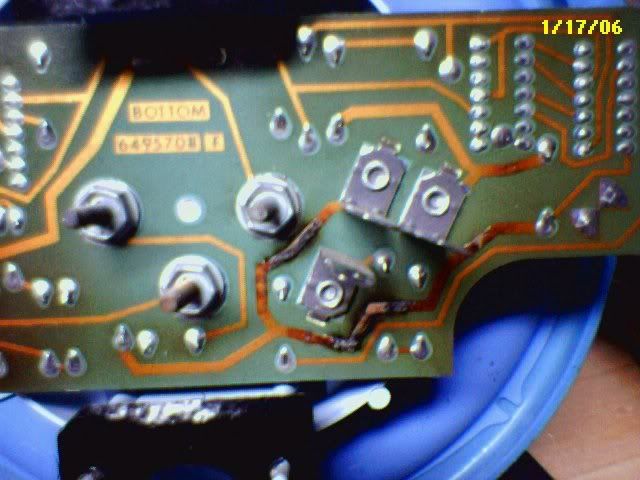
It is pretty common on 76 era. The trace burns out or the diode burns out. You can buy a new board or try to fix it. You have to replace the diode and repair the trace. I had a thread from when I fixed mine but can't find it. Below is from another forum member who helped me out. Sorry but at the moment I can't find his name.
It is my understanding that 1976 was the first year that corvettes had an electronic tach, and it shows!
The protection circuitry used in the first tachs was, shall we say, "less than optimal"? But we have to remember that this was designed in probably 1974, or 1975. At that time, microprocessers were only 4 bits! Automotive electronics were primarily relays and switches. Its not until stuff started blowing up that engineers started looking into automotive transients.
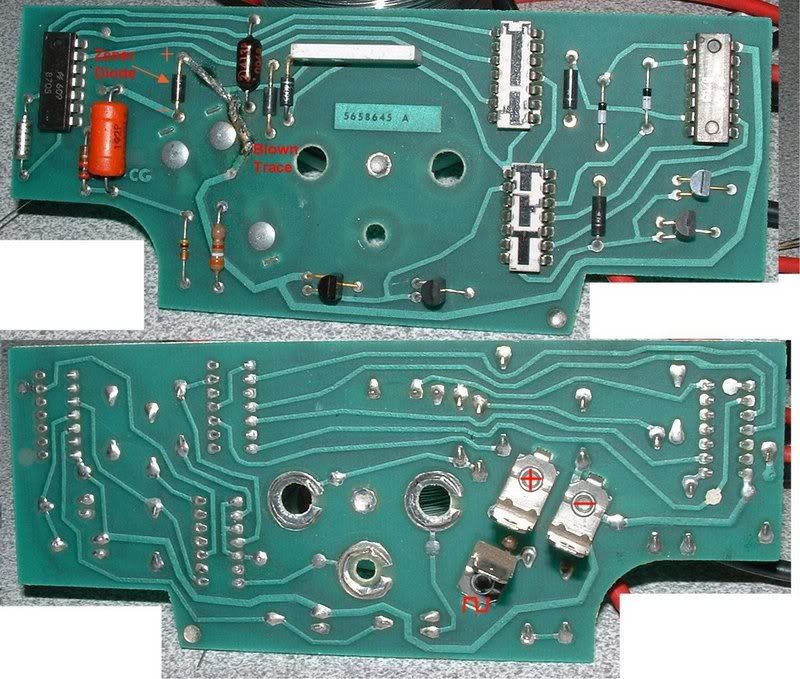
The issue with the original Corvette tachs is that they have a zener diode across the 12V input. If anyone ever hooks the battery up backwards, or boosts the car with 24 volts, this part is guaranteed to blow. That wouldn't be so bad if the zener blew open, then it would be gone and you wouldn't have to worry about it. However, Zeners usualy fail short. Which means it will pop a tace on your PCB. The Blown Zener diode is indicated by the arrow in the top left corner. Test Diode with Ohm meter, place positive and negative leads as shown. This should read as high resistance.
If the diode is shorted (Less than 5 ohms), remove it. Repair trace if required.
Test circuit by applying 12V to diode pads with polarity shown. MAKE SURE THE POLARITY IS CORRECT!
Now that the zener has been removed, reverse polarity will fry the board.
A current limited supply set to 200 mA is highly recommended.
The power can also be connected to the connector tabs as shown in the bottom diagram.
The square wave is the tach signal input.
It is pretty common on 76 era. The trace burns out or the diode burns out. You can buy a new board or try to fix it. You have to replace the diode and repair the trace. I had a thread from when I fixed mine but can't find it. Below is from another forum member who helped me out. Sorry but at the moment I can't find his name.
It is my understanding that 1976 was the first year that corvettes had an electronic tach, and it shows!
The protection circuitry used in the first tachs was, shall we say, "less than optimal"? But we have to remember that this was designed in probably 1974, or 1975. At that time, microprocessers were only 4 bits! Automotive electronics were primarily relays and switches. Its not until stuff started blowing up that engineers started looking into automotive transients.
The issue with the original Corvette tachs is that they have a zener diode across the 12V input. If anyone ever hooks the battery up backwards, or boosts the car with 24 volts, this part is guaranteed to blow. That wouldn't be so bad if the zener blew open, then it would be gone and you wouldn't have to worry about it. However, Zeners usualy fail short. Which means it will pop a tace on your PCB. The Blown Zener diode is indicated by the arrow in the top left corner. Test Diode with Ohm meter, place positive and negative leads as shown. This should read as high resistance.
If the diode is shorted (Less than 5 ohms), remove it. Repair trace if required.
Test circuit by applying 12V to diode pads with polarity shown. MAKE SURE THE POLARITY IS CORRECT!
Now that the zener has been removed, reverse polarity will fry the board.
A current limited supply set to 200 mA is highly recommended.
The power can also be connected to the connector tabs as shown in the bottom diagram.
The square wave is the tach signal input.
Race Director
Joined: Sep 2001
Posts: 10,560
Likes: 439
From: Wellington, FL
St. Jude Donor '11 thru '25
Last edited by Jud Chapin; Nov 8, 2006 at 11:20 PM.
Thread Starter
Instructor
Joined: Oct 2006
Posts: 188
Likes: 0
From: littlestown Pa
Great info. I will check the obvious first as described and go from there. Has anyone ever converted to a mechanical drive type in there 76? Would it be any better or worse than the current configuration?
Thanks
Bob
Thanks
Bob
Race Director
Joined: Sep 2001
Posts: 10,560
Likes: 439
From: Wellington, FL
St. Jude Donor '11 thru '25
Originally Posted by redvette1976
Great info. I will check the obvious first as described and go from there. Has anyone ever converted to a mechanical drive type in there 76? Would it be any better or worse than the current configuration?
Thanks
Bob
Thanks
Bob
Jud
Corvette Stories
The Best of Corvette for Corvette Enthusiasts

Top 10 Most Expensive Corvettes Ever Sold on Bring A Trailer
Brett Foote
10 Things Every Corvette Owner Needs (2026 Edition)
Michael S. Palmer
8 Most "Only Corvette Owners Understand" Quirks and Problems
Pouria Savadkouei
10 Reasons the C6 Z06 is Still A Performance Benchmark After 20 Years
Joe Kucinski
How Much Horsepower Every Corvette Engine "LOST" in 1972
Joe Kucinski
Top 10 DOs and DON'Ts for Protecting Your Convertible Top!
Michael S. Palmer
Top 10 Most Explosive Corvettes Ever Made: Power-to-Weight Ratio Ranked!
Joe Kucinski
150 hp to 1,250 hp: Every Corvette Generation Compared by the Specs That Matter
Joe Kucinski
8 Coolest Corvette Pace Cars (and Replicas) of All Time
Verdad Gallardo
Race Director
Joined: Sep 2002
Posts: 10,362
Likes: 5
From: San Diego - Deep Within The State of CONFUSION!
Originally Posted by redvette1976
Great info. I will check the obvious first as described and go from there. Has anyone ever converted to a mechanical drive type in there 76? Would it be any better or worse than the current configuration?
Thanks
Bob
Thanks
Bob
Reminder on the '76 tach - read the instructions on that board. Do NOT move the rheostat to center the needle! Needle should zero out, when the key is on. If/when you reassemble things do not be dismayed if you see the needle off zero with no power on it.
I replaced my board and the tach filter both at the same time. Before reassembling it, I took the tach and speedo to the local speedo shop to have them worked on.
The guy zero'd out the tach using the rheostat on the board, and true'd it up with his signal generator. Now that it's back in, the tach is wayyyy of. Yea it moves, but it reads 2K RPM high at the low end, and 3500 high at the high end.
We learned quickly that his signal generator does not provide the same signal as the HEI system. I'm ticked off at wasting all that work and having a broken tach still.


Race Director
Joined: Sep 2001
Posts: 10,560
Likes: 439
From: Wellington, FL
St. Jude Donor '11 thru '25
Originally Posted by SanDiegoPaul
No you want to keep the original type, not go back wards.
Reminder on the '76 tach - read the instructions on that board. Do NOT move the rheostat to center the needle! Needle should zero out, when the key is on. If/when you reassemble things do not be dismayed if you see the needle off zero with no power on it.
I replaced my board and the tach filter both at the same time. Before reassembling it, I took the tach and speedo to the local speedo shop to have them worked on.
The guy zero'd out the tach using the rheostat on the board, and true'd it up with his signal generator. Now that it's back in, the tach is wayyyy of. Yea it moves, but it reads 2K RPM high at the low end, and 3500 high at the high end.
We learned quickly that his signal generator does not provide the same signal as the HEI system. I'm ticked off at wasting all that work and having a broken tach still.
Reminder on the '76 tach - read the instructions on that board. Do NOT move the rheostat to center the needle! Needle should zero out, when the key is on. If/when you reassemble things do not be dismayed if you see the needle off zero with no power on it.
I replaced my board and the tach filter both at the same time. Before reassembling it, I took the tach and speedo to the local speedo shop to have them worked on.
The guy zero'd out the tach using the rheostat on the board, and true'd it up with his signal generator. Now that it's back in, the tach is wayyyy of. Yea it moves, but it reads 2K RPM high at the low end, and 3500 high at the high end.
We learned quickly that his signal generator does not provide the same signal as the HEI system. I'm ticked off at wasting all that work and having a broken tach still.
When I put a new board in my '75, Zip told me no adjustments were necessary. However, I talked to a spedo shop and they told me the opposite. Anyway, I let the shop set it up and it was fine after installing. And yes, they do not show zero with the ingnition off. With it on, though, w/o the engine running, it should register zero. That is what my '76 does and has done since I bought in new.


