




roller cam - cam button question

Thread Starter
Melting Slicks

Joined: Mar 2002
Posts: 2,164
Likes: 7
From: Beringen
 roller cam - cam button question
Hi,
I have a question about using a cam button on a street roller. Someone suggested using the crane rollorized type and using the standard chain cover, make a dent in it the size of the button, bolt it on, hit it more or less bac so that the play is take up.
Any thoughts on that ?
Thanks
Yves
I have a question about using a cam button on a street roller. Someone suggested using the crane rollorized type and using the standard chain cover, make a dent in it the size of the button, bolt it on, hit it more or less bac so that the play is take up.
Any thoughts on that ?
Thanks
Yves

Racer


Joined: Dec 2006
Posts: 417
Likes: 40
From: Swansea IL
Cam Button
Yves,
I have used cam button of both solid and roller type.
The solid buttons I used with a standard cam cover and solid lifter cam.
With the roller cam, my cam cover was a billet aluminum and the button was the roller type.
With a roller cam, it is important to keep cam "Walk" (fore and aft movement) to a minimum. I don't think that I would dent the stock cover and hope that it was sufficient to control the cam "Walk".
Budgets are always an issue but there are some things that if not executed correctly will come back to haunt you. Use the correct cover for the button you choose.
Bob
I have used cam button of both solid and roller type.
The solid buttons I used with a standard cam cover and solid lifter cam.
With the roller cam, my cam cover was a billet aluminum and the button was the roller type.
With a roller cam, it is important to keep cam "Walk" (fore and aft movement) to a minimum. I don't think that I would dent the stock cover and hope that it was sufficient to control the cam "Walk".
Budgets are always an issue but there are some things that if not executed correctly will come back to haunt you. Use the correct cover for the button you choose.
Bob
Thread Starter
Melting Slicks
Joined: Mar 2002
Posts: 2,164
Likes: 7
From: Beringen
Thanks Bob,
Any suggestions on how to shim (also where to get which parts ?) the button ? BTW the cam plugs are already in so I cannot measure the play at the end of the cam.
Yves
Any suggestions on how to shim (also where to get which parts ?) the button ? BTW the cam plugs are already in so I cannot measure the play at the end of the cam.
Yves

Race Director

Joined: Mar 2001
Posts: 11,322
Likes: 1
From: Living in the Hartland
Cloyes makes a nice cover with a built in roller button, makes it easy to set endplay also. Remove the smaller cover from the main cover, install the main cover on the block, push the cam all the way back into the block, put a piece of masking tape on the face of the roller button, put the smaller cover on, butt the roller button up to the cam, tighten down the button, remove the smaller cover, remove the masking tape and replace the smaller cover.
Here is the cover, says for long pumps but I used it with my short pump with a little grinding. Cost about $100
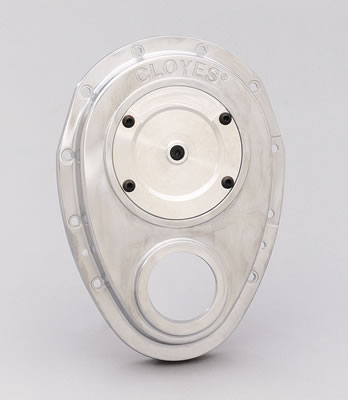
Here is the cover, says for long pumps but I used it with my short pump with a little grinding. Cost about $100
Last edited by Fevre; Mar 6, 2007 at 06:15 PM.

Le Mans Master


Joined: Oct 2001
Posts: 5,943
Likes: 3
From: Wildwood IL
Cloyes makes a nice cover with a built in roller button, makes it easy to set endplay also. Remove the smaller cover from the main cover, install the main cover on the block, push the cam all the way back into the block, put a piece of masking tape on the face of the roller button, put the smaller cover on, butt the roller button up to the cam, tighten down the button, remove the smaller cover, remove the masking tape and replace the smaller cover.
Here is the cover, says for long pumps but I used it with my short pump with a little grinding. Cost about $100
Here is the cover, says for long pumps but I used it with my short pump with a little grinding. Cost about $100

Team Owner


Joined: Apr 1999
Posts: 21,953
Likes: 1,445
From: Reno Nevada
2024 C3 of the Year Finalist- Modified
I used to set the roller cam roller buttons to .004 and screwed around with Cloyes **** poor excuse for a timing cover. I machined the upper top face off for water pump clearance. My blown 427 had a comp cams two piece.
Then my race shop enlightened me No freakin button. Just buy the best billet timing set sold. I happen to use Crane Cams billet. The chain is so tight and stays so tight. That for and aft cam movement is a thing of the past. I think that my 383 is Crane set is nearly 5 years old now and the last time I looked and the inner roller button face it appeared to have never been touched.
Just think about it. Strong chains only center the cam. No, back and forth. Forward motion is subject to braking "G force" It is not an issue on sub one "G" braking. 2-3 "G" braking get a cam button.
For all us mortals get a good chain!
Then my race shop enlightened me
No freakin button. Just buy the best billet timing set sold. I happen to use Crane Cams billet. The chain is so tight and stays so tight. That for and aft cam movement is a thing of the past. I think that my 383 is Crane set is nearly 5 years old now and the last time I looked and the inner roller button face it appeared to have never been touched.Just think about it. Strong chains only center the cam. No, back and forth. Forward motion is subject to braking "G force" It is not an issue on sub one "G" braking. 2-3 "G" braking get a cam button.
For all us mortals get a good chain!

Le Mans Master
Joined: Feb 2006
Posts: 6,048
Likes: 5
From: "cutesy" TN
I used to set the roller cam roller buttons to .004 and screwed around with Cloyes **** poor excuse for a timing cover. I machined the upper top face off for water pump clearance. My blown 427 had a comp cams two piece.
Then my race shop enlightened me No freakin button. Just buy the best billet timing set sold. I happen to use Crane Cams billet. The chain is so tight and stays so tight. That for and aft cam movement is a thing of the past. I think that my 383 is Crane set is nearly 5 years old now and the last time I looked and the inner roller button face it appeared to have never been touched.
Just think about it. Strong chains only center the cam. No, back and forth. Forward motion is subject to braking "G force" It is not an issue on sub one "G" braking. 2-3 "G" braking get a cam button.
For all us mortals get a good chain!
Then my race shop enlightened me
No freakin button. Just buy the best billet timing set sold. I happen to use Crane Cams billet. The chain is so tight and stays so tight. That for and aft cam movement is a thing of the past. I think that my 383 is Crane set is nearly 5 years old now and the last time I looked and the inner roller button face it appeared to have never been touched.Just think about it. Strong chains only center the cam. No, back and forth. Forward motion is subject to braking "G force" It is not an issue on sub one "G" braking. 2-3 "G" braking get a cam button.
For all us mortals get a good chain!
 As long as your block has not been line bored.

Instructor
Joined: Mar 2002
Posts: 204
Likes: 0
From: Bonney Lake WA
The dimple looks like the factory put it there and the money I saved I spent on something more inportant than a cover that does nothing for your performance.
Scott..
Last edited by aqua80; Mar 6, 2007 at 10:46 PM.
Corvette Stories
The Best of Corvette for Corvette Enthusiasts

Top 10 Most Expensive Corvettes Ever Sold on Bring A Trailer
Brett Foote
10 Things Every Corvette Owner Needs (2026 Edition)
Michael S. Palmer
8 Most "Only Corvette Owners Understand" Quirks and Problems
Pouria Savadkouei
10 Reasons the C6 Z06 is Still A Performance Benchmark After 20 Years
Joe Kucinski
How Much Horsepower Every Corvette Engine "LOST" in 1972
Joe Kucinski
Top 10 DOs and DON'Ts for Protecting Your Convertible Top!
Michael S. Palmer
Top 10 Most Explosive Corvettes Ever Made: Power-to-Weight Ratio Ranked!
Joe Kucinski
150 hp to 1,250 hp: Every Corvette Generation Compared by the Specs That Matter
Joe Kucinski
8 Coolest Corvette Pace Cars (and Replicas) of All Time
Verdad Gallardo
Team Owner
Joined: Apr 1999
Posts: 21,953
Likes: 1,445
From: Reno Nevada
2024 C3 of the Year Finalist- Modified
I'm not sure what you are saying. My stock blocks have always had the full sha bang - Blue print and bal.. job. studded mains and heads. I even went all out on a roller cam 355 ci with splayed main caps.
The key is heavy duty roller chains that install so tight that you never have fore and aft movement.
The Crane billet timing sets that I have on both of my motors ............ I just really think that they keep the cam so centered that the cam does not move back and forth. I have the needle roller thrust bearing behind the cam sprocket also. Racers like Norval drill the block to give the chain a constant oiling
my chains have been good every rebuild

Advanced
Joined: May 2006
Posts: 89
Likes: 0
From: Derby Kansas
roller cam - cam button question
. . . The key is heavy duty roller chains that install so tight that you never have fore and aft movement.
The Crane billet timing sets that I have on both of my motors ............ I just really think that they keep the cam so centered that the cam does not move back and forth. I have the needle roller thrust bearing behind the cam sprocket also. Racers like Norval drill the block to give the chain a constant oiling
my chains have been good every rebuild
The Crane billet timing sets that I have on both of my motors ............ I just really think that they keep the cam so centered that the cam does not move back and forth. I have the needle roller thrust bearing behind the cam sprocket also. Racers like Norval drill the block to give the chain a constant oiling
my chains have been good every rebuild
Team Owner
Joined: Apr 1999
Posts: 21,953
Likes: 1,445
From: Reno Nevada
2024 C3 of the Year Finalist- Modified
My 383 which has a billet Crane timing set is actually about 5 years old with prabably around 25,000 miles on the chain. The motor its self has been rebuilt once because of cam and lifter failure
Last edited by gkull; Mar 8, 2007 at 08:46 AM.
Advanced
Joined: May 2006
Posts: 89
Likes: 0
From: Derby Kansas
Jim

Race Director

Joined: May 2005
Posts: 10,674
Likes: 122
From: Millington Illinois
St. Jude Donor '08-'09
I won't disagree with your comment that most people use roller cams for, but I do disagree with "Roller cams can't be used in the same sentence as 100K miles". With tie introduction of Hydraulic Roller cams, Hydraulic Rollers are gaining popularity for street engines, and will be expected to run upwards of 100k. I have ~100k on my 350 flat tappit now, and when I rebuild it next year, I will go with a Hydraulic Roller. Not everyone is building an engine to scream down the 1/4 mile path.
Jim
Jim
Hydraulic roller cams are standard equipment in most new v8's. They are designed to run well over 100,000 miles trouble free. The price of a cam button compared to the cost of installing a retro roller and a performance rebuild I would think this is a no brainer. Use a cam button as the manufacturer recommends. If I was going through 2 or 3 motors a year I would be looking at doing making some changes in my build process or at least installing a rev limiter at a sane rpm setting. If I had to rebuild in less than 25,000 miles because of cam and lifter failure I would look at the cause of that failure and might come to the conclusion that I should have installed a cam button to minimize cam walk. JMHO.
Last edited by 63mako; Mar 8, 2007 at 08:32 AM.
Team Owner
Joined: Apr 1999
Posts: 21,953
Likes: 1,445
From: Reno Nevada
2024 C3 of the Year Finalist- Modified
High end pistons have tiny 1/16th inch rings. They are on the down hill slide long before 20K miles.
On the other hand if you drive your h-roller like a little old lady. You are probably not jumping on the brakes at over 1 "G" either. Also lighter springs for h-roller would make a good billet chain last a long time. Solid big springs and lobes are harder on the chain.
On the other hand if you drive your h-roller like a little old lady. You are probably not jumping on the brakes at over 1 "G" either. Also lighter springs for h-roller would make a good billet chain last a long time. Solid big springs and lobes are harder on the chain.
Team Owner
Joined: Apr 1999
Posts: 21,953
Likes: 1,445
From: Reno Nevada
2024 C3 of the Year Finalist- Modified
If I was going through 2 or 3 motors a year I would be looking at doing making some changes in my build process or at least installing a rev limiter at a sane rpm setting. If I had to rebuild in less than 25,000 miles because of cam and lifter failure I would look at the cause of that failure and might come to the conclusion that I should have installed a cam button to minimize cam walk. JMHO.
Motor number two that same summer was a budget 355 all forged short block with comp cams XE-274 cam. I strapped on my big heads and single plane. i had the tranny figured out by getting an Art Carr 700R4 and a 4.11 year end with a high stall (3800) After a few hundred 1/4 mile runs with slicks that motor was trashed. That is when I decided to start building my own 383 motor at home. Everyone of those companies out there is out to make a buck. That is fine if they would deliver what was promised


Le Mans Master
Joined: Sep 2001
Posts: 7,739
Likes: 630
From: Unreconstructed, South Carolina
Virtually all GM production cars & lite trucks with pushrod motors have hydraulic roller lifters & thin ringpaks.
Consider GM MY96-up iron head vortec 90* 4.3V6 & 5.7V8 ... they have OE hydraulic roller lifters and OE 1.5mm, 1.5mm, 3mm ringpaks ... and they typically run many miles over 100K while maintaining great compression & oil control ... and when torn down show remarkably little lifter-lobe wear & remarkably little bore wear.
Common hi-po ringpak is 1/16, 1/16, 1/8 ... that's about 0.062, 0.062, 0.125.
That OE 1.5mm ~ 0.059", 3mm ~ 0.118" ... same as how many aftermarket hi-po pistons are configured.
There is a real force that drives roller cam both front & back ... the effect of drag produced by oil pump that's transmitted through helical distributor-cam gears ... both ways ... acel & decel ... the tighter the distributor gear endplay is, the more pronounced that effect. Newer LSx motors don't experience similar pump-distributor drag effect ... NO distributor and oil pump driven directly off crank. Retrofit rollers should use both a good set & a button.
Consider GM MY96-up iron head vortec 90* 4.3V6 & 5.7V8 ... they have OE hydraulic roller lifters and OE 1.5mm, 1.5mm, 3mm ringpaks ... and they typically run many miles over 100K while maintaining great compression & oil control ... and when torn down show remarkably little lifter-lobe wear & remarkably little bore wear.
Common hi-po ringpak is 1/16, 1/16, 1/8 ... that's about 0.062, 0.062, 0.125.
That OE 1.5mm ~ 0.059", 3mm ~ 0.118" ... same as how many aftermarket hi-po pistons are configured.
There is a real force that drives roller cam both front & back ... the effect of drag produced by oil pump that's transmitted through helical distributor-cam gears ... both ways ... acel & decel ... the tighter the distributor gear endplay is, the more pronounced that effect. Newer LSx motors don't experience similar pump-distributor drag effect ... NO distributor and oil pump driven directly off crank. Retrofit rollers should use both a good set & a button.
Thread Starter
Melting Slicks
Joined: Mar 2002
Posts: 2,164
Likes: 7
From: Beringen
I didn' want to start a discussion about to or not to use a roller. Fact is that I wanted a motor that could do 7500 to 8000 rpm. This calls for some pretty strong springs and those springs cannot be handled by a flat tappet. So I had to go to the roller type, like it or not. BTW I built what is known as a short stroke, long rodded engine (that is a 400 ci block bored 0.03 over with a 3.250" stroke crank and oliver 6.250 " rods in them, all the rest to match)
Point that I'm asking about the cam button, is that I don't think a rollorized button needs any clearance at all. Normal buttons rub against the the timing chain cover and thus need the space for oiling reasons I would think. The rollorized item doesn't need oiling since the top part stays put and the lower part can roll. That's why someone suggested taking up all the clearance and essentially avoiding any cam walk. Plus, if there would be any kind of heat expansion to consider, the cover itself is more than flexible enough one would think
Any thougths on that ?
Yves
Point that I'm asking about the cam button, is that I don't think a rollorized button needs any clearance at all. Normal buttons rub against the the timing chain cover and thus need the space for oiling reasons I would think. The rollorized item doesn't need oiling since the top part stays put and the lower part can roll. That's why someone suggested taking up all the clearance and essentially avoiding any cam walk. Plus, if there would be any kind of heat expansion to consider, the cover itself is more than flexible enough one would think
Any thougths on that ?
Yves

Le Mans Master
Joined: Apr 2006
Posts: 5,403
Likes: 95
I didn' want to start a discussion about to or not to use a roller. Fact is that I wanted a motor that could do 7500 to 8000 rpm. This calls for some pretty strong springs and those springs cannot be handled by a flat tappet. So I had to go to the roller type, like it or not. BTW I built what is known as a short stroke, long rodded engine (that is a 400 ci block bored 0.03 over with a 3.250" stroke crank and oliver 6.250 " rods in them, all the rest to match)
Point that I'm asking about the cam button, is that I don't think a rollorized button needs any clearance at all. Normal buttons rub against the the timing chain cover and thus need the space for oiling reasons I would think. The rollorized item doesn't need oiling since the top part stays put and the lower part can roll. That's why someone suggested taking up all the clearance and essentially avoiding any cam walk. Plus, if there would be any kind of heat expansion to consider, the cover itself is more than flexible enough one would think
Any thougths on that ?
Yves
Point that I'm asking about the cam button, is that I don't think a rollorized button needs any clearance at all. Normal buttons rub against the the timing chain cover and thus need the space for oiling reasons I would think. The rollorized item doesn't need oiling since the top part stays put and the lower part can roll. That's why someone suggested taking up all the clearance and essentially avoiding any cam walk. Plus, if there would be any kind of heat expansion to consider, the cover itself is more than flexible enough one would think
Any thougths on that ?
Yves
block and a 327 large journal crank with special main bearings standard
5.7 rods and a 1rst design chevy off road cam, thing ran great.
Race Director
Joined: Nov 2000
Posts: 11,872
Likes: 12
From: Waterloo ontario Canada
I take cheap chrome cover and add a few modifications. Where the button hits the cover I use a slug of stainless and weld it to the cover. This spreads the load out and makes this area more rigid. I also add a hole with a plug so with the cover on I can measure the end play using a dial gage.
I also weld double nuts on the bottom of the cover so the bolts comming up through the oil pan never strip these threads.
The cheap replacement covers are actually quit rigid to begin with .

I also weld double nuts on the bottom of the cover so the bolts comming up through the oil pan never strip these threads.
The cheap replacement covers are actually quit rigid to begin with .
Le Mans Master
Joined: Sep 2001
Posts: 7,739
Likes: 630
From: Unreconstructed, South Carolina
I didn' want to start a discussion about to or not to use a roller. Fact is that I wanted a motor that could do 7500 to 8000 rpm. This calls for some pretty strong springs and those springs cannot be handled by a flat tappet. So I had to go to the roller type, like it or not. BTW I built what is known as a short stroke, long rodded engine (that is a 400 ci block bored 0.03 over with a 3.250" stroke crank and oliver 6.250 " rods in them, all the rest to match)Yves