






496/8100

Team Owner

Joined: Aug 2006
Posts: 24,125
Likes: 15
From: Columbia Missouri

Here's a shot I took with a straight edge laid across to the top. The throttle body mounting pad is even higher, measuring 9 1/8". The oil fill pipe could be easily removed, or trimmed.
How much do you know about this block? I'd been assuming it was just a stroked Gen VI 454. Are the heads interchangeable with the classic big block design?
How much do you know about this block? I'd been assuming it was just a stroked Gen VI 454. Are the heads interchangeable with the classic big block design?
Man that thing is huge. I will do some digging this week and see what I can come up with on the block. I have a feeling it's a stroked 454 as well.

Melting Slicks

Joined: Dec 2005
Posts: 2,441
Likes: 0
Here's one flavor, probably (hopefully  ) the most utilitarian of the bunch. Apparently they're used in the marine environment also.
http://www.gm.com/automotive/gmpower...4_8100_ind.pdf
) the most utilitarian of the bunch. Apparently they're used in the marine environment also.http://www.gm.com/automotive/gmpower...4_8100_ind.pdf

Thread Starter
Pro


Joined: Jan 2002
Posts: 695
Likes: 0
From: Ashley Michigan
In that write-up it says they have 18-bolt cylinder heads. I can't remember how many are on the old big blocks. It's been a while since I've tore into one. School tries to keep my mind away from what I enjoy, but this warm weather is driving me crazy without my car.
Team Owner
Joined: Aug 2006
Posts: 24,125
Likes: 15
From: Columbia Missouri
Here's one flavor, probably (hopefully ) the most utilitarian of the bunch. Apparently they're used in the marine environment also.
http://www.gm.com/automotive/gmpower...4_8100_ind.pdf
) the most utilitarian of the bunch. Apparently they're used in the marine environment also.http://www.gm.com/automotive/gmpower...4_8100_ind.pdf
You dig up any more info? I asked around a bit but no one seems to know what interchanges between the 8100 and the 7400, and if the 8100 is just it's stroked big brother.
I may call a few more places today as well.
Here's a pic where the TB is located at the front of the intake. That being the case turning it around might work great for cowl induction.

Thread Starter
Pro
Joined: Jan 2002
Posts: 695
Likes: 0
From: Ashley Michigan
I have been busy studying for a numerical methods test that I have tommorrow, so I haven't looked around yet. I'm not sure what gen BB the 8100 is... Another thing with turning the upper intake around would be whether it has a MAF sensor or if it is run by a MAP sensor. But, Durango has posted a more specific pic of the engine I am looking into.
Team Owner
Joined: Aug 2006
Posts: 24,125
Likes: 15
From: Columbia Missouri
Originally Posted by Automotive Engineering International
GM Powertrain engineers used the Vortec 7400 as a basis for creating the Vortec 8100 and focused on only those improvements that the company believed would provide real customer benefits. As an example, while the Vortec 7400's same general envelope size was maintained, engineers were still able to increase power and performance. The larger displacement comes from the longer stroke of 11 cm (4.37 in) used in the 8.1-L. The same bore size was maintained. A 50% increase in ignition energy, a reduction of emissions, and an improved idle quality are advantages obtained from the coil-near-plug ignition system.
I just found this information. Seems it's just the stroke.
Also, I read the ZZ502 cam slides right in for improved performance.
Last edited by Durango_Boy; May 9, 2007 at 10:58 PM.

Le Mans Master


Joined: Apr 2007
Posts: 7,353
Likes: 72
From: Graceland in a Not Correctly Restored Stingray
Does anyone know if the 8100 has the 10.200" tall deck? If so, could pose additional issues.
Also, you might want to look through the red tape the factories apparently lobbied the government to adopt before "converting" to E85. What a PITA. And, too few outlets. Bummer, too, what with the high octane. Maybe SEMA could help us with that one...
Also, you might want to look through the red tape the factories apparently lobbied the government to adopt before "converting" to E85. What a PITA. And, too few outlets. Bummer, too, what with the high octane. Maybe SEMA could help us with that one...
Corvette Stories
The Best of Corvette for Corvette Enthusiasts

Top 10 Most Explosive Corvettes Ever Made: Power-to-Weight Ratio Ranked!
Joe Kucinski
150 hp to 1,250 hp: Every Corvette Generation Compared by the Specs That Matter
Joe Kucinski
8 Coolest Corvette Pace Cars (and Replicas) of All Time
Verdad Gallardo
Top 10 Corvette Engines RANKED by Peak Torque (70+ Years of Muscle!)
Joe Kucinski
Corvette ZR1X Will Be Pacing the Indy 500, And Could Probably Race, Too!
Verdad Gallardo
Top 10 Corvettes Coming to Mecum Indy 2026!
Brett Foote
Top 10 C9 Corvette MUST-HAVES to Fix These C8 Generation Flaws!
Michael S. Palmer
10 Revolutionary 'Corvette Firsts' Most People Don't Know
Joe Kucinski
5 Reasons to Upgrade to an LS6-Powered Corvette; 5 Reasons to Stay LT2
Michael S. Palmer
Team Owner
Joined: Aug 2006
Posts: 24,125
Likes: 15
From: Columbia Missouri
I've been looking through everything I can find on the 8100. Seems it's what they call a 'heavily' modified 7400. The packaging is supposed to be the same so I would assume the deck height is the same as the 7400.
There were several versions. There is a lower HP 8100, under 300, which makes it pointless next to the 7400. There is also a higher HP 8100, closer to 500. That'd be the one to find. I'm still trying to figure out how to tell the difference.
There were several versions. There is a lower HP 8100, under 300, which makes it pointless next to the 7400. There is also a higher HP 8100, closer to 500. That'd be the one to find. I'm still trying to figure out how to tell the difference.


Drifting


Joined: Aug 2004
Posts: 1,883
Likes: 124
From: Lubbock TX
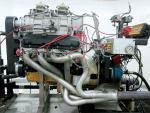
The intake you have pics of is NOT from an 8100 - that's off of a Vortec L-29, 7.4L 454. I have one just like it bare and one on a 454 in my '97 1-ton. The 8100 uses something completely different and is a completely different animal.
http://www.trailerlife.com/test/0010v8_drivetrain.cfm
It uses coil packs rather than a distributor. The tranny flange bolt pattern is the same as well as the engine mount bolts and exhaust manifold, but from there everything is different. Even though bore center is the same as 454/502's, the crank, rods, pistons, heads, yada yada are all different, it was a complete redesign including taller deck. Firing order is 18726543 versus 18436572 like other GM's. All the intake ports are identical in size and shape and every cylinder has 6 head bolts around it. Too bad they won't bolt up to a 502 block, that would rock! Word is that they're being discontinued and not available in the 2008 lineup for trucks but should still be available in boats and in crate form. Very few performance parts are made for 'em. Apparently they were hell on water, moved boats like nobody's business.
http://www.trailerlife.com/test/0010v8_drivetrain.cfm
It uses coil packs rather than a distributor. The tranny flange bolt pattern is the same as well as the engine mount bolts and exhaust manifold, but from there everything is different. Even though bore center is the same as 454/502's, the crank, rods, pistons, heads, yada yada are all different, it was a complete redesign including taller deck. Firing order is 18726543 versus 18436572 like other GM's. All the intake ports are identical in size and shape and every cylinder has 6 head bolts around it. Too bad they won't bolt up to a 502 block, that would rock! Word is that they're being discontinued and not available in the 2008 lineup for trucks but should still be available in boats and in crate form. Very few performance parts are made for 'em. Apparently they were hell on water, moved boats like nobody's business.
Last edited by L88Plus; May 10, 2007 at 08:09 AM.

Thread Starter
Pro
Joined: Jan 2002
Posts: 695
Likes: 0
From: Ashley Michigan
well, I was wrong- they are a tall deck
Gen 7: A very major revision of the previous engines resulted in the 8.1 liter/ 8100/ 496 cubic inch Gen 7 in 2001. The block gained .400 in deck height so it is the same height as the previous "Tall Deck" truck blocks, wider oil pan rails, and the cylinder heads have symmetrical port layouts instead of the previous 4 long/4 short port layout. Very little interchanges between the 8.1 liter engine and the previous Mark IV/Gen 5/Gen 6 engines. The head bolt pattern and even the firing order of the cylinders has been changed. There are some things that remained true to the previous Mk IV/Gen 5/Gen 6--the bellhousing bolt pattern, the side motor mount bolt pattern, the flywheel bolt pattern, and the exhaust manifold bolt pattern are the same. Note that the bolt holes are threaded for metric fasteners. The 8.1 is internally balanced, so you could install a flywheel/flexplate from a 396/427 Mk IV provided you use the correct bolts to suit the 8.1 crankshaft.
big block review
Gen 7: A very major revision of the previous engines resulted in the 8.1 liter/ 8100/ 496 cubic inch Gen 7 in 2001. The block gained .400 in deck height so it is the same height as the previous "Tall Deck" truck blocks, wider oil pan rails, and the cylinder heads have symmetrical port layouts instead of the previous 4 long/4 short port layout. Very little interchanges between the 8.1 liter engine and the previous Mark IV/Gen 5/Gen 6 engines. The head bolt pattern and even the firing order of the cylinders has been changed. There are some things that remained true to the previous Mk IV/Gen 5/Gen 6--the bellhousing bolt pattern, the side motor mount bolt pattern, the flywheel bolt pattern, and the exhaust manifold bolt pattern are the same. Note that the bolt holes are threaded for metric fasteners. The 8.1 is internally balanced, so you could install a flywheel/flexplate from a 396/427 Mk IV provided you use the correct bolts to suit the 8.1 crankshaft.
big block review

Melting Slicks

Joined: Sep 2004
Posts: 2,655
Likes: 19
There are pics on Mercruisers website. And the GM vortec marine motor looks exactly like the truck motor.
These engines are generally thought of as low torque (long stroke) truck motors. Merc uses them for the "family" boats.
For the high performance motors, even Merc still uses the Gen VI 502 based motors.
I have a feeling they're not exactly designed for high performance in a car.
These engines are generally thought of as low torque (long stroke) truck motors. Merc uses them for the "family" boats.
For the high performance motors, even Merc still uses the Gen VI 502 based motors.
I have a feeling they're not exactly designed for high performance in a car.
Team Owner
Joined: Aug 2006
Posts: 24,125
Likes: 15
From: Columbia Missouri
There are pics on Mercruisers website. And the GM vortec marine motor looks exactly like the truck motor.
These engines are generally thought of as low torque (long stroke) truck motors. Merc uses them for the "family" boats.
For the high performance motors, even Merc still uses the Gen VI 502 based motors.
I have a feeling they're not exactly designed for high performance in a car.
These engines are generally thought of as low torque (long stroke) truck motors. Merc uses them for the "family" boats.
For the high performance motors, even Merc still uses the Gen VI 502 based motors.
I have a feeling they're not exactly designed for high performance in a car.
With that in mind they would work well for low RPM cruisers and highway cars. That's usually how I build my cars and the 8100 fits right into that equation.