




nervous steering

Burning Brakes


Joined: Jan 2006
Posts: 957
Likes: 6
From: Burlington wisconsin

Save yourself the time and money, contact Gary as he offered & go from there. You'll be glad you did. Otherwise it's a guessing game and you'll end up replaceing everything!! as a process of elimination. Gary knows the questions to ask and the at home tests you can do to verify & drill down. IMO
Jimbo
Jimbo

Thread Starter
Pro


Joined: Apr 2006
Posts: 647
Likes: 22
From: Norwalk CT and Boynton Beach FL
I did not replace the steering box or the rag joint. I did put 4 new tires in the car had had a front wheel alignment and the rear camber done. The rear tow (shims) was not done and the shop said I had way too much toe-in.
How do you check the rag joint and the steering box. the rag joint visually looks fine. What's invloved in replacing it? Seems to me there should be some adjustments on the steering box to tighten up the little extra side to side play that I seem to have.
How difficult is it to replace the steering box?
How difficult is it to replace to rag joint.
My mechanic says everything is tight in the front end and there should not be a problem. I told him that if you drive the car under 60 mph you won't notice anything, but if you're on the highway doing 75 or 80 I have to move the steering wheel back and forth way too much.
What next?
How do you check the rag joint and the steering box. the rag joint visually looks fine. What's invloved in replacing it? Seems to me there should be some adjustments on the steering box to tighten up the little extra side to side play that I seem to have.
How difficult is it to replace the steering box?
How difficult is it to replace to rag joint.
My mechanic says everything is tight in the front end and there should not be a problem. I told him that if you drive the car under 60 mph you won't notice anything, but if you're on the highway doing 75 or 80 I have to move the steering wheel back and forth way too much.
What next?

Le Mans Master


Joined: Jul 2000
Posts: 6,001
Likes: 113
From: Saginaw Michigan
First inspect the flexible coupling (aka rag joint). Look for tears or cuts in the rubber disc. Look for noticeable wear on the stop pins.
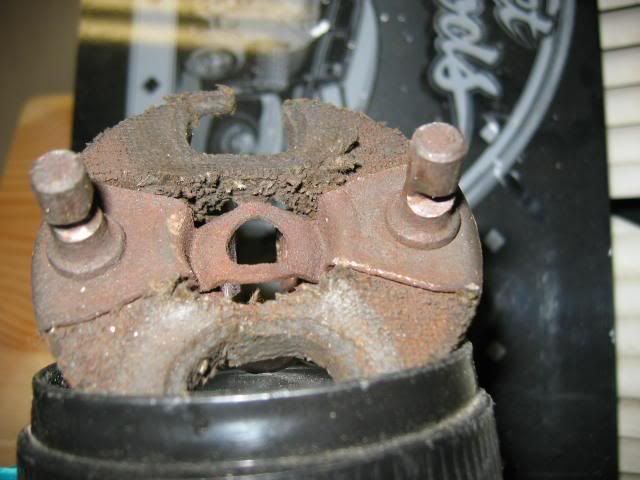
This is an extreme case. But notice the wear on the stop pins. This type of wear can only occur if your steering column is not correctly aligned to your steering gear. This misalignment also cause the rubber disc to fracture and tear apart.
If your flexible coupling appear to be in good condition - or you replaced it. Now it is time to take a look at your steering gear. There are two adjustments that can be made to a Corvette manual gear. The really correct way to adjust the gear is to remove it from the car and adjust it on a bench using an inch-lb torque wrench.
There is a screw with a lock nut sticking up through the aluminum cover on the gear. There should be about three threads sticking up through the lock nut. If the screw is buried down into the nut, someone has adjusted the gear in the past and there is no more adjustment possible. The gear should be rebuilt.
It is possible to make a fairly good ballpark adjustment of the gear by making small adjustments and driving the car to assess the results. Here is a paper that I have authored on the subject.
http://jimshea.corvettefaq.com/wp-co...-Rev25JA06.doc
Jim
This is an extreme case. But notice the wear on the stop pins. This type of wear can only occur if your steering column is not correctly aligned to your steering gear. This misalignment also cause the rubber disc to fracture and tear apart.
If your flexible coupling appear to be in good condition - or you replaced it. Now it is time to take a look at your steering gear. There are two adjustments that can be made to a Corvette manual gear. The really correct way to adjust the gear is to remove it from the car and adjust it on a bench using an inch-lb torque wrench.
There is a screw with a lock nut sticking up through the aluminum cover on the gear. There should be about three threads sticking up through the lock nut. If the screw is buried down into the nut, someone has adjusted the gear in the past and there is no more adjustment possible. The gear should be rebuilt.
It is possible to make a fairly good ballpark adjustment of the gear by making small adjustments and driving the car to assess the results. Here is a paper that I have authored on the subject.
http://jimshea.corvettefaq.com/wp-co...-Rev25JA06.doc
Jim

Team Owner


Joined: Oct 2004
Posts: 23,831
Likes: 10
From: Springfield MO
St. Jude Donor '07
Jim, if the disc disintegrates, you can get wear like that on the stop pins even if everything is aligned - the column flange will just keep turning until it hits the pins...ask me how I know. 
Le Mans Master
Joined: Jul 2000
Posts: 6,001
Likes: 113
From: Saginaw Michigan
We used to conduct wear tests on flexible couplings with the column and gear shafts at a 5 degree angle using manual steering loads. The wear test was if you were stopped with your foot on the brake and making about 20,000 lock to lock turns. We would eventually wear the rubber disc out. But we would never grind through the pins. You would see polish on the pins but not wear. With the gear and column shafts in alignment (even at a 5 degree angle), all you are doing is pushing the column flange directly against the stop pin. When the two shafts are not aligned, there is a metal to metal sawing action between the column flange and the pin.
The only way we could cause wear on the pins (and actually saw our way almost completely through the pin) was if we offset the gear shaft and the column shaft. This is why the Corvette AIM has a very specific alignment procedure for installing the steering column.
From my experience, I think that you had a misalignment situation as well as a rubber disc problem.
Jim
The only way we could cause wear on the pins (and actually saw our way almost completely through the pin) was if we offset the gear shaft and the column shaft. This is why the Corvette AIM has a very specific alignment procedure for installing the steering column.
From my experience, I think that you had a misalignment situation as well as a rubber disc problem.
Jim

Team Owner


Joined: Jul 1999
Posts: 65,492
Likes: 230
From: Orange Park Florida
I dunno Jim, when I drove my car with '92 vette rims/tires on it up north in good olde Maryland clay roads/freeways....it drove ok, didn't have to fight the wheel any worse than any other recirc ball setup...seemed ok, just too many turns to the wheel...3.7 turns lock to lock....pushing 4 turns...
down here in Florida ten years ago though with lovely Florida sand as a roadbed foundation, the ruts are stupid allready and that car picked it up pretty fast...all the time fighting the wheel at speed....
check it out till I was really sick of it....and finally installed a rack....
that was in '01, the rest is history....My opinion is the slop inherent in the location of the stock controll valve is the cause....I have nothing else to think, I went crazy wondering WTF else it could have been, and came up with nothing....
down here in Florida ten years ago though with lovely Florida sand as a roadbed foundation, the ruts are stupid allready and that car picked it up pretty fast...all the time fighting the wheel at speed....
check it out till I was really sick of it....and finally installed a rack....
that was in '01, the rest is history....My opinion is the slop inherent in the location of the stock controll valve is the cause....I have nothing else to think, I went crazy wondering WTF else it could have been, and came up with nothing....

Advanced

Joined: Jan 2007
Posts: 96
Likes: 0
From: Sandnes Norway
First inspect the flexible coupling (aka rag joint). Look for tears or cuts in the rubber disc. Look for noticeable wear on the stop pins.
This is an extreme case. But notice the wear on the stop pins. This type of wear can only occur if your steering column is not correctly aligned to your steering gear. This misalignment also cause the rubber disc to fracture and tear apart.
If your flexible coupling appear to be in good condition - or you replaced it. Now it is time to take a look at your steering gear. There are two adjustments that can be made to a Corvette manual gear. The really correct way to adjust the gear is to remove it from the car and adjust it on a bench using an inch-lb torque wrench.
There is a screw with a lock nut sticking up through the aluminum cover on the gear. There should be about three threads sticking up through the lock nut. If the screw is buried down into the nut, someone has adjusted the gear in the past and there is no more adjustment possible. The gear should be rebuilt.
http://jimshea.corvettefaq.com/wp-co...-Rev25JA06.doc
Jim
This is an extreme case. But notice the wear on the stop pins. This type of wear can only occur if your steering column is not correctly aligned to your steering gear. This misalignment also cause the rubber disc to fracture and tear apart.
If your flexible coupling appear to be in good condition - or you replaced it. Now it is time to take a look at your steering gear. There are two adjustments that can be made to a Corvette manual gear. The really correct way to adjust the gear is to remove it from the car and adjust it on a bench using an inch-lb torque wrench.
There is a screw with a lock nut sticking up through the aluminum cover on the gear. There should be about three threads sticking up through the lock nut. If the screw is buried down into the nut, someone has adjusted the gear in the past and there is no more adjustment possible. The gear should be rebuilt.
It is possible to make a fairly good ballpark adjustment of the gear by making small adjustments and driving the car to assess the results. Here is a paper that I have authored on the subject.
Jim
Bad thing for me is that your posting come 2 days after I made an adjustment to my steeringbox. I have read your paper and I see that I should not have done what I did.
I'd loosened the nut and started screwing the lash adjuster screw down with the wheels sentered and lifted from the ground. I turned the bolt down slowly while rotating the shaft back and forth and I went one and a half turn before the steering wheel felt good. At this point I started to worry about that I maybe tightened too much and therefor I took it a half turn back just to make sure I do not overtightened the thing.
Now when turning the wheels when of the ground I find that there is no lash when wheels are sentered but when they are at almost full turn to the sides they show some looseness, about half inch or so on the steering wheel . What is normal lash here?
Also when I drive on the highway I can feel no freeplay at all so I'm worrying about I maybe have overtightened it.
When I started out the free play on the steering wheel was about one inch when the wheels was sentered in the straight forward position.
Also the the lash adjuster screw had several treads exposed like you describe in your paper so it's possibly never been adjusted before.
So I may ask you what you think of my work on the steering box. Am I in a dangerous position ? Maybe should not drive the car like it is now?
Any help appreciated
Thanks
Clue
Corvette Stories
The Best of Corvette for Corvette Enthusiasts

Top 10 Most Expensive Corvettes Ever Sold on Bring A Trailer
Brett Foote
10 Things Every Corvette Owner Needs (2026 Edition)
Michael S. Palmer
8 Most "Only Corvette Owners Understand" Quirks and Problems
Pouria Savadkouei
10 Reasons the C6 Z06 is Still A Performance Benchmark After 20 Years
Joe Kucinski
How Much Horsepower Every Corvette Engine "LOST" in 1972
Joe Kucinski
Top 10 DOs and DON'Ts for Protecting Your Convertible Top!
Michael S. Palmer
Top 10 Most Explosive Corvettes Ever Made: Power-to-Weight Ratio Ranked!
Joe Kucinski
150 hp to 1,250 hp: Every Corvette Generation Compared by the Specs That Matter
Joe Kucinski
8 Coolest Corvette Pace Cars (and Replicas) of All Time
Verdad Gallardo
Team Owner
Joined: Oct 2004
Posts: 23,831
Likes: 10
From: Springfield MO
St. Jude Donor '07
Jim, the wear certainly wasn't severe like the coupler you posted...it was more of a "cupped" look...sort of a severe polish. I think the lower bearing was bad at that time, too, which could have caused some misalignment. Before I got the car from my dad, a local shop rebuild the steering column, but didn't replace the very worn-out coupling. The rebuild helped the steering some, but rebuilding the coupler tightened it up perfectly.
Le Mans Master
Joined: Jul 2000
Posts: 6,001
Likes: 113
From: Saginaw Michigan
MRVette,
Yes, it is the location of the control valve that causes the feel of looseness with a valve and adapter type power assist. Systems with the valve on the input side of the gear have a much better feel. It is amazing to me that the Chevrolet engineers felt that the valve and adapter steering felt "better" than a typical Saginaw power gear with a rotary valve. I think that the high investment to modify the C3 frame to accept the Saginaw integral power gear is the biggest reason why they didn't change. (Plus they knew that they were going to rack and pinion with the C4.)
Clue,
It is most important that the pitman shaft be adjusted with the gear on center. There is clearance between the pitman teeth and the rack when the gear is off center. For an exact adjustment, the gear should be removed from the car and adjusted with a inch-lb torque wrench.
Jim
Yes, it is the location of the control valve that causes the feel of looseness with a valve and adapter type power assist. Systems with the valve on the input side of the gear have a much better feel. It is amazing to me that the Chevrolet engineers felt that the valve and adapter steering felt "better" than a typical Saginaw power gear with a rotary valve. I think that the high investment to modify the C3 frame to accept the Saginaw integral power gear is the biggest reason why they didn't change. (Plus they knew that they were going to rack and pinion with the C4.)
Clue,
It is most important that the pitman shaft be adjusted with the gear on center. There is clearance between the pitman teeth and the rack when the gear is off center. For an exact adjustment, the gear should be removed from the car and adjusted with a inch-lb torque wrench.
Jim



Thread Starter
Pro
Joined: Apr 2006
Posts: 647
Likes: 22
From: Norwalk CT and Boynton Beach FL
Checked my rag joint over the weekend --- looks fine. Ive owned this car since 1983 and this car has been babyed. I don't think this car has seen rain in the past 15 years and always been garaged. The rag joint's stop posts are centered and no evidence of any movement or any wear on either side of the stop posts. I do notice that when I turn the wheel there is a little compression in the rubber/fabric material in the rag joint --- but my guess is that there is supposed to be some, otherwise there would be just be a metal universal joint there instead of that mickey mouse rag joint.
Next step is to fool with the steering box but i'm almost at the point where I'm going to except the somewhat loose steering as is. I'm also going to try reducing the air pressure in the front tires to put a little more tire in the road --- pressure currently at 30 lbs --- that may help[. Perhaps I've gotten to use to my everyday driver which is a BMW and all that modern technology. Thanks to all for your very helpful and knowledgable input.
Now on the the next issue --- that klunk i get from the rear when I take off from a dead stop. With these cars, it's always something!!!
Next step is to fool with the steering box but i'm almost at the point where I'm going to except the somewhat loose steering as is. I'm also going to try reducing the air pressure in the front tires to put a little more tire in the road --- pressure currently at 30 lbs --- that may help[. Perhaps I've gotten to use to my everyday driver which is a BMW and all that modern technology. Thanks to all for your very helpful and knowledgable input.
Now on the the next issue --- that klunk i get from the rear when I take off from a dead stop. With these cars, it's always something!!!

Burning Brakes
Joined: Jun 2000
Posts: 892
Likes: 0
From: GA
The steering should be pretty tight. I have not known the C3 to be sloppy, at least in my car.
That clunk could be a number of issues... u joint, trailling arm bushing, spindles... shock mounts...
In keeping with thread subject... I added power steering and to make long story short... my steering wheel is 90 degrees out when wheels are centered. Everything seem to be aligned. Although my coupler is not OEM... it is aftermarket bolt together. The steering arm is dead center on steering box but the steering shaft seems to mount 90 degrees off... I am a little stumped. Could it be the steering arm is not centered on steering box? That is the only thing I can think of....
That clunk could be a number of issues... u joint, trailling arm bushing, spindles... shock mounts...
In keeping with thread subject... I added power steering and to make long story short... my steering wheel is 90 degrees out when wheels are centered. Everything seem to be aligned. Although my coupler is not OEM... it is aftermarket bolt together. The steering arm is dead center on steering box but the steering shaft seems to mount 90 degrees off... I am a little stumped. Could it be the steering arm is not centered on steering box? That is the only thing I can think of....
Le Mans Master
Joined: Jul 2000
Posts: 6,001
Likes: 113
From: Saginaw Michigan
Does the flange on the flexible coupling have a flat?
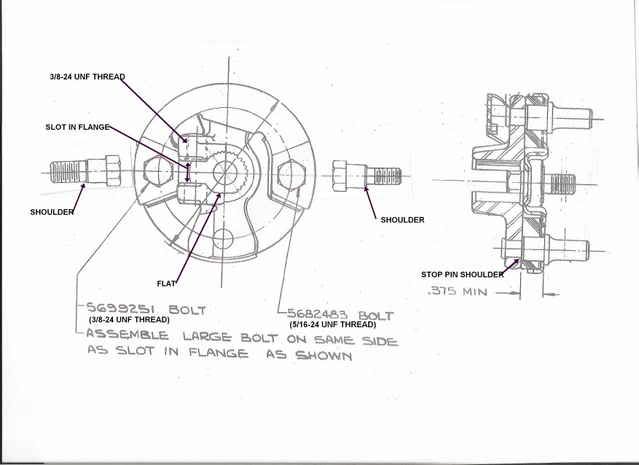
If the flange on the flexible coupling has a flat, then the input shaft on the gear must also have a flat. The flat on the gear input shaft must be at 12 o'clock when your gear is on center and your road wheels are pointing straight ahead.
My apologies with respect to the drawing. The drawing is correct but it is taken from a perspective of down being 12 o'clock. Left side of the flex coupling (big 3/8 bolt) is OK at 9 o'clock. Right side of the flex coupling (smaller 5/16 bolt) is OK at 3 o'clock.
When you look at the steering gear from the position of the driver, with the flexible coupling installed here is what you should see:
1). The stop pins on the flexible coupling must be at 6 and 12 o'clock respectively.
2). The large 3/8 bolts should be pointing at you from the 9 o'clock position.
3). The smaller 5/16 bolt should be at 3 o'clock.
4). The bolt that attaches the flex coupling flange to the gear should have the 12 point head pointing straight up. The bolt passing through the 9 o'clock position.
Let us know what you determine with respect to flats and topics 1 thru 4.
Jim
If the flange on the flexible coupling has a flat, then the input shaft on the gear must also have a flat. The flat on the gear input shaft must be at 12 o'clock when your gear is on center and your road wheels are pointing straight ahead.
My apologies with respect to the drawing. The drawing is correct but it is taken from a perspective of down being 12 o'clock. Left side of the flex coupling (big 3/8 bolt) is OK at 9 o'clock. Right side of the flex coupling (smaller 5/16 bolt) is OK at 3 o'clock.
When you look at the steering gear from the position of the driver, with the flexible coupling installed here is what you should see:
1). The stop pins on the flexible coupling must be at 6 and 12 o'clock respectively.
2). The large 3/8 bolts should be pointing at you from the 9 o'clock position.
3). The smaller 5/16 bolt should be at 3 o'clock.
4). The bolt that attaches the flex coupling flange to the gear should have the 12 point head pointing straight up. The bolt passing through the 9 o'clock position.
Let us know what you determine with respect to flats and topics 1 thru 4.
Jim
Last edited by Jim Shea; Jun 18, 2007 at 01:50 PM.
Burning Brakes
Joined: Jun 2000
Posts: 892
Likes: 0
From: GA
Does the flange on the flexible coupling have a flat?
If the flange on the flexible coupling has a flat, then the input shaft on the gear must also have a flat. The flat on the gear input shaft must be at 12 o'clock when your gear is on center and your road wheels are pointing straight ahead.
My apologies with respect to the drawing. The drawing is correct but it is taken from a perspective of down being 12 o'clock. Left side of the flex coupling (big 3/8 bolt) is OK at 9 o'clock. Right side of the flex coupling (smaller 5/16 bolt) is OK at 3 o'clock.
When you look at the steering gear from the position of the driver, with the flexible coupling installed here is what you should see:
1). The stop pins on the flexible coupling must be at 6 and 12 o'clock respectively.
2). The large 3/8 bolts should be pointing at you from the 9 o'clock position.
3). The smaller 5/16 bolt should be at 3 o'clock.
4). The bolt that attaches the flex coupling flange to the gear should have the 12 point head pointing straight up. The bolt passing through the 9 o'clock position.
Let us know what you determine with respect to flats and topics 1 thru 4.
Jim
If the flange on the flexible coupling has a flat, then the input shaft on the gear must also have a flat. The flat on the gear input shaft must be at 12 o'clock when your gear is on center and your road wheels are pointing straight ahead.
My apologies with respect to the drawing. The drawing is correct but it is taken from a perspective of down being 12 o'clock. Left side of the flex coupling (big 3/8 bolt) is OK at 9 o'clock. Right side of the flex coupling (smaller 5/16 bolt) is OK at 3 o'clock.
When you look at the steering gear from the position of the driver, with the flexible coupling installed here is what you should see:
1). The stop pins on the flexible coupling must be at 6 and 12 o'clock respectively.
2). The large 3/8 bolts should be pointing at you from the 9 o'clock position.
3). The smaller 5/16 bolt should be at 3 o'clock.
4). The bolt that attaches the flex coupling flange to the gear should have the 12 point head pointing straight up. The bolt passing through the 9 o'clock position.
Let us know what you determine with respect to flats and topics 1 thru 4.
Jim
Last edited by Mr.Gearhead; Jun 18, 2007 at 04:18 PM.
Burning Brakes
Joined: Jun 2000
Posts: 892
Likes: 0
From: GA
Okay. Just finished inspection coupler area.
If I turn the steering wheel to center, the coupler stop pins are 12 and 6 o'clock. The steering box flange bolt is veritcal on driver side and I am looking at the top of the 12pt bolt head.
NOW... the wheels are not so good... they are both pointing left...
Sooo... I am guessing the steering arm is not on center as I thought. I could swear I put that thing on when I rotated the steering gear and felt the high spot. Isn't the high spot the center on the steering box? I thought it was that way to aid in steering staight or keeping on center? Or is this a myth my mind made up in my Corvette Nightmares...?????
THis will be the third time I am playing with the power steering. First install, second install due to leaking valve when NEW... and it would seem a third because I can't install pwr steering right the first time...
If I turn the steering wheel to center, the coupler stop pins are 12 and 6 o'clock. The steering box flange bolt is veritcal on driver side and I am looking at the top of the 12pt bolt head.
NOW... the wheels are not so good... they are both pointing left...
Sooo... I am guessing the steering arm is not on center as I thought. I could swear I put that thing on when I rotated the steering gear and felt the high spot. Isn't the high spot the center on the steering box? I thought it was that way to aid in steering staight or keeping on center? Or is this a myth my mind made up in my Corvette Nightmares...?????
THis will be the third time I am playing with the power steering. First install, second install due to leaking valve when NEW... and it would seem a third because I can't install pwr steering right the first time...
Thread Starter
Pro
Joined: Apr 2006
Posts: 647
Likes: 22
From: Norwalk CT and Boynton Beach FL
I'm still troubled by the way my car handles when driving over 65 mph --- especially with all new suspension
I pulled out the computer printout of the wheel alignment I had done two weeks ago. Here are the final numbers in degrees. See attached file at very bottom for picture of computer printout of alignment
Front Left ; Front Right
Camber 0.6 ; 0.8
Caster 2.6 ; 2.3
Toe 0.16 ; 0.17
SAI 6.6 ; 6.2
included ang 7.2; 7.0
Rear Left ; Rear Right
Camber -0.1 ; -0.1
tow 0.44; 0.54
I have all new front and rear suspension and new tires 225/70TR15 Yokohama AVID S/T. I did not have them do the rear tow because it is a bear of a job and I didn't have confidence they would do it right or even worse, cause damage back there
Shouldn't the camber on the front wheels be a little negative (not positive they set it) and wouldn't a greater toe on the front wheels cause the car to drive/steer in a more stable fashion --- say a toe of 0.25 on each wheel?
HELP --- very frustrated at this point. Unsatisfactory handling afte spending a lot of money and time.
I pulled out the computer printout of the wheel alignment I had done two weeks ago. Here are the final numbers in degrees. See attached file at very bottom for picture of computer printout of alignment
Front Left ; Front Right
Camber 0.6 ; 0.8
Caster 2.6 ; 2.3
Toe 0.16 ; 0.17
SAI 6.6 ; 6.2
included ang 7.2; 7.0
Rear Left ; Rear Right
Camber -0.1 ; -0.1
tow 0.44; 0.54
I have all new front and rear suspension and new tires 225/70TR15 Yokohama AVID S/T. I did not have them do the rear tow because it is a bear of a job and I didn't have confidence they would do it right or even worse, cause damage back there
Shouldn't the camber on the front wheels be a little negative (not positive they set it) and wouldn't a greater toe on the front wheels cause the car to drive/steer in a more stable fashion --- say a toe of 0.25 on each wheel?
HELP --- very frustrated at this point. Unsatisfactory handling afte spending a lot of money and time.
Last edited by happiedazs; Jul 18, 2008 at 10:05 AM.
