







Tach Filter ?

Thread Starter
Intermediate

Joined: Apr 2007
Posts: 36
Likes: 0
 Tach Filter ?
Have read several posts about the tach filter and it being normal for the needle not to always go back to zero. My question is: What is the tach filter for ???? Noticed also that several posts have recommended bypassing the filter. Maybe help to dampen eratic movement ?
Bob
Bob

Drifting


Joined: May 2005
Posts: 1,629
Likes: 4
From: Somers CT
The tach filter is a capacitance circuit used to filter out electrical spikes from the ignition so the tach will not react to the spikes and give erratic movement. It will still work without it but you might see some crazy readings that aren't true numbers.
The tach will not return to zero by design without the ignition on, mine does the same thing.
Bill
The tach will not return to zero by design without the ignition on, mine does the same thing.
Bill
Last edited by TopGunn; Aug 31, 2007 at 06:18 PM.

Advanced

Joined: Aug 2007
Posts: 63
Likes: 2
From: Tucson, AZ
Drifting
Joined: May 2005
Posts: 1,629
Likes: 4
From: Somers CT
That doesn't sound right, so if you don't use it you ruin the tach board right away by not having it in line?? Can't figure that one out, but who knows. Capacitors are commonly used in sensitive electronics to remove voltage spikes.

Race Director

Joined: May 2006
Posts: 16,528
Likes: 53
From: Dayton, Ohio
 I will be talking to him again next week and I'll see if he'll give me more details.
Drifting
Joined: Sep 2006
Posts: 1,986
Likes: 21
From: Columbus MN
I added a new tach filter to my GM 350 HO Deluxe crate engine because the I thought it was necessary for the tach to work right. I never ran the car without one. Should I try it? Or does the tach filter actually protect the tach and make it work right?

Corvette Stories
The Best of Corvette for Corvette Enthusiasts

Top 10 Most Expensive Corvettes Ever Sold on Bring A Trailer
Brett Foote
10 Things Every Corvette Owner Needs (2026 Edition)
Michael S. Palmer
8 Most "Only Corvette Owners Understand" Quirks and Problems
Pouria Savadkouei
10 Reasons the C6 Z06 is Still A Performance Benchmark After 20 Years
Joe Kucinski
How Much Horsepower Every Corvette Engine "LOST" in 1972
Joe Kucinski
Top 10 DOs and DON'Ts for Protecting Your Convertible Top!
Michael S. Palmer
Top 10 Most Explosive Corvettes Ever Made: Power-to-Weight Ratio Ranked!
Joe Kucinski
150 hp to 1,250 hp: Every Corvette Generation Compared by the Specs That Matter
Joe Kucinski
8 Coolest Corvette Pace Cars (and Replicas) of All Time
Verdad Gallardo
Safety Car

Joined: Jun 2005
Posts: 3,841
Likes: 0
From: Inver Grove Minnesota
I haven't run with a filter since I took it out cause my tach didn't work. But my msd ignition does not say I need one so I don't really have plans of putting one in. Gauge doesn't go crazy either.
Le Mans Master


Joined: Jan 2007
Posts: 7,993
Likes: 3,334
From: Omaha NE
2025 c3 ('74-'82) of the Year Finalist - Unmodified
2023 C3 of the Year Finalist - Unmodified
2022 C3 of the Year Finalist - Unmodified
2020 C3 of the Year Finalist - Unmodified
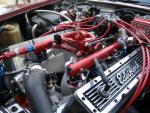
It mounts to the intake, behind the carb & a little to the left. They came from the factory with a bracket wraped around it that is held down by a bolt........
Burning Brakes

Joined: Aug 2005
Posts: 1,126
Likes: 0
From: Hudson Falls, N.Y. 76 Vette Modified L-48

Also, why DOES the tach needle stay at the last RPM reading when the key is turned off? My first thought was an energized circuit holding the needle, but wouldn't the energy eventually disipate?

Tech Contributor


Joined: Jun 2004
Posts: 20,905
Likes: 962
From: I tend to be leery of any guy who doesn't own a chainsaw or a handgun.
Guys,
The following are just my thoughts, as I don't have the schematics of the tachs and filters.
I would be inclined to continue using the filter. Rarely (okay, never) does GM go through the expense to build a part and then pay a lineworker to install it, if there wasn't a reason for it.
There's also a couple of technical reasons for a filter.
1) Isolation. The voltage at the (C-) tach line varies from zero volts to 200-400 volts during the ignition cycle. The tach circuit ideally should only need about 5-20 volts (pulses) to operate correctly. However, the C- voltage must not be loaded down, as this will affect the plug voltage/energy availability due to transformer action between the primary and secondary windings of the coil. Essentially, if you screw up the C- line, you can also screw up the high voltage (plug) line.
2) Filtering. There are multiple voltage spikes (ringing) on the tach line during the plug spark phase. Most tachs need just one spike per plug fire to read out accurately. A filter will help eliminate these multiple spikes entering the tach circuit. (Ideally, the tach should be designed to not need an external filter for ripple or voltage protection.)
Just my two cents.
The following are just my thoughts, as I don't have the schematics of the tachs and filters.
I would be inclined to continue using the filter. Rarely (okay, never) does GM go through the expense to build a part and then pay a lineworker to install it, if there wasn't a reason for it.
There's also a couple of technical reasons for a filter.
1) Isolation. The voltage at the (C-) tach line varies from zero volts to 200-400 volts during the ignition cycle. The tach circuit ideally should only need about 5-20 volts (pulses) to operate correctly. However, the C- voltage must not be loaded down, as this will affect the plug voltage/energy availability due to transformer action between the primary and secondary windings of the coil. Essentially, if you screw up the C- line, you can also screw up the high voltage (plug) line.
2) Filtering. There are multiple voltage spikes (ringing) on the tach line during the plug spark phase. Most tachs need just one spike per plug fire to read out accurately. A filter will help eliminate these multiple spikes entering the tach circuit. (Ideally, the tach should be designed to not need an external filter for ripple or voltage protection.)
Just my two cents.

