






PCV Valve Info needed--LARS

Thread Starter
Burning Brakes


Joined: May 2006
Posts: 763
Likes: 0
From: FBO Florida
 PCV Valve Info needed--LARS
I am aware that manifold vacuum is responsible for crankcase ventilation from valve cover to manifold. I am trying to understand it better for tuning. I am currently running an AC PN CV789c PCV valve. The correct valve for my 73 l82 is a 746c. The correct valve (746) causes a rough idle when I put it on. Is it too much vacuum or too little that causes rough idle and is there a simple carb adjustment I can make to even out the roughness with the 746 PCV on the car? Also does anyone know if the numbers reflect flow (ie a higher number equalling less or more flow)?

Pro

Joined: Jul 2004
Posts: 668
Likes: 3
From: Platteville WI
OK since no one has offered an answer yet, I'll take a swag. It sounds to me like the PCV valve is not opening given the amount of vacumm your engine is creating. How much vac do you have at idle? So, you either need a PCV valve that opens with less vacumm or you need to tune your carb or adjust timing to raise vac up to a respectable level. Should be 10-14 inches of vacuum? Again, this a simple man's guess.

Racer


Joined: Aug 2000
Posts: 434
Likes: 3
From: Cleveland Ohio

Tech Contributor


Joined: Aug 1999
Posts: 14,377
Likes: 6,377
From: At my Bar drinking and wrenching in Lafayette Colorado
I use the same PCVs as Henry described above - I find the 90-degree unit to be most versatile for a clean hose routing.
Although there may be slight flow differences between PCVs, any PCV will allow flow even with minimal engine vacuum. You don't have a vacuum issue, and a vacuum check will not give you any usable data for PCV selection. No, you cannot simply change your engine vacuum - vacuum is a function of engine efficiency based on your cam profile and other fixed engine parameters.
Your timing is way off. Fix your timing. You need to be at 36 total, which will likely put your initial up into the low-to-mid teens. Run your vacuum advance to a manifold vacuum source once you have fixed the base timing. You don't want 8 degrees initial timing unless you're trying to pass an emissions test. Your idle quality will likely be fixed once you fix the timing.
Although there may be slight flow differences between PCVs, any PCV will allow flow even with minimal engine vacuum. You don't have a vacuum issue, and a vacuum check will not give you any usable data for PCV selection. No, you cannot simply change your engine vacuum - vacuum is a function of engine efficiency based on your cam profile and other fixed engine parameters.
Your timing is way off. Fix your timing. You need to be at 36 total, which will likely put your initial up into the low-to-mid teens. Run your vacuum advance to a manifold vacuum source once you have fixed the base timing. You don't want 8 degrees initial timing unless you're trying to pass an emissions test. Your idle quality will likely be fixed once you fix the timing.

Racer


Joined: Apr 2006
Posts: 477
Likes: 43
From: Millbrae California
the CV789c is for a 2.8 v-6 chevy, it is a VERY low flow pcv valve. the letter on the bottom of the pintle valve inside the pcv valve indicates the size of the pintle, but i know of know why to rate find the flow rate other than open each box and look at the letter on the pintle. I think this letter rating only applies to AC/DELCO brand pcv valves but i could be wrong.
Henry @ oles
Henry @ oles
Tech Contributor
Joined: Aug 1999
Posts: 14,377
Likes: 6,377
From: At my Bar drinking and wrenching in Lafayette Colorado
On this topic, here's a neat little tuning thing you can do:
The PCV that Henry and I use (referenced above) is a modest-flow PCV. This is good to use on a performance engine, since the last thing you want is a lot of uncontrolled air dilution with the resultant lean-out condition (a PCV is, after all, just a controlled vacuum leak). But most carbs can easily be set up and tuned for the PCV in use.
But if you have any questions about the PCV "leak" sizing on your particular engine, you can simply start drilling a few 1/16" diameter holes right into your PCV vacuum hose going to the carb. The rubber hose is, obviously, cheap and easy to replace. So drill a few holes in the hose and see how the engine reacts in terms of idle quality. If it idles better with a few holes, you might want to use a PCV with a higher flow rate. Or... you may want to lean out your idle mixture a tad.
The other thing you can do with this "tuning method" is to see if you really need to drill your carb throttle plates: You have heard of the need to drill the carb throttle plates on big-cammed engines in order to get enough airflow with the throttle plates closed to obtain not more than .020" transition slot exposure. Before you trash a set of throttle blades by drilling them for more "air bypass," simply drill a few holes in the PCV hose to see if it produces the desired results. If it doesn't, there is no need to drill your plates and ruin a perfectly good carb...
The PCV that Henry and I use (referenced above) is a modest-flow PCV. This is good to use on a performance engine, since the last thing you want is a lot of uncontrolled air dilution with the resultant lean-out condition (a PCV is, after all, just a controlled vacuum leak). But most carbs can easily be set up and tuned for the PCV in use.
But if you have any questions about the PCV "leak" sizing on your particular engine, you can simply start drilling a few 1/16" diameter holes right into your PCV vacuum hose going to the carb. The rubber hose is, obviously, cheap and easy to replace. So drill a few holes in the hose and see how the engine reacts in terms of idle quality. If it idles better with a few holes, you might want to use a PCV with a higher flow rate. Or... you may want to lean out your idle mixture a tad.
The other thing you can do with this "tuning method" is to see if you really need to drill your carb throttle plates: You have heard of the need to drill the carb throttle plates on big-cammed engines in order to get enough airflow with the throttle plates closed to obtain not more than .020" transition slot exposure. Before you trash a set of throttle blades by drilling them for more "air bypass," simply drill a few holes in the PCV hose to see if it produces the desired results. If it doesn't, there is no need to drill your plates and ruin a perfectly good carb...
Last edited by lars; Oct 13, 2007 at 02:25 PM.
Corvette Stories
The Best of Corvette for Corvette Enthusiasts

10 Reasons the C6 Z06 is Still A Performance Benchmark After 20 Years
Joe Kucinski
How Much Horsepower Every Corvette Engine "LOST" in 1972
Joe Kucinski
Top 10 DOs and DON'Ts for Protecting Your Convertible Top!
Michael S. Palmer
Top 10 Most Explosive Corvettes Ever Made: Power-to-Weight Ratio Ranked!
Joe Kucinski
150 hp to 1,250 hp: Every Corvette Generation Compared by the Specs That Matter
Joe Kucinski
8 Coolest Corvette Pace Cars (and Replicas) of All Time
Verdad Gallardo
Top 10 Corvette Engines RANKED by Peak Torque (70+ Years of Muscle!)
Joe Kucinski
Corvette ZR1X Will Be Pacing the Indy 500, And Could Probably Race, Too!
Verdad Gallardo
Top 10 Corvettes Coming to Mecum Indy 2026!
Brett Foote
Thread Starter
Burning Brakes
Joined: May 2006
Posts: 763
Likes: 0
From: FBO Florida
Timing for Dumbies question
the CV789c is for a 2.8 v-6 chevy, it is a VERY low flow pcv valve. the letter on the bottom of the pintle valve inside the pcv valve indicates the size of the pintle, but i know of know why to rate find the flow rate other than open each box and look at the letter on the pintle. I think this letter rating only applies to AC/DELCO brand pcv valves but i could be wrong.
Henry @ oles
Henry @ oles
So i will set initial timing first to low teens then rehook the vaccum advance. I don't understand what you mean by "to a manifold source". Do you mean to a place other than it is now? I guess what you mean is I am looking for a way to get 36 degrees total?
Instructor

Joined: Sep 2005
Posts: 180
Likes: 1
LARS,
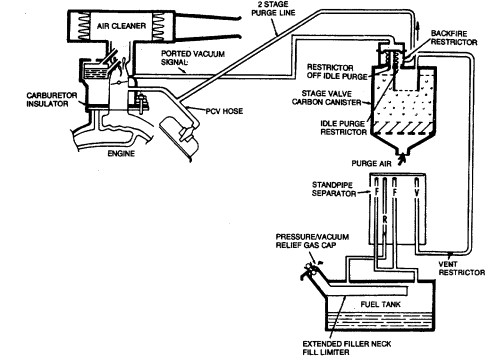
On this same subject, from the charcoal cannister comes two lines, one goes to the pcv valve and then continues to the base of the carb, this is the large hose, the second line goes from the canister to directly to the carb and is the small hose. My question is should the small hose go to a ported vacuum sorce or a full time vacuum source? I am using a holley carb on the 71 LS6?
On this same subject, from the charcoal cannister comes two lines, one goes to the pcv valve and then continues to the base of the carb, this is the large hose, the second line goes from the canister to directly to the carb and is the small hose. My question is should the small hose go to a ported vacuum sorce or a full time vacuum source? I am using a holley carb on the 71 LS6?

Drifting

Joined: Dec 2002
Posts: 1,946
Likes: 28
From: Long Beach CA
What they're trying to say is that you need to set your timing to 36* with the engine running at 2,800-3,000 rpm with the vacuum advance hose disconnected and plugged. Let the idle timing fall where it falls. It may be 12*, it may be 16*, it doesn't matter as long as your total timing is 36*. Then connect the vacuum advance hose to a port on the carburetor that has manifold vacuum at idle.

Racer
Joined: May 2006
Posts: 264
Likes: 0
From: Fort Myers, Fl / St. Paul, Mn
For future reference - Ported
LARS,
On this same subject, from the charcoal cannister comes two lines, one goes to the pcv valve and then continues to the base of the carb, this is the large hose, the second line goes from the canister to directly to the carb and is the small hose. My question is should the small hose go to a ported vacuum sorce or a full time vacuum source? I am using a holley carb on the 71 LS6?
On this same subject, from the charcoal cannister comes two lines, one goes to the pcv valve and then continues to the base of the carb, this is the large hose, the second line goes from the canister to directly to the carb and is the small hose. My question is should the small hose go to a ported vacuum sorce or a full time vacuum source? I am using a holley carb on the 71 LS6?

Race Director


Joined: May 2005
Posts: 10,674
Likes: 122
From: Millington Illinois
St. Jude Donor '08-'09
The car came from New York State originally. Maybe they were trying to pass emissions there. I can't imagine why they selected that PCV because the engine was totally rebuilt and it seems like a funny error to make if it was an error. Maybe their thinking is the lower the better for performance?. At any rate it runs super with the 789C but I am a bug and did not like the 90 degree angle PCV since it does not look like my other cars setup which is all original and has no bend in its route to the carb. So if I understand Lars correctly I need to increase my initial timing to the low teens from 8 degrees if I want to try to use the 746 PCV. Otherwise I may take your advice and go and get the CV769 which you say has no bend and is a LOW flow good for a performance engine but not as low as the VERY low 789.
So i will set initial timing first to low teens then rehook the vaccum advance. I don't understand what you mean by "to a manifold source". Do you mean to a place other than it is now? I guess what you mean is I am looking for a way to get 36 degrees total?
So i will set initial timing first to low teens then rehook the vaccum advance. I don't understand what you mean by "to a manifold source". Do you mean to a place other than it is now? I guess what you mean is I am looking for a way to get 36 degrees total?

Race Director
Joined: Nov 1999
Posts: 10,643
Likes: 8
From: Foxfield CO 1970 Convertible
The manifold source means to a fitting that is at manifold pressure, which is *below* the butterfly valves in the carb, or anywhere in the manifold. Using a fitting in the carb throat will disperse the oil vapor among the pistons. The ported fittings are located somewhere above the butterflies and have less and differing vacuum. Thinpockets picture shows this pretty well.
Tech Contributor
Joined: Aug 1999
Posts: 14,377
Likes: 6,377
From: At my Bar drinking and wrenching in Lafayette Colorado
Sorry I didn't see your post until now. If you need me on specifics, drop me an e-mail or a PM...
Yes, the charcoal canister vent line goes to ported vacuum. By doing this, you avoid what effectively becomes a massive vacuum leak at idle: The ported source does not pull any (or much) vacuum at idle, so you do not get any adverse intake charge dilution at low engine speed. Once the engine is off idle and operating at higher rpm, the ported source will allow venting of the canister with a slight dilution of the intake charge. This dilution becomes irrelevant at the higher rpm. Under power, since there is no manifold vacuum at WOT, the system does not function, so there is no WOT power penalty. So overall, it's really not a bad system, and it does not rob any power or drivability from the engine.
Yes, the charcoal canister vent line goes to ported vacuum. By doing this, you avoid what effectively becomes a massive vacuum leak at idle: The ported source does not pull any (or much) vacuum at idle, so you do not get any adverse intake charge dilution at low engine speed. Once the engine is off idle and operating at higher rpm, the ported source will allow venting of the canister with a slight dilution of the intake charge. This dilution becomes irrelevant at the higher rpm. Under power, since there is no manifold vacuum at WOT, the system does not function, so there is no WOT power penalty. So overall, it's really not a bad system, and it does not rob any power or drivability from the engine.
