






Estimating quarter mile times

Thread Starter
Advanced

Joined: Jul 2007
Posts: 54
Likes: 0
From: Denver PA, surrounded by Amish
 Estimating quarter mile times
Does anyone know (or could give a link to) how to calculate a quarter mile time without knowing horsepower or trap speed? There's got to be a way to do it knowing your vehicle weight and an elapsed time for a certain speed reached. Like if you would know your 0-60 time and the weight of your car, the horsepower could be estimated and with HP, the quarter mile time could be figured. Or better yet, a 0-any speed time.
I will go to the track next year, but I'm just curious what ballpark I'll be in.
I will go to the track next year, but I'm just curious what ballpark I'll be in.

Burning Brakes


Joined: Dec 2003
Posts: 1,004
Likes: 7
From: Adelaide South Australia
Borrow/buy a Gtech meter.
The original units are pretty inexpensive, if you can still get one. (~$30)
They will give you 0-60 ft, 1/4 mile ET and trap speed mph estimation based on your accelleration rate (G force). It will even estimate your power output if you enter the actual curb weight.
Reasonably accurate (+/- 0.2 seconds and/or +/- 3mph )
That will give you a chance to practice your launches before you go to the track and get a real time slip.
Other than that, find a quiet stretch of (private test )track, measure out a 1/4 mile, and have a buddy time you with a stop watch.
You've got a 383 with ~400hp ??..... no info on the rest of your setup.
You could be anywhere from mid 14's to low 12's with a dedicated track setup.
As said above..... you may as well buy a lottery ticket without factual data.
The original units are pretty inexpensive, if you can still get one. (~$30)
They will give you 0-60 ft, 1/4 mile ET and trap speed mph estimation based on your accelleration rate (G force). It will even estimate your power output if you enter the actual curb weight.
Reasonably accurate (+/- 0.2 seconds and/or +/- 3mph )
That will give you a chance to practice your launches before you go to the track and get a real time slip.
Other than that, find a quiet stretch of (private test
)track, measure out a 1/4 mile, and have a buddy time you with a stop watch.You've got a 383 with ~400hp ??..... no info on the rest of your setup.
You could be anywhere from mid 14's to low 12's with a dedicated track setup.
As said above..... you may as well buy a lottery ticket without factual data.

Race Director


Joined: Jan 2003
Posts: 15,176
Likes: 88
From: State of Confusion
E.T. is all about applying the HP & TQ that you have to the pavement smoothly via traction, weight-transfer, chassis and suspension, and gearing:
MPH shows mow-much HP you are making at that time.
When the Z06s were first introduced a few years ago, people raved how they were track-tested, showing results of 12.7 @ 117 MPH, yet my 29 year-old Z28 runs the same E.T. at 107 MPH due to gearing (4.10s ), TQ-multiplication (an 8", 4500 RPM converter ) chassis, suspension, and weight-transfer (frame-connectors, slapper-bars, shocks ), and traction (28" x 10" slicks ), while shifting what is probably a lower-HP motor at a lower RPM (5800 ) than the LS2 (6600? ).
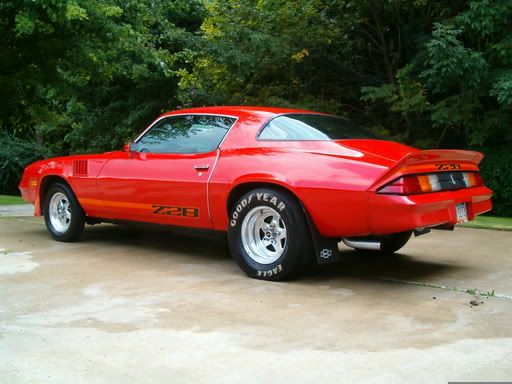
You are lucky-enough to live near one of the best-run and best-prepped tracks in the country (Maple Grove Raceway ):
post your results when you go testing.
MPH shows mow-much HP you are making at that time.
When the Z06s were first introduced a few years ago, people raved how they were track-tested, showing results of 12.7 @ 117 MPH, yet my 29 year-old Z28 runs the same E.T. at 107 MPH due to gearing (4.10s ), TQ-multiplication (an 8", 4500 RPM converter ) chassis, suspension, and weight-transfer (frame-connectors, slapper-bars, shocks ), and traction (28" x 10" slicks ), while shifting what is probably a lower-HP motor at a lower RPM (5800 ) than the LS2 (6600? ).
You are lucky-enough to live near one of the best-run and best-prepped tracks in the country (Maple Grove Raceway ):
post your results when you go testing.
Thread Starter
Advanced
Joined: Jul 2007
Posts: 54
Likes: 0
From: Denver PA, surrounded by Amish
Come now, somebody here has the math skills to do this problem as an estimate. Yes, I'm very aware that you can have same E.T.s with different trap speeds, but they're close. Just as you can estimate HP from trap speed or ET, you can estimate HP with a 0-60 or 0-100 if you've got the right math. Obviously, the later in the game, the more accurate the numbers are. I agree that for a 0-20 MPH it would be a complete joke. If I use your example above and told you that I can do 0-110 in about 12.7 seconds, we could estimate that it's close to a correct quarter mile time.
I did think about the accelerometer, thanks for that info.
I didn't realize that my Maple Grove was such a prestigious track. That's good to know. I've been to the NHRA nationals for the last 3 yrs. They actually have one more test and tune this Saturday. I may be able to make it. Yes, I will post the sorry-*** results. I have never driven on a track in my life - can't wait.
I did think about the accelerometer, thanks for that info.
I didn't realize that my Maple Grove was such a prestigious track. That's good to know. I've been to the NHRA nationals for the last 3 yrs. They actually have one more test and tune this Saturday. I may be able to make it. Yes, I will post the sorry-*** results. I have never driven on a track in my life - can't wait.

Team Owner


Joined: Jan 2003
Posts: 21,234
Likes: 19
From: Freestate Corvette Club! Elkridge, MD
St. Jude Donor '17
Come now, somebody here has the math skills to do this problem as an estimate. Yes, I'm very aware that you can have same E.T.s with different trap speeds, but they're close. Just as you can estimate HP from trap speed or ET, you can estimate HP with a 0-60 or 0-100 if you've got the right math. Obviously, the later in the game, the more accurate the numbers are. I agree that for a 0-20 MPH it would be a complete joke. If I use your example above and told you that I can do 0-110 in about 12.7 seconds, we could estimate that it's close to a correct quarter mile time.
I did think about the accelerometer, thanks for that info.
I didn't realize that my Maple Grove was such a prestigious track. That's good to know. I've been to the NHRA nationals for the last 3 yrs. They actually have one more test and tune this Saturday. I may be able to make it. Yes, I will post the sorry-*** results. I have never driven on a track in my life - can't wait.
I did think about the accelerometer, thanks for that info.
I didn't realize that my Maple Grove was such a prestigious track. That's good to know. I've been to the NHRA nationals for the last 3 yrs. They actually have one more test and tune this Saturday. I may be able to make it. Yes, I will post the sorry-*** results. I have never driven on a track in my life - can't wait.

Corvette Stories
The Best of Corvette for Corvette Enthusiasts

Top 10 Most Expensive Corvettes Ever Sold on Bring A Trailer
Brett Foote
10 Things Every Corvette Owner Needs (2026 Edition)
Michael S. Palmer
8 Most "Only Corvette Owners Understand" Quirks and Problems
Pouria Savadkouei
10 Reasons the C6 Z06 is Still A Performance Benchmark After 20 Years
Joe Kucinski
How Much Horsepower Every Corvette Engine "LOST" in 1972
Joe Kucinski
Top 10 DOs and DON'Ts for Protecting Your Convertible Top!
Michael S. Palmer
Top 10 Most Explosive Corvettes Ever Made: Power-to-Weight Ratio Ranked!
Joe Kucinski
150 hp to 1,250 hp: Every Corvette Generation Compared by the Specs That Matter
Joe Kucinski
8 Coolest Corvette Pace Cars (and Replicas) of All Time
Verdad Gallardo


Race Director
Joined: Jan 2003
Posts: 15,176
Likes: 88
From: State of Confusion
Originally Posted by Stosh507
Come now, somebody here has the math skills to do this problem as an estimate..... Just as you can estimate HP from trap speed or ET, you can estimate HP with a 0-60 or 0-100 if you've got the right math.....
you can estimate HP from trap-speed, if you know the car's weight, but E.T. factors-in the application of that power to the track.....
The traction-factor prohibits us from 'getting the math right' :
here's an example that I witnessed a few years ago at my home track, Pittsburgh Raceway Park -
some members of this Forum may recall a member named Bence13_33, who had mid-'70s C3 with a well-done 468" BBC, with high-compression, square-ports heads, free-revving cam, 4-speed, 4.11s, 29" x 11" slicks, etc., that was conservatively-estimated to be 550-575 HP:
on an early-season test-and-tune, I saw the car run it's usual 12-teens at 116 MPH.....
a few pair back in the staging-lanes was another rubber-bumper Shark, with a box-stock ZZ502 (just 502 HP ), THM400 with an 'on-sale' 10" converter, 3.90s, and the same-size slicks:
leaving from idle and shifting at 5400 RPM, he ran an effortless 12.003 @ 112 MPH, a full 1/10th quicker at 4 MPH-less, shifting 1000 RPM lower @ 9.6:1 compression-ratio, with less gear-ratio, from less HP.

Bence's car was still pulling (and would've probably pulled well-past ) at the finish-line, while the ZZ502 was done-in 100' before the stripe, but he USED all of his power in those 1320':
having-power and smoothly applying-it are two different things.

Knowing HP & weight, you can estimate a car's POTENTIAL trap-speed, but getting that car to E.T., relative-to that trap-speed, is based-upon the great 'unknown' of gearing, chassis, traction, etc.

Originally Posted by Stosh507
I didn't realize that my Maple Grove was such a prestigious track. That's good to know. I've been to the NHRA nationals for the last 3 yrs. They actually have one more test and tune this Saturday. I may be able to make it. Yes, I will post the sorry-*** results. I have never driven on a track in my life - can't wait.
Track Manager George Case proudly pointed-out that his Track Champions received better Points Fund Awards (read MONEY ) than NHRA Divisional Champions, who chase points across the country, and while Old Bridge Township Raceway Park (Englishtown ) has a great publicity-machine in a larger media-market, MGR has better weekly track-prep and much better weekly payout than most any track in the country (North-East )
If this is your first-ever trip down a drag-strip, you may want to look into the Drag Racing section of this Forum, for general tips, safety-regulations, etc., so you'll have no surprises.
Thread Starter
Advanced
Joined: Jul 2007
Posts: 54
Likes: 0
From: Denver PA, surrounded by Amish
Well, just to satisfy my own curiosity, I did the math myself. The biggest problem is that it assumes constant acceleration the whole length of the track.
Quarter mile ET=(1800*t/Vf)^(-2)
That means the square root of (1800 times measured time divided by final speed)
Both time measurements are in seconds and speed is in MPH. This formula will give a quarter mile ET too high because the acceleration in the first half is higher than in the second half.
All this came about because I did a 0-85 MPH in about 11 seconds and was just wondering how to place that in the quarter mile. Using the above formula it puts me at a little over 15 seconds which stinks. But like I said, this will estimate high. Anyway, it was a fun exercise in math.
Quarter mile ET=(1800*t/Vf)^(-2)
That means the square root of (1800 times measured time divided by final speed)
Both time measurements are in seconds and speed is in MPH. This formula will give a quarter mile ET too high because the acceleration in the first half is higher than in the second half.
All this came about because I did a 0-85 MPH in about 11 seconds and was just wondering how to place that in the quarter mile. Using the above formula it puts me at a little over 15 seconds which stinks. But like I said, this will estimate high. Anyway, it was a fun exercise in math.
Race Director
Joined: Jan 2003
Posts: 15,176
Likes: 88
From: State of Confusion
Here are a few things to consider.....
A typical car that traps at 100 MPH is doing about 80 MPH at half-track, and this '80%-MPH at half-track' seems to apply to all well set-up, maximum-effort cars, short of Top Fuel & Funny Car, which have rev-limiter/ignition-retard units to keep speeds within reason for the insurance-carriers:
those cars can hit 275+ in 660', yet rarely trap over 330 MPH (330 x .8 = 264 ) these days, with cylinders going-out near the stripe.
My Z28 hits 85 MPH at half-track in 8.3 seconds..... just for ***** & grins, what does that formula say it'd run in 1320'?
Old-time Stock and Super/Stock racers used to multiply their ET by their MPH, and called this result their 'hook-factor', and they soon realized that an ideal H-F of 1320 (oddly-enough, the number of feet in a 1/4-mile ) to be optimal, REGARDLESS of how-quick or fast their cars were
(this factor of 1320 doesn't apply to T/F, F/C, or Pro Stock because these cars make so-much power they can't throw it all at the tires off the line:
the teams have-to slip the clutch to keep the tires from spinning, and fuel-cars H-F in the 1450-1480 range, while P/S can factor at 1370-1390 ).
A car that H-Fs way-above 1320 could run quicker by gearing, traction, chassis, etc. improvements, while cars that factor below 1320 are running-out of RPM because they have too-much gear-ratio (gear-bound ), and would actually run quicker with less-gearing
(i.e.- they'd pull TO the finish-line, instead of leveling-off before the stripe )
You can crunch a LOTTA numbers trying to figure all this out.....

Well, just to satisfy my own curiosity, I did the math myself. The biggest problem is that it assumes constant acceleration the whole length of the track.
Quarter mile ET=(1800*t/Vf)^(-2)
That means the square root of (1800 times measured time divided by final speed)
Both time measurements are in seconds and speed is in MPH. This formula will give a quarter mile ET too high because the acceleration in the first half is higher than in the second half.
Quarter mile ET=(1800*t/Vf)^(-2)
That means the square root of (1800 times measured time divided by final speed)
Both time measurements are in seconds and speed is in MPH. This formula will give a quarter mile ET too high because the acceleration in the first half is higher than in the second half.
those cars can hit 275+ in 660', yet rarely trap over 330 MPH (330 x .8 = 264 ) these days, with cylinders going-out near the stripe.
All this came about because I did a 0-85 MPH in about 11 seconds and was just wondering how to place that in the quarter mile. Using the above formula it puts me at a little over 15 seconds which stinks. But like I said, this will estimate high. Anyway, it was a fun exercise in math.
Old-time Stock and Super/Stock racers used to multiply their ET by their MPH, and called this result their 'hook-factor', and they soon realized that an ideal H-F of 1320 (oddly-enough, the number of feet in a 1/4-mile ) to be optimal, REGARDLESS of how-quick or fast their cars were
(this factor of 1320 doesn't apply to T/F, F/C, or Pro Stock because these cars make so-much power they can't throw it all at the tires off the line:
the teams have-to slip the clutch to keep the tires from spinning, and fuel-cars H-F in the 1450-1480 range, while P/S can factor at 1370-1390 ).
A car that H-Fs way-above 1320 could run quicker by gearing, traction, chassis, etc. improvements, while cars that factor below 1320 are running-out of RPM because they have too-much gear-ratio (gear-bound ), and would actually run quicker with less-gearing
(i.e.- they'd pull TO the finish-line, instead of leveling-off before the stripe )
You can crunch a LOTTA numbers trying to figure all this out.....
Thread Starter
Advanced
Joined: Jul 2007
Posts: 54
Likes: 0
From: Denver PA, surrounded by Amish
Really cool stuff. Thanks for the insight.
That formula gives you a 1320' of 13.25 seconds using the numbers you listed, but like I said previously, that averaged out your acceleration from the starting line to that point and continued it to the end. A good launch will make these numbers useless I imagine. I enjoy playing with numbers to try to get a feel of what's either going to happen or what's supposed to happen. I realize that none of this means anything on race day, but it's still fun. I'm sure race day will be funner still!
That formula gives you a 1320' of 13.25 seconds using the numbers you listed, but like I said previously, that averaged out your acceleration from the starting line to that point and continued it to the end. A good launch will make these numbers useless I imagine. I enjoy playing with numbers to try to get a feel of what's either going to happen or what's supposed to happen. I realize that none of this means anything on race day, but it's still fun. I'm sure race day will be funner still!

Safety Car


Joined: Oct 2004
Posts: 3,926
Likes: 739
From: Youngstown Ohio
Does anyone know (or could give a link to) how to calculate a quarter mile time without knowing horsepower or trap speed? There's got to be a way to do it knowing your vehicle weight and an elapsed time for a certain speed reached. Like if you would know your 0-60 time and the weight of your car, the horsepower could be estimated and with HP, the quarter mile time could be figured. Or better yet, a 0-any speed time.
I will go to the track next year, but I'm just curious what ballpark I'll be in.
I will go to the track next year, but I'm just curious what ballpark I'll be in.
http://www.tciauto.com/Products/Tech...alculators.asp
Race Director
Joined: Jan 2003
Posts: 15,176
Likes: 88
From: State of Confusion
That formula gives you a 1320' of 13.25 seconds using the numbers you listed, but like I said previously, that averaged out your acceleration from the starting line to that point and continued it to the end. A good launch will make these numbers useless I imagine. I enjoy playing with numbers to try to get a feel of what's either going to happen or what's supposed to happen. I realize that none of this means anything on race day, but it's still fun. I'm sure race day will be funner still!
My H-F of 1350 (12.85 x 10⁵ ) is because I deep-stage, rolling-in further at the starting-line until the top Pre-Stage bulb goes-out, which reduces the distance my front-tires have to move before stopping the RT-clocks, and starting the ET clocks:
this is important to me as a bracket-racer, where quick RTs are critical, but the reduce distance (also called 'roll-out' ) means that when I clear the beams, I am moving slower (less of a rolling-start ), and my car receives slower time-slips.....


not deep-staging has reduced my ET by .18-.21 while having no-bearing on my MPH, so my ET could-be 12.65 @ 105, a H-F of an almost-perfect 1328
Thread Starter
Advanced
Joined: Jul 2007
Posts: 54
Likes: 0
From: Denver PA, surrounded by Amish
Again, thanks for more great info. I knew of pre-stage and stage, but I didn't know they were so far up in the air. I guess I just assumed that they were so close together that it was a very fine line to have both of them lit up at the same time. Now I see there's quite a bit of roll-out possible. Excuse me for the dumb question, but isn't that cheating? You're allowed to be going a few miles per how when they start clocking you? No wonder that formula is so far off. That answers why your "slower" times more closely follow the laws of physics and constant acceleration - because you're not getting the "cheating" start! I guess to you guys that have been doing this for years, it's just the way it is.
I'm going to be power braking, so how long before the green lights do I let go of the brake? Does it take about a quarter second to get across the stage beam? If your drawing is to scale and you say you lose about .2 seconds, then it looks like it may take about .3 - .4 seconds to go from one end of tire to the other?
I'm going to be power braking, so how long before the green lights do I let go of the brake? Does it take about a quarter second to get across the stage beam? If your drawing is to scale and you say you lose about .2 seconds, then it looks like it may take about .3 - .4 seconds to go from one end of tire to the other?
Race Director
Joined: Jan 2003
Posts: 15,176
Likes: 88
From: State of Confusion
Again, thanks for more great info. I knew of pre-stage and stage, but I didn't know they were so far up in the air. I guess I just assumed that they were so close together that it was a very fine line to have both of them lit up at the same time. Now I see there's quite a bit of roll-out possible.
Excuse me for the dumb question, but isn't that cheating? You're allowed to be going a few miles per how when they start clocking you? No wonder that formula is so far off. That answers why your "slower" times more closely follow the laws of physics and constant acceleration - because you're not getting the "cheating" start! I guess to you guys that have been doing this for years, it's just the way it is.
that's 10-millionths of a second.
NHRA mandates that the car be at-least 3" off the ground, so nothing can block the beam once the car moves out-of the beam:
some cars used to 'sag' on the launch, unintentionally blocking the beam until the REAR-tires cleared the beams, giving it a bigger rolling-start for performance, but terrible Reaction Times.
I'm going to be power braking, so how long before the green lights do I let go of the brake? Does it take about a quarter second to get across the stage beam? If your drawing is to scale and you say you lose about .2 seconds, then it looks like it may take about .3 - .4 seconds to go from one end of tire to the other?
Regardless of WHEN you react to the 3rd Amber bulb, your E.T. will remain the same:
E.T. begins when the car clears the Stage beam, and trips the finish-line beam, 1320' down-track REGARDLESS of when you leave the starting-line.
The Reaction Time is based-on when the tire clears the beam, in-relation to the Green light coming-on:
at the same-instant, the E.T. clocks start, so when you hear a guy say "If I could only cut a better-light, I know I could get a better E.T." , he is wrong.
Think of it this way.....
if 2 identically-prepared cars were to race each-other (meaning they'd run the exact-same E.T. ), the driver who left the starting-line first, without red-lighting, would reach the finish-line first, by the amount of time he left the starting-line first:
if you and I raced identical cars, and you left exactly .1-seconds before me, you'd reach the stripe exactly .1-seconds before me.
In 'real' racing, like you see on ESPN2, a slower car will beat a quicker car if the driver reacts first by a margin greater than the E.T. difference in the 2 cars:
here is an example of this, taken from yesterday's AC/DElco Nationals at The Strip in Las Vegas -
http://www.dragracecentral.com/DRCSt...r=100#indextop
Tony Pedregon RT: 0.070 ET: 4.871 MPH: 318.47
Ashley Force RT: 0.130 ET: 4.829 MPH 298.93
In the Final Round of Funny Car, Tony Pedregon reacted .060-quicker than Ashley Force, yet ran .058-seconds slower than Force in taking a 'holeshot' win, with a Margin-of-Victory of .002-seconds (.060 RT advantage less .058 performance disadvantage = .002-seconds ):
keep-in-mind the lanes are timed seperately, so Pedregon started the clocks first, and his 'slower-but earlier' 4.871 beat Force's 'quicker-but-later' 4.829.
The bulbs flash exactly 1/2-second apart, and research has shown that normal human reactions take .17-.18 seconds to react to stimuli, so if you react to the 3rd Amber bulb glowing, by the time your foot comes-off the brake pedal and the car moves out of the beams, chances-are the Green bulb will already be glowing, and you won't foul-start/red-light:
very few street-driven cars can produce red-lights when driven by seasoned racers, reacting to the 3rd Amber bulb.
Study some of the threads in the Drag Racing section before you go to MGR, so you'll better understand what is going-on, then report-back after you make your first runs.

Team Owner
Joined: Jul 2001
Posts: 182,997
Likes: 88
From: Lakeland, FL
Cruise-In IV-V-VI-VII-VIII Veteran
St. Jude Donor '03, '06, '17
Honestly, you can't estimate HP from ET, because ET takes into-account the traction, gearing, etc., as mentioned above, and this is a variable in every car, in every run:
you can estimate HP from trap-speed, if you know the car's weight, but E.T. factors-in the application of that power to the track.....
The traction-factor prohibits us from 'getting the math right' :
here's an example that I witnessed a few years ago at my home track, Pittsburgh Raceway Park -
some members of this Forum may recall a member named Bence13_33, who had mid-'70s C3 with a well-done 468" BBC, with high-compression, square-ports heads, free-revving cam, 4-speed, 4.11s, 29" x 11" slicks, etc., that was conservatively-estimated to be 550-575 HP:
on an early-season test-and-tune, I saw the car run it's usual 12-teens at 116 MPH.....
a few pair back in the staging-lanes was another rubber-bumper Shark, with a box-stock ZZ502 (just 502 HP ), THM400 with an 'on-sale' 10" converter, 3.90s, and the same-size slicks:
leaving from idle and shifting at 5400 RPM, he ran an effortless 12.003 @ 112 MPH, a full 1/10th quicker at 4 MPH-less, shifting 1000 RPM lower @ 9.6:1 compression-ratio, with less gear-ratio, from less HP.
Bence's car was still pulling (and would've probably pulled well-past ) at the finish-line, while the ZZ502 was done-in 100' before the stripe, but he USED all of his power in those 1320':
having-power and smoothly applying-it are two different things.
Knowing HP & weight, you can estimate a car's POTENTIAL trap-speed, but getting that car to E.T., relative-to that trap-speed, is based-upon the great 'unknown' of gearing, chassis, traction, etc.
you can estimate HP from trap-speed, if you know the car's weight, but E.T. factors-in the application of that power to the track.....
The traction-factor prohibits us from 'getting the math right' :
here's an example that I witnessed a few years ago at my home track, Pittsburgh Raceway Park -
some members of this Forum may recall a member named Bence13_33, who had mid-'70s C3 with a well-done 468" BBC, with high-compression, square-ports heads, free-revving cam, 4-speed, 4.11s, 29" x 11" slicks, etc., that was conservatively-estimated to be 550-575 HP:
on an early-season test-and-tune, I saw the car run it's usual 12-teens at 116 MPH.....
a few pair back in the staging-lanes was another rubber-bumper Shark, with a box-stock ZZ502 (just 502 HP ), THM400 with an 'on-sale' 10" converter, 3.90s, and the same-size slicks:
leaving from idle and shifting at 5400 RPM, he ran an effortless 12.003 @ 112 MPH, a full 1/10th quicker at 4 MPH-less, shifting 1000 RPM lower @ 9.6:1 compression-ratio, with less gear-ratio, from less HP.
Bence's car was still pulling (and would've probably pulled well-past ) at the finish-line, while the ZZ502 was done-in 100' before the stripe, but he USED all of his power in those 1320':
having-power and smoothly applying-it are two different things.
Knowing HP & weight, you can estimate a car's POTENTIAL trap-speed, but getting that car to E.T., relative-to that trap-speed, is based-upon the great 'unknown' of gearing, chassis, traction, etc.

So many factors come into play.. I remember Shane's goal to hit 11's.. (Bence13_33). He had a lot more HP than myself and he never hit 11's with that setup. I had a mild pump gas 383 (465 HP or so) and a 5-speed TKO tranny with 3.70 gears and I ran 11.67 @ 119.79 mph.
It's not just the gears, it's the combination of the engines power band, transmission gear ratios, rear gear ratios and trap RPM. Ideally, you want to trap close to peak HP RPM. (that's where the rear gear ratio comes into play). Another key thing is transmission gearing. If you have a very narrow power band on the engine, you want narrow gear spacing. If you have a wide power band (like a big block or stroker small block), you should go with bigger first gear and therefore it'll result in larger gear spacing. A larger first gear on the tranny might only help you if you can hook up.. That is a result of tires and suspension. Even with big slicks, it's still possible to spin if the suspension is not setup correctly... Another issues is track prep.. If the track is sticky, you might run up to .5 faster etc..
Way too many factors to consider. Without knowing all the factors, a estimation will be far off..
For example, I've seen cars picking up a full second without adding any power to the car. A torque converter with the correct stall speed alone can give you over 3 tenths of a second etc. etc...