



How to Safety Wire

Thread Starter
Drifting


Joined: Nov 2007
Posts: 1,704
Likes: 272
From: New York
 How to Safety Wire
Since I have been running my car in time trials, I want to secure critical parts. I have purchased AN bolts and the jig to drill them with cobalt bits. I also ordered safety wire twister.
I understand that best tutorial on this was written by Carol Smith. Does anyone know which of his books goes into how to properly safety wire:
Tune to Win
Engineer to Win
Or…Carroll Smith's Nuts, Bolts, Fasteners and Plumbing Handbook. I would suspect this one, but want to be sure.
Any info on how to safety wire would be appreciated.
I understand that best tutorial on this was written by Carol Smith. Does anyone know which of his books goes into how to properly safety wire:
Tune to Win
Engineer to Win
Or…Carroll Smith's Nuts, Bolts, Fasteners and Plumbing Handbook. I would suspect this one, but want to be sure.
Any info on how to safety wire would be appreciated.

Instructor

Joined: Jul 2007
Posts: 213
Likes: 0
From: Nowhere Mars (Southern Indiana)
You just have to wire it so that in order to unbolt (spin) the other bolt head would have to come off. It's hard to explain, but hopefully someone can come up with a graphic. i know i've seen it before.

Advanced
Joined: Jun 2004
Posts: 86
Likes: 0
From: cypress tx
Here's a good link to saftey wiring. My Land Rover uses this all though the engine and other places.
http://www.whizwheels.com/Tips/safetywiring.html
enjoy the reading
Ben
http://www.whizwheels.com/Tips/safetywiring.html
enjoy the reading
Ben

Pro

Joined: Nov 2007
Posts: 741
Likes: 1
From: Woodstock GA
Since I have been running my car in time trials, I want to secure critical parts. I have purchased AN bolts and the jig to drill them with cobalt bits. I also ordered safety wire twister.
I understand that best tutorial on this was written by Carol Smith. Does anyone know which of his books goes into how to properly safety wire:
Tune to Win
Engineer to Win
Or…Carroll Smith's Nuts, Bolts, Fasteners and Plumbing Handbook. I would suspect this one, but want to be sure.
Any info on how to safety wire would be appreciated.
I understand that best tutorial on this was written by Carol Smith. Does anyone know which of his books goes into how to properly safety wire:
Tune to Win
Engineer to Win
Or…Carroll Smith's Nuts, Bolts, Fasteners and Plumbing Handbook. I would suspect this one, but want to be sure.
Any info on how to safety wire would be appreciated.
I don't know if its true or not, but I heard Smith wanted to call the Nuts, Bolts, Fasteners and Plumbing Handbook "Screw To Win"!


Team Owner


Joined: Apr 1999
Posts: 21,953
Likes: 1,445
From: Reno Nevada
2024 C3 of the Year Finalist- Modified
Since I have been running my car in time trials, I want to secure critical parts. I have purchased AN bolts and the jig to drill them with cobalt bits. I also ordered safety wire twister.
I understand that best tutorial on this was written by Carol Smith. Does anyone know which of his books goes into how to properly safety wire:
Tune to Win
Engineer to Win
Or…Carroll Smith's Nuts, Bolts, Fasteners and Plumbing Handbook. I would suspect this one, but want to be sure.
Any info on how to safety wire would be appreciated.
I understand that best tutorial on this was written by Carol Smith. Does anyone know which of his books goes into how to properly safety wire:
Tune to Win
Engineer to Win
Or…Carroll Smith's Nuts, Bolts, Fasteners and Plumbing Handbook. I would suspect this one, but want to be sure.
Any info on how to safety wire would be appreciated.
The only thing that I have safety wired on my Vette is the two piece brake rotors. Everything else just gets a dab of Permitex hight temp red silicone. It is so quick and easy. The bolt or nut can't back out,
See the red dab on the header studs? This is my old 427 small block when I was installing it

Last edited by gkull; Feb 20, 2008 at 12:07 PM.
Drifting

Joined: Sep 2007
Posts: 1,572
Likes: 51
From: Wichita Kansas
Here's a good link to saftey wiring. My Land Rover uses this all though the engine and other places.
http://www.whizwheels.com/Tips/safetywiring.html
enjoy the reading
Ben
http://www.whizwheels.com/Tips/safetywiring.html
enjoy the reading
Ben

With my 34 years of aviation and many safety wire scares to show, I can completely agree that this link provides great examples of proper safety wire.
You can mock up a set of fasteners on a plate in a vise and do some practice. Make sure that your wire is pulled tight between bolts. You will become comforable with the SW pliers.
When doing basic 2 bolt patern just remember it should look like a reversed "S".
Melting Slicks

Joined: May 2004
Posts: 2,084
Likes: 1
From: Aussie expat in Saudi Arabia
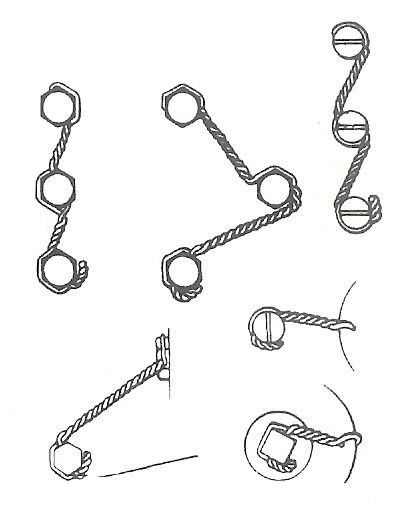
The purpose of lockwiring nuts and bolts is obviously to stop them coming undone. You need to do it so that you come off the first bolt/nut in the direction that would tighten it and then to the next bolt/nut in the direction that it tightens. Once the wire's in place, if either bolt tries to "undo", it will pull the the wire in the direction that tries to tighten the other bolt/nut. Make sense?
Whenever you finish a lockwire, make sure to tail the end. There's no hard and fast rules but I would probably cut the lockwire and inch to an inch and a quarter after the last bolt then bend that piece over in half. Try to tuck the cut end into the hole that the wire's coming out of, or at least in such a way that it won't catch on anything - mainly YOU. You will quite possibly whimper like a puppy the first time you reach your arm past a lousy lockwire tail and it lays you open from elbow to wrist
 Or, when you're fumbling around near a lockwire and you push the little chisel ends a quarter of an inch into your fingertip!
 If you're using Inconnel lockwire, it'll take longer for the cuts to heal too
Apart from that, it's pretty easy

Corvette Stories
The Best of Corvette for Corvette Enthusiasts

How Much Horsepower Every Corvette Engine "LOST" in 1972
Joe Kucinski
Top 10 DOs and DON'Ts for Protecting Your Convertible Top!
Michael S. Palmer
Top 10 Most Explosive Corvettes Ever Made: Power-to-Weight Ratio Ranked!
Joe Kucinski
150 hp to 1,250 hp: Every Corvette Generation Compared by the Specs That Matter
Joe Kucinski
8 Coolest Corvette Pace Cars (and Replicas) of All Time
Verdad Gallardo
Top 10 Corvette Engines RANKED by Peak Torque (70+ Years of Muscle!)
Joe Kucinski
Corvette ZR1X Will Be Pacing the Indy 500, And Could Probably Race, Too!
Verdad Gallardo
Top 10 Corvettes Coming to Mecum Indy 2026!
Brett Foote
Top 10 C9 Corvette MUST-HAVES to Fix These C8 Generation Flaws!
Michael S. Palmer
Thread Starter
Drifting
Joined: Nov 2007
Posts: 1,704
Likes: 272
From: New York
Here's a good link to saftey wiring. My Land Rover uses this all though the engine and other places.
http://www.whizwheels.com/Tips/safetywiring.html
enjoy the reading
Ben
http://www.whizwheels.com/Tips/safetywiring.html
enjoy the reading
Ben
Thank you!
Thread Starter
Drifting
Joined: Nov 2007
Posts: 1,704
Likes: 272
From: New York
Could you tell me about you TT car? I just got my full Time Trials SCCA license. I'm working on my competition license so I can run the historic races in my 79 Vette and hopefully 1972 March F2 that i have been helping to restore.
The only thing that I have safety wired on my Vette is the two piece brake rotors. Everything else just gets a dab of Permitex hight temp red silicone. It is so quick and easy. The bolt or nut can't back out,
See the red dab on the header studs? This is my old 427 small block when I was installing it
The only thing that I have safety wired on my Vette is the two piece brake rotors. Everything else just gets a dab of Permitex hight temp red silicone. It is so quick and easy. The bolt or nut can't back out,
See the red dab on the header studs? This is my old 427 small block when I was installing it
I never safety wired stuff before. But through the years I have had some mishaps. I have had caliper bolts come loose. A bolt that held the cam gear on came loose caused all sorts of issues for me. ($$$) Also, I have seen other mishaps at the track. Yes, I use a torque wrench, and lock washers and Locktite.
My friend used Mark races a Sirocco (a full cage race car). He noticed that Caliper mounting brackets from the Factory uses Locktite. But due to high heat, that does not work on track, after one fell out and tried to cut the inside of his rim in half.
He also told me about his Oil Pickup Screen tube to Oil Pump-after that
"Holy crap I have no oil pressure entering turn 4 at VIR incident"
What I wire wrap and what I don't again comes from my friend Mark.
One: Is it a mission critical part and if it comes loose am I royally
screwed.
Two: As you nut and bolt the car in between track weekends. The stuff that you torked to 35 or 50 lbs before the event and then got more than a half turn after the event are wire wrap candidates. Stuff that you hardly move the wrench, probably not.
They safety wire aircraft for a reason. I figure I try it for added reliability. The start-up cost to do it are very modest.
Racer
Joined: Jun 2007
Posts: 274
Likes: 2
From: Finger TN
safety wiring
Speaking from my aviation experience, I would not recommend using safety wire pliers. Wherever you clamp down on the wire to start the twist, the wire gets nicked, weakening it. As long as you keep a good 90 degree angle between the wire ends as you twist them by hand, you will always have uniform wraps. Most of the safety wire I use is .032" and using the 90 degree trick you will get 6 to 8 wraps per inch. Also, keep your diagonal cutters sharp and it will minimize the razor end syndrome. Good luck Any general aviation manual would also be a great resource for safetying tips.
Any general aviation manual would also be a great resource for safetying tips.
Melting Slicks
Joined: May 2004
Posts: 2,084
Likes: 1
From: Aussie expat in Saudi Arabia
Speaking from my aviation experience, I would not recommend using safety wire pliers. Wherever you clamp down on the wire to start the twist, the wire gets nicked, weakening it. As long as you keep a good 90 degree angle between the wire ends as you twist them by hand, you will always have uniform wraps. Most of the safety wire I use is .032" and using the 90 degree trick you will get 6 to 8 wraps per inch. Also, keep your diagonal cutters sharp and it will minimize the razor end syndrome. Good luck Any general aviation manual would also be a great resource for safetying tips.
Any general aviation manual would also be a great resource for safetying tips. What's your aviation experience r3? You can't have more than one lockwire a week (and nothing else) to do if you're doing them by hand. Granted, you can do a nice lockwire by hand but you'll never get it as tight as when you're using lockwire pliers and if you are using decent ones, they won't nick the wire either. Get something like Bahco Belzer lockwire pliers, they won't mark the wire at all. And, sharp cutters or not, the lockwire tail will always cut you - the very design of side/angle cutters means that the lockwire will always be cut at a nice sharp angle.
Oh, never pull the lockwire tight in the general direction of your face because when the lockwire breaks, you'll bury the pliers in your face. I was right beside a bloke one day when he smashed his two front teeth in half
Melting Slicks
Joined: May 2004
Posts: 2,084
Likes: 1
From: Aussie expat in Saudi Arabia