







RPM Air Gap

Thread Starter
Burning Brakes


Joined: Sep 2005
Posts: 895
Likes: 4
From: whitman massachusetts
 RPM Air Gap
I have an Edelbrock RPM Air Gap intake installed on my ZZ383. I am trying to figure the way to go for a carburetor, and decided to go with a rebuild on a Quadrajet, tuned in to my motors spec. I am just a bit confused on the Rochester being a spread-bore and the Air Gap intake being a square-bore. Will a Quadrajet work effeciently with this intake, or will I be sacraficing performance? Any info is appreciated.
Race Director


Joined: Jun 2000
Posts: 10,046
Likes: 675
From: FL
You will need an adapter to fit the spread bore Q-Jet on the square bore RPM Air Gap. That may disturb flow and will add height which may be an issue based on your hood. A more elegant solution is the 7104 RPM Q-Jet. It is not an Air Gap but does have the spread bore pattern so the Q-Jet fits nicely.
Here is mine using a Moroso Low Profile Racing Aircleaner with 14x3" filter. I did have to dimple the base a little for the accelerator pump arm. I have 3/4" clearance with the stock '75 hood.

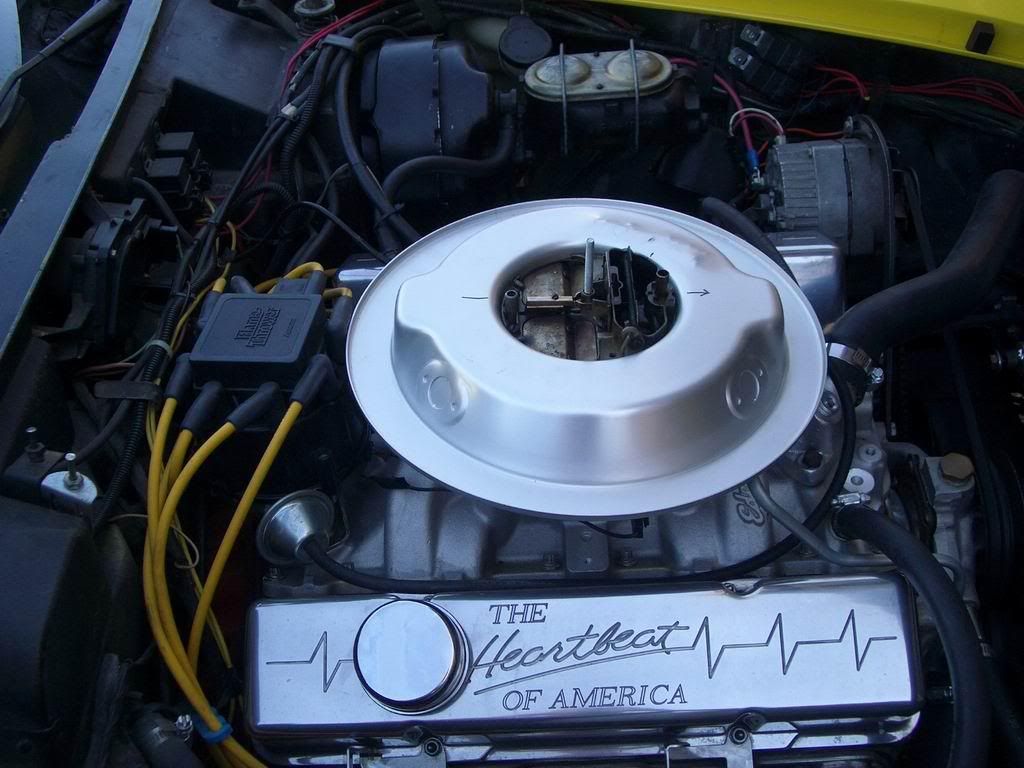
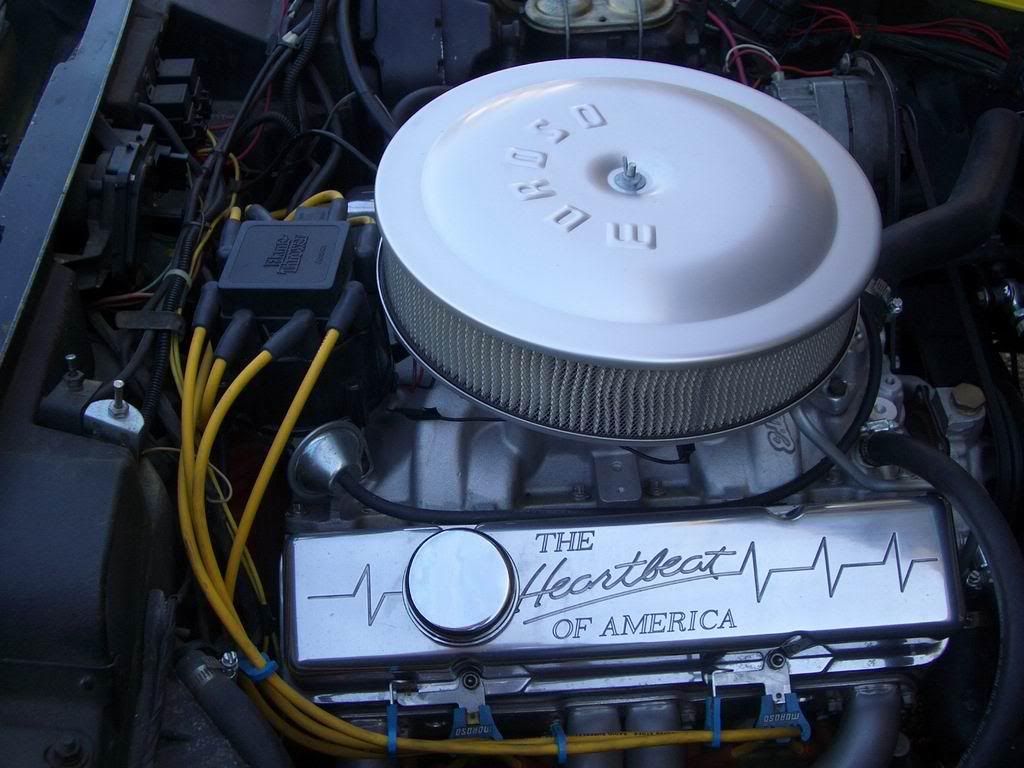
Here is mine using a Moroso Low Profile Racing Aircleaner with 14x3" filter. I did have to dimple the base a little for the accelerator pump arm. I have 3/4" clearance with the stock '75 hood.
Last edited by SteveG75; Feb 28, 2009 at 10:21 PM.

Melting Slicks


Joined: Mar 2006
Posts: 2,465
Likes: 0
From: Orange Park Fl
The RPM Air Gap is only for square bore. The regular Performer Air Gap comes in square or spread bore. I have heard that Lars says you should not use an air gap manifold on a street car, so if you are looking for performance in that RPM range, I would go with the regular RPM non-Air Gap manifold. If you already own the RPM Air Gap manifold, it is a high demand item that I'm sure you can sell for what either a Performer Air Gap or a regular RPM manifold would cost.
God bless, Sensei
God bless, Sensei

Pro

Joined: Mar 2008
Posts: 716
Likes: 1
From: Albuquerque New Mexico
The RPM Air Gap is only for square bore. The regular Performer Air Gap comes in square or spread bore. I have heard that Lars says you should not use an air gap manifold on a street car, so if you are looking for performance in that RPM range, I would go with the regular RPM non-Air Gap manifold. If you already own the RPM Air Gap manifold, it is a high demand item that I'm sure you can sell for what either a Performer Air Gap or a regular RPM manifold would cost.
God bless, Sensei
God bless, Sensei

Melting Slicks


Joined: May 2005
Posts: 2,209
Likes: 12
From: Montgomery Alabama
Cruise-In VII Veteran
St. Jude Donor '06
This post adds very little to this conversation
"I have heard that Lars says"
I read that someone heard that someone else said Lars said this too....
Personally, I wouldn't put a Q-Jet on an adapter to make it square bore to fit the air gap intake, but heck, it just might make more HP that way.
I bougth the air gap, and the Thunder Road series carb for it, then found out my L88 hood was a piece of crap, so it has been sitting in a box waiting on me to get a good L88 hood.
I read that someone heard that someone else said Lars said this too....
Personally, I wouldn't put a Q-Jet on an adapter to make it square bore to fit the air gap intake, but heck, it just might make more HP that way.
I bougth the air gap, and the Thunder Road series carb for it, then found out my L88 hood was a piece of crap, so it has been sitting in a box waiting on me to get a good L88 hood.
Corvette Stories
The Best of Corvette for Corvette Enthusiasts

Top 10 Most Expensive Corvettes Ever Sold on Bring A Trailer
Brett Foote
10 Things Every Corvette Owner Needs (2026 Edition)
Michael S. Palmer
8 Most "Only Corvette Owners Understand" Quirks and Problems
Pouria Savadkouei
10 Reasons the C6 Z06 is Still A Performance Benchmark After 20 Years
Joe Kucinski
How Much Horsepower Every Corvette Engine "LOST" in 1972
Joe Kucinski
Top 10 DOs and DON'Ts for Protecting Your Convertible Top!
Michael S. Palmer
Top 10 Most Explosive Corvettes Ever Made: Power-to-Weight Ratio Ranked!
Joe Kucinski
150 hp to 1,250 hp: Every Corvette Generation Compared by the Specs That Matter
Joe Kucinski
8 Coolest Corvette Pace Cars (and Replicas) of All Time
Verdad Gallardo

Racer


Joined: Apr 2006
Posts: 477
Likes: 43
From: Millbrae California
The reason i avoid air-gap intakes for a non-race application is: The factory intake manifolds used heat from the exhaust crossover on the bottom of the intake manifold in an effort to help further vaporize the air/fuel mixture as it passed thru the intake manifold on its way to each cylinder of the engine. Many of the aftermarket high performance manifolds on the market today including air-gao intakes block this exhaust crossover in an effort to increase high rpm engine power. The lack of exhaust heat in this non-exhaust heated style of intake manifolds will often cause some engine driveability problems because some of the vaporized fuel will condense back into a liquid. An engine can only properly burn gasoline that is in a vaporized form evenly mixed with the air in its combustion chamber. The added high rpm performance that an non exhaust heated and/or air-gap intake manifold offers is often offset by a loss of driveability and power at lower rpm engine operating conditions.
I hope this helps Henry @ olescarb
I hope this helps Henry @ olescarb
