



1970 Carburetor question

Thread Starter
Pro


Joined: May 2006
Posts: 573
Likes: 5
From: Georgetown Township MI
 1970 Carburetor question
Greetings!
Spring is here and I'm anxious at getting my car out of storage but
concerned about it's performance and lingering gas fumes. My good friend
loaned me a carburetor from his collection to get my car running until a
suitable replacement could be found. When I bought the car 4 years ago,
it came with a Holley which, was not correct. The loaner, a Rochester
Quadrajet - 7040507.
I have a few questions to ask.
What is the difference between this carburetor (7040507) and
the 7040207 or any other 70-72 4-speed Quadrajet? Is it restricted?
Are there different components in it? Could it prevent the 4 barrels from
opening up completely?
Next, I smelled gas lingering in the garage after I shut the car off.
I wondered if the rubber lines that come off the front of the carburetor
would have anything to do with this.
On the 70' 7040507, there are two nipples, one large and one small.
The larger hose goes directly into the left valve cover. I can't remember
if it goes into a PCV valve or not.
The other, smaller nipple at the front of the carburetor;
I can't remember if it's capped off or routed somewhere to the
right rear of the motor. The car is in storage, away from my home,
so I can't run out and look at it.
Way back when on my 72', 350/200hp 4-speed, I faintly remember
the (2) rubber lines at the front of the Carter carburetor, were routed
differently than the 70' Rochester.
On the 72' Carter, the larger of the two hoses went to a Tee in the
left valve cover, connecting to a PCV valve? The hose on the other side
of the Tee and the other smaller hose from the front of the carburetor were
routed down, somewhere into the left front fender. But to what?
Is my 70' supposed to be routed the same way?
Could this account for the lingering gas fumes?
I don't have any photos to show this,
but I hope my description can help you answer my questions.
Any info would be appreciated.
Spring is here and I'm anxious at getting my car out of storage but
concerned about it's performance and lingering gas fumes. My good friend
loaned me a carburetor from his collection to get my car running until a
suitable replacement could be found. When I bought the car 4 years ago,
it came with a Holley which, was not correct. The loaner, a Rochester
Quadrajet - 7040507.
I have a few questions to ask.
What is the difference between this carburetor (7040507) and
the 7040207 or any other 70-72 4-speed Quadrajet? Is it restricted?
Are there different components in it? Could it prevent the 4 barrels from
opening up completely?
Next, I smelled gas lingering in the garage after I shut the car off.
I wondered if the rubber lines that come off the front of the carburetor
would have anything to do with this.
On the 70' 7040507, there are two nipples, one large and one small.
The larger hose goes directly into the left valve cover. I can't remember
if it goes into a PCV valve or not.
The other, smaller nipple at the front of the carburetor;
I can't remember if it's capped off or routed somewhere to the
right rear of the motor. The car is in storage, away from my home,
so I can't run out and look at it.
Way back when on my 72', 350/200hp 4-speed, I faintly remember
the (2) rubber lines at the front of the Carter carburetor, were routed
differently than the 70' Rochester.
On the 72' Carter, the larger of the two hoses went to a Tee in the
left valve cover, connecting to a PCV valve? The hose on the other side
of the Tee and the other smaller hose from the front of the carburetor were
routed down, somewhere into the left front fender. But to what?
Is my 70' supposed to be routed the same way?
Could this account for the lingering gas fumes?
I don't have any photos to show this,
but I hope my description can help you answer my questions.
Any info would be appreciated.

Drifting


Joined: Jul 2006
Posts: 1,259
Likes: 154
From: Deplorableville Nebraska
Greetings to you;
I have 2 '70 L46 350/350 cars like yours. The 7040507 carb you have on your car is the California emissions version, option code NA9. The other number, 7040207, is for the other 49 states. Unknown which carb your car takes without some investigation, but chances are its a federal (207) car. You might look for a ECS canister mounted on the drivers side inner fender. That would be for the NA9. I can't tell you what it looks like, I've never seen one.
Regarding smelling gas, some is normal at shutoff I believe, but you shouldn't smell any after that. You say "rubber lines", do you mean from the carb to fuel pump? If so, change that out immediately. Also, check the "S" hoses from the fuel lines to the fuel pump for cracks and condition. You don't want gas leaking here.
You should have 2 nipples in front, the larger one is connected to the PCV valve. The smaller one would be for the vacuum advance, routed either to the distributor, or the TCS switch.
If you would want some pics, I could post some, or I'm sure someone could chime in.
BTW; if you are looking for a real nice 7040207 carb, there is one on that auction site now, expiring in 1 day. Not mine, I have no connection, but know the owner. It's a good one, and very hard to find.
Good Luck!
I have 2 '70 L46 350/350 cars like yours. The 7040507 carb you have on your car is the California emissions version, option code NA9. The other number, 7040207, is for the other 49 states. Unknown which carb your car takes without some investigation, but chances are its a federal (207) car. You might look for a ECS canister mounted on the drivers side inner fender. That would be for the NA9. I can't tell you what it looks like, I've never seen one.
Regarding smelling gas, some is normal at shutoff I believe, but you shouldn't smell any after that. You say "rubber lines", do you mean from the carb to fuel pump? If so, change that out immediately. Also, check the "S" hoses from the fuel lines to the fuel pump for cracks and condition. You don't want gas leaking here.
You should have 2 nipples in front, the larger one is connected to the PCV valve. The smaller one would be for the vacuum advance, routed either to the distributor, or the TCS switch.
If you would want some pics, I could post some, or I'm sure someone could chime in.
BTW; if you are looking for a real nice 7040207 carb, there is one on that auction site now, expiring in 1 day. Not mine, I have no connection, but know the owner. It's a good one, and very hard to find.
Good Luck!
Drifting


Joined: Sep 1999
Posts: 1,970
Likes: 91
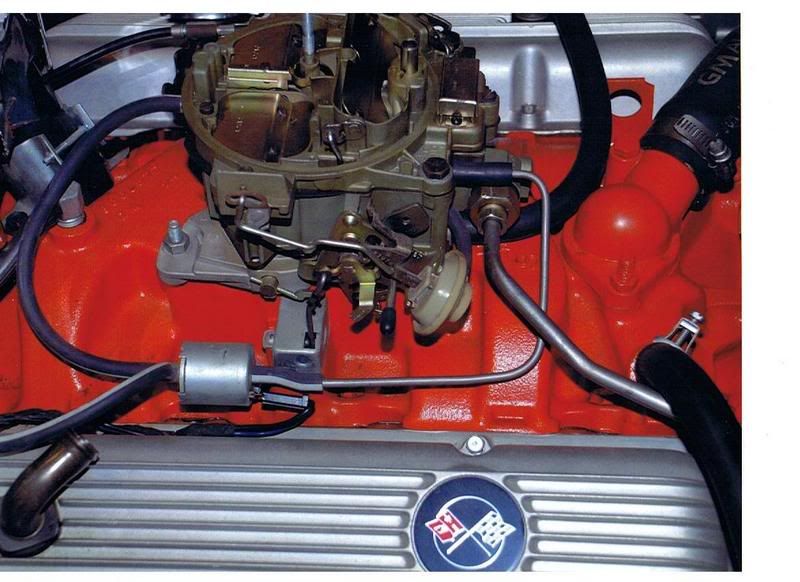
Here's 2 pics.... the first is I believe a 7040507, due to that capped off tube by the vac break diaphram . I want to say that tube connect to a vacuum hose used on the smog system that wasn't on the 207 version. I've yet to have someone confirm this, but that's my take on it.
The second is off my L-46 and is a correct 7040207. You'll notice no tube there at all.
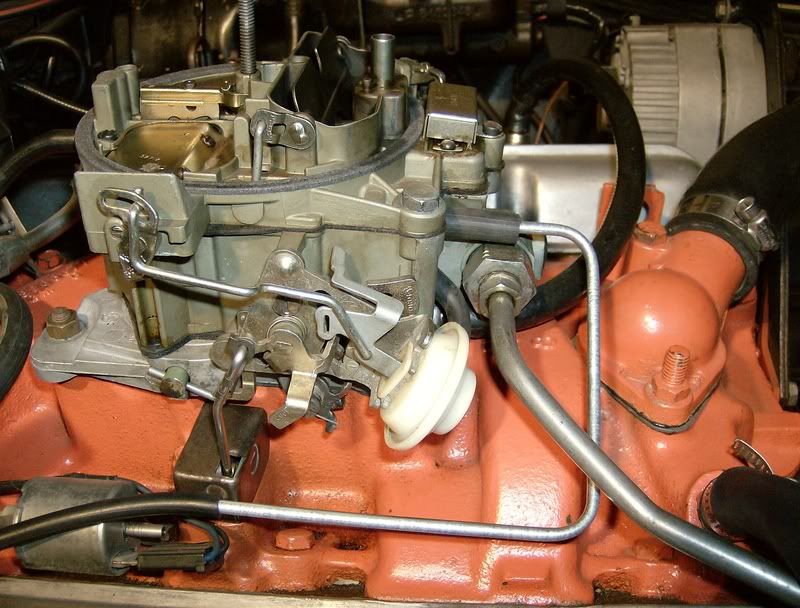
The second is off my L-46 and is a correct 7040207. You'll notice no tube there at all.
Thread Starter
Pro
Joined: May 2006
Posts: 573
Likes: 5
From: Georgetown Township MI
Hello and thank you for your responses.
The next time I go to the barn, hopefully tomorrow,
I will look for the ECS canister you mentioned.
The "rubber lines" I mentioned are not from the carb to fuel pump.
The carb to fuel pump lines are all new as well as the fuel pump and
there is no leak, but thanks for asking just the same.
As we have discussed this, my memory does recall I think,
having the 2 nipples in front, the larger one is connected to the
PCV valve and the smaller one is going to the vacuum advance at
the distributor.
Rudy
The next time I go to the barn, hopefully tomorrow,
I will look for the ECS canister you mentioned.
The "rubber lines" I mentioned are not from the carb to fuel pump.
The carb to fuel pump lines are all new as well as the fuel pump and
there is no leak, but thanks for asking just the same.
As we have discussed this, my memory does recall I think,
having the 2 nipples in front, the larger one is connected to the
PCV valve and the smaller one is going to the vacuum advance at
the distributor.
Rudy
Thread Starter
Pro
Joined: May 2006
Posts: 573
Likes: 5
From: Georgetown Township MI
Dennis,
I see in the first photo, the vacuum line at both the
front and rear of carburetor connect to the spark control solenoid.
What is the primary function of the spark control solenoid?
Do I really need it? I noticed your not using yours. Since I do not
have one currently, I assume in the second photo (your setup)
the smaller rubber line in front going to the metal tube which,
bypasses the spark control solenoid goes to the vacuum advance on
the distributor?
Where then is the rubber hose that comes off the back of the
carburetor going to? Also, do you have a rubber cap on the other
small nipple on the far right front side of your carburetor?
Thanks again.
Joe
[/QUOTE]
I see in the first photo, the vacuum line at both the
front and rear of carburetor connect to the spark control solenoid.
What is the primary function of the spark control solenoid?
Do I really need it? I noticed your not using yours. Since I do not
have one currently, I assume in the second photo (your setup)
the smaller rubber line in front going to the metal tube which,
bypasses the spark control solenoid goes to the vacuum advance on
the distributor?
Where then is the rubber hose that comes off the back of the
carburetor going to? Also, do you have a rubber cap on the other
small nipple on the far right front side of your carburetor?
Thanks again.
Joe
[/QUOTE]
Thread Starter
Pro
Joined: May 2006
Posts: 573
Likes: 5
From: Georgetown Township MI
Dave,
I found out the black canister in my drivers side inner fender is to retain
the vacuum for my wiper door and headlights. Is this the same as an
ECS canister?
Also, the 7040507 carburetor has (3) nipples in front,
(2) smaller, (1) on each side and the larger one which goes to
my left valve cover.
Your carburetor, I assume is 7040207 only has (2) nipples -
(1) small and (1) large? If so, then there's a difference right there
between the 7040207 and the 7040507.
Thanks.
Joe
I found out the black canister in my drivers side inner fender is to retain
the vacuum for my wiper door and headlights. Is this the same as an
ECS canister?
Also, the 7040507 carburetor has (3) nipples in front,
(2) smaller, (1) on each side and the larger one which goes to
my left valve cover.
Your carburetor, I assume is 7040207 only has (2) nipples -
(1) small and (1) large? If so, then there's a difference right there
between the 7040207 and the 7040507.
Thanks.
Joe
Safety Car


Joined: Apr 2000
Posts: 3,802
Likes: 61
From: Wichita KS
Dave,
I found out the black canister in my drivers side inner fender is to retain
the vacuum for my wiper door and headlights. Is this the same as an
ECS canister?
Also, the 7040507 carburetor has (3) nipples in front,
(2) smaller, (1) on each side and the larger one which goes to
my left valve cover.
Your carburetor, I assume is 7040207 only has (2) nipples -
(1) small and (1) large? If so, then there's a difference right there
between the 7040207 and the 7040507.
Thanks.
Joe
I found out the black canister in my drivers side inner fender is to retain
the vacuum for my wiper door and headlights. Is this the same as an
ECS canister?
Also, the 7040507 carburetor has (3) nipples in front,
(2) smaller, (1) on each side and the larger one which goes to
my left valve cover.
Your carburetor, I assume is 7040207 only has (2) nipples -
(1) small and (1) large? If so, then there's a difference right there
between the 7040207 and the 7040507.
Thanks.
Joe
cc
Drifting
Joined: Sep 1999
Posts: 1,970
Likes: 91
Dennis,
I see in the first photo, the vacuum line at both the
front and rear of carburetor connect to the spark control solenoid.
Where then is the rubber hose that comes off the back of the
carburetor going to? Also, do you have a rubber cap on the other
small nipple on the far right front side of your carburetor?
Thanks again.
Joe
QUOTE]
I see in the first photo, the vacuum line at both the
front and rear of carburetor connect to the spark control solenoid.
Where then is the rubber hose that comes off the back of the
carburetor going to? Also, do you have a rubber cap on the other
small nipple on the far right front side of your carburetor?
Thanks again.
Joe
QUOTE]
I have mine disconnected but all there. Runs much better dialed in at 12* BTDC
Also the 207 doesn't have the small a small tube on the driver front. Wonder if that's a 507 thing. Geez can't get a clear answer on this. Any idea's what connects to that other front tube??

Corvette Stories
The Best of Corvette for Corvette Enthusiasts

Corvette ZR1X Will Be Pacing the Indy 500, And Could Probably Race, Too!
Verdad Gallardo
Top 10 Corvettes Coming to Mecum Indy 2026!
Brett Foote
Top 10 C9 Corvette MUST-HAVES to Fix These C8 Generation Flaws!
Michael S. Palmer
10 Revolutionary 'Corvette Firsts' Most People Don't Know
Joe Kucinski
5 Reasons to Upgrade to an LS6-Powered Corvette; 5 Reasons to Stay LT2
Michael S. Palmer
2027 Corvette vs The World: Every C8 vs Its Closest Competitor
Joe Kucinski
10 Most Common Corvette Problems of the Last 20 Years!
Joe Kucinski
5 MOST and 5 LEAST Popular Corvette Model Years in History!
Joe Kucinski
2027 Corvette Buyer's Guide: Everything You Need to Know!
Joe Kucinski
Thread Starter
Pro
Joined: May 2006
Posts: 573
Likes: 5
From: Georgetown Township MI
It's a vacuum tank which stores vacuum to operate
headlamps and wiper doors after engine shutdown.
1972 or possibly 71' I believe was the first year of the charcoal canister.
Drifting
Joined: Mar 2006
Posts: 1,526
Likes: 2
From: Oak Ridge NC
This is what the canister looks like:
http://www.ecklers.com/product.asp?p...2&dept_id=1247
Don't confuse it with your vacuum reserve canister.
Last edited by SmokinBBC; Mar 28, 2009 at 09:39 PM.
Safety Car
Joined: Apr 2000
Posts: 3,802
Likes: 61
From: Wichita KS
Joe, earlier you asked what the purpose of the Transmission Controlled Spark solenoid was. It eliminates vacuum advance except in certain circumstances.
First, if the engine temperature is below 82 degrees or above 232 degrees it will allow vacuum advance through then it will cut it off until you shift into 4th gear.
It is very disconcerting at first to be in fourth gear and slowing down because the idle remains somewhat high, around 1500 rpm, and as soon as you shift out of fourth it drops to normal idle speed.
cc
First, if the engine temperature is below 82 degrees or above 232 degrees it will allow vacuum advance through then it will cut it off until you shift into 4th gear.
It is very disconcerting at first to be in fourth gear and slowing down because the idle remains somewhat high, around 1500 rpm, and as soon as you shift out of fourth it drops to normal idle speed.
cc
Drifting
Joined: Mar 2006
Posts: 1,526
Likes: 2
From: Oak Ridge NC
Joe, earlier you asked what the purpose of the Transmission Controlled Spark solenoid was. It eliminates vacuum advance except in certain circumstances.
First, if the engine temperature is below 82 degrees or above 232 degrees it will allow vacuum advance through then it will cut it off until you shift into 4th gear.
It is very disconcerting at first to be in fourth gear and slowing down because the idle remains somewhat high, around 1500 rpm, and as soon as you shift out of fourth it drops to normal idle speed.
cc
First, if the engine temperature is below 82 degrees or above 232 degrees it will allow vacuum advance through then it will cut it off until you shift into 4th gear.
It is very disconcerting at first to be in fourth gear and slowing down because the idle remains somewhat high, around 1500 rpm, and as soon as you shift out of fourth it drops to normal idle speed.
cc
Safety Car
Joined: Apr 2000
Posts: 3,802
Likes: 61
From: Wichita KS
 All Corvettes have a vacuum reserve tank, at least until they stopped using vacuum headlights. Then I couldn't tell you if they had them or not.
cc
Thread Starter
Pro
Joined: May 2006
Posts: 573
Likes: 5
From: Georgetown Township MI
7040507 is a California carb. California cars had the canister in '70.
This is what the canister looks like:
http://www.ecklers.com/product.asp?p...2&dept_id=1247
Don't confuse it with your vacuum reserve canister.
This is what the canister looks like:
http://www.ecklers.com/product.asp?p...2&dept_id=1247
Don't confuse it with your vacuum reserve canister.
My Bad! I owe you an apology.

There are charcoal canister's on a 70' from California.
I meant to say my "Michigan Car" has a 7040507 California
emissions carburetor (Incorrect) with a vacuum tank, not the
charcoal or fuel vapor canister.
I just wanted the 7040507 to work properly and efficently on my car,
trying to use as close to correct carburetor (7040207) which, I can't afford.
The original carburetor either was trashed and or apparently went by the wayside
when the original block blew up in 1974 and was replaced.
So with a cap on that nipple, will the carburetor still work without causing poor performance?
Thank you.
Rudy
Drifting
Joined: Mar 2006
Posts: 1,526
Likes: 2
From: Oak Ridge NC
Smokin BBC,
My Bad! I owe you an apology.
There are charcoal canister's on a 70' from California.
I meant to say my "Michigan Car" has a 7040507 California
emissions carburetor (Incorrect) with a vacuum tank, not the
charcoal or fuel vapor canister.
I just wanted the 7040507 to work properly and efficently on my car,
trying to use as close to correct carburetor (7040207) which, I can't
afford. The original carburetor either was trashed and or apparently
went by the wayside when the original block blew up in 1974 and was
replaced.
So with a cap on that nipple and the carburetor will still
work without causing poor performance?
Thank you.
Rudy
My Bad! I owe you an apology.
There are charcoal canister's on a 70' from California.
I meant to say my "Michigan Car" has a 7040507 California
emissions carburetor (Incorrect) with a vacuum tank, not the
charcoal or fuel vapor canister.
I just wanted the 7040507 to work properly and efficently on my car,
trying to use as close to correct carburetor (7040207) which, I can't
afford. The original carburetor either was trashed and or apparently
went by the wayside when the original block blew up in 1974 and was
replaced.
So with a cap on that nipple and the carburetor will still
work without causing poor performance?
Thank you.
Rudy
Drifting
Joined: Jul 2006
Posts: 1,259
Likes: 154
From: Deplorableville Nebraska
I must apologize, I've been to a bock beer fest today, just got home. The beer was VERY good! Your buddy's 507 carb should run fine with this set-up. FYI, I ran a '69 (7029207) 350/350 carb on one of my cars for a while, and it did fine. Much more common, and easier to find.
Drifting
Joined: Mar 2006
Posts: 1,526
Likes: 2
From: Oak Ridge NC
I must apologize, I've been to a bock beer fest today, just got home. The beer was VERY good! Your buddy's 507 carb should run fine with this set-up. FYI, I ran a '69 (7029207) 350/350 carb on one of my cars for a while, and it did fine. Much more common, and easier to find. Gotta love a beerfest!