






Ragjoint question

Thread Starter
Advanced

Joined: May 2008
Posts: 50
Likes: 0
From: Port Washington Wi
 Ragjoint question
Steering on my '79 is a little sloppy and I'm would like to tighten it up. I've seen numerous posts that reccomend replacement of the ragjoint as a cure. My question is what exactly wears on the joint? Is it the bolts, the holes in the flange?

Burning Brakes

Joined: Jun 2008
Posts: 1,086
Likes: 1
From: Michigan
You need to either move the steering column partially back into the cabin or unbolt the steering box and move it out of the way to replace the rag joint. Don't rebuild it, replace it. You may also want to take a look at your steering box lubrication, bearing end play and worm gear lash adjustments as well.
I had 6" of play in either direction when I bought the car. Now that I have replaced the rag joint, lubed the steering box and made the steering box adjustments there is no longer any play.
Replacing the rag joint and making the steering box adjustments is also a good opportunity to align the steering system and steering wheel as well.
http://jimshea.corvettefaq.com/?page_id=4
I had 6" of play in either direction when I bought the car. Now that I have replaced the rag joint, lubed the steering box and made the steering box adjustments there is no longer any play.
Replacing the rag joint and making the steering box adjustments is also a good opportunity to align the steering system and steering wheel as well.
http://jimshea.corvettefaq.com/?page_id=4
Last edited by 08vycpe; Apr 9, 2009 at 05:01 PM.

Burning Brakes

Joined: Jan 2009
Posts: 1,224
Likes: 1
From: Clarksville Indiana
watch it while somebody turns your steering wheel back and forth and see if thats where your slop is.. I would think there would be more chance the slop would be in the steering gear.

Team Owner


Joined: Jan 2006
Posts: 37,637
Likes: 3,118
From: Crossville TN
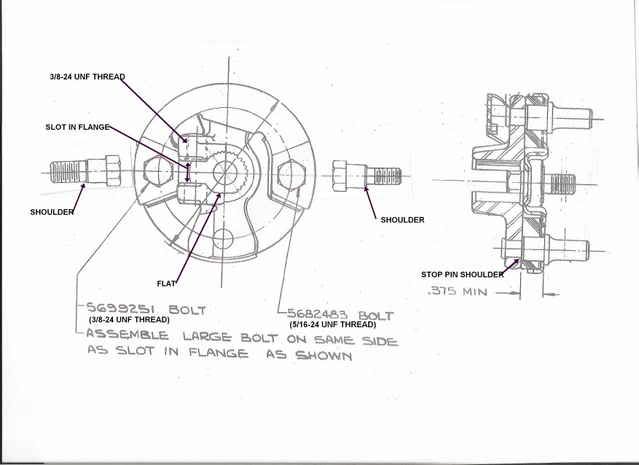
If the metal parts of the ragjoint are in good shape, just change out the fiber flex 'donut'. There are suppliers that sell just those. It is normally the only thing that wears out. The two bolts going through the fiber washer are of different size, so keep track of which goes where and rebuild it the same way. You will have to completely remove the locking bolts from the flanges to remove them from their shafts.

Le Mans Master


Joined: Jul 2000
Posts: 6,001
Likes: 113
From: Saginaw Michigan
The problem that I find with most rebuild "kits" is that the supplied bolts are not shoulder bolts like the original. You should never make a critical bolted connection through rubber. You need a metal to metal connection to be secure.
Even if you double nut; use torque prevailing nuts; Loctite the connection; etc, the rubber relaxes with time and the connection will loosen.
Be sure to use the nuts, bolts, and lockwashers that came with your original assembly regardless as to how rusty they might be. They are shoulder bolts.
One other thing, all of the rebuild "kits" that I have examined do not provide a method of electrical grounding through the rubber disc. You may note that your original disc has sharp metal screening sticking out from the edge of the disc. The metal screening was not for strength but actually conducted electrical current across the disc for your horn. Very early flex coupling assemblies (1963-1971) actually had a ground strap or wire that circled around the inside "donut hole" in the rubber disc.
If at all possible, I recommend that you purchase a NOS or an OEM replacement flexible coupling.
Jim
Even if you double nut; use torque prevailing nuts; Loctite the connection; etc, the rubber relaxes with time and the connection will loosen.
Be sure to use the nuts, bolts, and lockwashers that came with your original assembly regardless as to how rusty they might be. They are shoulder bolts.
One other thing, all of the rebuild "kits" that I have examined do not provide a method of electrical grounding through the rubber disc. You may note that your original disc has sharp metal screening sticking out from the edge of the disc. The metal screening was not for strength but actually conducted electrical current across the disc for your horn. Very early flex coupling assemblies (1963-1971) actually had a ground strap or wire that circled around the inside "donut hole" in the rubber disc.
If at all possible, I recommend that you purchase a NOS or an OEM replacement flexible coupling.
Jim
Tech Contributor


Joined: Aug 1999
Posts: 15,188
Likes: 4,010
From: Connecticut, USA
Jim is correct, use a new GM rag while you can still get them. I've seen many of the kits and aftermarket joints sold. Corvette steering is the only place that I would trust with a rebuilt joint as he suppplies many of the vendors. Some of the rags sold are so flimsy they offer worse feel then a worn out one, others had the D flat 180* off. Spend the $100 on this part.
Corvette Stories
The Best of Corvette for Corvette Enthusiasts

Every 2027 Corvette Engine Explained
Joe Kucinski
Designer Imagines A Corvette That Looks More Like a Corvette Than the Corvette
Verdad Gallardo
10 Ugly Corvettes That We Still Kinda Love
Joe Kucinski
Top 10 Most Expensive Corvettes Ever Sold on Bring A Trailer
Brett Foote
10 Things Every Corvette Owner Needs (2026 Edition)
Michael S. Palmer
8 Most "Only Corvette Owners Understand" Quirks and Problems
Pouria Savadkouei
10 Reasons the C6 Z06 is Still A Performance Benchmark After 20 Years
Joe Kucinski
How Much Horsepower Every Corvette Engine "LOST" in 1972
Joe Kucinski
Top 10 DOs and DON'Ts for Protecting Your Convertible Top!
Michael S. Palmer
Le Mans Master
Joined: Jul 2000
Posts: 6,001
Likes: 113
From: Saginaw Michigan
Not true 7T1Vette. You will not find a metal connection between adjacent quadrants of a flexible coupling assembly unless it has the screen face on the disc or it has a internal strap or wire. A metal connection between opposite quadrants will not get electrical current from one flange to the other.
Jim
Jim
