









Worn Distributor Gear

Thread Starter
Racer


Joined: Feb 2007
Posts: 389
Likes: 7
From: Cliffwood Beach NJ

It retards timing (steady rpm) and increases spark scatter.
Worn gear was discovered due to a manifold change, wonder how long it would have taken to figure out.

Race Director


Joined: Jan 2000
Posts: 13,022
Likes: 2,265
From: Corsicana, Tx
2020 C2 of the Year - Modified Winner
2020 Corvette of the Year (performance mods)
C2 of Year Winner (performance mods) 2019
2017 C2 of Year Finalist
Interestingly, often a high gear timing retard works to increase MPH.
You're probably getting erratic timing if it's worn that much. You can see it on a timing light as marks bounce around everywhere.
Cut a .030 slot in the dist housing to provide oil directly to the gear when you install the new one.
JIM
You're probably getting erratic timing if it's worn that much. You can see it on a timing light as marks bounce around everywhere.
Cut a .030 slot in the dist housing to provide oil directly to the gear when you install the new one.
JIM

Race Director
Joined: Dec 2007
Posts: 14,345
Likes: 4
From: Hartselle AL
St. Jude Donor '09
Are you sure it is the actual gear teeth that are worn? On my old dist. the spacer bushings/shims wore allowing the shaft to move up and down. That could effect the timing and mine was chewing up the cap and rotor.

Team Owner


Joined: Jan 2006
Posts: 37,637
Likes: 3,118
From: Crossville TN
Worn gear teeth (either component) allow backlash [slop] into the gear mesh. Thus, the timing can wander a bit. If the wear is consistent between all teeth, timing will not drift as long as engine RPM are increasing due to the gears maintaining mesh on the 'drive' side of the gear teeth. But, when RPM begins to decrease, the gear teeth separate (due to the wear on them) and the timing shifts. Any steady speed will show the timing to be erratic as the gear teeth move [back-and-forth] between 'coast' and 'drive' side of the teeth. Keep in mind that the distributor gear is relatively small in diameter, so wear in the gear translates to timing error pretty quickly.
Corvette Stories
The Best of Corvette for Corvette Enthusiasts

Every 2027 Corvette Engine Explained
Joe Kucinski
Designer Imagines A Corvette That Looks More Like a Corvette Than the Corvette
Verdad Gallardo
10 Ugly Corvettes That We Still Kinda Love
Joe Kucinski
Top 10 Most Expensive Corvettes Ever Sold on Bring A Trailer
Brett Foote
10 Things Every Corvette Owner Needs (2026 Edition)
Michael S. Palmer
8 Most "Only Corvette Owners Understand" Quirks and Problems
Pouria Savadkouei
10 Reasons the C6 Z06 is Still A Performance Benchmark After 20 Years
Joe Kucinski
How Much Horsepower Every Corvette Engine "LOST" in 1972
Joe Kucinski
Top 10 DOs and DON'Ts for Protecting Your Convertible Top!
Michael S. Palmer


 [/IMG]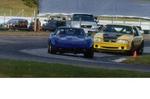

Thread Starter
Racer
Joined: Feb 2007
Posts: 389
Likes: 7
From: Cliffwood Beach NJ
results from the track today....
Ran best of 12.20 which is the best we have seen in awhile, with a top speed 116.26, which is the highest this year.
Guess timing is everything.
Ran best of 12.20 which is the best we have seen in awhile, with a top speed 116.26, which is the highest this year.
Guess timing is everything.
