




Engine tuning almost finished !!!
Thread Starter
Burning Brakes


Joined: Aug 2005
Posts: 1,164
Likes: 1
From: Europe, France
 Engine tuning almost finished !!!
I think this time I'm finished with the tuning of my engine !!! 
First, specs :
350CI- L82 - 1973 - Manual transmission
Intake manifold : Holley Street Dominator ( single-plane )
Carburetor : Holley 0-4776-S ( 600 CFM double pumper ), Stock jets : 122-66 & 122-73, 2 pink pump cams, nozzles : 28 & 32
Stock heads, but ported, and it seems that I have Bee-Hive springs on them, so I don't know what else had already been changed...
Stainless steel headers and exhaust lines ( 2,5" )
Camshaft : Unknown, but hydraulic lifters.
Tuning helps : Innovate LM-2, G-Tech SS
Recording : AFR, RPM, MAP, TPS.
And now, the pictures :
MAP sender :

TPS Sender :

LM-2 & G-Tech :


Here is the result of my ( long ) investigation :
- The single plane intake manifold was way too hot for Summer. So the exhaust crossover has been TIG welded, fully closed. Sorry, no pictures !
- The stock carb gasket wasn't thick enough, causing fuel vaporlock in Summer at very low speeds.
This has been fixed with a sandwich made of two gaskets with a large aluminum sheet between them, acting as a heat sink ( Hood clearance is low ! ). Easy, but really effective :

- The old air filter ( Edelbrock 1002 proflow, see below... ) was too restrictive, causing power loss and a rich AFR at high RPM + high load conditions :

A KNN air cleaner solved the issue :

I made my own aluminum stubstack, and adjusted it with the TRANSDAPT air filter base :

I milled the choke tower, too :

And now the results :
- I was a little surprised, but the stock main jets were pretty close to perfection. Only the secondaries were a bit lean. One size bigger was enough to reach optimum AFR.
- On the contrary, the squirters ( primaries : 28 and secondaries : 32 ) were really too small for my application... Even with the strongest pump cams. Single plane manifolds really like an early big shot !
So I purchased two "tube type" 0.035" discharge nozzles for both primary and secondary, and used the orange cam on primaries and green one on secondaries.
The transition is now really smooth between cruise circuits and main jets, and I get 11.6 < AFR < 13.0 during the transition ( about 0,3 second ).
( AFR was more than 16.0 with the stock pink pump cams and nozzles, causing serious bogs and sometimes backfires ).
Primaries didn't need all the pump capacity, but the secondaries almost did.
- Stabilized AFR at WOT is now : 12,8 at 3000 RPM and close to 12,4 at 6000 RPM ( outside air temperature = 77°F )
I tried main jets one size bigger and one size smaller, but power seems lower in both cases.
- Stock power valve is rated at 6,5" Hg and seems to work great like this, but I didn't try others, so I can't be sure it's the best one...
- Total timing is set at 37° BTDC, all in at 2800 RPM. Vacuum advance is 15° at 10" Hg ( on manifold vacuum ), centrifugal advance is 20°, idle at 1000 RPM ( engine pulls 13" Hg vacuum ).
I didn't try yet to change timing and see how it affects engine power and torque ( recorded with the G-Tech ), but I think it will be next and last step
- Oh yes, one more thing : it seems that engine power hasn't yet reached its maximum at 6000 RPM ( power curve still rising ), but I don't want to rev it higher :
Hydraulic lifters, MSD-6AL limiter set at 6200 RPM and maybe soon limited by carb cfm...
First, specs :
350CI- L82 - 1973 - Manual transmission
Intake manifold : Holley Street Dominator ( single-plane )
Carburetor : Holley 0-4776-S ( 600 CFM double pumper ), Stock jets : 122-66 & 122-73, 2 pink pump cams, nozzles : 28 & 32
Stock heads, but ported, and it seems that I have Bee-Hive springs on them, so I don't know what else had already been changed...
Stainless steel headers and exhaust lines ( 2,5" )
Camshaft : Unknown, but hydraulic lifters.
Tuning helps : Innovate LM-2, G-Tech SS
Recording : AFR, RPM, MAP, TPS.
And now, the pictures :
MAP sender :
TPS Sender :
LM-2 & G-Tech :
Here is the result of my ( long ) investigation :
- The single plane intake manifold was way too hot for Summer. So the exhaust crossover has been TIG welded, fully closed. Sorry, no pictures !
- The stock carb gasket wasn't thick enough, causing fuel vaporlock in Summer at very low speeds.
This has been fixed with a sandwich made of two gaskets with a large aluminum sheet between them, acting as a heat sink ( Hood clearance is low ! ). Easy, but really effective :
- The old air filter ( Edelbrock 1002 proflow, see below... ) was too restrictive, causing power loss and a rich AFR at high RPM + high load conditions :
A KNN air cleaner solved the issue :
I made my own aluminum stubstack, and adjusted it with the TRANSDAPT air filter base :
I milled the choke tower, too :
And now the results :
- I was a little surprised, but the stock main jets were pretty close to perfection. Only the secondaries were a bit lean. One size bigger was enough to reach optimum AFR.
- On the contrary, the squirters ( primaries : 28 and secondaries : 32 ) were really too small for my application... Even with the strongest pump cams. Single plane manifolds really like an early big shot !
So I purchased two "tube type" 0.035" discharge nozzles for both primary and secondary, and used the orange cam on primaries and green one on secondaries.
The transition is now really smooth between cruise circuits and main jets, and I get 11.6 < AFR < 13.0 during the transition ( about 0,3 second ).
( AFR was more than 16.0 with the stock pink pump cams and nozzles, causing serious bogs and sometimes backfires ).
Primaries didn't need all the pump capacity, but the secondaries almost did.
- Stabilized AFR at WOT is now : 12,8 at 3000 RPM and close to 12,4 at 6000 RPM ( outside air temperature = 77°F )
I tried main jets one size bigger and one size smaller, but power seems lower in both cases.
- Stock power valve is rated at 6,5" Hg and seems to work great like this, but I didn't try others, so I can't be sure it's the best one...
- Total timing is set at 37° BTDC, all in at 2800 RPM. Vacuum advance is 15° at 10" Hg ( on manifold vacuum ), centrifugal advance is 20°, idle at 1000 RPM ( engine pulls 13" Hg vacuum ).
I didn't try yet to change timing and see how it affects engine power and torque ( recorded with the G-Tech ), but I think it will be next and last step
- Oh yes, one more thing : it seems that engine power hasn't yet reached its maximum at 6000 RPM ( power curve still rising ), but I don't want to rev it higher :
Hydraulic lifters, MSD-6AL limiter set at 6200 RPM and maybe soon limited by carb cfm...
Last edited by 73StreetRace; Jul 20, 2009 at 12:27 PM.
Pro

Joined: Mar 2009
Posts: 703
Likes: 2
I like the gauge arrangment and location.. Maybe I will move my Tac and shift light like yours. Right now they are a little to close to my wheel.
Looks like someone has alot of work into those stock heads.. Just curious, can you post more about the heads like chamber size, valve size and were they opening up from stock?
What does the short block consist of? and have you had a chance to test drive it yet?
Lokks great
Looks like someone has alot of work into those stock heads.. Just curious, can you post more about the heads like chamber size, valve size and were they opening up from stock?
What does the short block consist of? and have you had a chance to test drive it yet?
Lokks great
Thread Starter
Burning Brakes
Joined: Aug 2005
Posts: 1,164
Likes: 1
From: Europe, France
Sorry, but I don't know much about the history of the heads. Never removed them. Maybe one day 
But I'm going to remove some valve springs in a few days to see what kind of valve stem seals I have ( they are not stock, look like rubber with teflon insert ) :

However, I can show you two more pictures of the gauges if you want :
:

Gauges seen from the driver seat :

But I'm going to remove some valve springs in a few days to see what kind of valve stem seals I have ( they are not stock, look like rubber with teflon insert ) :
However, I can show you two more pictures of the gauges if you want
:Gauges seen from the driver seat :
Last edited by 73StreetRace; Jul 21, 2009 at 07:07 AM.

Intermediate

Joined: Sep 2005
Posts: 47
Likes: 0
From: Elberta AL
I have been working on these same things. Is 12.8 AFR optimum for HP? Where is your AFR at cruise? Could you post a log from the LM2 for me to look over? And don't overlook timing, it plays a big role in tuning.
Thread Starter
Burning Brakes
Joined: Aug 2005
Posts: 1,164
Likes: 1
From: Europe, France
As far as I know, most engines make maximum power with an AFR between 12,6 and 12,8 as a rule of thumb.
But actually, the optimum AFR is a curve, depending on RPM and engine modifications.
These are the values I found in a Holley tuning book :
Standard Engine Optimum AFR ( WOT ) :
1000 RPM -> 13,9
2000 RPM -> 12,9
3000 RPM -> 12,5
4000 RPM -> 12,5
5000 RPM -> 12,45
Slightly Modified Engine Optimum AFR ( WOT ) :
1000 RPM -> 13,3
2000 RPM -> 13,1
3000 RPM -> 12,45
4000 RPM -> 12,4
5000 RPM -> 12,3
6000 RPM -> 12,25
For a race car, AFR is even richer. However, I think these values are on the rich side ( no chance to melt a piston ! ). My experience is that 12,5 -12,8 seems to make a little more power. The fact is, with colder temperatures, air density increases, and AFR moves to the lean side ( about 0,2 AFR variation each 9°F ). Hygrometry and air pressure also affects AFR. So jetting can be perfect only in very precise atmospheric conditions. This is where fuel injection exceeds carburetion.
The best way to know which AFR value is the best for your engine is a dyno test or a 1/4 mile run...
About the AFR at cruise, I get between 13.0 and 13.5. This is of course a little rich, but all double pumpers are built like this.
They are not economy carburetors, their purpose is not to save fuel, but to make power.
I still have to record some logs with the LM-2 and I will post a log file ASAP. Keep tuned.
But actually, the optimum AFR is a curve, depending on RPM and engine modifications.
These are the values I found in a Holley tuning book :
Standard Engine Optimum AFR ( WOT ) :
1000 RPM -> 13,9
2000 RPM -> 12,9
3000 RPM -> 12,5
4000 RPM -> 12,5
5000 RPM -> 12,45
Slightly Modified Engine Optimum AFR ( WOT ) :
1000 RPM -> 13,3
2000 RPM -> 13,1
3000 RPM -> 12,45
4000 RPM -> 12,4
5000 RPM -> 12,3
6000 RPM -> 12,25
For a race car, AFR is even richer. However, I think these values are on the rich side ( no chance to melt a piston ! ). My experience is that 12,5 -12,8 seems to make a little more power. The fact is, with colder temperatures, air density increases, and AFR moves to the lean side ( about 0,2 AFR variation each 9°F ). Hygrometry and air pressure also affects AFR. So jetting can be perfect only in very precise atmospheric conditions. This is where fuel injection exceeds carburetion.
The best way to know which AFR value is the best for your engine is a dyno test or a 1/4 mile run...
About the AFR at cruise, I get between 13.0 and 13.5. This is of course a little rich, but all double pumpers are built like this.
They are not economy carburetors, their purpose is not to save fuel, but to make power.
I still have to record some logs with the LM-2 and I will post a log file ASAP. Keep tuned.
Last edited by 73StreetRace; Jul 20, 2009 at 12:30 PM.
Intermediate
Joined: Sep 2005
Posts: 47
Likes: 0
From: Elberta AL
So a little rich in this hot weather should be close to optimum when cooler temps arive. I am cruising at 13.2 to 13.6 as I thought this was rich I was just wanting to compare and see if it was the norm for a dp. I have recently dove into the LS1 tuning world and some of the tuning translates over to carbs, but the LS and a carbed small block are totally different beasts. I logged some 1/4 mile runs yesterday. I'll try to get them posted tommorrow.
Thread Starter
Burning Brakes
Joined: Aug 2005
Posts: 1,164
Likes: 1
From: Europe, France
So, here are the final results :
The following picture shows a pull in second gear from 2600 RPM to 5800 RPM.
The two horizontal lines are 12.5 and 12.8 AFR marks.
The green plot is TPS and the red one is MAP ( both with some noise, caused by the extreme sensibility of the LM-2 ).
Note that the MAP sensor was not not perfectly calibrated the D-day, so 1,7" Hg vacuum is actually atmospheric pressure
No plots are smoothed. I tried every cam, even the biggest for 30cc pump ( blue ) and I still have a slight peak when TPS goes to WOT.
It's the same ( worst ) with bigger nozzles ( I tried 0,040 and 0,042" ).
I think it takes some time to vaporize the fuel discharged from the nozzles, but air arrives instantly with a double pumper. This is the best configuration I have found. Acceleration is very clean, no bog, no noticeable hesitation at any time. The green, red and white cam were too bumpy, the pink and orange one not enough.
I slightly modified the white cam so it has a shape between the green and the pink cams.
Speed at 6000 RPM ( 2nd gear ) is 87 MPH. I made 3 or 4 other pulls, with the same consistent results. Outside air temperature was 79°F during the recording.
If someone wants the .log or .d32 file ( full length : 11 minutes ), send me a PM...

The following picture shows a pull in second gear from 2600 RPM to 5800 RPM.
The two horizontal lines are 12.5 and 12.8 AFR marks.
The green plot is TPS and the red one is MAP ( both with some noise, caused by the extreme sensibility of the LM-2
).Note that the MAP sensor was not not perfectly calibrated the D-day, so 1,7" Hg vacuum is actually atmospheric pressure
No plots are smoothed. I tried every cam, even the biggest for 30cc pump ( blue ) and I still have a slight peak when TPS goes to WOT.
It's the same ( worst ) with bigger nozzles ( I tried 0,040 and 0,042" ).
I think it takes some time to vaporize the fuel discharged from the nozzles, but air arrives instantly with a double pumper. This is the best configuration I have found. Acceleration is very clean, no bog, no noticeable hesitation at any time. The green, red and white cam were too bumpy, the pink and orange one not enough.
I slightly modified the white cam so it has a shape between the green and the pink cams.
Speed at 6000 RPM ( 2nd gear ) is 87 MPH. I made 3 or 4 other pulls, with the same consistent results. Outside air temperature was 79°F during the recording.
If someone wants the .log or .d32 file ( full length : 11 minutes ), send me a PM...
Last edited by 73StreetRace; Jul 29, 2009 at 04:38 AM.
Corvette Stories
The Best of Corvette for Corvette Enthusiasts

Top 10 Most Explosive Corvettes Ever Made: Power-to-Weight Ratio Ranked!
Joe Kucinski
150 hp to 1,250 hp: Every Corvette Generation Compared by the Specs That Matter
Joe Kucinski
8 Coolest Corvette Pace Cars (and Replicas) of All Time
Verdad Gallardo
Top 10 Corvette Engines RANKED by Peak Torque (70+ Years of Muscle!)
Joe Kucinski
Corvette ZR1X Will Be Pacing the Indy 500, And Could Probably Race, Too!
Verdad Gallardo
Top 10 Corvettes Coming to Mecum Indy 2026!
Brett Foote
Top 10 C9 Corvette MUST-HAVES to Fix These C8 Generation Flaws!
Michael S. Palmer
10 Revolutionary 'Corvette Firsts' Most People Don't Know
Joe Kucinski
5 Reasons to Upgrade to an LS6-Powered Corvette; 5 Reasons to Stay LT2
Michael S. Palmer

 Didn't know this one
Thread Starter
Burning Brakes
Joined: Aug 2005
Posts: 1,164
Likes: 1
From: Europe, France
It's a "home made" stainless steel necklace. I used a tape of rubber ( inner tube ) between the steering column and the necklace.
This helps to prevent scratches on paint, dampers vibrations transmitted to the instruments and also prevents them from moving.
The necklace has been sandblasted and painted ( black ) :

I made one for the tachometer too ( the middle part is made of aluminum ) :

This helps to prevent scratches on paint, dampers vibrations transmitted to the instruments and also prevents them from moving.
The necklace has been sandblasted and painted ( black ) :
I made one for the tachometer too ( the middle part is made of aluminum ) :
Last edited by 73StreetRace; Jul 29, 2009 at 01:01 AM.


Race Director


Joined: Apr 2000
Posts: 17,676
Likes: 201
From: Who says "Nothing is impossible" ? I've been doing nothing for years.
Mine runs around 13.5 at cruise, these Gen 1 motors like it rich especially if you have them slightly modified. I can set it to run anywhere I want, 15:1 if I want but the motor doesn't like it and I get lean misses.
My tach is moved closer to the steering wheel, believe it or not my tilt / telescope still works and my hands never hit the tach
BTW nice job on everything you've done
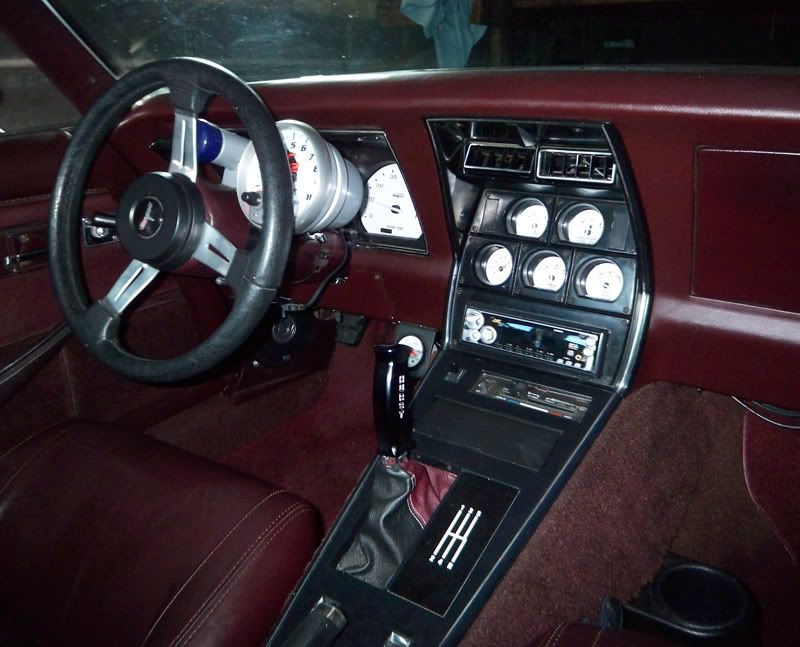
My tach is moved closer to the steering wheel, believe it or not my tilt / telescope still works and my hands never hit the tach
BTW nice job on everything you've done
Thread Starter
Burning Brakes
Joined: Aug 2005
Posts: 1,164
Likes: 1
From: Europe, France
I think the steering column was much longer in the oldest C3, and the stock instruments were deeply "inlaid" in the dashboard, so it was certainly easier for me to fit in a huge tachometer...
BTW, awesome Vette you have, too
Thanks everyone for the compliments !
Last edited by 73StreetRace; Jul 29, 2009 at 01:47 AM.

Pro
Joined: Sep 2008
Posts: 508
Likes: 1
From: Olive Branch MS
Just some more experience info with A/F ratio. Same as Motorhead said, I found mine (almost the same motor) likes to cruise a 13.5 or so. I can cruise at 14.7 with a push of a button, but you can just tell isn't happy. What I've found on the dyno with some really top notch builds (Nascar) is that the more efficient the heads, the leaner they make peak power. I've seen motors make best power at 13.5 and was amazed actually. These had very good heads though. Most of our "street heads" are not that good and will like 13.0 to 12.5 depending on your combustion chamber and piston type (flat or domed). Domed usually hurts efficiency some.
Intermediate
Joined: Sep 2005
Posts: 47
Likes: 0
From: Elberta AL
I tried every cam, even the biggest for 30cc pump ( blue ) and I still have a slight peak when TPS goes to WOT.
It's the same ( worst ) with bigger nozzles ( I tried 0,040 and 0,042" ).
I think it takes some time to vaporize the fuel discharged from the nozzles, but air arrives instantly with a double pumper. This is the best configuration I have found. Acceleration is very clean, no bog, no noticeable hesitation at any time. The green, red and white cam were too bumpy, the pink and orange one not enough.
I slightly modified the white cam so it has a shape between the green and the pink cams.
It's the same ( worst ) with bigger nozzles ( I tried 0,040 and 0,042" ).
I think it takes some time to vaporize the fuel discharged from the nozzles, but air arrives instantly with a double pumper. This is the best configuration I have found. Acceleration is very clean, no bog, no noticeable hesitation at any time. The green, red and white cam were too bumpy, the pink and orange one not enough.
I slightly modified the white cam so it has a shape between the green and the pink cams.
Thread Starter
Burning Brakes
Joined: Aug 2005
Posts: 1,164
Likes: 1
From: Europe, France

Actually, the green cam was the first I tried, and I still had the same lean pike, immediatly followed by a very rich pike ( 10,0 AFR ).
However, If I depress the throttle pedal slightly slower, or if i punch it at a higher RPM, the lean pike is much smaller.