


Engine tuning almost finished !!!


Melting Slicks


Joined: Oct 2002
Posts: 2,317
Likes: 111
From: St Louis MO

Good job with the instrumentation and tuning!
It appears that you still have some horsepower left on the table - the MAP (vacuum) is rising as RPM increases to ~2" Hg. A larger carburetor will help gain an inch of MAP, lowering the vacuum to ~1" Hg, and therefore producing more power.
Can you send us DIY guys the schematic for the TPS and MAP sensors?
Cheers!
It appears that you still have some horsepower left on the table - the MAP (vacuum) is rising as RPM increases to ~2" Hg. A larger carburetor will help gain an inch of MAP, lowering the vacuum to ~1" Hg, and therefore producing more power.
Can you send us DIY guys the schematic for the TPS and MAP sensors?
Cheers!
Thread Starter
Burning Brakes


Joined: Aug 2005
Posts: 1,164
Likes: 1
From: Europe, France
Good job with the instrumentation and tuning!
It appears that you still have some horsepower left on the table - the MAP (vacuum) is rising as RPM increases to ~2" Hg. A larger carburetor will help gain an inch of MAP, lowering the vacuum to ~1" Hg, and therefore producing more power.
Can you send us DIY guys the schematic for the TPS and MAP sensors?
Cheers!
It appears that you still have some horsepower left on the table - the MAP (vacuum) is rising as RPM increases to ~2" Hg. A larger carburetor will help gain an inch of MAP, lowering the vacuum to ~1" Hg, and therefore producing more power.
Can you send us DIY guys the schematic for the TPS and MAP sensors?
Cheers!
 :
:
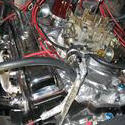
I removed the sensors this morning, so here are a few more pictures :

Take notice of the shielded wire ( 3 conductors including the shield ). Red is +12V, Shield is ground ( 0V ), Yellow is the analog signal.
Metal plate is made of stainless steel, TIG welded :

I had enough room for two 1000µF capacitors on the MAP sensor, so I did it. All components are epoxied ( 5 min Araldite )
Blue wire is Negative ( ground ), Brown is Positive ( +12V ), Green is signal. I didn't use shielded wire here because the LM-2 connector is really close to the circuit :

Last edited by 73StreetRace; Aug 1, 2009 at 06:17 AM.
Le Mans Master

Joined: Oct 2002
Posts: 7,098
Likes: 378
From: Las Vegas - Just stop perpetuating myths please.
I like those timing numbers.
I think this time I'm finished with the tuning of my engine !!! 
First, specs :
350CI- L82 - 1973 - Manual transmission
Intake manifold : Holley Street tor ( single-plane )
Carburetor : Holley 0-4776-S ( 600 CFM double pumper ), Stock jets : 122-66 & 122-73, 2 pink pump cams, nozzles : 28 & 32
Stock heads, but ported, and it seems that I have Bee-Hive springs on them, so I don't know what else had already been changed...
Stainless steel headers and exhaust lines ( 2,5" )
Camshaft : Unknown, but hydraulic lifters.
Tuning helps : Innovate LM-2, G-Tech SS
Recording : AFR, RPM, MAP, TPS.
Here is the result of my ( long ) investigation :
- .....
( AFR was more than 16.0 with the stock pink pump cams and nozzles, causing serious bogs and sometimes backfires ).
Primaries didn't need all the pump capacity, but the secondaries almost did.
- Stabilized AFR at WOT is now : 12,8 at 3000 RPM and close to 12,4 at 6000 RPM ( outside air temperature = 77°F )
I tried main jets one size bigger and one size smaller, but power seems lower in both cases.
- Stock power valve is rated at 6,5" Hg and seems to work great like this, but I didn't try others, so I can't be sure it's the best one...
- Total timing is set at 37° BTDC, all in at 2800 RPM. Vacuum advance is 15° at 10" Hg ( on manifold vacuum ), centrifugal advance is 20°, idle at 1000 RPM ( engine pulls 13" Hg vacuum ).
I didn't try yet to change timing and see how it affects engine power and torque ( recorded with the G-Tech ), but I think it will be next and last step
- Oh yes, one more thing : it seems that engine power hasn't yet reached its maximum at 6000 RPM ( power curve still rising ), but I don't want to rev it higher :
Hydraulic lifters, MSD-6AL limiter set at 6200 RPM and maybe soon limited by carb cfm...
First, specs :
350CI- L82 - 1973 - Manual transmission
Intake manifold : Holley Street tor ( single-plane )
Carburetor : Holley 0-4776-S ( 600 CFM double pumper ), Stock jets : 122-66 & 122-73, 2 pink pump cams, nozzles : 28 & 32
Stock heads, but ported, and it seems that I have Bee-Hive springs on them, so I don't know what else had already been changed...
Stainless steel headers and exhaust lines ( 2,5" )
Camshaft : Unknown, but hydraulic lifters.
Tuning helps : Innovate LM-2, G-Tech SS
Recording : AFR, RPM, MAP, TPS.
Here is the result of my ( long ) investigation :
- .....
( AFR was more than 16.0 with the stock pink pump cams and nozzles, causing serious bogs and sometimes backfires ).
Primaries didn't need all the pump capacity, but the secondaries almost did.
- Stabilized AFR at WOT is now : 12,8 at 3000 RPM and close to 12,4 at 6000 RPM ( outside air temperature = 77°F )
I tried main jets one size bigger and one size smaller, but power seems lower in both cases.
- Stock power valve is rated at 6,5" Hg and seems to work great like this, but I didn't try others, so I can't be sure it's the best one...
- Total timing is set at 37° BTDC, all in at 2800 RPM. Vacuum advance is 15° at 10" Hg ( on manifold vacuum ), centrifugal advance is 20°, idle at 1000 RPM ( engine pulls 13" Hg vacuum ).
I didn't try yet to change timing and see how it affects engine power and torque ( recorded with the G-Tech ), but I think it will be next and last step
- Oh yes, one more thing : it seems that engine power hasn't yet reached its maximum at 6000 RPM ( power curve still rising ), but I don't want to rev it higher :
Hydraulic lifters, MSD-6AL limiter set at 6200 RPM and maybe soon limited by carb cfm...
Total = 37*. That's like right out'a the books.
 What i read is 15* from vac adv and 20* mechanical leaves your initial timing (with vac adv disconnected) = 2*? Yes? Is so please comment on how well easy it starts and idles. But on a low compression motor u may well be able to use more initial adv - more like 8* - 10*.
Also, how did you develop your adv curve? Unloaded in the garage or loaded on the road? Listen for pre-ignition ping/knock? How?

Thx for posting, this is great info for the forum as way too many want to install expensive engine parts before learning how to tune the ignition let alone the carb. But you have set the standard here for tuning effort.

cardo0


Race Director


Joined: Apr 2000
Posts: 17,676
Likes: 201
From: Who says "Nothing is impossible" ? I've been doing nothing for years.
That's great work, I always fooled around with the idea of a TPS and Map sender but never had the time to do it. I do have my LM-1 inside the Vette at all times though 
Thread Starter
Burning Brakes
Joined: Aug 2005
Posts: 1,164
Likes: 1
From: Europe, France
Total = 37*. That's like right out'a the books. What i read is 15* from vac adv and 20* mechanical leaves your initial timing (with vac adv disconnected) = 2*? Yes? Is so please comment on how well easy it starts and idles. But on a low compression motor u may well be able to use more initial adv - more like 8* - 10*.
Also, how did you develop your adv curve? Unloaded in the garage or loaded on the road? Listen for pre-ignition ping/knock? How?
cardo0
Also, how did you develop your adv curve? Unloaded in the garage or loaded on the road? Listen for pre-ignition ping/knock? How?
cardo0
So advance at idle is 37° - 20° = 17° + vacuum advance = 31°.
Starter only sees 17° ( almost no vacuum ), which is already much more than the stock 8° at 900 RPM.
About the advance curve, I started at 36° total and tried it on the road.
The G-Tech can give accurate informations about the ellapsed time between two speeds, le'ts say 40 MPH and 80 MPH.
Once you have the time needed to accelerate ( at WOT ) from 40 to 80 MPH, ( and without changing gear ) you modify total timing by turning slightly the distributor body ( 1° at each run ).
Then you compare the new ellapsed time with the previous one. You must choose the same road in the same atmospheric conditions to achieve the best possible comparison, so that means the same day, at least.
The best ET is associated to the best timing for your car.
About total advance + vacuum advance, I knew it had to be between 52-54°, so I limited it to 15° ( 37 + 15 = 52° ).
I had first tried 54°, but the car was jerking a little at cruise. As idle vacuum is 13" Hg, I set the can to give full advance at 10" Hg.
This is only for economy and has nothing to do with performance.
What I didn't try yet is to change the centrifugal advance springs. At this time I get full mechanical advance at 2800 RPM. I have to try if engine likes it a little sooner or not...
About the AMP sensor : I had noticed that the intake manifold vacuum was slightly increasing with RPM at WOT. What I don't know yet is if it's carb ( low cfm ) or air cleaner ( a little restrictive, even if it's a KNN 14" diameter x 3" height ) related.
I think I'll try to plug the MAP sensor inside the air cleaner. If pressure decreases with RPM, that will mean it's the air cleaner. If pressure is almost the same, then it's the carb.
Last edited by 73StreetRace; Aug 2, 2009 at 05:07 AM.
Le Mans Master
Joined: Oct 2002
Posts: 7,098
Likes: 378
From: Las Vegas - Just stop perpetuating myths please.
Why so much initial advance?
No. Actually vacuum advance can uses manifold vacuum and not carb ported vacuum .
So advance at idle is 37° - 20° = 17° + vacuum advance = 31°.
Starter only sees 17° ( almost no vacuum ), which is already much more than the stock 8° at 900 RPM.
About the advance curve, I started at 36° total and tried it on the road.
The G-Tech can give accurate informations about the ellapsed time between two speeds, le'ts say 40 MPH and 80 MPH.
Once you have the time needed to accelerate ( at WOT ) from 40 to 80 MPH, ( and without changing gear ) you modify total timing by turning slightly the distributor body ( 1° at each run ).
Then you compare the new ellapsed time with the previous one. You must choose the same road in the same atmospheric conditions to achieve the best possible comparison, so that means the same day, at least.
The best ET is associated to the best timing for your car.
About total advance + vacuum advance, I knew it had to be between 52-54°, so I limited it to 15° ( 37 + 15 = 52° ).
I had first tried 54°, but the car was jerking a little at cruise. As idle vacuum is 13" Hg, I set the can to give full advance at 10" Hg.
This is only for economy and has nothing to do with performance.
What I didn't try yet is to change the centrifugal advance springs. At this time I get full mechanical advance at 2800 RPM. I have to try if engine likes it a little sooner or not...
About the AMP sensor : I had noticed that the intake manifold vacuum was slightly increasing with RPM at WOT. What I don't know yet is if it's carb ( low cfm ) or air cleaner ( a little restrictive, even if it's a KNN 14" diameter x 3" height ) related.
I think I'll try to plug the MAP sensor inside the air cleaner. If pressure decreases with RPM, that will mean it's the air cleaner. If pressure is almost the same, then it's the carb.
So advance at idle is 37° - 20° = 17° + vacuum advance = 31°.
Starter only sees 17° ( almost no vacuum ), which is already much more than the stock 8° at 900 RPM.
About the advance curve, I started at 36° total and tried it on the road.
The G-Tech can give accurate informations about the ellapsed time between two speeds, le'ts say 40 MPH and 80 MPH.
Once you have the time needed to accelerate ( at WOT ) from 40 to 80 MPH, ( and without changing gear ) you modify total timing by turning slightly the distributor body ( 1° at each run ).
Then you compare the new ellapsed time with the previous one. You must choose the same road in the same atmospheric conditions to achieve the best possible comparison, so that means the same day, at least.
The best ET is associated to the best timing for your car.
About total advance + vacuum advance, I knew it had to be between 52-54°, so I limited it to 15° ( 37 + 15 = 52° ).
I had first tried 54°, but the car was jerking a little at cruise. As idle vacuum is 13" Hg, I set the can to give full advance at 10" Hg.
This is only for economy and has nothing to do with performance.
What I didn't try yet is to change the centrifugal advance springs. At this time I get full mechanical advance at 2800 RPM. I have to try if engine likes it a little sooner or not...
About the AMP sensor : I had noticed that the intake manifold vacuum was slightly increasing with RPM at WOT. What I don't know yet is if it's carb ( low cfm ) or air cleaner ( a little restrictive, even if it's a KNN 14" diameter x 3" height ) related.
I think I'll try to plug the MAP sensor inside the air cleaner. If pressure decreases with RPM, that will mean it's the air cleaner. If pressure is almost the same, then it's the carb.
17* initial advance is very hard on the starter when the engine begins to fire. The purpose for vacuum advance is to allow starting with lower initial advance and then after the engine fires makes the vacuum can bring in the advance.
Initial timing is measured with vacuum advance line disconnected and intake fitting plugged.
Only when vacuum is greater than 10" (by your setting) will the vacuum can advance the distributor plate a full 15*. What I'm saying is when you turn the start switch the distributor only has the initial timing for advance. You can take a mini vac brake tool, connect it to the vacuum can and observe at what vacuum the vacuum can starts to move the distributor plate (which is when the vacuum can begins to add advance).
The ideal tune is to find a vacuum can that brings in enough advance at the desired idle vacuum and drops out at the desired WOT vacuum (you have to measure these vacuum for each individual motor).
As you can see at WOT there is little manifold vacuum (especially at load) and total advance is now mostly mechanical plus the initial setting.
The old way to choose a spring set was to make runs just like you are and keep swapping in lighter springs until your sense knock/ping and roughness - then return to next heavier spring set. You need to spend just as much time looking out for the police as looking at your tachometer.
More modern is a knock sensor indicator like one from MSD #8964.It is hard to use manifold pressure to determine intake restrictions as there are other variables to consider and higher rpm means higher air flow which produces greater pressure drop regardless how well the induction flows. I guess I just don't see a large enough increase in your MAP reading for concern.

Again nice work and good luck 73,
cardo0
Thread Starter
Burning Brakes
Joined: Aug 2005
Posts: 1,164
Likes: 1
From: Europe, France
Thanks cardo0 !
I know 17° is a lot for the starter. When I began my tuning ( a few years ago ), Lars had told me that 36°-38° total timing was the way to go.
He had told me too that if my distributor had 26° mechanical advance, it was too much. So I limited the centrifugal advance to 20° with bigger bushings, and set total timing at 36°.
Lars had also told me that 12 - 16° initial was great. As I just had 36° - 20° = 16° initial, I was still in the good range.
But now I have set it at 37°, I get 17° at idle ( without vacuum advance ). Maybe I could slightly modify the distributor weight bushings to get 23° mechanical advance. This would give me 37° - 23° = 14° initial.
However, I've got a Holley electric fuel pump, and the engine always starts first go, actually so quickly that I hardly hear the starter
So I hope the starter will last a few more years like this...
I know 17° is a lot for the starter. When I began my tuning ( a few years ago ), Lars had told me that 36°-38° total timing was the way to go.
He had told me too that if my distributor had 26° mechanical advance, it was too much. So I limited the centrifugal advance to 20° with bigger bushings, and set total timing at 36°.
Lars had also told me that 12 - 16° initial was great. As I just had 36° - 20° = 16° initial, I was still in the good range.
But now I have set it at 37°, I get 17° at idle ( without vacuum advance ). Maybe I could slightly modify the distributor weight bushings to get 23° mechanical advance. This would give me 37° - 23° = 14° initial.
However, I've got a Holley electric fuel pump, and the engine always starts first go, actually so quickly that I hardly hear the starter
So I hope the starter will last a few more years like this...
Last edited by 73StreetRace; Aug 3, 2009 at 04:18 AM.







