



Second guessing cam change

Melting Slicks


Joined: Jul 2006
Posts: 2,275
Likes: 483
From: Salmon Arm, BC

The 462624 heads are junk compared to a set of vortecs. The port technology on the vortecs is about 30 years newer, and the combustion chamber design is far superior.
I suggest not to invest in any of the older head designs, as better torque/power can be had with brand new castings for not much money.
here's a link http://www.sdparts.com/product/12558...Assembled.aspx
I suggest not to invest in any of the older head designs, as better torque/power can be had with brand new castings for not much money.
here's a link http://www.sdparts.com/product/12558...Assembled.aspx
Thread Starter
Instructor


Joined: May 2007
Posts: 130
Likes: 0
From: Houston TX
Thanks again for the advice and links. As much as I would like to keep it "stock" I don't want to waste my time and money.
The Alum heads 10088113 look like a good deal but have angled plugs. Not sure that will work with my headers....and what intake fits this "88 and later" style head??
I like the Vortecs if I can poney up the $$$
I'm pulling the heads on Sat. The blocks been decked and it's supposed to have flat top Pistons. So it might be best to check all including deck heighth, static CR, etc before making a final selection.

The Alum heads 10088113 look like a good deal but have angled plugs. Not sure that will work with my headers....and what intake fits this "88 and later" style head??
I like the Vortecs if I can poney up the $$$
I'm pulling the heads on Sat. The blocks been decked and it's supposed to have flat top Pistons. So it might be best to check all including deck heighth, static CR, etc before making a final selection.

Race Director


Joined: May 2005
Posts: 10,674
Likes: 122
From: Millington Illinois
St. Jude Donor '08-'09
Thanks again for the advice and links. As much as I would like to keep it "stock" I don't want to waste my time and money.
The Alum heads 10088113 look like a good deal but have angled plugs. Not sure that will work with my headers....and what intake fits this "88 and later" style head??
I like the Vortecs if I can poney up the $$$
I'm pulling the heads on Sat. The blocks been decked and it's supposed to have flat top Pistons. So it might be best to check all including deck heighth, static CR, etc before making a final selection.
The Alum heads 10088113 look like a good deal but have angled plugs. Not sure that will work with my headers....and what intake fits this "88 and later" style head??
I like the Vortecs if I can poney up the $$$
I'm pulling the heads on Sat. The blocks been decked and it's supposed to have flat top Pistons. So it might be best to check all including deck heighth, static CR, etc before making a final selection.
Thread Starter
Instructor
Joined: May 2007
Posts: 130
Likes: 0
From: Houston TX
OK, I'm sold...what about the springs? Looks like a better price w/o and pick the springs I need...less $$...or are the Manley springs worth it.?
Thread Starter
Instructor
Joined: May 2007
Posts: 130
Likes: 0
From: Houston TX
I need some addtl input on my rebuild. I've found some Edelbrock Performer Alum heads. 2.02/1.60, 185 intake runners and 64cc comb chamb. My 350 has a stock bore and stroke with a 0.045 deck. I have the Lunati 60101 cam, 213/219, .454/.468 to install. I'm concerned that even with a std head gasket my DCR may be too high. What head gasket should I use for this Alum head and to get the right CR/DCR?? 
Appreciate some addtl input on this.
Appreciate some addtl input on this.
Melting Slicks
Joined: Jul 2006
Posts: 2,275
Likes: 483
From: Salmon Arm, BC
Well I just ran the numbers on the link that I use and got:
Static -9.3 / 1
Dynamic -8.78 / 1
This was using a Fel-pro z1010 head gasket .039 thick. With those numbers I think your good to go.Here is the link I used
http://www.projectpontiac.com/ppsite...nt/view/16/40/
Static -9.3 / 1
Dynamic -8.78 / 1
This was using a Fel-pro z1010 head gasket .039 thick. With those numbers I think your good to go.
Here is the link I usedhttp://www.projectpontiac.com/ppsite...nt/view/16/40/
Corvette Stories
The Best of Corvette for Corvette Enthusiasts

Corvette ZR1X Will Be Pacing the Indy 500, And Could Probably Race, Too!
Verdad Gallardo
Top 10 Corvettes Coming to Mecum Indy 2026!
Brett Foote
Top 10 C9 Corvette MUST-HAVES to Fix These C8 Generation Flaws!
Michael S. Palmer
10 Revolutionary 'Corvette Firsts' Most People Don't Know
Joe Kucinski
5 Reasons to Upgrade to an LS6-Powered Corvette; 5 Reasons to Stay LT2
Michael S. Palmer
2027 Corvette vs The World: Every C8 vs Its Closest Competitor
Joe Kucinski
10 Most Common Corvette Problems of the Last 20 Years!
Joe Kucinski
5 MOST and 5 LEAST Popular Corvette Model Years in History!
Joe Kucinski
2027 Corvette Buyer's Guide: Everything You Need to Know!
Joe Kucinski
Melting Slicks
Joined: Mar 2005
Posts: 2,838
Likes: 10
From: Austin TX
For performance, I wouldn't do anything to the engine until I replaced the 3.08's. Then I'd match your top-end to the rear-end. I think you'd be disappointed if you built everything for the 3.08's then finally decide the 3.08' need to go.
3.55's are nice all-around choice.
FWIW
3.55's are nice all-around choice.
FWIW
Melting Slicks
Joined: Jul 2006
Posts: 2,275
Likes: 483
From: Salmon Arm, BC
For performance, I wouldn't do anything to the engine until I replaced the 3.08's. Then I'd match your top-end to the rear-end. I think you'd be disappointed if you built everything for the 3.08's then finally decide the 3.08' need to go.
3.55's are nice all-around choice.
FWIW
3.55's are nice all-around choice.
FWIW
Now I just ran the dynamic test again using .020" deck height instead of the .045" height and I got:
Static -9.83
Dynamic -9.27
Thats still OK for premium fuel, or you can go with the thick head gasket (.052" I think) to reduce compression.
Race Director
Joined: May 2005
Posts: 10,674
Likes: 122
From: Millington Illinois
St. Jude Donor '08-'09
Max dynamic compression to run on pump fuel is 8.5 to 1. This is if everything is perfect including .040 quench and aluminum heads. 8.2 to 1 DCR is a safe design goal with aluminum heads.
Thread Starter
Instructor
Joined: May 2007
Posts: 130
Likes: 0
From: Houston TX
That deck height was checked twice with a dial micrometer on the #1 cylinder at TDC. It does sound high from what I've read...am I meas correctly?
Also, someone beat me to the Edelbrk heads...sold before I got there. Anyway, I've bought similar World Prod heads (not Alum) same valves but 67cc chambers and ported 170cc intake runners.
My cam card indicates 34.5 deg intake closing ABDC, and 108deg "above center line will make this cam 4deg advanced". So do you use those figures in the calc for torq/hp? And do I set the cam 4deg advanced??
Also, someone beat me to the Edelbrk heads...sold before I got there. Anyway, I've bought similar World Prod heads (not Alum) same valves but 67cc chambers and ported 170cc intake runners.
My cam card indicates 34.5 deg intake closing ABDC, and 108deg "above center line will make this cam 4deg advanced". So do you use those figures in the calc for torq/hp? And do I set the cam 4deg advanced??

Le Mans Master


Joined: Jun 2004
Posts: 6,231
Likes: 65
From: Seattle WA
St. Jude Donor '14
That deck height was checked twice with a dial micrometer on the #1 cylinder at TDC. It does sound high from what I've read...am I meas correctly?
Also, someone beat me to the Edelbrk heads...sold before I got there. Anyway, I've bought similar World Prod heads (not Alum) same valves but 67cc chambers and ported 170cc intake runners.
My cam card indicates 34.5 deg intake closing ABDC, and 108deg "above center line will make this cam 4deg advanced". So do you use those figures in the calc for torq/hp? And do I set the cam 4deg advanced??
Also, someone beat me to the Edelbrk heads...sold before I got there. Anyway, I've bought similar World Prod heads (not Alum) same valves but 67cc chambers and ported 170cc intake runners.
My cam card indicates 34.5 deg intake closing ABDC, and 108deg "above center line will make this cam 4deg advanced". So do you use those figures in the calc for torq/hp? And do I set the cam 4deg advanced??
The P/N for the World Products heads would help a lot - they make a bunch of different heads.
That advance is "ground in" to the cam, so it should be installed "straight up"
Thread Starter
Instructor
Joined: May 2007
Posts: 130
Likes: 0
From: Houston TX
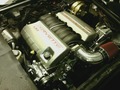
Thks for the feedback. When the engine was rebuilt in '04 the block was decked and flattop pistons intalled...so would expect a much lower deck height. Here is a pic...unless my timing mark is off, I'm sure this is TDC. Maybe I should bump the crank to see if I get some rise in the piston. No. 6 cylinder is also at top and meas close to same.??
Maybe a poor rebuild??

Maybe a poor rebuild??
Le Mans Master
Joined: Jun 2004
Posts: 6,231
Likes: 65
From: Seattle WA
St. Jude Donor '14
Ah, we find the problem The timing mark is virtually never exactly right for TDC. It's close enough for timing, but it's not close enough for a deck height measurement.
There are a couple of ways to go. First and most accurate is with a dial indicator if you've got one - ideally on a bridge.
Second is to cut a piece of scrap that will span the bore and allow you to use head bolts to secure it to the deck, and to weld (or epoxy) a nut to the center of it. Strap it to the engine, and turn the engine just off of TDC and put a bolt through the nut that contacts the piston. Turn the engine GENTLY until it stops against that bolt in both directions and carefully mark the balancer. Actual TDC is midway between those two marks. This is kinda hard to explain, but I bet there's a picture out there somewhere
The timing mark is virtually never exactly right for TDC. It's close enough for timing, but it's not close enough for a deck height measurement.There are a couple of ways to go. First and most accurate is with a dial indicator if you've got one - ideally on a bridge.
Second is to cut a piece of scrap that will span the bore and allow you to use head bolts to secure it to the deck, and to weld (or epoxy) a nut to the center of it. Strap it to the engine, and turn the engine just off of TDC and put a bolt through the nut that contacts the piston. Turn the engine GENTLY until it stops against that bolt in both directions and carefully mark the balancer. Actual TDC is midway between those two marks. This is kinda hard to explain, but I bet there's a picture out there somewhere
Thread Starter
Instructor
Joined: May 2007
Posts: 130
Likes: 0
From: Houston TX
BTW what vol do I use for the valve reliefs in the CR calc??
I'm guessing 3-6ccs.
And, the only number I have on the World heads is a casting # 1-037.
The seller says these are "angle plug steel heads IMCA".
I'm guessing 3-6ccs.
And, the only number I have on the World heads is a casting # 1-037.
The seller says these are "angle plug steel heads IMCA".
Thread Starter
Instructor
Joined: May 2007
Posts: 130
Likes: 0
From: Houston TX
I have a magnetic base dial indicator I can set on the deck and locate directly over the piston. Do I just rotate through TDC to find the highest point and then compare to the deck at that point??
Le Mans Master
Joined: Jun 2004
Posts: 6,231
Likes: 65
From: Seattle WA
St. Jude Donor '14
Mmmm...with no P/N I'm not sure what to say. IMCA indicates they're PROBABLY World S/R or S/R Torquers which are "eh", about on par with the "camel hump" heads.
Le Mans Master
Joined: Jun 2004
Posts: 6,231
Likes: 65
From: Seattle WA
St. Jude Donor '14
- Preloaded on the deck, as the piston will be lower.
- Perpendicular in all respects to the bore; this is hard...if it's at an angle, the measurement will be off. This is what a bridge does.
- Put on the piston along the centerline of the pin, as the piston will rock in the bore along the pin axis.