




Why do large tires wonder?

Le Mans Master


Joined: Oct 2007
Posts: 7,455
Likes: 977
From: RI, Now Franklin/Nashville TN

Sorry for the lack of info. I just got the car so don’t know everything about it. It has BF Goodrich G-Force T/A 275/40 ZR17 98w M&S, 400 treadwear, and Traction AA. The front are the same but 245/45/17.
What do you mean by “ET fo those alloys”? Sorry, trying to learn a lot here.
I don’t know what the scrub radius is, but will google shortly.
I don’t know if the front has poly. I’m just assuming and you know what that means. How do I tell? It’s all new stuff. The previous owner put a lot of $ in the suspension, and it looks like the VBP street/slalom setups with same shocks, sway bar dimensions, and new coil springs, smart struts etc.
What tools are needed to do your own alignment? I’d love to play and experiment!
Thanks guy also for spending time to help answer some questions. Your experience is a big help.
I have to order some Hemi joints for the rear and figure out some how if the front has poly or not.
What do you mean by “ET fo those alloys”? Sorry, trying to learn a lot here.
I don’t know what the scrub radius is, but will google shortly.
I don’t know if the front has poly. I’m just assuming and you know what that means. How do I tell? It’s all new stuff. The previous owner put a lot of $ in the suspension, and it looks like the VBP street/slalom setups with same shocks, sway bar dimensions, and new coil springs, smart struts etc.
What tools are needed to do your own alignment? I’d love to play and experiment!
Thanks guy also for spending time to help answer some questions. Your experience is a big help.
I have to order some Hemi joints for the rear and figure out some how if the front has poly or not.
Pro

Joined: May 2003
Posts: 593
Likes: 0
From: London England

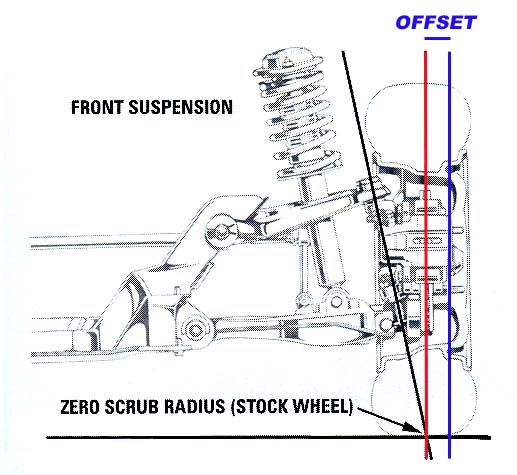
Wheel offset is important because it interacts with scrub radius to effect your steering stability.
Scrub radius is the point where a theoretical line through the upper and lower ball joints intersects with a line draw through the centre of the wheel. These two lines should intersect in the centre of the tyre contact patch at ground level or fractionally below.
If you change the wheel offset you get uneven feedback and load across the tyre when you steer. Also when the tyre meets an uneven road surface the tyre contact patch is loaded unevenly causing the tyre to pull to one side. A bit like a shopping kart with a bent castor wheel.
(hope that makes sense)

Le Mans Master


Joined: Apr 2007
Posts: 7,353
Likes: 72
From: Graceland in a Not Correctly Restored Stingray
...Toe: old -.13/.0 now +.14/+.13
Total change rear: Toe old -.13 now .27 (shouldn't the rear have tow in???)
...But if it's geometry issues, why don't aftermarket A arm fix it? Is it not the a arms?
What is scrub radius and rear camber curves?
Can't an alignment fix toe-steer or a set of poly bushings?
...P.S. I 99% sure the car already has the VBP Street and Slalom system in it. Visual inspection shows all the same components, shocks, springs, sway bar, Smart strut bracket, HD camber strut rods. I cannot verify spring rate though. It even has the off set trailing arms.
Someone, previous owner, dumped some $ in this car.
Total change rear: Toe old -.13 now .27 (shouldn't the rear have tow in???)
...But if it's geometry issues, why don't aftermarket A arm fix it? Is it not the a arms?
What is scrub radius and rear camber curves?
Can't an alignment fix toe-steer or a set of poly bushings?
...P.S. I 99% sure the car already has the VBP Street and Slalom system in it. Visual inspection shows all the same components, shocks, springs, sway bar, Smart strut bracket, HD camber strut rods. I cannot verify spring rate though. It even has the off set trailing arms.
Someone, previous owner, dumped some $ in this car.
Given their attachment points and that everything outboard was designed to mate with a 15" wheel, there are problems at both ends of the C2/C3 A-arms which cannot be readily overcome by simply bolting on different bits.
Golden illustrated what is scrub radius sufficently.

The camber spec on your basic alignment sheet is only the static camber when the vehicle is at rest. When the suspension travels up and down, except in the case of equal-length/parallel control arms, camber changes in relation to the chassis. Just how camber changes (typically you gain negative camber in bump), in relation to this travel is the camber curve. For pretty much everything but drag racing - where you want the rear tires to stay square to the surface when the vehicle squats during launch - negative camber gain is usually a good thing, as the outside tires would otherwise lean into positive camber when the chassis rolls during cornering, but the C3 seems to have a tad too much for many modern tires (the C2 is even worse).
The angle of the camber struts in relation to the half-shafts determines how much or little negative camber is gained in bump or squat, and a good place to start is with the inner links 1/2" lower than their OEM hieght (as originally recommended by John Greenwood). IMCO, unless you have the equipment and ability to actually test other heights scientifically, I wouldn't recommend going lower; the exception, again, being when setting up for drag racing. Slick as the Smart Strut bracket may be, it makes it all too easy to screw this item up, and in any event, you don't want the inner camber strut links further down from the half-shafts than the outer links, as this would cause positive camber gain in bump.

Toe steer is a result of the half-shafts determining the track of the rear tires as it arcs thru its range of travel and of the C2/C3 TA's having a fixed pivot point (theoretically) where they attach into the frame. Thus, as the rear track changes during suspension travel, so does rear toe. The C4 addressed this with double trailing links from the frame to the upright (or hub carrier assembly) and employed a separate toe link to control toe-steer. On the C2/C3, the best we can do is set up the rear ride height to reduce the liklihood that the half-shafts will travel below level from the outer stubs to the inner yokes, and to consider stiffer springs/shocks. The former may involve raising the diff in the chassis on lowered cars, and the latter will affect handling balance and ride.
FWIW, I don't subscribe to using poly for strut (or TA) bushings, as their travel isn't limited to a single plane, preferring heim-jointed rod ends myself, but they're fine for control arms and anti-roll bars. For control arms, look for those with serrated sleeves if you're not in the habit of doing a routine periodic "nut & bolt". Hope that helps.

Last edited by TheSkunkWorks; Nov 28, 2009 at 09:57 PM. Reason: correction

Thread Starter
Advanced

Joined: Nov 2009
Posts: 84
Likes: 1
FWIW - my 98 C5 (130,000 miles) recently started following a 'groove' in the freeway at one area where they moved lanes with painted lines. I am attributing it to the current, worn, run flat tires - plan to put on new rubber very soon and I expect it will go away (if not will check my front bushings). Note that my 79 w/ BFG 60 series 15 inch tires, poly bushings, ... - does NOT follow this same 'groove'.
How is the tread on your BFG T/A tires?
How is the tread on your BFG T/A tires?

Melting Slicks

Joined: Jul 2006
Posts: 2,291
Likes: 493
From: Salmon Arm, BC
I'm sure you have something like these, but if not have a look. They suggest some different settings than you have on your car now....especially the toe and camber
http://www.guldstrand.com/alignment.asp
http://www.vbandp.com/instructions/h...ruct/align.htm
With both ends of your car having toe out will make it darty.....toe in slightly on both will make it track much straighter. Your camber is too much @ -3.0, Try -0.5 to -0.75 degrees.
http://www.guldstrand.com/alignment.asp
http://www.vbandp.com/instructions/h...ruct/align.htm
With both ends of your car having toe out will make it darty.....toe in slightly on both will make it track much straighter. Your camber is too much @ -3.0, Try -0.5 to -0.75 degrees.
Thread Starter
Advanced
Joined: Nov 2009
Posts: 84
Likes: 1
No rear out tow. I read the report wrong. What is factory rim off set? I'll measure mine tomorrow. The vette came with factory 8" rims and I have 10" rims. 2" increase doesn't seam like much. Of course the side wall is hugely different from F70-15 vs. 245/45/17. I have a friend purchasing a 69 that I'll later see if i can swap rims for a day.

Race Director


Joined: Apr 2000
Posts: 17,676
Likes: 201
From: Who says "Nothing is impossible" ? I've been doing nothing for years.
I went from big balloon 15 inch BFG tires we have all had or still have to Toyo T1R Ultra High Performance 285/40/18 on the back and 255/45/17 on the front.
Now I am speaking from something I have done and I have 15 years seat time in this car and have been driving it on the same roads for 15 years around my home.
What I expected was a much harsher ride due to thinner sidewall and sidewall stiffness but also expected better traction and cornering.
What I got was a smoother ride, that's right actually less harsh ride and a car that handled like a different car, like a sports-car should handle around corners.
No other changes, just wheel size and tires and the handling went from dump truck to sports car. The car does not wander just tracks where you steer it. Real world experience I am talking about here no theory involved, just the facts
Now I am speaking from something I have done and I have 15 years seat time in this car and have been driving it on the same roads for 15 years around my home.
What I expected was a much harsher ride due to thinner sidewall and sidewall stiffness but also expected better traction and cornering.
What I got was a smoother ride, that's right actually less harsh ride and a car that handled like a different car, like a sports-car should handle around corners.
No other changes, just wheel size and tires and the handling went from dump truck to sports car. The car does not wander just tracks where you steer it. Real world experience I am talking about here no theory involved, just the facts
Thread Starter
Advanced
Joined: Nov 2009
Posts: 84
Likes: 1
Seems a ton of people have good luck with wide tires. I wish I had a pro to check things out. My local vette shops says it most likely due to a worn rear spring. However, it's not that old and looking at pics of everyone else's springs, mine sits the same. I guess I need to do the free stuff, swap rims and test drive. My front rims might have too much scrub, but then reading some, people say older cars had a lot of scrub. I don't know what to believe anymore. Although breaking into ruts is horridly scarry, it points to too much scrub from my readings.
What is factory scrub? 1", none, have no idea.
Will only swapping front tires prove anything or should both front and rear be changed at the same time?
What is factory scrub? 1", none, have no idea.
Will only swapping front tires prove anything or should both front and rear be changed at the same time?
Corvette Stories
The Best of Corvette for Corvette Enthusiasts

Top 10 Most Expensive Corvettes Ever Sold on Bring A Trailer
Brett Foote
10 Things Every Corvette Owner Needs (2026 Edition)
Michael S. Palmer
8 Most "Only Corvette Owners Understand" Quirks and Problems
Pouria Savadkouei
10 Reasons the C6 Z06 is Still A Performance Benchmark After 20 Years
Joe Kucinski
How Much Horsepower Every Corvette Engine "LOST" in 1972
Joe Kucinski
Top 10 DOs and DON'Ts for Protecting Your Convertible Top!
Michael S. Palmer
Top 10 Most Explosive Corvettes Ever Made: Power-to-Weight Ratio Ranked!
Joe Kucinski
150 hp to 1,250 hp: Every Corvette Generation Compared by the Specs That Matter
Joe Kucinski
8 Coolest Corvette Pace Cars (and Replicas) of All Time
Verdad Gallardo
Racer
Joined: Dec 2004
Posts: 410
Likes: 0
From: Wichita Kansas
I didn't see anyone discuss Caster in this string, might have missed it. My C-5 buddies get 7 degress of caster in their cars with 3 degrees of negative camber, (AutoX settings) I can only get 2.5 degress neg camber and 1.5 degress caster. Think of a shopping carts rear wheels. I believe the addition of wider wheels/stiffer tires (aspect ratio) and not much caster is the issue. After market upper A arms are suppoesed to allow much more caster and I would like to try it for a fix. You all should drive my car with 295/35/17 Hoosiers on the street. Better have both hands on the wheel. I have poly bushings and everything in my front and rear suspension has less than 3,000 miles on it.
Thread Starter
Advanced
Joined: Nov 2009
Posts: 84
Likes: 1
I didn't see anyone discuss Caster in this string, might have missed it. My C-5 buddies get 7 degress of caster in their cars with 3 degrees of negative camber, (AutoX settings) I can only get 2.5 degress neg camber and 1.5 degress caster. Think of a shopping carts rear wheels. I believe the addition of wider wheels/stiffer tires (aspect ratio) and not much caster is the issue. After market upper A arms are suppoesed to allow much more caster and I would like to try it for a fix. You all should drive my car with 295/35/17 Hoosiers on the street. Better have both hands on the wheel. I have poly bushings and everything in my front and rear suspension has less than 3,000 miles on it.
How do I measure my scrub radius at home with common tools?
Burning Brakes


Joined: Mar 2006
Posts: 915
Likes: 2
From: Lima, OH -- 69 L71 427/435hp
Well I learned some new things I didn't know before from this thread, but I have a question.
Here's the situation:
My Mom has a '93 vette that has 285/40/ZR17 rears and 255/45/ZR17 fronts and I have a '95 stang with 275/35/ZR18 front and rears...and on the same roads her vette doesn't wander nearly as bad as my stang does.
My stang is lowered 2" with Steeda suspension, her vette has Goodyear's tires and mine has Yokohamas, and seems the tread of the Goodyears is a bit thicker than mine, but both are cut in a V pattern.
So they are both somewhat similar, so what causes such a difference in wandering?
From a 35 to 40/45 sidewall does it make that much of a difference? Or does tread depth factor in as well? Or different compounds of the tire?
Thanks, just curious since were on this subject.
Here's the situation:
My Mom has a '93 vette that has 285/40/ZR17 rears and 255/45/ZR17 fronts and I have a '95 stang with 275/35/ZR18 front and rears...and on the same roads her vette doesn't wander nearly as bad as my stang does.
My stang is lowered 2" with Steeda suspension, her vette has Goodyear's tires and mine has Yokohamas, and seems the tread of the Goodyears is a bit thicker than mine, but both are cut in a V pattern.
So they are both somewhat similar, so what causes such a difference in wandering?
From a 35 to 40/45 sidewall does it make that much of a difference? Or does tread depth factor in as well? Or different compounds of the tire?
Thanks, just curious since were on this subject.

Le Mans Master
Joined: Jan 2000
Posts: 8,918
Likes: 27
From: New Hill NC
Kind of defeated the idea of wide front tires for lots of grip didn't you?
If you don't understand alignment setting and what they do you should read up on it. Castor, camber, & toe. the internet is good starting point to learn. A little toe in goes a long way to helping out a car.
Wide tires would ruin the handling of a Yugo also!
If you don't understand alignment setting and what they do you should read up on it. Castor, camber, & toe. the internet is good starting point to learn. A little toe in goes a long way to helping out a car.
Wide tires would ruin the handling of a Yugo also!
Melting Slicks
Joined: Jul 2006
Posts: 2,291
Likes: 493
From: Salmon Arm, BC
Kind of defeated the idea of wide front tires for lots of grip didn't you?
If you don't understand alignment setting and what they do you should read up on it. Castor, camber, & toe. the internet is good starting point to learn. A little toe in goes a long way to helping out a car.
Wide tires induce more thrust. In a C-3 which was marginally built brand new was not made for the TQ of modern wide low profile tires. You have to have a stiffer or caged frame, poly bushing a-arms, bigger everything..................
Wide tires would ruin the handling of a Yugo also!
If you don't understand alignment setting and what they do you should read up on it. Castor, camber, & toe. the internet is good starting point to learn. A little toe in goes a long way to helping out a car.
Wide tires induce more thrust. In a C-3 which was marginally built brand new was not made for the TQ of modern wide low profile tires. You have to have a stiffer or caged frame, poly bushing a-arms, bigger everything..................
Wide tires would ruin the handling of a Yugo also!

Its not like we went from 1 degree to 8 degrees...... more like 1* to 21/2*. Maybe you should email these guys and tell them they have it setup all wrong too


Team Owner


Joined: Jan 2006
Posts: 37,637
Likes: 3,118
From: Crossville TN
From your alignment specs, you have a lot of 'toe' adjustement in the front wheels (compared to mfg. specs). And, if your steering wheel doesn't straighten on it's own in a parking lot, that means the steering box is likely too tight. So, on an open highway, if the wheels need to re-center themselves, they [apparently] aren't. Can you free up the steering system at all?
Race Director
Joined: Apr 2000
Posts: 17,676
Likes: 201
From: Who says "Nothing is impossible" ? I've been doing nothing for years.
It was a sad day when they went to those tires, I quit watching F1.

These guys are light years ahead of anyone and constantly trying to do things to go faster.
Many of their engineering improvements from safety to paddle shifters to brakes eventually gets into our modern cars. Then they make them run on snow tires

Pro
Joined: May 2003
Posts: 593
Likes: 0
From: London England
Where does this quote come from cos I can't see it anywhere in this thread?
Originally Posted by gkull
Kind of defeated the idea of wide front tires for lots of grip didn't you?
If you don't understand alignment setting and what they do you should read up on it. Castor, camber, & toe. the internet is good starting point to learn. A little toe in goes a long way to helping out a car.
Wide tires would ruin the handling of a Yugo also!
If you don't understand alignment setting and what they do you should read up on it. Castor, camber, & toe. the internet is good starting point to learn. A little toe in goes a long way to helping out a car.
Wide tires would ruin the handling of a Yugo also!

Team Owner
Joined: Apr 1999
Posts: 21,953
Likes: 1,445
From: Reno Nevada
2024 C3 of the Year Finalist- Modified
I didn't see anyone discuss Caster in this string, might have missed it. My C-5 buddies get 7 degress of caster in their cars with 3 degrees of negative camber, (AutoX settings) I can only get 2.5 degress neg camber and 1.5 degress caster. Think of a shopping carts rear wheels. I believe the addition of wider wheels/stiffer tires (aspect ratio) and not much caster is the issue. After market upper A arms are suppoesed to allow much more caster and I would like to try it for a fix. You all should drive my car with 295/35/17 Hoosiers on the street. Better have both hands on the wheel. I have poly bushings and everything in my front and rear suspension has less than 3,000 miles on it.
Jim, I just got my front end back together with speed directs new shorter springs for QA-1 shocks. They have them in 50 pound increments from 500 - 1000 pounds. I just threw on the 600# to test. So far I'm very impressed

