



 I was really making a similar point, if you see what I mean.
VBP smart struts

Race Director


Joined: Feb 1999
Posts: 19,659
Likes: 34
From: Lenoir City Tennessee
Ci 6, 8 & 10 Veteran
St. Jude Donor '05-'06-'07-'08-'09-'10-'11-'12-'13-'14-'15

So, if I understand this even somewhat remotely, I need to have less at the bumps. Any suggestions as to what I should be looking for at the bumps?

Drifting


Joined: Jul 2002
Posts: 1,254
Likes: 1
From: Edinburgh

Tech Contributor


Joined: Jun 2004
Posts: 20,944
Likes: 962
From: I tend to be leery of any guy who doesn't own a chainsaw or a handgun.
If you have an incredibly stiff suspension in roll (no lean at all), then you want the tires to go straight up and down in travel. This gives you maximum traction while accelerating in a straight line.
In the real world, your suspension is soft enough where the body/frame will lean when going through a corner. So, you need the suspension to compensate for this lean to keep the tire upright.
Suspensions are always compromises. You will never have the best of all worlds. You just have to dial in the amount of geometry change that suits your driving style, and also if you have a car that is all handling and no horsepower (think Formula Ford), or a lot of horsepower (think about the old Can-Am cars) that needs to be utilized coming out of the corners.
JMHO.

Melting Slicks


Joined: Feb 2001
Posts: 3,330
Likes: 13
From: Europe , Luxembourg
You don't have a 68.
I moved my wheels all the way up against the rubber stops on the trailing arm ( with the spring disconnected ) and still had to trim the fender a very little bit.
The tires would not make it if they wouldn't move inwards a touch on the top.
I can not install the lowered strut bracket.
But every Vette is a bit different and 68 especially.

Happy new year. Günther
Drifting
Joined: Jul 2002
Posts: 1,254
Likes: 1
From: Edinburgh

Le Mans Master


Joined: Apr 2007
Posts: 7,353
Likes: 72
From: Graceland in a Not Correctly Restored Stingray
It looks like you need more, not less at the bumps. Your car is going to roll (lean) when you go around a corner. You want the wheel to lean in the opposite direction of the body/frame lean to keep the tire perpendicular to the pavement.
If you have an incredibly stiff suspension in roll (no lean at all), then you want the tires to go straight up and down in travel. This gives you maximum traction while accelerating in a straight line.
In the real world, your suspension is soft enough where the body/frame will lean when going through a corner. So, you need the suspension to compensate for this lean to keep the tire upright.
Suspensions are always compromises. You will never have the best of all worlds. You just have to dial in the amount of geometry change that suits your driving style, and also if you have a car that is all handling and no horsepower (think Formula Ford), or a lot of horsepower (think about the old Can-Am cars) that needs to be utilized coming out of the corners.
JMHO.
If you have an incredibly stiff suspension in roll (no lean at all), then you want the tires to go straight up and down in travel. This gives you maximum traction while accelerating in a straight line.
In the real world, your suspension is soft enough where the body/frame will lean when going through a corner. So, you need the suspension to compensate for this lean to keep the tire upright.
Suspensions are always compromises. You will never have the best of all worlds. You just have to dial in the amount of geometry change that suits your driving style, and also if you have a car that is all handling and no horsepower (think Formula Ford), or a lot of horsepower (think about the old Can-Am cars) that needs to be utilized coming out of the corners.
JMHO.


Melting Slicks
Joined: May 2006
Posts: 2,590
Likes: 403
From: Nashville TN
St. Jude Donor '09
I am in the process of installing Van Steel version of smart struts. The setup I have does move the inner mounting point down but it also allows it to be moved up and down using the eccentric. My question is should I put the eccentric at the bottom, lowering the inner mount or should it be put near the midpoint. The struts themselves are adjustable too to get the camber back to where I found it.

Le Mans Master
Joined: Apr 2007
Posts: 7,353
Likes: 72
From: Graceland in a Not Correctly Restored Stingray
Their strong reputation for components and service aside, IMCO that's still not the best starting point for most C3's (exceptions have been noted), as that relationship puts the static instantaneous centers at infinity...
Corvette Stories
The Best of Corvette for Corvette Enthusiasts

5 Best & 5 Worst Corvette Daily Drivers
Joe Kucinski
The Headlights of Every Corvette Generation Explained
Joe Kucinski
5 Best & 5 Most Overrated Corvette Track Packages of All Time!
Joe Kucinski
Every 2027 Corvette Engine Explained
Joe Kucinski
Designer Imagines A Corvette That Looks More Like a Corvette Than the Corvette
Verdad Gallardo
10 Ugly Corvettes That We Still Kinda Love
Joe Kucinski
Top 10 Most Expensive Corvettes Ever Sold on Bring A Trailer
Brett Foote
10 Things Every Corvette Owner Needs (2026 Edition)
Michael S. Palmer
8 Most "Only Corvette Owners Understand" Quirks and Problems
Pouria Savadkouei
Advanced

Joined: Dec 2009
Posts: 59
Likes: 0
From: York PA
Not to beat this to death but.
I'm confused. My 77 rear wheels tilt in at the top. I understand from reading this thread that it is a characteristic of the car - the rear wheels are GM designed to tilt in at the top. I had assumed this was for 2 reasons: 1 - in cornering it helps the tire remain perpendicular to the surface and 2 - as they rotate, like a gyroscope, the wheels true themselves perpendicular to the surface. I have never seen my car going down the road or cornering from the back so I never could confirm this. Here's the confusion> other than to fine tune the rear wheels why would anyone put these adjustable struts on their car? I just went out and looked at mine and I have very little clearance between the body wheel well and the top of the tire so straightening the wheel for me, as someone said, would probably casue the wheel to hit the body. Am I missing something - is a fune tune the real answer?
tks,
chuck
tks,
chuck
Le Mans Master
Joined: Apr 2007
Posts: 7,353
Likes: 72
From: Graceland in a Not Correctly Restored Stingray
Chuck, unfortunately the complexities of vehicle dynamics offer considerable room for confusion and misunderstanding. Yes, the C2/C3 rear suspension was/is intended to have some rear camber and some rear camber gain. But, given the vast number of variables involved, there's a huge grey area when it comes to trying to improve and fine tune things in which one can easily become lost.
However, don't be intimidated into thinking you have to immerse yourself in the subject to arrive at a reasonably good alignment and setup. Unless you just want to (or need to, because you're hardcore) take the time and trouble to test scientifically, selecting static alignment settings from VB&P's menu which best describes what you're after will get you close. Beyond that you simply should not IMCO lower the inner camber strut links further than 1/2" below OEM C3 heights unless you come to fully understand if and why your car is an exception to this sound rule of thumb. Clearance issues may require some compromise, but if it is at all possible I'd try to solve that with something other than altering geometry. That said, additional (not less) camber gain (read, "higher inner camber strut links") might help clearances...

However, don't be intimidated into thinking you have to immerse yourself in the subject to arrive at a reasonably good alignment and setup. Unless you just want to (or need to, because you're hardcore) take the time and trouble to test scientifically, selecting static alignment settings from VB&P's menu which best describes what you're after will get you close. Beyond that you simply should not IMCO lower the inner camber strut links further than 1/2" below OEM C3 heights unless you come to fully understand if and why your car is an exception to this sound rule of thumb. Clearance issues may require some compromise, but if it is at all possible I'd try to solve that with something other than altering geometry. That said, additional (not less) camber gain (read, "higher inner camber strut links") might help clearances...
Last edited by TheSkunkWorks; Dec 29, 2009 at 07:57 PM.
Advanced
Joined: Dec 2009
Posts: 59
Likes: 0
From: York PA
Thank you for expanding on that. When I had my last 4 wheel alignment the shop said they were within specs and the tilt was a characteristic . I was just thinking cosmetically. I've seen some bad boob jobs and some nasty face work that I'm sure others think look just fine. I think at this point I'll just leave them as is. Thanks again.
chuck
chuck

Team Owner

Joined: Apr 1999
Posts: 21,953
Likes: 1,445
From: Reno Nevada
2024 C3 of the Year Finalist- Modified
Never, never, never trust some shop monkey to set something within specs
Put a little thought into what you need. Take a close look at all four tires for inner or outer ware. Google alignment settings castor, camber, toe.
Look at VB&P base alignment guide. Then when you get an alignment go to a shop that does optical alignments and request specific settings and they give you a printout of before and after specs.
Years ago I had a shop do and alignment and the shop monkey gave me different settings from side to side??????? I ask why did he do that? "Because they set up cars for crown in the road to drive straight."
That is dandy for going straight on crowned roads. But you might have "1 G" turning right and ".80 G" turning left
Put a little thought into what you need. Take a close look at all four tires for inner or outer ware. Google alignment settings castor, camber, toe.
Look at VB&P base alignment guide. Then when you get an alignment go to a shop that does optical alignments and request specific settings and they give you a printout of before and after specs.
Years ago I had a shop do and alignment and the shop monkey gave me different settings from side to side??????? I ask why did he do that? "Because they set up cars for crown in the road to drive straight."
That is dandy for going straight on crowned roads. But you might have "1 G" turning right and ".80 G" turning left

Race Director
Joined: Jul 2001
Posts: 15,892
Likes: 42
Makes no difference when the car is sitting still or any time the suspension is not deflected.

Safety Car

Joined: Nov 2005
Posts: 3,961
Likes: 573
From: Lompoc, CA. Santa Barbara County
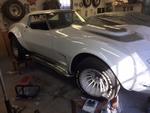
You don't even need modified brackets. Look closely at picture of the old and new brackets, there is an aluminum spacer on top that I used to lower my stock bracket.
Bee Jay
Bee Jay
Team Owner
Joined: Apr 1999
Posts: 21,953
Likes: 1,445
From: Reno Nevada
2024 C3 of the Year Finalist- Modified
If you have a lower powered car with tall sidewalls tires and wimpy rear spring. Camber gain might be a good thing. During high speed cornering at the traction limit you will have body roll and the tall side wall tire is rolling under. Back in the 80's I installed some of the tallest sidewall tires made. The 275/50/15 rear tires and I didn't even feel safe laying my vette hard into a turn. A bigger negative camber will help increase traction.
But if you drive a car that has enough power to spin the tires in a straight line.......Like drag racing. Where the front end comes up and the rear end squats, you want "ZERO" camber gain to keep your rear tires as flat as possible on the road for max. traction
People running 17 - 18 inch rims with low profile side wall tires have very little tread roll under while cornering. So that is why I only use a static setting of .53 degrees of negative camber on the rear. I measure my tire ware and verified even temps across my tire face during hot lapping at the local 4.2 mile road racing track.
But if you drive a car that has enough power to spin the tires in a straight line.......Like drag racing. Where the front end comes up and the rear end squats, you want "ZERO" camber gain to keep your rear tires as flat as possible on the road for max. traction
People running 17 - 18 inch rims with low profile side wall tires have very little tread roll under while cornering. So that is why I only use a static setting of .53 degrees of negative camber on the rear. I measure my tire ware and verified even temps across my tire face during hot lapping at the local 4.2 mile road racing track.
Melting Slicks
Joined: May 2006
Posts: 2,590
Likes: 403
From: Nashville TN
St. Jude Donor '09
Thanks. I just reread the entire thread and saw your note " . . . lower the inner camber strut links to 1/2" below the C3's OEM height . . ." and I'll take a look at it. I'm a novice to all this and was just looking for a good setting to start from. One of these days I'll dive a little more into it to better understand and find my "sweet spot". I still haven't had the alignment completed yet, so now would be the time for me to make changes. I'm still wrapping up my top-end rebuild and once I get back on the road, one of the first stops will be the alignment shop. Thanks for the feedback . . .
Melting Slicks
Joined: May 2006
Posts: 2,590
Likes: 403
From: Nashville TN
St. Jude Donor '09

Racer
Joined: Mar 2005
Posts: 294
Likes: 1
From: Racine Wisconsin

Last edited by 7T3C3TTZ07; Mar 7, 2010 at 09:55 AM.

Racer
Joined: Dec 2004
Posts: 410
Likes: 0
From: Wichita Kansas
I use the SS bracket but use the stock locators so the rods are located in center with no adjustment. In another post I noted that I had 1/4 inch locators welded on the top of the bracket to prevent the four holes from getting egg shaped from the high side loads created from the 295 Hoosier AutoX compund tires I use. I run the car with about 1 1/4 degree of Negative camber to prevent the outsides of the tries from wearing out first (wider wheels would help this). The lower SS bracket helps significantly with tire wear due to camber change while cornering and car control. Even with all that help I run with about 1/4 total toe in. I can throttle hard on corner exit and if the rear comes out it is very controllable. Only complaint is that the rear is so planted it is difficult to get it to rotate on corner entry. I can increase the rebound on the rear shocks, but then pay with some looseness on high speed transitions. I've driven a C-5 Z06 and the rear suspension is so much better. And the steering and balance are light years ahead, making the car much easier to drive. But my C-3 is more fun as most people don't ecpect it to be so fast.
