Man it smells in here....

Thread Starter
Drifting


Joined: May 2002
Posts: 1,546
Likes: 282
From: Back in Nebraska
 Man it smells in here....
I’m confused. I have been researching previous threads about gas smell in the garage. I have a 1970 350/300 with that problem. According to my diagrams for a 1970 it shows a vapor canister mounted somewhere on the left side by the left wheel. My car shows no sign of this ever being there. No line and no bracket. Did all 1970 small blocks have this component? Also, I need a new gas cap. Some show a “Vented” and some show a “Sealed” cap. Which one is proper? I’m sooooo.. confused!!!!! 
Melting Slicks


Joined: Nov 2001
Posts: 2,668
Likes: 43
From: Eastern US XX
A sealed cap is used on a system with a Vapor Canister!! If you don't have a vapor canister, or the line from the tank to it is cut and plugged then you probably need the vented cap. If you do have the vapor canister and it is all connected up and functioning, then the sealed cap would be appropriate.
Race Director


Joined: Sep 2002
Posts: 10,362
Likes: 5
From: San Diego - Deep Within The State of CONFUSION!
Look at the emissions label under the hood. If it's a 49-state car (non Calif) then it may not have the cannister but the label will tell you.
My '70 Nova had one but it was a CA car.
My '70 Nova had one but it was a CA car.

Team Owner


Joined: Sep 2006
Posts: 31,229
Likes: 4,321
From: Westminster Maryland
Hi AC,
I believe SDP is right, the 1970 model year cars didn't have the Evaporative Control System (the carbon cannister) UNLESS they was delivered to California (option NA9).
1970 gas caps were the 'sealed' type.
Some times just the gasket in the cap needs to be replaced.
Regards,
Alan
I believe SDP is right, the 1970 model year cars didn't have the Evaporative Control System (the carbon cannister) UNLESS they was delivered to California (option NA9).
1970 gas caps were the 'sealed' type.
Some times just the gasket in the cap needs to be replaced.
Regards,
Alan

Safety Car


Joined: Apr 2000
Posts: 3,802
Likes: 61
From: Wichita KS
Hi AC,
I believe SDP is right, the 1970 model year cars didn't have the Evaporative Control System (the carbon cannister) UNLESS they was delivered to California (option NA9).
1970 gas caps were the 'sealed' type.
Some times just the gasket in the cap needs to be replaced.
Regards,
Alan
I believe SDP is right, the 1970 model year cars didn't have the Evaporative Control System (the carbon cannister) UNLESS they was delivered to California (option NA9).
1970 gas caps were the 'sealed' type.
Some times just the gasket in the cap needs to be replaced.
Regards,
Alan
cc
Team Owner
Joined: Sep 2006
Posts: 31,229
Likes: 4,321
From: Westminster Maryland
Hi CC,
How are you?
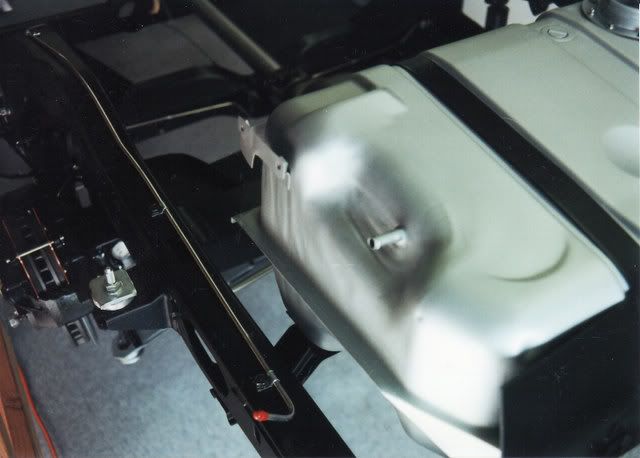
My understanding is that the cars without EEC still had sealed tanks that were vented through the small button valve on the top of the tank located just to the left of the filler neck. The valve is about the size of a quarter. (The EEC tanks had the valve too.)
You can just see the valve in this picture of my 71 (EEC) tank. Upper, right corner of picture.
The Quanta site mentions and shows what tanks have the valve but doesn't describe it.
Regards,
Alan
How are you?
My understanding is that the cars without EEC still had sealed tanks that were vented through the small button valve on the top of the tank located just to the left of the filler neck. The valve is about the size of a quarter. (The EEC tanks had the valve too.)
You can just see the valve in this picture of my 71 (EEC) tank. Upper, right corner of picture.
The Quanta site mentions and shows what tanks have the valve but doesn't describe it.
Regards,
Alan
Safety Car
Joined: Apr 2000
Posts: 3,802
Likes: 61
From: Wichita KS
Interesting. My neighbor has 2 1970's, one a 350/350 and the other a 454/390. Both are in body off mode right now so I'll need to go check out his tanks and see if they have those buttons. I know he has the sealed gas caps and he went to a lot of trouble making sure he had the correct gas tank.
The small block is going to go for NCRS judging when he is done with it. The big block is going to be a driver.
Actually, we just took the big block frame to Arkansas City Friday to be straightened and the tank wasn't in it so either he doesn't have it or it's in his attic storage area.
I need to post the story on this car some time. It's quite a tale of "barn" find, chasing the original body/frame/engine etc.
cc
The small block is going to go for NCRS judging when he is done with it. The big block is going to be a driver.
Actually, we just took the big block frame to Arkansas City Friday to be straightened and the tank wasn't in it so either he doesn't have it or it's in his attic storage area.
I need to post the story on this car some time. It's quite a tale of "barn" find, chasing the original body/frame/engine etc.
cc
Last edited by CCrane65; Jan 24, 2010 at 12:19 PM.

Racer


Joined: Oct 2000
Posts: 429
Likes: 0
From: Oak Harbor WA
Gas Smell
I think the smell is simply gas evaporating from the huge carburetors on these cars. I have a fully sealed tank, relatively new vapor canister, and all vent lines are new and tight. But after driving and pulling into the garage, there's always a gas smell for the first day. Big carb, big fuel bowl, evaporates out the air filter assembly. The smell disappears after a day.
If you smell gas all the time, then there's a problem somewhere.
If you smell gas all the time, then there's a problem somewhere.
Corvette Stories
The Best of Corvette for Corvette Enthusiasts

Top 10 Most Explosive Corvettes Ever Made: Power-to-Weight Ratio Ranked!
Joe Kucinski
150 hp to 1,250 hp: Every Corvette Generation Compared by the Specs That Matter
Joe Kucinski
8 Coolest Corvette Pace Cars (and Replicas) of All Time
Verdad Gallardo
Top 10 Corvette Engines RANKED by Peak Torque (70+ Years of Muscle!)
Joe Kucinski
Corvette ZR1X Will Be Pacing the Indy 500, And Could Probably Race, Too!
Verdad Gallardo
Top 10 Corvettes Coming to Mecum Indy 2026!
Brett Foote
Top 10 C9 Corvette MUST-HAVES to Fix These C8 Generation Flaws!
Michael S. Palmer
10 Revolutionary 'Corvette Firsts' Most People Don't Know
Joe Kucinski
5 Reasons to Upgrade to an LS6-Powered Corvette; 5 Reasons to Stay LT2
Michael S. Palmer
Safety Car
Joined: Sep 2007
Posts: 4,458
Likes: 331
From: Indy Indiana
could be a tiny leak in the fuel pump or connection to it.. not enough to leak on the floor.. or only leak some when running..it may leak so slow that it evaporates before dripping on the floor. I had this problem.. run your fingers all around the fuel pump both before and after running the engine and check for wetness. There is a tiny vent hole on the fuel pump where the diaphram seal may be broke where gas may be comming out.
Instructor
Joined: Jun 2006
Posts: 104
Likes: 0
From: Missouri City Texas
could be a tiny leak in the fuel pump or connection to it.. not enough to leak on the floor.. or only leak some when running..it may leak so slow that it evaporates before dripping on the floor. I had this problem.. run your fingers all around the fuel pump both before and after running the engine and check for wetness. There is a tiny vent hole on the fuel pump where the diaphram seal may be broke where gas may be comming out.
Team Owner
Joined: Sep 2006
Posts: 31,229
Likes: 4,321
From: Westminster Maryland
I agree with K that these old carburated cars always smelled more than our new injected cars do. I also agree with JoeW that even a very slight weep at a connection will give a surprising amount of odor in a fairly well sealed garage.
My car is in a garage in the basement, so I (and my wife) was very aware of any gas odor when I finaly put gas in the tank as the restoration was ending. It took a while to track every little weep down and I even ended up replacing a couple of original rubber hoses I really wanted to re-use because the gas would seep through the old rubber.
Good Luck!
Regards,
Alan
My car is in a garage in the basement, so I (and my wife) was very aware of any gas odor when I finaly put gas in the tank as the restoration was ending. It took a while to track every little weep down and I even ended up replacing a couple of original rubber hoses I really wanted to re-use because the gas would seep through the old rubber.
Good Luck!
Regards,
Alan
Instructor
Joined: Mar 2009
Posts: 209
Likes: 1
From: Denver CO
--although they dont reccomend these for racing if you get a fire and power is still on it will continually pump fuel to the fire!!!! Never intend to crash mine though so it was a nice fix!

Burning Brakes

Joined: Oct 2001
Posts: 911
Likes: 5
From: TN
70's sealed system
I am the original owner of 1970 bought in Texas. Have no cannister. Do have the original gas cap and it says sealed on it. When I remove the gas cap to install gas, there is pressure. Acutally lots of pressure. I keep my 70 in my garage. No smell of gas.
Over or about 25 or so years ago started out on a trip. Driving down the interstate noticed the gas guage had moved off FULL to quickly. Stopped and checked the rear of the car and saw gas coming from the fuel return line going to the gas tank was dripping fuel. Was not that far down the road from starting my trip and returned home and replaced the original rubber return line coming from the return metal line to the gas tank.
Both the supply line and return lines at the rear of the car get over looked sometimes as a source of a gas leak. The right muffler is right below these gas lines.
Over or about 25 or so years ago started out on a trip. Driving down the interstate noticed the gas guage had moved off FULL to quickly. Stopped and checked the rear of the car and saw gas coming from the fuel return line going to the gas tank was dripping fuel. Was not that far down the road from starting my trip and returned home and replaced the original rubber return line coming from the return metal line to the gas tank.
Both the supply line and return lines at the rear of the car get over looked sometimes as a source of a gas leak. The right muffler is right below these gas lines.