



Pilot Bushing Trick -- Useful!

Racer


Joined: Apr 2005
Posts: 402
Likes: 4
From: Nassau

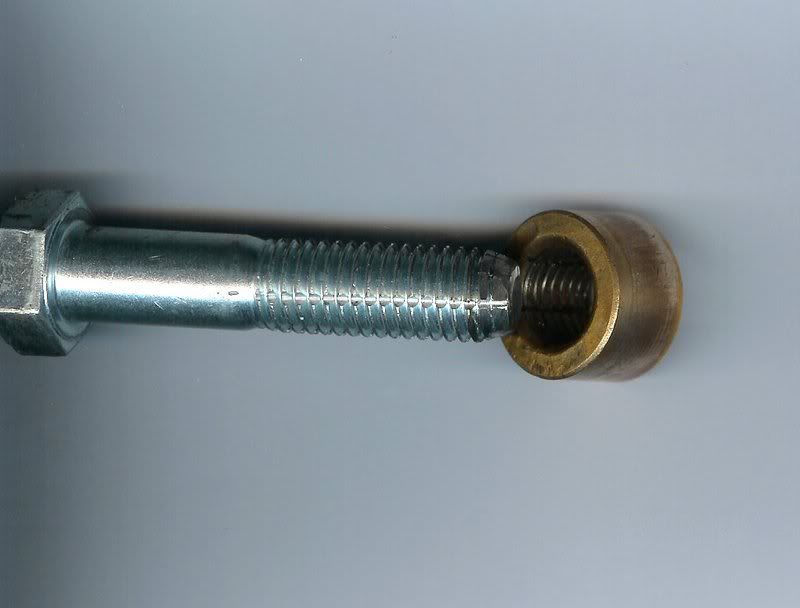
It worked once for me but never on any big block Ive tried it on. If the bearing is really tight its not coming out using that method. Ive also had to drill out a bushing in a Skyline r33 with a RB25 engine after the trans shaft snapped and mangled it to hell. Ive used a nut and ground off 2 sides so it will fit through the bushing then use a screwdriver to stand it upright so the unground sides of the nut are behind the bushing. Then use a socket that is bigger than the bushing and push a bolt through it and thread it into the nut and tighten. It will pull out the bushing 99% of the time.

Limping across the line


Joined: Oct 2002
Posts: 5,299
Likes: 109
From: Peoria Az
I agre the method works well for a bushing. But if you use a roller type bearing in there(as my Olds does) you need to use puller. Warming the crank flang and using freeze spray on the bearing outer race aids in removal

Le Mans Master

Joined: Apr 1999
Posts: 6,134
Likes: 46
From: Raleigh North Carolina
I always start with the grease trick.. and then escalate my assault according to resistance... with the tap/bolt being my last resort. Mustang 302's are tempermental in this way... at least most of the ones I have done.


Thread Starter
Instructor

Joined: Mar 2009
Posts: 209
Likes: 1
From: Denver CO
--- and I agree about the newer LS engines... DONT USE THIS METHOD! The pressure P will force the freeze plug out and then you are really screwed. -- Take the time to tap it and get a slide hammer out and youll be fine!
Last edited by Raider74; Jan 29, 2010 at 05:10 PM.
Thread Starter
Instructor
Joined: Mar 2009
Posts: 209
Likes: 1
From: Denver CO
So tapping the bearing is faster than filling it with grease and whacking a rod with a hammer? I dont think so.... I agree that the tapping method is a solid method by creating the threads, but this method is much faster and easier. And NEVER save a used pilot bushing... if you take it out replace it. Trust me ive done stress, x-ray, and ultrasonic analysis on used pilots vs. new ones. Even if it appears to have no wear or damage it can have its properties changed due to repeated heating/cooling cycles that create microfractures in the brass/copper alloy or whatever your bushing is. (usually brass) I am a mechanical engineer and i know that this bearing is CRITICAL. So, although my method has the nice side effect of not damaging the bearing it still should ALWAYS be replaced with a new bushing. (sorry just realized as im typing this that i keep alternating between the word bearing and bushing--- when technically it is actually a bushing) ... also, some of the puller tools can scrape the walls of the seat for the bearing which will interfere with the proper press fit functionality, and allow for extra thermal stress. Not trying to ruin anyones parade here, but this method is the fastest, cheapest, and easiest flat down. (altough free loaner tools are pretty cheap too!) If you like using pullers or tapping then keep doing it... this is just a better way thats all!
Le Mans Master
Joined: Apr 1999
Posts: 6,134
Likes: 46
From: Raleigh North Carolina
The comment about getting the tolerance tight between the dowel and the worn out bearing is on the money. Unfortunately, worn pilot bearings aren't going to fall within the desired tolerance... they will all be worn differently... and a new dowel would have to be made for nearly every one you pull.
It's gonna work... but not always.
I tried half a dozen different Muncie shafts as well as chicken legs, donky dorks, and metal mushrooms on this last one. None of them provided a tight enough seal to confine the hydraulic pressure. That's when I tried the pullers (yes... I have the one that the auto parts stores rent out... I bought a new one in a pretty plastic case just for this project and it didn't work).
I think if you get the seal tight enough -every time- it will work... but that's the trick.
After several hours screwing around with various dowels and pullers, I gave up and went for the tap/bolt and slide hammer.
I wanted to measure the wear on the old bushing and tapping it ruined all my chances of doing that... so I didn't rush into it.

Instructor
Joined: Sep 2009
Posts: 115
Likes: 1
From: New Hartford Iowa
I've done it that way on about seven cranks. I only had troubles with one....but it eventually came out.
One other tip I can add is if the dowel is slightly loose in the bushing, cut a 1" wide strip of paper and wrap it around the dowel, or whatever your using, until the dowel has a tight fit...tight enough that it requires a tap with a small hammer to get it in....then get out the big hammer and give it a good solid whack.....it'll pop right out. I've used this method several times
One other tip I can add is if the dowel is slightly loose in the bushing, cut a 1" wide strip of paper and wrap it around the dowel, or whatever your using, until the dowel has a tight fit...tight enough that it requires a tap with a small hammer to get it in....then get out the big hammer and give it a good solid whack.....it'll pop right out. I've used this method several times

I use duct tape instead of paper. The tape seals better IMO as duct tape is a bit compressible.
Corvette Stories
The Best of Corvette for Corvette Enthusiasts

150 hp to 1,250 hp: Every Corvette Generation Compared by the Specs That Matter
Joe Kucinski
8 Coolest Corvette Pace Cars (and Replicas) of All Time
Verdad Gallardo
Top 10 Corvette Engines RANKED by Peak Torque (70+ Years of Muscle!)
Joe Kucinski
Corvette ZR1X Will Be Pacing the Indy 500, And Could Probably Race, Too!
Verdad Gallardo
Top 10 Corvettes Coming to Mecum Indy 2026!
Brett Foote
Top 10 C9 Corvette MUST-HAVES to Fix These C8 Generation Flaws!
Michael S. Palmer
10 Revolutionary 'Corvette Firsts' Most People Don't Know
Joe Kucinski
5 Reasons to Upgrade to an LS6-Powered Corvette; 5 Reasons to Stay LT2
Michael S. Palmer
2027 Corvette vs The World: Every C8 vs Its Closest Competitor
Joe Kucinski
Thread Starter
Instructor
Joined: Mar 2009
Posts: 209
Likes: 1
From: Denver CO
I know you didnt say it was faster... Roger did. Yes I see how differently worn bearings could complicate things but for the most part they should still be close enough to the original specs for a precisely machined rod to do the trick. Sounds like in your particular case though you fought with it enough and went to a surefire way-- the tapping and slide hammer method. At least you got it out eventually!
to everyone else Im just saying that that method should be secondary to the hydraulic method which is the cheaper/faster/easier way to do it. And it really isn't that messy like everyone keeps complaining about... i just was a noob the first time i did it and had too small of a dowel but it still worked in addition to ruining a shirt. Using my machined brass dowel i dont even need a shop rag around the rod, there is no grease splashback because the seal is so tight. Once the bearing is out... wrap a rag around your dowel and swipe out the excess grease, you dont even really need to get it all. Excess grease in the bushing will only help it function that much smoother when your crank and input shaft are spinning at 6000 rpm!
to everyone else Im just saying that that method should be secondary to the hydraulic method which is the cheaper/faster/easier way to do it. And it really isn't that messy like everyone keeps complaining about... i just was a noob the first time i did it and had too small of a dowel but it still worked in addition to ruining a shirt. Using my machined brass dowel i dont even need a shop rag around the rod, there is no grease splashback because the seal is so tight. Once the bearing is out... wrap a rag around your dowel and swipe out the excess grease, you dont even really need to get it all. Excess grease in the bushing will only help it function that much smoother when your crank and input shaft are spinning at 6000 rpm!

Drifting


Joined: May 2005
Posts: 1,629
Likes: 4
From: Somers CT

Safety Car

Joined: Oct 2007
Posts: 3,729
Likes: 267
From: Austin Texas
Corvette of the Year Winner 2017
2016 C3 of Year Finalist
use an old front main shaft, I have kept mine for over 30 years just for this reason.
pack with grease , insert input shaft and smack it good a couple times.
I have removed many over the years this way, this is the way most older mechanics did it,
they didn't have a rent it tool shop around the corner. 69VETT
pack with grease , insert input shaft and smack it good a couple times.
I have removed many over the years this way, this is the way most older mechanics did it,
they didn't have a rent it tool shop around the corner. 69VETT

Race Director

Joined: May 2006
Posts: 16,528
Likes: 53
From: Dayton, Ohio
 I didn't say I would "reuse" the old bushing. Sometimes being able to remove a bushing without further damage for inspection provides useful information. I would think being an engineer you would understand this.
Raider, the tool in Topgunn's pic is "exactly" like mine, 2 seconds with my 1/2" impact and the bushing is out. You wouldn't even have 1 of your latex gloves on in that time.

Thread Starter
Instructor
Joined: Mar 2009
Posts: 209
Likes: 1
From: Denver CO
I didn't say I would "reuse" the old bushing. Sometimes being able to remove a bushing without further damage for inspection provides useful information. I would think being an engineer you would understand this.Raider, the tool in Topgunn's pic is "exactly" like mine, 2 seconds with my 1/2" impact and the bushing is out. You wouldn't even have 1 of your latex gloves on in that time.
 My mis assumption my good sir.
 As far as the impact wrench method that is far too involved. When my motor is on my motor stand I dont even get my gun near it. It is all hand tools, so I can feel the work on the engine, and I think it takes me less than two seconds. I have the hammer in my right, the rod in my left, swish it in the grease, put it in the hole, and smack it... feasibly takes about one second. no air lines to drag over or compressor to fill up, no crazy bolt to modify, no socket to go get, and saves the bushing every time! Plus for extra wrenchin style a good mechanic will grease the pilot bushing anyways to lubricate when the engine and tranny are mated again. This way automatically does that, because when you install the new bushing the grease re-locates to the center! Why not save yourself the hassle of having to deal with air tools AND get the grease?

Last edited by Raider74; Jan 30, 2010 at 12:12 AM.
Thread Starter
Instructor
Joined: Mar 2009
Posts: 209
Likes: 1
From: Denver CO
I dont suspect it was in too "tight", I suspect it was so badly worn that a proper hydraulic seal couldnt be created. When the centers of the shafts first start to rotate about eachother instead of a common axis.... they tend to go pretty quick. How old was the engine that was being worked on might i ask?

Race Director
Joined: May 2006
Posts: 16,528
Likes: 53
From: Dayton, Ohio
Imagine a crankshaft when going through inspection that is found to be perfect except the pilot bushing hole....
 ...hmmm.....Install it in an engine with an automatic trans because the nose of the torque converter doesn't require as close a tolerance as the 4 speed input shaft.
I have seen the pilot bushing hole machined too large,too small and the what most guys miss,the machined part of the hole is too short,shallow,not deep enough. This lack of depth on the machined surface can cause the the ID of the pilot bushing to be made smaller if the bushing is driven in too far. This will cause the input shaft to fit too tight and cause grinding when going into gear.
The moral to the story is don't forget to inspect the pilot bushing hole before building your engine around the crank. ( Also don't forget to check the flywheel flange for runout.)
I've seen this overlooked area of the crankshaft RUIN many a guys day.


Race Director

Joined: Apr 2000
Posts: 17,676
Likes: 201
From: Who says "Nothing is impossible" ? I've been doing nothing for years.
I dont suspect it was in too "tight", I suspect it was so badly worn that a proper hydraulic seal couldnt be created. When the centers of the shafts first start to rotate about eachother instead of a common axis.... they tend to go pretty quick. How old was the engine that was being worked on might i ask?
 maybe
maybe 
I think they needed it in there to balance the assembly too. I am not sure about this because I was not there, all I know is there was a non roller bearing in there when I went to pick up my rotating assembly after balancing
The shop has probably changed or replaced a few thousand over 30 years. No, they aren't a mickey mouse shop they build the motors for the TV show ( don't even know if that show is still on ? ) Dream Car Garage and build the big block rats for Peter Klutts' '69 Corvette vintage road race car. Like I said they know every trick in the book.
Most of the methods used in this thread have been used how many times ? Once, twice maybe 10 times or more ? by each individual member. Saying something will work in every case is like saying you have the fastest car in town, and we all know what happens there
I tried this method once a few years back and it didn't work for me. I also broke the loaner puller and eventually had to grind / drill / chip it out.
The tool didn't break when trying to pull the bearing, it broke when I threw it down the driveway after it wouldn't catch the back of bearing
Theoretically the grease method would work every time on bearing that was not in there too tight. I might even say hitting it with enough force might dislodge a very tight bearing but you are not going to be able to create that much force with your arm.
The method you describe will work but not in all cases, I can also see that the bolt method would work but might not in every case too. The bolt threading in would expand the bearing creating more friction on the bearing to crank surfaces and I can see it just turning and making stripped threads and the bearing not moving.
Please don't get me wrong here I am not trying to put down anyone's ideas, on the contrary the grease method should be at least tried first, then maybe a puller, then maybe you can make one of those bolts and you will have success without resorting to grinding it out.
Everyone is trying to help here and lots of good ideas so use whatever method works for you
Last edited by MotorHead; Jan 31, 2010 at 12:47 AM.
