


Brake proportioning valve leaking
Thread Starter
Intermediate

Joined: May 2010
Posts: 26
Likes: 0
From: Cairns Queensland
 Brake proportioning valve leaking
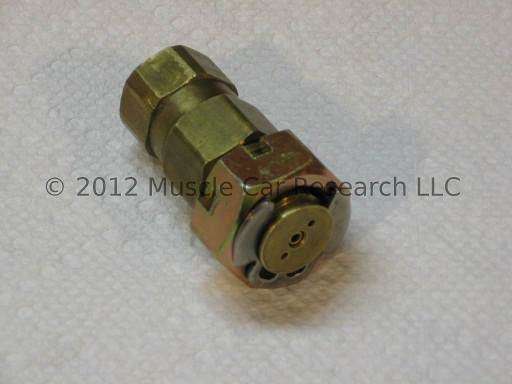
My 1975 Corvette appears to be leaking brake fluid from (and possibly sucking air in through) the small "crater" on the side of the proportioning nut on the proportioning valve. What is the purpose of this small "crater", and can I replace the nut or do I have to replace the entire valve? Andrew
Le Mans Master


Joined: Mar 2001
Posts: 6,640
Likes: 287
From: Ann Arbor Michigan
You will need to replace the valve. The hole in the side of the end plug is a vent between 2 o'rings inside the plug. There is a pressed in plug that holds it together. The one in the 2nd photo was machined to get it apart.
Gary


Gary
Thread Starter
Intermediate
Joined: May 2010
Posts: 26
Likes: 0
From: Cairns Queensland
Gary, Thank you for your reply. The photos are a great help. If I can get my hands on a plug that isn't leaking from the vent, can I not just swap it over rather than having to replace the whole unit? Andrew
Le Mans Master
Joined: Mar 2001
Posts: 6,640
Likes: 287
From: Ann Arbor Michigan

Gary
Thread Starter
Intermediate
Joined: May 2010
Posts: 26
Likes: 0
From: Cairns Queensland
Gary, The replacement valve that I'm looking at getting has the following number stamped on it:
366/810.3637963
WAG 6 139
7
GM part # 339780
Have I got the correct brass body Weatherhead unit?
366/810.3637963
WAG 6 139
7
GM part # 339780
Have I got the correct brass body Weatherhead unit?
Le Mans Master
Joined: Mar 2001
Posts: 6,640
Likes: 287
From: Ann Arbor Michigan
Andrew,
Yes, 339780 is the correct part number. If you are going to toss the old one, I'll take it for the cost of shipping. I want to try and figure out a way to get it apart to replace the O'rings and keep it useable.
Gary
Yes, 339780 is the correct part number. If you are going to toss the old one, I'll take it for the cost of shipping. I want to try and figure out a way to get it apart to replace the O'rings and keep it useable.
Gary
Last edited by Duke94; May 8, 2010 at 07:42 PM.
Corvette Stories
The Best of Corvette for Corvette Enthusiasts

Top 10 Most Explosive Corvettes Ever Made: Power-to-Weight Ratio Ranked!
Joe Kucinski
150 hp to 1,250 hp: Every Corvette Generation Compared by the Specs That Matter
Joe Kucinski
8 Coolest Corvette Pace Cars (and Replicas) of All Time
Verdad Gallardo
Top 10 Corvette Engines RANKED by Peak Torque (70+ Years of Muscle!)
Joe Kucinski
Corvette ZR1X Will Be Pacing the Indy 500, And Could Probably Race, Too!
Verdad Gallardo
Top 10 Corvettes Coming to Mecum Indy 2026!
Brett Foote
Top 10 C9 Corvette MUST-HAVES to Fix These C8 Generation Flaws!
Michael S. Palmer
10 Revolutionary 'Corvette Firsts' Most People Don't Know
Joe Kucinski
5 Reasons to Upgrade to an LS6-Powered Corvette; 5 Reasons to Stay LT2
Michael S. Palmer
3rd Gear
Joined: Sep 2012
Posts: 3
Likes: 0
From: Virginia
Digging up an old post...
I've been talking to Duke94 about this valve since I first found this topic a few weeks ago. He found a way to remove the plug by inserting a piece of steel pin into the outer fluid port and tapping or pressing to force the plug off. I came up with another way using a spindle nut and a side-mount retaining ring: