





Anyone ever use an Engine Test Stand?

Thread Starter
Pro


Joined: Apr 2008
Posts: 596
Likes: 6
From: Irving Texas

Ok, bought my cheapie welder and about to put this thing together.
I researched youtube and saw everything from $1000 engine run stands to a guy running his engine off a $25 engine mini stand.
I'm going to use my current Harbor Freight engine stand and fab up a V frame that ties the motor mounts to the center horizontal support. The support is designed to be easily removed and can be used on small and big-blocks. Yes, I measured and the V doesnt hit the oil pan. I will post pics once the welding is done.
Here's my not-to-scale drawing:

I researched youtube and saw everything from $1000 engine run stands to a guy running his engine off a $25 engine mini stand.
I'm going to use my current Harbor Freight engine stand and fab up a V frame that ties the motor mounts to the center horizontal support. The support is designed to be easily removed and can be used on small and big-blocks. Yes, I measured and the V doesnt hit the oil pan. I will post pics once the welding is done.
Here's my not-to-scale drawing:

Safety Car


Joined: Aug 2000
Posts: 3,711
Likes: 43
From: San Antonio TX
I used to just run them on the garage floor. A couple wooden blocks to brace the engine and a pad under the oil pan. Not nearly as pretty as a $1,000 fabricated stand but I don't think the engines knew the difference. Now, I don't even bother. I run an engine in the chassis. If it has to come out again, oh well.

Race Director


Joined: Apr 2000
Posts: 17,676
Likes: 201
From: Who says "Nothing is impossible" ? I've been doing nothing for years.
I used to just run them on the garage floor. A couple wooden blocks to brace the engine and a pad under the oil pan. Not nearly as pretty as a $1,000 fabricated stand but I don't think the engines knew the difference. Now, I don't even bother. I run an engine in the chassis. If it has to come out again, oh well.
 Really a waste of time IMHO especially with a roller motor, put it in the car, fire it up, look for leaks, check the timing and take it out for a spin and seat the rings. Last two motors in mine were up to near 5,000RPM within minutes of first fire

Melting Slicks

Joined: Jul 2006
Posts: 2,373
Likes: 6
From: Baltimore MD
Ok, bought my cheapie welder and about to put this thing together.
I researched youtube and saw everything from $1000 engine run stands to a guy running his engine off a $25 engine mini stand.
I'm going to use my current Harbor Freight engine stand and fab up a V frame that ties the motor mounts to the center horizontal support. The support is designed to be easily removed and can be used on small and big-blocks. Yes, I measured and the V doesnt hit the oil pan. I will post pics once the welding is done.
Here's my not-to-scale drawing:
I researched youtube and saw everything from $1000 engine run stands to a guy running his engine off a $25 engine mini stand.
I'm going to use my current Harbor Freight engine stand and fab up a V frame that ties the motor mounts to the center horizontal support. The support is designed to be easily removed and can be used on small and big-blocks. Yes, I measured and the V doesnt hit the oil pan. I will post pics once the welding is done.
Here's my not-to-scale drawing:

Pro


Joined: Jun 2008
Posts: 680
Likes: 3
From: charlotte N.C

Racer

Joined: Aug 2010
Posts: 263
Likes: 0
From: bethpage NY
could you take this
http://www.jegs.com/i/JEGS/555/80065/10002/-1
and beef it up and use it as a run stand??
http://www.jegs.com/i/JEGS/555/80065/10002/-1
and beef it up and use it as a run stand??
Thread Starter
Pro
Joined: Apr 2008
Posts: 596
Likes: 6
From: Irving Texas
Yes, there's a guy in YouTube that used one of these cheapy stands....and it works.
The only bad thing is that the engine is near the ground which means you have to bend down to tune it and use the water hose method since the radiator may not mate up.
The only bad thing is that the engine is near the ground which means you have to bend down to tune it and use the water hose method since the radiator may not mate up.
Corvette Stories
The Best of Corvette for Corvette Enthusiasts

Top 10 Most Expensive Corvettes Ever Sold on Bring A Trailer
Brett Foote
10 Things Every Corvette Owner Needs (2026 Edition)
Michael S. Palmer
8 Most "Only Corvette Owners Understand" Quirks and Problems
Pouria Savadkouei
10 Reasons the C6 Z06 is Still A Performance Benchmark After 20 Years
Joe Kucinski
How Much Horsepower Every Corvette Engine "LOST" in 1972
Joe Kucinski
Top 10 DOs and DON'Ts for Protecting Your Convertible Top!
Michael S. Palmer
Top 10 Most Explosive Corvettes Ever Made: Power-to-Weight Ratio Ranked!
Joe Kucinski
150 hp to 1,250 hp: Every Corvette Generation Compared by the Specs That Matter
Joe Kucinski
8 Coolest Corvette Pace Cars (and Replicas) of All Time
Verdad Gallardo
Racer
Joined: Aug 2010
Posts: 263
Likes: 0
From: bethpage NY
I've been using a run stand for every engine I've built for the past 5 years. I hang the engines from a bellhousing, and the stand is drilled to accept various bellhousing tranny bolt patterns. I have an inventory of various bellhousings to bolt onto the stand, so I can install almost any engine in under 30 minutes. I have my "standard test engine" bolted to the stand most of the time, and I use this to test all the carbs I rebuild.
A run stand is good for breaking in cams, checking for leaks, setting timing, adjusting the carb, and overall setup, but you cannot break in rings on a no-load test stand: You have to put the engine under load to seat the rings. For this reason, you want to be a little careful about how long you run a new engine under no load on a run stand: Set the engine up, let the cam break in, and fix your leaks. Then, get the engine in the car and get it under a hard load to make sure the rings seat.
Some photos of my well-used run stand:

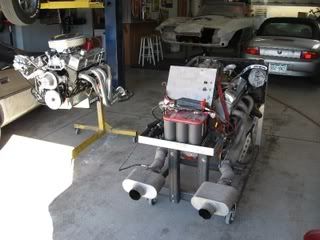
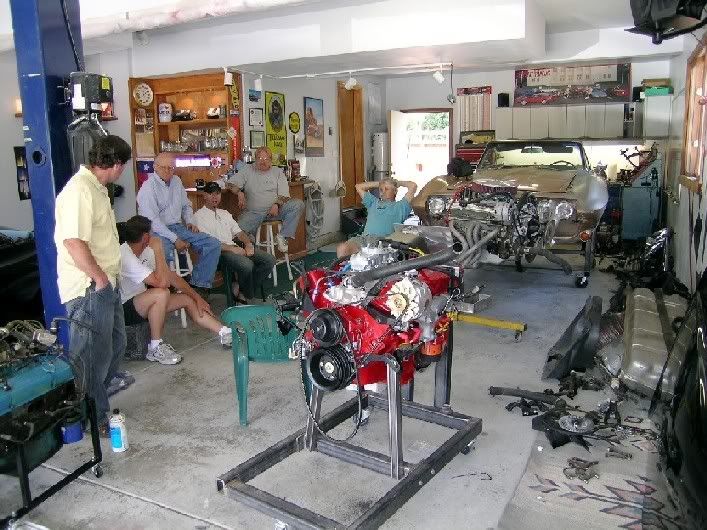
This last one is an early photo when I first built the stand: I thought I needed members coming up and supporting the engine at the engine mounts. This turned out to be unneccessary, so the current version of the stand uses nothing but the bellhousing to hang the engine off:
A run stand is good for breaking in cams, checking for leaks, setting timing, adjusting the carb, and overall setup, but you cannot break in rings on a no-load test stand: You have to put the engine under load to seat the rings. For this reason, you want to be a little careful about how long you run a new engine under no load on a run stand: Set the engine up, let the cam break in, and fix your leaks. Then, get the engine in the car and get it under a hard load to make sure the rings seat.
Some photos of my well-used run stand:
This last one is an early photo when I first built the stand: I thought I needed members coming up and supporting the engine at the engine mounts. This turned out to be unneccessary, so the current version of the stand uses nothing but the bellhousing to hang the engine off:
http://www.jegs.com/i/JEGS/555/80040/10002/-1
Thread Starter
Pro
Joined: Apr 2008
Posts: 596
Likes: 6
From: Irving Texas
Hee hee, yes, it is not pretty but does work.
Check this guy out:
http://www.youtube.com/watch?v=41GTBz_SPrY
Check this guy out:
http://www.youtube.com/watch?v=41GTBz_SPrY

Le Mans Master


Joined: Dec 2003
Posts: 5,727
Likes: 38
From: Fremont CA
One caveat: don't get too excitied about firing off 2 years of hard work and forget to remove your ratchet from the harmonic balancer bolt (trick ARP part.)
Here you go:http://www.youtube.com/watch?v=99VH2tQGXx4
Here you go:http://www.youtube.com/watch?v=99VH2tQGXx4

Drifting

Joined: Dec 2005
Posts: 1,973
Likes: 5
From: Valrico Florida
so u mean to say that you can run a motor off a regular stand such as this one??
http://www.jegs.com/i/JEGS/555/80040/10002/-1
http://www.jegs.com/i/JEGS/555/80040/10002/-1

Pro
Joined: Oct 2004
Posts: 573
Likes: 0
From: Stafford VA
If there isn't an engine dyno in your area, I agree with trying to run the motor outside the car. If there is an engine dyno around though, it would be much better to run the motor under load and get some kind of tune on it over just firing it up to check for leaks and such.
Le Mans Master
Joined: Dec 2003
Posts: 5,727
Likes: 38
From: Fremont CA
If there isn't an engine dyno in your area, I agree with trying to run the motor outside the car. If there is an engine dyno around though, it would be much better to run the motor under load and get some kind of tune on it over just firing it up to check for leaks and such.
I also tore down top end of this build to look at all the lifters to make sure wear patterns were developing well after break-in of cam even though I used Joe Gibbs Racing "BR" break-in motor oil on the start-up. The last thing I wanted to have happen is a cam failure in my wife's 70 LT-1, I would have never heard the end of that one from her. Motor has about 4K miles on it right now and valve lash has been checked twice with good clearances being evident so far (who says you need a roller cam?)
In my area, a good engine dyno session runs about $750 to $1000 so, unless you doing testing of parts, it probably isn't worth while to go that route, I will be doing that with my "bullet" for my 72 LT-1
Last edited by Solid LT1; Sep 21, 2010 at 01:41 AM.

Team Owner

Joined: Apr 1999
Posts: 21,953
Likes: 1,445
From: Reno Nevada
2024 C3 of the Year Finalist- Modified
The dark side
Years ago my room mate acquired an engine test stand to do the 20 minute break in runs
Big radiator and electric fans, battery, tach, oil pressure,...... We used it once. You have all the man hours of putting it on and off the test stand when you could have just put it in the vehicle anyway. Lars has it down to less than an hour. If you were a shop building and repair or selling motors I could see it.
Where I work we use the engine dyno with a 25% load for motor breakins before installing or shipping them. Unless it is getting the whole dyno tune with print outs
Years ago my room mate acquired an engine test stand to do the 20 minute break in runs
Big radiator and electric fans, battery, tach, oil pressure,...... We used it once. You have all the man hours of putting it on and off the test stand when you could have just put it in the vehicle anyway. Lars has it down to less than an hour. If you were a shop building and repair or selling motors I could see it.
Where I work we use the engine dyno with a 25% load for motor breakins before installing or shipping them. Unless it is getting the whole dyno tune with print outs

Drifting
Joined: Aug 2004
Posts: 1,883
Likes: 124
From: Lubbock TX
