






Anyone ever use an Engine Test Stand?

Thread Starter
Pro


Joined: Apr 2008
Posts: 596
Likes: 6
From: Irving Texas
 Anyone ever use an Engine Test Stand?
Anyone ever use an Engine Test Stand to break-in an engine? Or tune an engine?
Any suggestions as to welding one VS buying one? The cheapest I found was $500 but I'm tempted to make one but I dont have a welder.

Any suggestions as to welding one VS buying one? The cheapest I found was $500 but I'm tempted to make one but I dont have a welder.

Racer

Joined: Apr 2005
Posts: 259
Likes: 45
From: Columbus Mn
Yep. I built this one 20 some years ago.

I've had Fords, Olds, and countless chevy engines started and broke in on it. I like using one because you can check for leaks, adjust valves, play with the carb, and do compresson checks prior to dropping it in the vehicle. Mine is set up for the engine and transmission. I usually drop the engine and tranny in together, so it has worked well for me. It's nothing fancy but it has served me well.
I've had Fords, Olds, and countless chevy engines started and broke in on it. I like using one because you can check for leaks, adjust valves, play with the carb, and do compresson checks prior to dropping it in the vehicle. Mine is set up for the engine and transmission. I usually drop the engine and tranny in together, so it has worked well for me. It's nothing fancy but it has served me well.

Melting Slicks

Joined: Jul 2006
Posts: 2,373
Likes: 6
From: Baltimore MD
I have and still do use a regular engine stand and i run water hose to it to keep cool ,regulate it also,i have supports that run up from bottom square bar ,that has the rollers on it,to the engine mounts.Works great and super cheap  I might have $100.00 in it.Then you run wires to the starter with a start button,to the battery that sits on floor
  and another wire to + distributor.Ive seen alot of guys on here that do it also.
I might have $100.00 in it.Then you run wires to the starter with a start button,to the battery that sits on floor and another wire to + distributor.Ive seen alot of guys on here that do it also.
Thread Starter
Pro
Joined: Apr 2008
Posts: 596
Likes: 6
From: Irving Texas
Whoa, so weld some tubes from the motor mount down to the front tires area?
I'm worried that the whole thing will flip on its side due to rotational forces.....am I just overthinking it?
Also, the water hose thing sounds good but what do you do with the upper hose? Let it empty into a bucket?
Have any pics?

I'm worried that the whole thing will flip on its side due to rotational forces.....am I just overthinking it?
Also, the water hose thing sounds good but what do you do with the upper hose? Let it empty into a bucket?
Have any pics?
Melting Slicks
Joined: Jul 2006
Posts: 2,373
Likes: 6
From: Baltimore MD
Dont have any pics ,but some body on here does,they have posted it before.If you are not knowegable about the working of the engine and how to do this,i would not do it.It is simple though to do if your mechanically incline.I drilled a hole through the bottom of the engine stand and i ran flat bar from there to the motor mounts and welded 3/8 pipe ,about 3 inches long on top of flat bar and i bolted motor mounts on engine and ran a bolt through to hold engine still.Does that sound understandable? The flat bar does have to be bent and angled up to the motor mounts. Where i drilled holes in the stand ,i ran a bolt through there and a lock nut ,and the flat bar will pivot now and when there isnt a engine on stand you can push them down towards the floor and out of the way ,if you wanted.

Team Owner


Joined: Jan 2006
Posts: 37,637
Likes: 3,117
From: Crossville TN
Since you don't have any way to 'load' the engine on one of those stands, you can't really generate much engine torque to make it 'roll'. If you did something stupid, maybe....but why would you do that? An un-loaded test stand is for checking out leaks, carburetion, ignition and timing. You need a dyno hooked to it to do anything else.
Corvette Stories
The Best of Corvette for Corvette Enthusiasts

10 Reasons the C6 Z06 is Still A Performance Benchmark After 20 Years
Joe Kucinski
How Much Horsepower Every Corvette Engine "LOST" in 1972
Joe Kucinski
Top 10 DOs and DON'Ts for Protecting Your Convertible Top!
Michael S. Palmer
Top 10 Most Explosive Corvettes Ever Made: Power-to-Weight Ratio Ranked!
Joe Kucinski
150 hp to 1,250 hp: Every Corvette Generation Compared by the Specs That Matter
Joe Kucinski
8 Coolest Corvette Pace Cars (and Replicas) of All Time
Verdad Gallardo
Top 10 Corvette Engines RANKED by Peak Torque (70+ Years of Muscle!)
Joe Kucinski
Corvette ZR1X Will Be Pacing the Indy 500, And Could Probably Race, Too!
Verdad Gallardo
Top 10 Corvettes Coming to Mecum Indy 2026!
Brett Foote


Le Mans Master


Joined: Dec 2003
Posts: 5,727
Likes: 38
From: Fremont CA
I used one to break in my 70 LT-1 motor and keep an eye on lifter patterns while breaking in the flat tappet cam. Worked well and kept my paint job on the Vette in excellent condition. Make sure if you run a total loss water system (from the faucet) to restrict the outflow a little bit to build system pressure in the cooling system.
Racer
Joined: Apr 2005
Posts: 259
Likes: 45
From: Columbus Mn
Yep, I drilled one single hole through the square tube to allow the motor and tranny to move forward and backwards so different tranny's could be mounted.
That picture doesn't show the radiator mount very well. It actually has two vertical posts that sandwich the radiator. The c-clamps towards the bottom allow you to slide the radiator forward and backwards.
Can't imagine I have more the $75 or so into it. I bought a cheap-o trio gauge set for monitoring the motor vitals.
Having more experience and money, I'd like to build a more refined version, but there is really nothing so wrong with my rookie first attempt, why bother.
So, I say, go get some steel, and cut and weld away.
Racer
Joined: Apr 2005
Posts: 259
Likes: 45
From: Columbus Mn
I guess I like it all on one stand because I can store it like that until I'm ready to drop it in. I use to drop them both in the engine bay at the same time. Now I have a removeable tranny crossmember, so it's easy enough to install the motor without the tranny.
Oh, now I remember one reason. I didn't like the flywheel dangerously exposed, spinning around on the back of the motor waiting to grab cloths, wires, or flesh.
Oh, now I remember one reason. I didn't like the flywheel dangerously exposed, spinning around on the back of the motor waiting to grab cloths, wires, or flesh.

Pro


Joined: Jun 2008
Posts: 680
Likes: 3
From: charlotte N.C
I guess I like it all on one stand because I can store it like that until I'm ready to drop it in. I use to drop them both in the engine bay at the same time. Now I have a removeable tranny crossmember, so it's easy enough to install the motor without the tranny.
Oh, now I remember one reason. I didn't like the flywheel dangerously exposed, spinning around on the back of the motor waiting to grab cloths, wires, or flesh.
Oh, now I remember one reason. I didn't like the flywheel dangerously exposed, spinning around on the back of the motor waiting to grab cloths, wires, or flesh.

Race Director


Joined: Jan 2000
Posts: 13,015
Likes: 2,260
From: Corsicana, Tx
2020 C2 of the Year - Modified Winner
2020 Corvette of the Year (performance mods)
C2 of Year Winner (performance mods) 2019
2017 C2 of Year Finalist
I use one every chance I can. Fire it up, break in flat tappet cam, ck for leaks, retorque heads etc etc.
Here's a recent 400" disguised to look like a 283/270 being run.

A 555" last year...

Another 555" this year...

This stand belongs to our Vette group and is rotated constantly among everyone. Seems like there is always something being fired up on it from Chevy's to Pontiacs and even Fords on it. You can see the protective cardboard on the corners to protect it during all the pickup rides it takes!
A steady agreement is that everyone needs to try and add an improvement to it each time they use it. It's getting pretty nice!
A buddy built one for me last year for a Christmas present. I just need to finish adding all the goodies to it...but it's going to be even better!
It takes very little to hold it in place. They don't move around at all when running or revved.
JIM
Here's a recent 400" disguised to look like a 283/270 being run.
A 555" last year...
Another 555" this year...
This stand belongs to our Vette group and is rotated constantly among everyone. Seems like there is always something being fired up on it from Chevy's to Pontiacs and even Fords on it. You can see the protective cardboard on the corners to protect it during all the pickup rides it takes!
A steady agreement is that everyone needs to try and add an improvement to it each time they use it. It's getting pretty nice!
A buddy built one for me last year for a Christmas present. I just need to finish adding all the goodies to it...but it's going to be even better!
It takes very little to hold it in place. They don't move around at all when running or revved.
JIM

Burning Brakes

Joined: Sep 2006
Posts: 1,242
Likes: 12
From: Kalispell MT
I used one that belongs to a buddy of mine earlier this year when I built my 555. It's a lot easier to fix anything should you need to in the stand than in the car. You can set the timing with the cast iron manifolds and then easily swap to the headers if you concerned about burning off coatings, etc.. Plus, it's just cool to be able to walk around it while it's running and see it from every aspect.


....and you've got to watch the video to really appreciate it:
http://www.youtube.com/watch?v=MVfocgqrHts

....and you've got to watch the video to really appreciate it:
http://www.youtube.com/watch?v=MVfocgqrHts

Tech Contributor


Joined: Jun 2004
Posts: 20,868
Likes: 961
From: I tend to be leery of any guy who doesn't own a chainsaw or a handgun.
Finished mine last week and ran the engine for a while on it. Given how much a PITA it is to do some types of engine work while it's in the car, I always run mine on a stand first. I sold my original stand a couple years back, and the guy apparently likes it too much to sell it back to me after I inquired about getting it back to run the new engine. A picture during the build of the new stand:

Running the engine last week:

Fortunately no problems, but I always feel better if I can get good access to the engine in the event of having to make a repair or correction to the engine.
Running the engine last week:
Fortunately no problems, but I always feel better if I can get good access to the engine in the event of having to make a repair or correction to the engine.



Melting Slicks

Joined: Jan 2003
Posts: 2,877
Likes: 13
From: Doha
St. Jude Donor '08

Tech Contributor


Joined: Aug 1999
Posts: 14,377
Likes: 6,377
From: At my Bar drinking and wrenching in Lafayette Colorado
I've been using a run stand for every engine I've built for the past 5 years. I hang the engines from a bellhousing, and the stand is drilled to accept various bellhousing tranny bolt patterns. I have an inventory of various bellhousings to bolt onto the stand, so I can install almost any engine in under 30 minutes. I have my "standard test engine" bolted to the stand most of the time, and I use this to test all the carbs I rebuild.
A run stand is good for breaking in cams, checking for leaks, setting timing, adjusting the carb, and overall setup, but you cannot break in rings on a no-load test stand: You have to put the engine under load to seat the rings. For this reason, you want to be a little careful about how long you run a new engine under no load on a run stand: Set the engine up, let the cam break in, and fix your leaks. Then, get the engine in the car and get it under a hard load to make sure the rings seat.
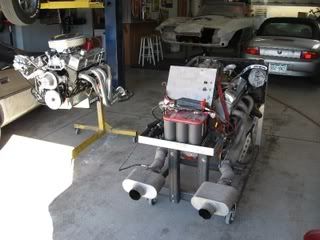
Some photos of my well-used run stand:

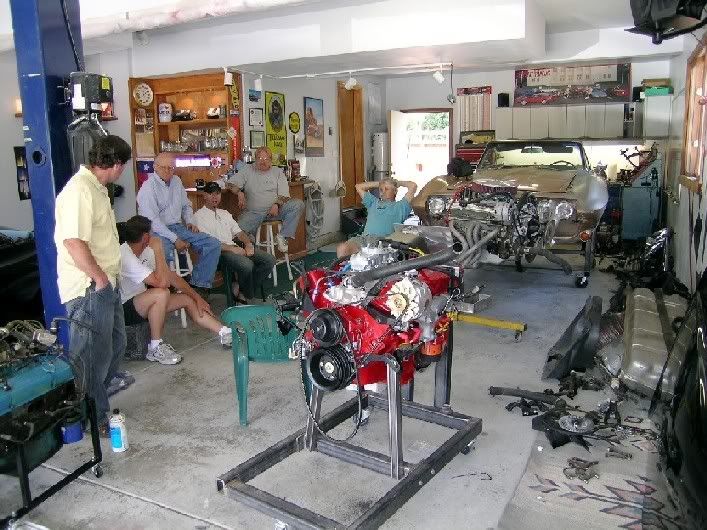
This last one is an early photo when I first built the stand: I thought I needed members coming up and supporting the engine at the engine mounts. This turned out to be unneccessary, so the current version of the stand uses nothing but the bellhousing to hang the engine off:
A run stand is good for breaking in cams, checking for leaks, setting timing, adjusting the carb, and overall setup, but you cannot break in rings on a no-load test stand: You have to put the engine under load to seat the rings. For this reason, you want to be a little careful about how long you run a new engine under no load on a run stand: Set the engine up, let the cam break in, and fix your leaks. Then, get the engine in the car and get it under a hard load to make sure the rings seat.
Some photos of my well-used run stand:
This last one is an early photo when I first built the stand: I thought I needed members coming up and supporting the engine at the engine mounts. This turned out to be unneccessary, so the current version of the stand uses nothing but the bellhousing to hang the engine off:
Last edited by lars; Sep 7, 2010 at 12:42 PM.