






Smart Struts

Burning Brakes


Joined: Sep 2008
Posts: 753
Likes: 0

Sorry, I was apparently more tired than I thought when I posted that reply (see correction), and should have said to add the ~0.750" to your D height measurement. That said, I was not aware your D height was so high (equal ~1.125" above Chevy Power D height), but with that at 1.5" (center of slot) your current 2.3" Z does put your chassis pretty much parallel to that had with Chevy Power D & Z heights. So, I'd give some thought to ~1.5" Z and 1.0" D (center of slot) if you can't get the rear further down.

sounds fine
lowering D to 1" will make my 1/2 shafts almost level to the ground i think... but i'm going to increase the rear toe-in from 1/4" to 3/8" and so partially offset the toe-steer issue.Anyway it's easy to test the car with D= 1" and 1,5" so I'll see which gives a better feeling.
Also I want to try to disconnect the OEM rear sway bar and see what happens
Unfortunately my car is a compromise in respect to chassis : not that stiff, not that low...etc. trying to get the best into the limits. Intriguing anyway this suspension's brainstorming...
Last edited by elle88; Oct 24, 2010 at 03:07 AM.

Team Owner


Joined: Apr 1999
Posts: 21,953
Likes: 1,445
From: Reno Nevada
2024 C3 of the Year Finalist- Modified
Here is some other ideas
http://forums.corvetteforum.com/c3-t...arge-pics.html

Heel & Toe

Joined: Jul 2007
Posts: 15
Likes: 0
From: Tustin CA
D height
This may be sacrilege to question Chev Power but by my measurements the vertical distance between the outer u-joint center and outer strut pivot is about 6.75 in. The vertical distance between the inner pivots with the standard bracket is about 5 in. The Chev Power seems to indicate adjusting height with longer spring bolts to achieve the specified D height of 1.25. This method would put the inner u-joint about 0.5 inch below the outer in conflict with the Greenwood recommened Plus 0.5 in to control toe out. It would seem that to keep the inner u-joint 0.5 above the outer for toe control and have a 1.25 D height the inner pivot point on the bracket should be about 1 in below the stock location. Which is about the drop Skunk Works said the smart strut bracket would provide.

Le Mans Master


Joined: Apr 2007
Posts: 7,353
Likes: 72
From: Graceland in a Not Correctly Restored Stingray
This may be sacrilege to question Chev Power but by my measurements the vertical distance between the outer u-joint center and outer strut pivot is about 6.75 in. The vertical distance between the inner pivots with the standard bracket is about 5 in. The Chev Power seems to indicate adjusting height with longer spring bolts to achieve the specified D height of 1.25. This method would put the inner u-joint about 0.5 inch below the outer in conflict with the Greenwood recommened Plus 0.5 in to control toe out. It would seem that to keep the inner u-joint 0.5 above the outer for toe control and have a 1.25 D height the inner pivot point on the bracket should be about 1 in below the stock location. Which is about the drop Skunk Works said the smart strut bracket would provide.

Safety Car

Joined: Sep 2003
Posts: 4,206
Likes: 8
From: Belmar NJ
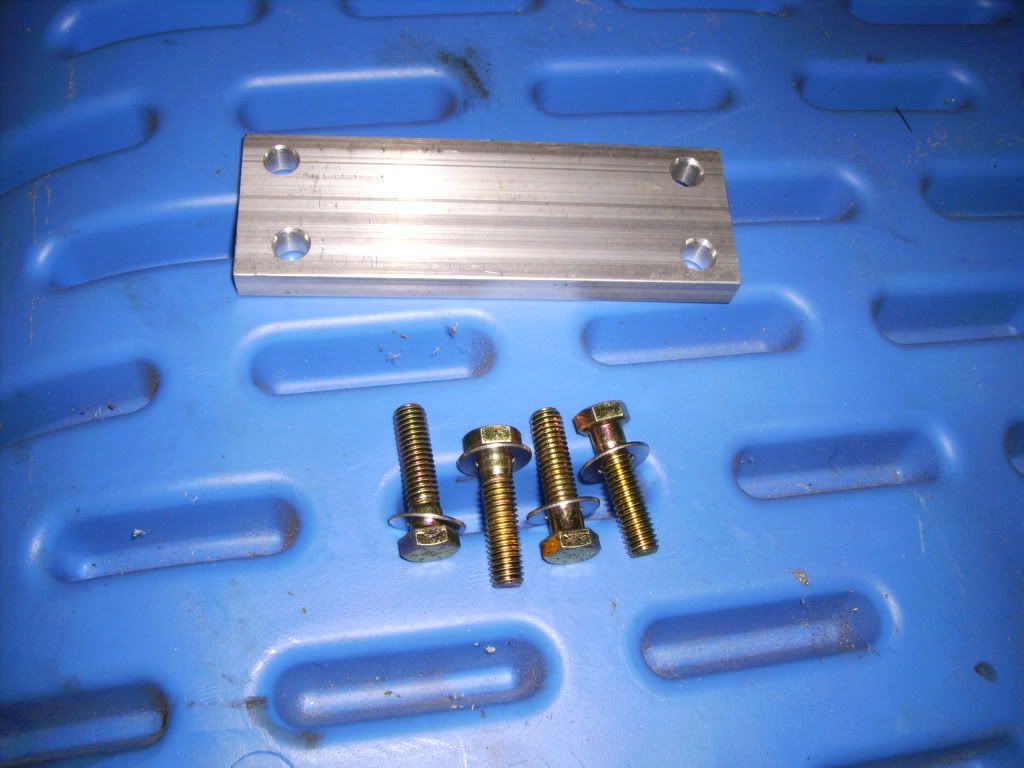
Here is an extra camber plate, made from 1/2" alum. bar stock. CNC machined, grade 8 bolts, stainless steel washers. I was worried about bottoming out in the rear (1 1/4 length would have been better than 1 1/2" bolts but I couldn't find them. Instead I used a lock washer on each). $50 shipped anywhere in the continental US. Please PM.

Le Mans Master

Joined: Aug 2006
Posts: 7,426
Likes: 1,559
From: mount holly NC
2025 c3 ('74-'82) of the Year Finalist - Unmodified
2019 C3 of Year Finalist (appearance mods)
Le Mans Master
Joined: Apr 2007
Posts: 7,353
Likes: 72
From: Graceland in a Not Correctly Restored Stingray
http://www.corvettefaq.com/c3/ChevyPower.pdf
Corvette Stories
The Best of Corvette for Corvette Enthusiasts

Top 10 Most Expensive Corvettes Ever Sold on Bring A Trailer
Brett Foote
10 Things Every Corvette Owner Needs (2026 Edition)
Michael S. Palmer
8 Most "Only Corvette Owners Understand" Quirks and Problems
Pouria Savadkouei
10 Reasons the C6 Z06 is Still A Performance Benchmark After 20 Years
Joe Kucinski
How Much Horsepower Every Corvette Engine "LOST" in 1972
Joe Kucinski
Top 10 DOs and DON'Ts for Protecting Your Convertible Top!
Michael S. Palmer
Top 10 Most Explosive Corvettes Ever Made: Power-to-Weight Ratio Ranked!
Joe Kucinski
150 hp to 1,250 hp: Every Corvette Generation Compared by the Specs That Matter
Joe Kucinski
8 Coolest Corvette Pace Cars (and Replicas) of All Time
Verdad Gallardo
Heel & Toe
Joined: Jul 2007
Posts: 15
Likes: 0
From: Tustin CA
Chev Power heretic
Raising the diff will help the CG but since the strut rod bracket is attached to the diff it will also be raised. Chev Power (at least my old, old edition) only recommends welding a single hole plate over the camber adjusting slot, no spacer, no modified bracket. With these conditions the relationship of the inner u-joint and the inner strut rod pivots remain unchanged. The only way to achive the recommended D height with the outer pivots location fixed by the tire diameter is to lower the inner pivots which results in an inner u-joint about 1/2 inch below the outer. Not a desireable setting for controling toe out. What I am saying is Chev Power, as written, gives bad advice. Now you can burn me at the stake.
This post is about the Smart Strut bracket and how to use it. The vertical slots in the Smart Strut bracket allow adjustment of the D height by changing the relationship between the inner u-joint and the lower strut rod pivot point. The additional degree of freedom built into the bracket allows the inner u-joint to be located above the outer and also achive a 1.25 in D height. As Skunk Works said a plate with a hole in the center of the slot comes very close to delivering a 1.25 D height.
This post is about the Smart Strut bracket and how to use it. The vertical slots in the Smart Strut bracket allow adjustment of the D height by changing the relationship between the inner u-joint and the lower strut rod pivot point. The additional degree of freedom built into the bracket allows the inner u-joint to be located above the outer and also achive a 1.25 in D height. As Skunk Works said a plate with a hole in the center of the slot comes very close to delivering a 1.25 D height.

Melting Slicks

Joined: Jan 2006
Posts: 3,028
Likes: 2
From: North NJ

If you're goal is to lower the car (stance) to achieve the "look" or lower CG then its worth raising the diff to keep proper Half-shaft geometry.
You just have to know that you are limiting wheel travel. I would think your strut rod bracket should be raised then to keep the current geometry. So your strut rod would not change in relation to its mounting to the diff.

Burning Brakes
Joined: Jan 2009
Posts: 845
Likes: 54
From: Bangor, Northern Ireland
I appreciate this is a few years old but thought i'd share anyway
I did both, raised the diff and got smart struts, not perfect but good enough. the car handles very well
[IMG] [/IMG]
I did both, raised the diff and got smart struts, not perfect but good enough. the car handles very well
[IMG]
[/IMG]
Le Mans Master
Joined: Apr 2007
Posts: 7,353
Likes: 72
From: Graceland in a Not Correctly Restored Stingray
Unless straight line acceleration at the strip is your only priority, you really should dial your SS inner links back up to the top of the "inclination" slot. That would put them back to only ~1/2" lower than are their stock heights, which is where John Greenwood rightly recommends and where IMCO they should remain as the default adjustment in lieu of actual test results proving otherwise for a given set of circumstances.
Burning Brakes
Joined: Jan 2009
Posts: 845
Likes: 54
From: Bangor, Northern Ireland
Unless straight line acceleration at the strip is your only priority, you really should dial your SS inner links back up to the top of the "inclination" slot. That would put them back to only ~1/2" lower than are their stock heights, which is where John Greenwood rightly recommends and where IMCO they should remain as the default adjustment in lieu of actual test results proving otherwise for a given set of circumstances.

The car is light years better than it was.
I really need some double adjustable shocks to dial the car properly but they'll have to wait.
So the idea is not to get the lower arm and half shaft level then?
Cheers
Burning Brakes
Joined: Sep 2008
Posts: 753
Likes: 0
you have to have the 1/2 shaft angled down externally. to do this you should raise the rear of car
i solved the toe steer issue adding a lot of rear toe-in and stiffening as much as possible the rear suspension to avoid excessive body roll
i use a 7 leaf steel spring ( which is stiffer than your composite) and qa1 single adjust shock setted quite stiff. i suggest qa1 because are really easy and fun to tune...just turn the ****
i solved the toe steer issue adding a lot of rear toe-in and stiffening as much as possible the rear suspension to avoid excessive body roll
i use a 7 leaf steel spring ( which is stiffer than your composite) and qa1 single adjust shock setted quite stiff. i suggest qa1 because are really easy and fun to tune...just turn the ****
Last edited by elle88; Mar 18, 2013 at 04:58 AM.
Burning Brakes
Joined: Jan 2009
Posts: 845
Likes: 54
From: Bangor, Northern Ireland
you have to have the 1/2 shaft angled down externally. to do this you should raise the rear of car
i solved the toe steer issue adding a lot of rear toe-in and stiffening as much as possible the rear suspension to avoid excessive body roll
i use a 7 leaf steel spring ( which is stiffer than your composite) and qa1 single adjust shock setted quite stiff. i suggest qa1 because are really easy and fun to tune...just turn the ****
i solved the toe steer issue adding a lot of rear toe-in and stiffening as much as possible the rear suspension to avoid excessive body roll
i use a 7 leaf steel spring ( which is stiffer than your composite) and qa1 single adjust shock setted quite stiff. i suggest qa1 because are really easy and fun to tune...just turn the ****
I have adjustable Spax's on the car at the moment but double adjustable is what i'm after.
It's compromise between stance and geometry hence why it's not perfect but good enough for a fast road car, oddly the only racing I do with the car is drag racing even though it's set up as a circuit racer

Instructor

Joined: Feb 2008
Posts: 113
Likes: 1
From: Raleigh NC
St. Jude Donor '13,'15,'17,'18,'22-'23-'24-'25
Unless straight line acceleration at the strip is your only priority, you really should dial your SS inner links back up to the top of the "inclination" slot. That would put them back to only ~1/2" lower than are their stock heights, which is where John Greenwood rightly recommends and where IMCO they should remain as the default adjustment in lieu of actual test results proving otherwise for a given set of circumstances.
 . So we're saying the struts and half shafts should have some down angle for a street car? Pic of my 68, unweighted, on the jack stands waiting for the body to be dropped back on.!
Last edited by Steve C.; Mar 18, 2013 at 07:34 AM.
Burning Brakes
Joined: Jan 2009
Posts: 845
Likes: 54
From: Bangor, Northern Ireland
Correct, yes the axles should point down so that they're level when the car squats.
My picture was to illustrate trying to get the axle and lower arm level, my goal was to get the ride height I wanted and engineer the suspension to suit i.e the cut down bump stops, this mod provides another 3/4" suspension travel without any rubbing, moving the diff up gets the shafts straighter and smart struts allow things to line up easier.
It's as good as it'll get and a damn sight better than it was with the standard setup, I can really throw the car around now and get it to 95% of it's cornering capability
Next up is a roll cage to stiffen that floppy frame.
My picture was to illustrate trying to get the axle and lower arm level, my goal was to get the ride height I wanted and engineer the suspension to suit i.e the cut down bump stops, this mod provides another 3/4" suspension travel without any rubbing, moving the diff up gets the shafts straighter and smart struts allow things to line up easier.
It's as good as it'll get and a damn sight better than it was with the standard setup, I can really throw the car around now and get it to 95% of it's cornering capability
Next up is a roll cage to stiffen that floppy frame.
Last edited by aaroncorvette; Mar 18, 2013 at 07:56 AM.
 [/IMG]