




Repairing/replacing gas lines.

Thread Starter
Pro

Joined: May 2003
Posts: 593
Likes: 0
From: London England
 Repairing/replacing gas lines.
After the answers I got to another threaed of mine I suspect I may have to replace or repair the gas line on my '71 due to damage or corrosion.
Am I right in thinking that sections of the pipe are hidden above the frame? If I do find a leak somewhere I was considering bypassing a section of the line with either replacement soft hose or use hose to join the factory line with some replacement hard line.
Any thoughts?
Thanks guys
Am I right in thinking that sections of the pipe are hidden above the frame? If I do find a leak somewhere I was considering bypassing a section of the line with either replacement soft hose or use hose to join the factory line with some replacement hard line.
Any thoughts?
Thanks guys

Melting Slicks


Joined: Oct 2005
Posts: 2,056
Likes: 8
From: Redruth Cornwall
Several years ago, I had a leak on my 75 that was discovered at the Nationals. It was in the area just above the gusset in front of the rear kick up. As you have become aware, mud etc gets trapped here and rots the line out. I replaced a piece about 1m long from above the frame rail in the wheel well to a point just in front of the kick up using flexible fuel hose and a couple of fuel line clamps.
Worked well and was going to be a temporary repair.......
Worked well and was going to be a temporary repair.......
Le Mans Master


Joined: Mar 2001
Posts: 6,638
Likes: 287
From: Ann Arbor Michigan
If you have the working space, it's always best to patch in a new section of steel brake tube. Don't use rubber hose unless you can put a raised bead on the end of the steel tube so the rubber hose won't come off. Just sliding a piece of rubber hose over the tube with a hose clamp to hold it is a 
Gary
Gary
Melting Slicks
Joined: Oct 2005
Posts: 2,056
Likes: 8
From: Redruth Cornwall
If you have the working space, it's always best to patch in a new section of steel brake tube. Don't use rubber hose unless you can put a raised bead on the end of the steel tube so the rubber hose won't come off. Just sliding a piece of rubber hose over the tube with a hose clamp to hold it is a
Gary
Gary

Team Owner


Joined: Sep 2006
Posts: 31,108
Likes: 4,170
From: Westminster Maryland
Hi G,
It's the rear section of the gas and return line that are difficult to get to. People have been successful in replacing the lines with out lifting the body but it's a good bit of work. Using regular steel lines rather than SS makes it a little easier since the regular steel line is a lot easier to bend.
Here's a picture that shows where access to the lines become difficult on the passenger's side frame rail.
Good Luck!
Regards,
Alan
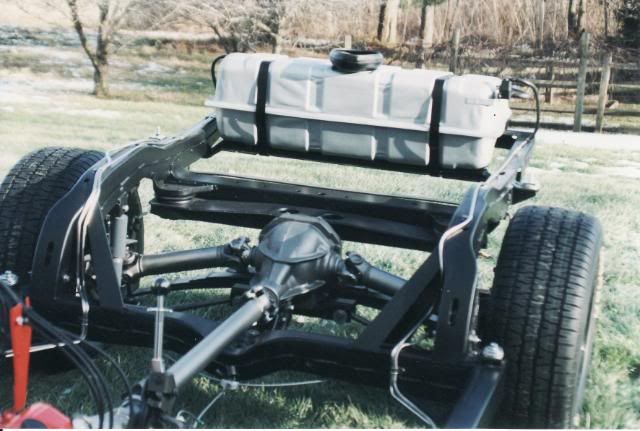
It's the rear section of the gas and return line that are difficult to get to. People have been successful in replacing the lines with out lifting the body but it's a good bit of work. Using regular steel lines rather than SS makes it a little easier since the regular steel line is a lot easier to bend.
Here's a picture that shows where access to the lines become difficult on the passenger's side frame rail.
Good Luck!
Regards,
Alan
Melting Slicks
Joined: Oct 2005
Posts: 2,056
Likes: 8
From: Redruth Cornwall

When I helped a friend replace his fuel and brake lines with an after market set, they didnt have a flared or bubble end. Hasnt leaked and he has since changed to a FI setup. Would be difficult to get at some of the connections now to install a flare.
Thread Starter
Pro
Joined: May 2003
Posts: 593
Likes: 0
From: London England
Corvette Stories
The Best of Corvette for Corvette Enthusiasts

10 Most Common Corvette Problems of the Last 20 Years!
Joe Kucinski
5 MOST and 5 LEAST Popular Corvette Model Years in History!
Joe Kucinski
2027 Corvette Buyer's Guide: Everything You Need to Know!
Joe Kucinski
10 Things C8 Corvette Owners Hate (But Won't Tell You)
Joe Kucinski
10 Best Corvettes Coming to Barrett-Jackson Palm Beach 2026!
Brett Foote
Every Corvette Grand Sport Explained! (C2, C4, C6, C7, & C8)
Joe Kucinski
Grand Sport & Grand Sport X Launch Alongside All-New 535hp LS6 V8!
Michael S. Palmer
5 Reasons Bad Drivers Crash & 5 Ways to Avoid a Costly Mistake!
Joe Kucinski
7 Bolt-On Upgrades From Extreme Online Store to Level Up Your C6 Corvette
Pouria Savadkouei
Le Mans Master
Joined: Mar 2001
Posts: 6,638
Likes: 287
From: Ann Arbor Michigan


Race Director

Joined: Mar 2006
Posts: 14,112
Likes: 27
From: Florida
The fuel supply line is 3/8" od and the return line is 1/4" od.
(tubing is always measured by the od)
The supply line can leak in storage but the return line will not, other than a pint or so at first, till empty.
Don't know if sae sizes are easily available over there but, brake line is the same tubing, sold with flare nuts installed at any parts store here. You can use an inverted flare coupling to connect two pieces. This is the best way to splice a line. You must flare the old line in place and space can create a challange.
You can repair either supply or return with gasoline rated hose. To put a bead on the end with less than the proper bead tool, you can take a regular 45° flaring tool and just do the first step to prepare the invert with the dye, acts just like the proper bead.
You can even just clamp it on the straight pipe, pushing it on longer and 2 clamps if wanted.
The supply line has no pressure running and only gravity sitting and the return has next to no pressure running.
(tubing is always measured by the od)
The supply line can leak in storage but the return line will not, other than a pint or so at first, till empty.
Don't know if sae sizes are easily available over there but, brake line is the same tubing, sold with flare nuts installed at any parts store here. You can use an inverted flare coupling to connect two pieces. This is the best way to splice a line. You must flare the old line in place and space can create a challange.
You can repair either supply or return with gasoline rated hose. To put a bead on the end with less than the proper bead tool, you can take a regular 45° flaring tool and just do the first step to prepare the invert with the dye, acts just like the proper bead.
You can even just clamp it on the straight pipe, pushing it on longer and 2 clamps if wanted.
The supply line has no pressure running and only gravity sitting and the return has next to no pressure running.

Drifting


Joined: Jun 2002
Posts: 1,590
Likes: 28
From: Tallmadge Ohio
C3 of Year Finalist (stock) 2019
St. Jude Donor '09-'10-'11-'12-'13-'14-'15-'16-'17-‘18-'19
Oldtimer
I did the exact repair that jotto did. The repair was in the same location and I used rubber fuel rated line. That was about 17 years ago. No problems.
