




Wind Tunnel Tests C1-6

Thread Starter
Drifting

Joined: Oct 2010
Posts: 1,972
Likes: 6
From: Chester Virginia
 Wind Tunnel Tests C1-6
The attached youtube shows wind tunnel testing of c1-c6 vettes. Beginning with C3's it looks like the bodies start slipping easily through the air and the C6 smoke looks very tight over the body.
http://www.youtube.com/watch?v=FjwyUOq_goI
http://www.youtube.com/watch?v=FjwyUOq_goI
Thread Starter
Drifting
Joined: Oct 2010
Posts: 1,972
Likes: 6
From: Chester Virginia
rumor is that one of the generation C7 vette versions had a drag coefficient of .23.
2006 corvette drag coefficient .27
C5 drag coefficient was .31
C4 drag coefficient was .34
C3 1968 L-88 Vette: 0.360
I'm not enough of an engineer to know how much and there are forum pieces on it (specific circumstances usually) but the more drag, the more horsepower needed to overcome that drag to reach a certain speed.
The newer generations wedgelike shapes seem to slip through the air faster and I suppose at anything over 120 mph or so it makes a bigger difference.
2006 corvette drag coefficient .27
C5 drag coefficient was .31
C4 drag coefficient was .34
C3 1968 L-88 Vette: 0.360
I'm not enough of an engineer to know how much and there are forum pieces on it (specific circumstances usually) but the more drag, the more horsepower needed to overcome that drag to reach a certain speed.
The newer generations wedgelike shapes seem to slip through the air faster and I suppose at anything over 120 mph or so it makes a bigger difference.

Race Director


Joined: Sep 1999
Posts: 11,361
Likes: 383
From: Plano TX
Drag coefficient isn't all that important. It's how much power it takes to push each square foot of frontal area through the air. So the higher CD of a C3 is compensated by the smaller frontal area compared to a C6.
For more important is front end lift. This is where the C1-C3 sucks. They didn't get the front lift fixed until the C4. The C3 actually has a good rear end lift figure (a slight push down, which is great). But although the C3 doesn't lift the front as badly as the C1-C2, it's still nothing you want to take to 150 mph.
For more important is front end lift. This is where the C1-C3 sucks. They didn't get the front lift fixed until the C4. The C3 actually has a good rear end lift figure (a slight push down, which is great). But although the C3 doesn't lift the front as badly as the C1-C2, it's still nothing you want to take to 150 mph.
Thread Starter
Drifting
Joined: Oct 2010
Posts: 1,972
Likes: 6
From: Chester Virginia
Zwede..I'm not an engineer so I think I understand what you said...the front end of a c3 at speed might tend to rise with air pressue pushing it up instead of down slightly to aid traction? If that's not correct please explain as I'd like to understand. If you watch the wind tunnel clips they do it with headlamps out and in and it sure makes a diff. in air flow and has to add to resistance against the wind with more front surface area...like pushing a box into the wind takes more work than a spear.
I want to understand a little better because April 13, 2011 I'm taking the car to VIR for their Touring Lights day which won't be at high speeds but is 100 minutes in the day on the 3.27 mile, 17 turn road track. At the end of the back straight there is a set of what look like not too sharp curves or esses but they are called the Roller Coasters because they rise and fall quickly with elevation. Enter them too fast with a light front end and you would be headed airborne possibly. Never driven on a track before and this is controlled paced conditions I'll be driving in but I'd like to know all I can and understand it.
I want to understand a little better because April 13, 2011 I'm taking the car to VIR for their Touring Lights day which won't be at high speeds but is 100 minutes in the day on the 3.27 mile, 17 turn road track. At the end of the back straight there is a set of what look like not too sharp curves or esses but they are called the Roller Coasters because they rise and fall quickly with elevation. Enter them too fast with a light front end and you would be headed airborne possibly. Never driven on a track before and this is controlled paced conditions I'll be driving in but I'd like to know all I can and understand it.
Thread Starter
Drifting
Joined: Oct 2010
Posts: 1,972
Likes: 6
From: Chester Virginia
I have a moderate air dam under my front end on the '76. Like a black scoop from the factory. It could be to force air to the radiator with the high thermostat of the engine but it also could be to force air up to some degree and the nose down. Know what the purpose of it actually is? I'm speculating without specific knowledge. Thanks, btw.
Corvette Stories
The Best of Corvette for Corvette Enthusiasts

Top 10 Most Expensive Corvettes Ever Sold on Bring A Trailer
Brett Foote
10 Things Every Corvette Owner Needs (2026 Edition)
Michael S. Palmer
8 Most "Only Corvette Owners Understand" Quirks and Problems
Pouria Savadkouei
10 Reasons the C6 Z06 is Still A Performance Benchmark After 20 Years
Joe Kucinski
How Much Horsepower Every Corvette Engine "LOST" in 1972
Joe Kucinski
Top 10 DOs and DON'Ts for Protecting Your Convertible Top!
Michael S. Palmer
Top 10 Most Explosive Corvettes Ever Made: Power-to-Weight Ratio Ranked!
Joe Kucinski
150 hp to 1,250 hp: Every Corvette Generation Compared by the Specs That Matter
Joe Kucinski
8 Coolest Corvette Pace Cars (and Replicas) of All Time
Verdad Gallardo
Race Director
Joined: Sep 1999
Posts: 11,361
Likes: 383
From: Plano TX
The factory air dam was to force air into the radiator.
Yes, the problem with the C3 is that there is too much air going under the car that then gets trapped in the engine compartment creating lift. Duntov had a test car with a hot motor he played with in 69 or 70. He had it up to close to 200 mph when the hood flew off. There was so much pressure from underneath it snapped the hinges.
Have a look at this LeMans race car:
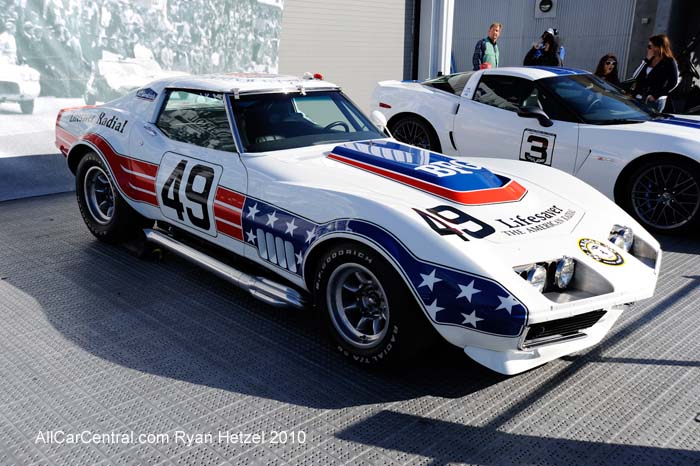
See how they lowered the front, and raised the rear? They also made a much large air dam to limit the air that got under the car. This is all to minimize front end lift. This car was able to do over 200 mph at the 1973 LeMans.
Yes, the problem with the C3 is that there is too much air going under the car that then gets trapped in the engine compartment creating lift. Duntov had a test car with a hot motor he played with in 69 or 70. He had it up to close to 200 mph when the hood flew off. There was so much pressure from underneath it snapped the hinges.
Have a look at this LeMans race car:
See how they lowered the front, and raised the rear? They also made a much large air dam to limit the air that got under the car. This is all to minimize front end lift. This car was able to do over 200 mph at the 1973 LeMans.
Thread Starter
Drifting
Joined: Oct 2010
Posts: 1,972
Likes: 6
From: Chester Virginia
So, if I'm going 50, 60, 70 or so it shouldn't be a big deal but the faster you go the more upward pressure pushing more air under and up. I don't think we'll be allowed to get anywhere near real flat out racing speeds though they might let is pick it up on the straights some. We'll all be novices and follow a pacing car. One session to learn the lines to take then a second, then a third, then a final fourth session in the day totalling 100 minutes. The lady who registered me said that it would be an exciting and exhilerating day for me. No racing and no passing so it ought to be safe enough.
Thread Starter
Drifting
Joined: Oct 2010
Posts: 1,972
Likes: 6
From: Chester Virginia
Zwede, That's my thought. We may be allowed up over 100 on the straights or in that neighorhood by the end of the day but we'll see. I've had mine at 95 or so on the Interstate and it really likes that groove. Feels fine. I haven't figured it out but proportionately with the rpms at where it probably would max out I doubt if my '76 small block would do much more than 120, max 128 by my rough ratios and I have no desire for that.
Lots of things to learn and these Vettes are good vehicles for gaining that knowledge. Thanks.
Lots of things to learn and these Vettes are good vehicles for gaining that knowledge. Thanks.

Former Vendor
Joined: Aug 2006
Posts: 76,656
Likes: 1,853
From: Jeffersonville Indiana 812-288-7103
St. Jude Donor '08-'09-'10-'11-'12-'13-'14-'15
Zwede, That's my thought. We may be allowed up over 100 on the straights or in that neighorhood by the end of the day but we'll see. I've had mine at 95 or so on the Interstate and it really likes that groove. Feels fine. I haven't figured it out but proportionately with the rpms at where it probably would max out I doubt if my '76 small block would do much more than 120, max 128 by my rough ratios and I have no desire for that.
Lots of things to learn and these Vettes are good vehicles for gaining that knowledge. Thanks.
Lots of things to learn and these Vettes are good vehicles for gaining that knowledge. Thanks.
It's been my personal experience that the front end will start to rise about 135 -140 mph range on a stock car 1973 up to 1979. I don't think you'll have a problem.
Willcox
