



Steering Locking Up

Thread Starter
Intermediate

Joined: May 2010
Posts: 26
Likes: 0
From: Cairns Queensland

Did you check the casting numbers on your pitman arm? Having a manual arm on a power steering application can cause the "stick in left turn" condition that you mention. The two arms look very much alike. But they have subtle differences that could cause your problem.
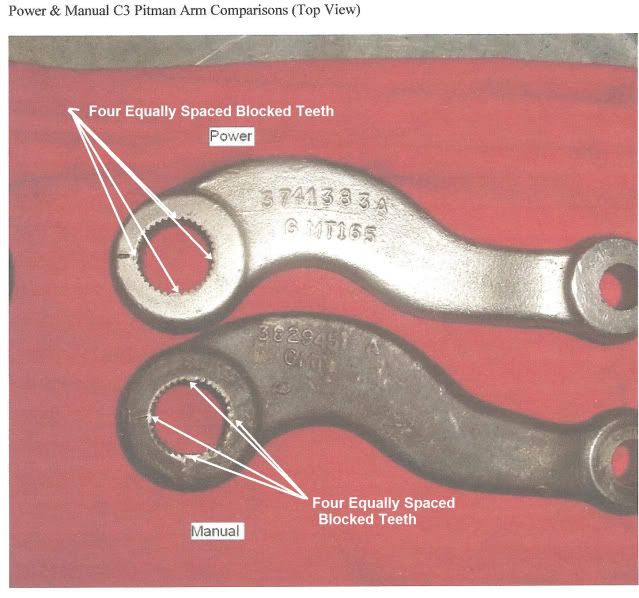
jim
jim

Le Mans Master


Joined: Jul 2000
Posts: 6,001
Likes: 113
From: Saginaw Michigan
On your '74 Vett you should have two sets of tapered holes in your steering arms. The arms are extending rearward from the steering knuckle. The rearmost holes (longest arm) is for manual steering. The tie rods on a manual steering car can be moved to the forward holes (shortest arm) for a faster ratio.
With power steering, only the forward holes (shortest arm) are to be used. I am not sure of the actual problem but I believe that there is some type of interference if the tie rod from a power steering system is installed in the rearmost hole.
Jim
With power steering, only the forward holes (shortest arm) are to be used. I am not sure of the actual problem but I believe that there is some type of interference if the tie rod from a power steering system is installed in the rearmost hole.
Jim
Thread Starter
Intermediate
Joined: May 2010
Posts: 26
Likes: 0
From: Cairns Queensland
On your '74 Vett you should have two sets of tapered holes in your steering arms. The arms are extending rearward from the steering knuckle. The rearmost holes (longest arm) is for manual steering. The tie rods on a manual steering car can be moved to the forward holes (shortest arm) for a faster ratio.
With power steering, only the forward holes (shortest arm) are to be used. I am not sure of the actual problem but I believe that there is some type of interference if the tie rod from a power steering system is installed in the rearmost hole.
Jim
With power steering, only the forward holes (shortest arm) are to be used. I am not sure of the actual problem but I believe that there is some type of interference if the tie rod from a power steering system is installed in the rearmost hole.
Jim
Thread Starter
Intermediate
Joined: May 2010
Posts: 26
Likes: 0
From: Cairns Queensland
I've had a look. The steering tie rods appear to be installed correctly (short arm position). The long arm holes are plugged with some sort of grommet that does not appear to have removed or replaced ever.
Thread Starter
Intermediate
Joined: May 2010
Posts: 26
Likes: 0
From: Cairns Queensland
I did learn one thing from this exercise: Pressure must build up in the system because p/s fluid squirted out of the top of the filler cap. Another 5 minute job that turned into a 2 hour saga (engine bay wash, car wash, garage floor wash).
Thread Starter
Intermediate
Joined: May 2010
Posts: 26
Likes: 0
From: Cairns Queensland
Jim, your thoughts please: With front end lifted, engine off, I had no problems turning the steering wheel. Can we now conclude that my problem is hydraulic not mechanical, and if so, what could the problem be?
Le Mans Master
Joined: Jul 2000
Posts: 6,001
Likes: 113
From: Saginaw Michigan
Since your problem is only in full left turn, the problem cannot be the pump. (The pump doesn't know which way you are turning.)
You never did mention if the problem just suddenly surfaced or not?
This leaves just a couple possibilities:
Still something mechanical that interferes near full left turn with the suspension in its normal down-the-road position. (I assume that when you raised the front end, engine off, the front wheels are hanging in full rebound position.)
Next there might be something wrong inside the control valve (such as left to right balance).
Something inside the assist ram with the rod fully extended.
The last steering component would be the steering gear itself.
One last thought. You mentioned that you replaced the flexible coupling assembly. In order to do that, you should have done one of two procedures:
1. You needed to unbolt the steering column and pull it back inside the driver compartment in order to disengage the steering shaft from the coupling assembly.
2. Or you had to remove the steering gear attaching bolts to the frame and tip the gear so that the coupling assembly could be disengaged from the gear input shaft.
In either case, you need to make sure that when you reinstalled everything, the steering column has to be aligned to that it points directly at the steering gear input shaft. You have to make sure that there is no binding when turning the steering wheel. Inspect the stop pins that are part of the flexible coupling. The pins should fit into slots in the flange that is part of the steering column shaft. The pins should not touch the column flange and there should be about 1/8 inch clearance (stop pins to flange slots) in all steering wheel positions.
Jim
You never did mention if the problem just suddenly surfaced or not?
This leaves just a couple possibilities:
Still something mechanical that interferes near full left turn with the suspension in its normal down-the-road position. (I assume that when you raised the front end, engine off, the front wheels are hanging in full rebound position.)
Next there might be something wrong inside the control valve (such as left to right balance).
Something inside the assist ram with the rod fully extended.
The last steering component would be the steering gear itself.
One last thought. You mentioned that you replaced the flexible coupling assembly. In order to do that, you should have done one of two procedures:
1. You needed to unbolt the steering column and pull it back inside the driver compartment in order to disengage the steering shaft from the coupling assembly.
2. Or you had to remove the steering gear attaching bolts to the frame and tip the gear so that the coupling assembly could be disengaged from the gear input shaft.
In either case, you need to make sure that when you reinstalled everything, the steering column has to be aligned to that it points directly at the steering gear input shaft. You have to make sure that there is no binding when turning the steering wheel. Inspect the stop pins that are part of the flexible coupling. The pins should fit into slots in the flange that is part of the steering column shaft. The pins should not touch the column flange and there should be about 1/8 inch clearance (stop pins to flange slots) in all steering wheel positions.
Jim
Corvette Stories
The Best of Corvette for Corvette Enthusiasts

5 Best & 5 Worst Corvette Daily Drivers
Joe Kucinski
The Headlights of Every Corvette Generation Explained
Joe Kucinski
5 Best & 5 Most Overrated Corvette Track Packages of All Time!
Joe Kucinski
Every 2027 Corvette Engine Explained
Joe Kucinski
Designer Imagines A Corvette That Looks More Like a Corvette Than the Corvette
Verdad Gallardo
10 Ugly Corvettes That We Still Kinda Love
Joe Kucinski
Top 10 Most Expensive Corvettes Ever Sold on Bring A Trailer
Brett Foote
10 Things Every Corvette Owner Needs (2026 Edition)
Michael S. Palmer
8 Most "Only Corvette Owners Understand" Quirks and Problems
Pouria Savadkouei
Thread Starter
Intermediate
Joined: May 2010
Posts: 26
Likes: 0
From: Cairns Queensland
Jim, Further to you suggestion: "Still something mechanical that interferes near full left turn with the suspension in its normal down-the-road position", I have now tried full left turn with the engine off and the car on the ground. Obviously, the steering was very heavy, but there was no sticking.

Le Mans Master


Joined: Jun 2004
Posts: 6,231
Likes: 65
From: Seattle WA
St. Jude Donor '14

