




Each Degree Dwell = ? Degrees Timing

Racer

Joined: Nov 2008
Posts: 491
Likes: 0
From: Myrtle Beach South Carolina
 Dwell
Dwell
Adjusting the points gap can be read with a Dwell meter. This would be (68-74) distributor. Not many folks have a dwell meter anymore. I have one from 20 years ago. As I recall, 28-30 is the dwell for GM V8's
I don't think HEI distributors have any need for dwell.
I probably didn't answer your question
I don't think HEI distributors have any need for dwell.
I probably didn't answer your question

Thread Starter
Team Owner


Joined: Aug 1999
Posts: 30,995
Likes: 99
From: Ontario
Adjusting the points gap can be read with a Dwell meter. This would be (68-74) distributor. Not many folks have a dwell meter anymore. I have one from 20 years ago. As I recall, 28-30 is the dwell for GM V8's
I don't think HEI distributors have any need for dwell.
I probably didn't answer your question
I don't think HEI distributors have any need for dwell.
I probably didn't answer your question
Last summer I had a complete failure of a points distributor. I had a re-built spare and to keep the car going I bench set the points at 0.017". I thought that would be good enough and indeed the car ran fairly well. Foolishly I did not set the timing. The idle was a little rough but I had no real problems.
This week I checked the dwell and it was 26. I checked the timing and it was 2*BTDC. Ouch!! I re-set the dwell at 30 and the timing at 10*BTDC static and things are much better. So it would seem 4*dwell = 8*timing or two for one.
I do have a Sears dial-back light but I did not have time to get fancy. I will drive tomorrow and see how things go and if need be go further on Monday.
I have a Breakerless SE unit, bought in a moment of high-tech weakness, but I do not trust those things.
Thread Starter
Team Owner
Joined: Aug 1999
Posts: 30,995
Likes: 99
From: Ontario
But here's a treat for you. That hose is what is left of the end of my inlet 3/8" rubber hose on my fuel pump (strangely a fuel smell in my garage!!). Done. That donut gasket is what was left of the driver's side of my exhaust manifold/pipe. Done. So step-by-step. Old cars are fun at times....
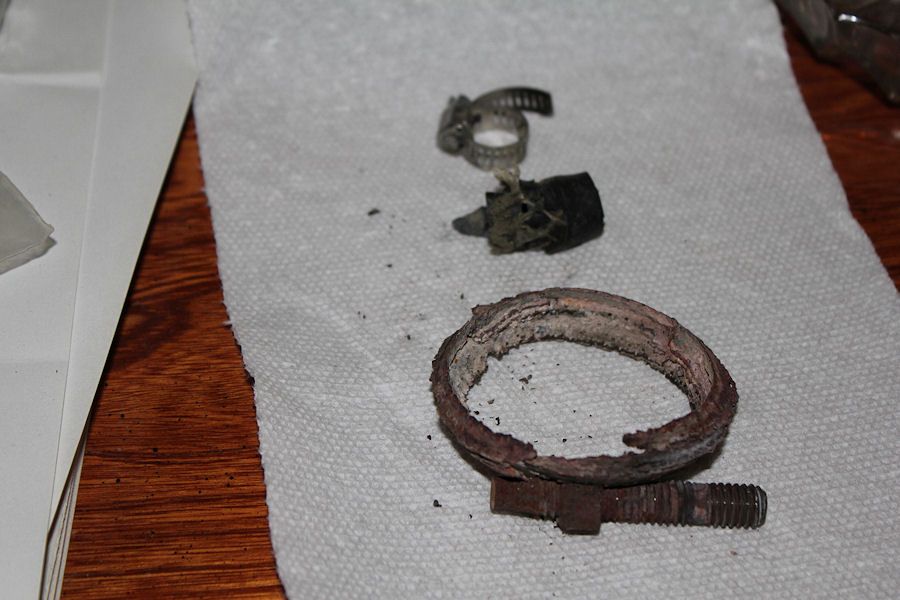
Last edited by Paul L; Jun 25, 2011 at 08:31 PM.

Melting Slicks


Joined: Oct 2002
Posts: 2,317
Likes: 111
From: St Louis MO
Since dwell refers to how long the points remain closed, increasing the dwell causes the points to close a bit sooner and open a bit later as the rubbing block of the points rides over the cam.
Further, since the spark occurs when the points open, two degrees of dwell increase results in a spark one degree later at the distributor; but one degree at the distributor is two degrees at the crank.
Therefore, if the distributor is not re-adjusted, for each degree of dwell increase, the spark is retarded by one degree at the crank.

Further, since the spark occurs when the points open, two degrees of dwell increase results in a spark one degree later at the distributor; but one degree at the distributor is two degrees at the crank.
Therefore, if the distributor is not re-adjusted, for each degree of dwell increase, the spark is retarded by one degree at the crank.
Last edited by larrywalk; Jun 26, 2011 at 11:54 AM.

Safety Car


Joined: Sep 2007
Posts: 4,458
Likes: 331
From: Indy Indiana

first, you do not want dwell to be the basis of your timing, your dwell should be set at 30 degrees, that allows the correct saturation of your coil for it to fire correctly and for your condensor ( capacitor ) to recover, and to not burn your points. you adjust timing thru the position of the distributor.
for each degree of dwell change you are changing the closing of the points 1/2 a degree and changing the re-opening of the points by 1/2 a degree, for a total of 1 degree of change. so for each 1/2 degree of distributor rotation that you cause the opening of the point to occur, then you are changing your timing 1 degree since crankshaft rotation is twice distributor rotation.
so the answer is 1 to 1..
people think that changing dwell is 1 to 2, but you are actually changing both the opening and closing points by 1/2 the change for a total of the entire change.
it is confusing, so set your dwell at 30 and set your timing at the distributor.

Intermediate
Joined: Aug 2010
Posts: 33
Likes: 1
Changing the dwell affects timing (as you've seen), but changing the timing doesn't affect dwell. Therefore, to time a car well you need to set the dwell first, then set the timing.
I've never really thought of the relationship of dwell angle changes to timing (a change of dwell of x degrees = Y degrees of timing change). I suppose they are related as some above have noted. But I don't know if that's all that useful. You wouldn't really want to adjust timing by changing dwell anyway would you?
I've never really thought of the relationship of dwell angle changes to timing (a change of dwell of x degrees = Y degrees of timing change). I suppose they are related as some above have noted. But I don't know if that's all that useful. You wouldn't really want to adjust timing by changing dwell anyway would you?
Corvette Stories
The Best of Corvette for Corvette Enthusiasts

Top 10 Most Expensive Corvettes Ever Sold on Bring A Trailer
Brett Foote
10 Things Every Corvette Owner Needs (2026 Edition)
Michael S. Palmer
8 Most "Only Corvette Owners Understand" Quirks and Problems
Pouria Savadkouei
10 Reasons the C6 Z06 is Still A Performance Benchmark After 20 Years
Joe Kucinski
How Much Horsepower Every Corvette Engine "LOST" in 1972
Joe Kucinski
Top 10 DOs and DON'Ts for Protecting Your Convertible Top!
Michael S. Palmer
Top 10 Most Explosive Corvettes Ever Made: Power-to-Weight Ratio Ranked!
Joe Kucinski
150 hp to 1,250 hp: Every Corvette Generation Compared by the Specs That Matter
Joe Kucinski
8 Coolest Corvette Pace Cars (and Replicas) of All Time
Verdad Gallardo
Thread Starter
Team Owner
Joined: Aug 1999
Posts: 30,995
Likes: 99
From: Ontario
it is confusing, so set your dwell at 30 and set your timing at the distributor.
I re-did both yesterday after initially finding the dwell at 26 and the timing at 2*BTDC. Dwell is now at 30 and timing at 10*BTDC. I got out for two hours this morning and this is an entirely new car! Startup, choke, idle in P and D, all perfect. Acceleration without hesitation. The car humms! Lesson? Round-to-its are meant to gotten around to.
I re-did both yesterday after initially finding the dwell at 26 and the timing at 2*BTDC. Dwell is now at 30 and timing at 10*BTDC. I got out for two hours this morning and this is an entirely new car! Startup, choke, idle in P and D, all perfect. Acceleration without hesitation. The car humms! Lesson? Round-to-its are meant to gotten around to.

Race Director


Joined: Jul 2001
Posts: 15,892
Likes: 42
for each degree of dwell change you are changing the closing of the points 1/2 a degree and changing the re-opening of the points by 1/2 a degree, for a total of 1 degree of change. so for each 1/2 degree of distributor rotation that you cause the opening of the point to occur, then you are changing your timing 1 degree since crankshaft rotation is twice distributor rotation.
so the answer is 1 to 1..
so the answer is 1 to 1..

A dwell meter measures the number of degrees the points are closed, and represents the degrees of distributor shaft rotatation. IOW, 30 degrees of dwell = 30 degrees of distributor shaft rotation.
30 degrees of distributor rotation = 60 degrees of crankshaft rotation.
Timing is measured at the crankshaft, dwell is measured at the distributor
Thread Starter
Team Owner
Joined: Aug 1999
Posts: 30,995
Likes: 99
From: Ontario
I think you sort of disagreed with yourself part way through your answer.
A dwell meter measures the number of degrees the points are closed, and represents the degrees of distributor shaft rotatation. IOW, 30 degrees of dwell = 30 degrees of distributor shaft rotation.
30 degrees of distributor rotation = 60 degrees of crankshaft rotation.
Timing is measured at the crankshaft, dwell is measured at the distributor
A dwell meter measures the number of degrees the points are closed, and represents the degrees of distributor shaft rotatation. IOW, 30 degrees of dwell = 30 degrees of distributor shaft rotation.
30 degrees of distributor rotation = 60 degrees of crankshaft rotation.
Timing is measured at the crankshaft, dwell is measured at the distributor
Intermediate
Joined: Aug 2010
Posts: 33
Likes: 1
I remember reading a good article once on points, condensers, and coils and how they work together to generate a spark. It involved primary windings, and secondary windings, and fields collapsing and generating sparks...it was interesting, but I'd have to read it many times to really get it. Anyway, my point is that dwell may not be as simple as the degrees that the points are closed...though that's the easiest way to think about it. I think there may be other factors as well. So while 1 degree of dwell change may result in 2 degrees of timing change in your car, that may not be the same for someone else. But it's probably pretty close.
Thread Starter
Team Owner
Joined: Aug 1999
Posts: 30,995
Likes: 99
From: Ontario
I may only have a tenuous grasp of the dwell concept, but I think that the condition of the contacts and perhaps other parts of the ignition circuit could also affect your dwell reading (though that may be a very tiny effect).
I remember reading a good article once on points, condensers, and coils and how they work together to generate a spark. It involved primary windings, and secondary windings, and fields collapsing and generating sparks...it was interesting, but I'd have to read it many times to really get it. Anyway, my point is that dwell may not be as simple as the degrees that the points are closed...though that's the easiest way to think about it. I think there may be other factors as well. So while 1 degree of dwell change may result in 2 degrees of timing change in your car, that may not be the same for someone else. But it's probably pretty close.
I remember reading a good article once on points, condensers, and coils and how they work together to generate a spark. It involved primary windings, and secondary windings, and fields collapsing and generating sparks...it was interesting, but I'd have to read it many times to really get it. Anyway, my point is that dwell may not be as simple as the degrees that the points are closed...though that's the easiest way to think about it. I think there may be other factors as well. So while 1 degree of dwell change may result in 2 degrees of timing change in your car, that may not be the same for someone else. But it's probably pretty close.


Tech Contributor
Joined: Jun 2004
Posts: 20,905
Likes: 962
From: I tend to be leery of any guy who doesn't own a chainsaw or a handgun.
I may only have a tenuous grasp of the dwell concept, but I think that the condition of the contacts and perhaps other parts of the ignition circuit could also affect your dwell reading (though that may be a very tiny effect).
I remember reading a good article once on points, condensers, and coils and how they work together to generate a spark. It involved primary windings, and secondary windings, and fields collapsing and generating sparks...it was interesting, but I'd have to read it many times to really get it. Anyway, my point is that dwell may not be as simple as the degrees that the points are closed...No, by definition dwell is how many distributor degrees that the coil is charging, and in the case of a points distributor it is the distributor angle that the points are closed though that's the easiest way to think about it. I think there may be other factors as well. So while 1 degree of dwell change may result in 2 degrees of timing change in your car, that may not be the same for someone else. But it's probably pretty close.
I remember reading a good article once on points, condensers, and coils and how they work together to generate a spark. It involved primary windings, and secondary windings, and fields collapsing and generating sparks...it was interesting, but I'd have to read it many times to really get it. Anyway, my point is that dwell may not be as simple as the degrees that the points are closed...No, by definition dwell is how many distributor degrees that the coil is charging, and in the case of a points distributor it is the distributor angle that the points are closed though that's the easiest way to think about it. I think there may be other factors as well. So while 1 degree of dwell change may result in 2 degrees of timing change in your car, that may not be the same for someone else. But it's probably pretty close.
Thread Starter
Team Owner
Joined: Aug 1999
Posts: 30,995
Likes: 99
From: Ontario
Tech Contributor
Joined: Jun 2004
Posts: 20,905
Likes: 962
From: I tend to be leery of any guy who doesn't own a chainsaw or a handgun.
Thread Starter
Team Owner
Joined: Aug 1999
Posts: 30,995
Likes: 99
From: Ontario
But when a Pertronix goes, it goes.
If I seem like a Luddite here is a distributor in my basement professionally rebuilt from shims to shaft and more with a Breakerless SE unit (Lectric Limited). I may try it but not with a lot of confidence.
(thumbnail)

Last edited by Paul L; Jun 26, 2011 at 07:38 PM.
Tech Contributor
Joined: Jun 2004
Posts: 20,905
Likes: 962
From: I tend to be leery of any guy who doesn't own a chainsaw or a handgun.
With my former 1979 that I drove for many years I experienced two HEI module failures from heat saturation. They were installed correctly with di-electric grease on the heat sink distributor base but nevertheless those now primitive micro-chips were flaky. You are correct in that they degraded, albeit suddenly, but maintained enough integrity to allow me to limp home in each instance about 30 miles.
But when a Pertronix goes, it goes.
If I seem like a Luddite here is a distributor in my basement professionally rebuilt from shims to shaft and more with a Breakerless SE unit (Lectric Limited). I may try it but not with a lot of confidence.
(thumbnail)
................
But when a Pertronix goes, it goes.
If I seem like a Luddite here is a distributor in my basement professionally rebuilt from shims to shaft and more with a Breakerless SE unit (Lectric Limited). I may try it but not with a lot of confidence.
(thumbnail)
................

Race Director
Joined: Mar 2006
Posts: 14,112
Likes: 28
From: Florida
With my former 1979 that I drove for many years I experienced two HEI module failures from heat saturation. They were installed correctly with di-electric grease on the heat sink distributor base but nevertheless those now primitive micro-chips were flaky. You are correct in that they degraded, albeit suddenly, but maintained enough integrity to allow me to limp home in each instance about 30 miles.
But when a Pertronix goes, it goes.
If I seem like a Luddite here is a distributor in my basement professionally rebuilt from shims to shaft and more with a Breakerless SE unit (Lectric Limited). I may try it but not with a lot of confidence.
But when a Pertronix goes, it goes.
If I seem like a Luddite here is a distributor in my basement professionally rebuilt from shims to shaft and more with a Breakerless SE unit (Lectric Limited). I may try it but not with a lot of confidence.
Ford was responsible for most of the Apollo console equipment on the ground.
I would never have suspected they designed and made their own stuff.
They perhaps could have competed with Intel.
