



Q Jet

Thread Starter
Race Director


Joined: Sep 2003
Posts: 16,839
Likes: 341
From: Database Error Indiana
 Q Jet
Q Jet
I have an 80 with an earlier Quadrajet, bought used. I rebuilt it 4 years ago and it starts and runs good. Choke works well. It just idles rich, always has. Car has been parked a long time and I'd like to get it on the road. I'd apreciate any ideas to correct this.

Team Owner


Joined: Jan 2006
Posts: 37,637
Likes: 3,118
From: Crossville TN
First of all, you will need to know if that carb is a Rochester-built carb, a Carter-built carb, or an Edelbrock remake of that carb (after they bought the Q-Jet tooling). Yes, Carter did build some Q-Jets at a time when Rochester didn't have the capacity to supply all that GM needed.
You need to find the carb part number (in the case of the GM supplier-built carbs) or know which Edelbrock part that carb is (#1901, 1902, 1903, 1904, or 1906). For GM factory carbs, NAPA or other car parts store can order a rebuild kit (per the stamped part number) that will work for your unit. For Edelbrock carbs, you will need to order a rebuild kit from them for the model you have. You can order a kit that would be correct for the carb that came on your car originally, but it may not be correct for the carb you now have. If there is merely a difference in gaskets, etc. it can cause you problems.
I presently have a similar problem and my unit is an Edelbrock 1901 carb. I am waiting the shipment of two carb repair and modification books (ie, Ruggles; Roe). I'll likely end up buying the Edelbrock rebuild kit and then go through the carb per the 'expert' books' instructions.
You need to find the carb part number (in the case of the GM supplier-built carbs) or know which Edelbrock part that carb is (#1901, 1902, 1903, 1904, or 1906). For GM factory carbs, NAPA or other car parts store can order a rebuild kit (per the stamped part number) that will work for your unit. For Edelbrock carbs, you will need to order a rebuild kit from them for the model you have. You can order a kit that would be correct for the carb that came on your car originally, but it may not be correct for the carb you now have. If there is merely a difference in gaskets, etc. it can cause you problems.
I presently have a similar problem and my unit is an Edelbrock 1901 carb. I am waiting the shipment of two carb repair and modification books (ie, Ruggles; Roe). I'll likely end up buying the Edelbrock rebuild kit and then go through the carb per the 'expert' books' instructions.
Thread Starter
Race Director
Joined: Sep 2003
Posts: 16,839
Likes: 341
From: Database Error Indiana
Thanks, its a Rochester , I think maybe a late 70s truck application. I put a kit in it 4 years ago. Just thinking its a mechanical type problem. Like maybe the metering rods not seating. I remember having a hard time getting the linkage and all the top part stuff situated to get the top mated to the bottom.

Racer

Joined: Nov 2004
Posts: 485
Likes: 1
From: Oakville ON
If it has a 170xxxx number on the side it is a '75 or later model Roch. QJ. Car primary needles are no longer available and don't buy Edelbrock because they sell the fatter-tip truck needles (which may in fact be okay for you if it is in fact a truck carb, but check tip diamater first).
Believe it or not the primary jetting and APT setting affect idle mixtre, as of course does the float height and any air leaks (gaskets, hoses).
If you can't lean out the idle mixture by turning the screws clockwise, and the car gats decent mileage during cruise, I would try adjusting the APT first. Roe's book does a good job of explaining how.
I set mine (after engine mods) by turning it in (closkwise, down) until I got slight surging on cruise - it is very sensitive. Quarter to half turn counterclockwise and it runs great. Full travel for the APT stop screw is just over 8 turns out and mine runs and idles great at 3.5 turns out. Others need up to 5 out, depends on your manifold vacuum too. My idle vac is 16 - 17 inches.
Believe it or not the primary jetting and APT setting affect idle mixtre, as of course does the float height and any air leaks (gaskets, hoses).
If you can't lean out the idle mixture by turning the screws clockwise, and the car gats decent mileage during cruise, I would try adjusting the APT first. Roe's book does a good job of explaining how.
I set mine (after engine mods) by turning it in (closkwise, down) until I got slight surging on cruise - it is very sensitive. Quarter to half turn counterclockwise and it runs great. Full travel for the APT stop screw is just over 8 turns out and mine runs and idles great at 3.5 turns out. Others need up to 5 out, depends on your manifold vacuum too. My idle vac is 16 - 17 inches.
Thread Starter
Race Director
Joined: Sep 2003
Posts: 16,839
Likes: 341
From: Database Error Indiana
I will look at the numbers. Later this week when I have time I think I will take a look at the needle and seat and float setting. Metering rods too. It would be easy to replace the carb but I like the way the car runs with this and dont want to throw $$$ at it just because I overlooked something thats fixable.

Race Director

Joined: Apr 1999
Posts: 11,520
Likes: 13
From: CORVETTE 77 385 C.I. TEXAS
Thanks, its a Rochester , I think maybe a late 70s truck application. I put a kit in it 4 years ago. Just thinking its a mechanical type problem. Like maybe the metering rods not seating. I remember having a hard time getting the linkage and all the top part stuff situated to get the top mated to the bottom.
Team Owner
Joined: Jan 2006
Posts: 37,637
Likes: 3,118
From: Crossville TN
I'm afraid that I don't remember the details, but I do remember Lars [Grimsrud] (the Q-Jet guru who was 'dismissed' from this Forum for unknown reasons) discussing that the truck Q-Jets were different from the car models. It also comes to mind that he had some reservations about using the truck models on a Corvette; but I don't remember why.
If you send him an e-mail requesting his advice on your situation, I feel that he would respond and give you the "straight skinny" on what to do. You will need to include any numbers stamped into the body of your carb, the model year of your car, type of transmission, and a summary of any modifications that you have made to the engine.
V8FastCars@msn.com
If you send him an e-mail requesting his advice on your situation, I feel that he would respond and give you the "straight skinny" on what to do. You will need to include any numbers stamped into the body of your carb, the model year of your car, type of transmission, and a summary of any modifications that you have made to the engine.
V8FastCars@msn.com
Thread Starter
Race Director
Joined: Sep 2003
Posts: 16,839
Likes: 341
From: Database Error Indiana
I'm afraid that I don't remember the details, but I do remember Lars [Grimsrud] (the Q-Jet guru who was 'dismissed' from this Forum for unknown reasons) discussing that the truck Q-Jets were different from the car models. It also comes to mind that he had some reservations about using the truck models on a Corvette; but I don't remember why.
If you send him an e-mail requesting his advice on your situation, I feel that he would respond and give you the "straight skinny" on what to do. You will need to include any numbers stamped into the body of your carb, the model year of your car, type of transmission, and a summary of any modifications that you have made to the engine.
V8FastCars@msn.com
If you send him an e-mail requesting his advice on your situation, I feel that he would respond and give you the "straight skinny" on what to do. You will need to include any numbers stamped into the body of your carb, the model year of your car, type of transmission, and a summary of any modifications that you have made to the engine.
V8FastCars@msn.com
Corvette Stories
The Best of Corvette for Corvette Enthusiasts

5 Best & 5 Worst Corvette Daily Drivers
Joe Kucinski
The Headlights of Every Corvette Generation Explained
Joe Kucinski
5 Best & 5 Most Overrated Corvette Track Packages of All Time!
Joe Kucinski
Every 2027 Corvette Engine Explained
Joe Kucinski
Designer Imagines A Corvette That Looks More Like a Corvette Than the Corvette
Verdad Gallardo
10 Ugly Corvettes That We Still Kinda Love
Joe Kucinski
Top 10 Most Expensive Corvettes Ever Sold on Bring A Trailer
Brett Foote
10 Things Every Corvette Owner Needs (2026 Edition)
Michael S. Palmer
8 Most "Only Corvette Owners Understand" Quirks and Problems
Pouria Savadkouei
Thread Starter
Race Director
Joined: Sep 2003
Posts: 16,839
Likes: 341
From: Database Error Indiana
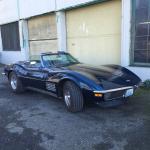
 Had to put my mower gas in it just so I could park it. Going to get plates on it this week so I can get to the gas station and get out for a test drive.

Pro


Joined: Feb 2008
Posts: 556
Likes: 13
From: C3 Forum, Colorado
You can check to see if the power piston and metering rods are moving freely by sticking a small screwdriver down the fuel bowl vent tube and operating the piston up and down. The screwdriver must be in the forward most side of the tube though.
Thread Starter
Race Director
Joined: Sep 2003
Posts: 16,839
Likes: 341
From: Database Error Indiana
Racer
Joined: Nov 2004
Posts: 485
Likes: 1
From: Oakville ON
I never understood what Lars had against the truck QJs. I have used 2 different 1985 models on different cars, including my Vette, with excellent results. The primary venturies are a bit different, but they work great when set up right. Stick to 1975 model to 1980 models. The Canadian '85s had no electronic controls, unlike the US '81 models. Ours were like the 1980 US models.
Last edited by Rich's'78; Jul 26, 2011 at 02:07 PM.

Melting Slicks

Joined: Mar 2005
Posts: 2,838
Likes: 10
From: Austin TX
Given a choice, a 1974 or earlier (pre-smog) q-jet is better for performance. They have a wider range of adjustment.
Here's really good q-jet white paper from a couple of guys who know their stuff. They're both tough as nails on the track,..SE class, usually Ponchos. The mods they suggest will work great on the street.
http://home.comcast.net/~gtopercy/Pi...rajetTech.html
Good luck!
Here's really good q-jet white paper from a couple of guys who know their stuff. They're both tough as nails on the track,..SE class, usually Ponchos. The mods they suggest will work great on the street.
http://home.comcast.net/~gtopercy/Pi...rajetTech.html
Good luck!
Last edited by 73, Dark Blue 454; Jul 26, 2011 at 05:11 PM.
Thread Starter
Race Director
Joined: Sep 2003
Posts: 16,839
Likes: 341
From: Database Error Indiana
Given a choice, a 1974 or earlier (pre-smog) q-jet is better for performance. They have a wider range of adjustment.
Here's really good q-jet white paper from a couple of guys who know their stuff. They're both tough as nails on the track,..SE class, usually Ponchos. The mods they suggest will work great on the street.
http://home.comcast.net/~gtopercy/Pi...rajetTech.html
Good luck!
Here's really good q-jet white paper from a couple of guys who know their stuff. They're both tough as nails on the track,..SE class, usually Ponchos. The mods they suggest will work great on the street.
http://home.comcast.net/~gtopercy/Pi...rajetTech.html
Good luck!

