



HEI distributer module failures

Race Director

Joined: May 2006
Posts: 16,528
Likes: 53
From: Dayton, Ohio

Race Director

Joined: Nov 2002
Posts: 12,142
Likes: 54
From: Taylor Michigan

the discount modules are white, the brand names are black and should have the brand molded into the surface of the part........Echlin has both the discount and the premium piece......and Wells is a low price discount short line ignition brand and usually imported......

Intermediate

Joined: Nov 2008
Posts: 26
Likes: 0
Well, I took things apart tonight carefully looking for frayed wires etc. I hooked up a DVM to the tach wire and jjiggled the heck out of moving it all around, looked as far as I could to where it went into the harness and didn't see anything or get any reaction on the meter.
A couple of people mentioned the ground inside the cap, I pulled the one shown here off, checked the connection, reinstalled it, checked continuity from that metal shield all the way to the connector and found it to be good.
I'm unsure by the comments regarding the ground wire inside the distributor. The module is grounded by virtue of the screw at the end attaching it to the base. Is there supposed to be another ground? There is a "G" wire that comes off the end and travels under the weights, is that what you are referring to?
Gene, pulling that thing apart to change that pickup doesn't look like too much fun, think that really could be an issue?

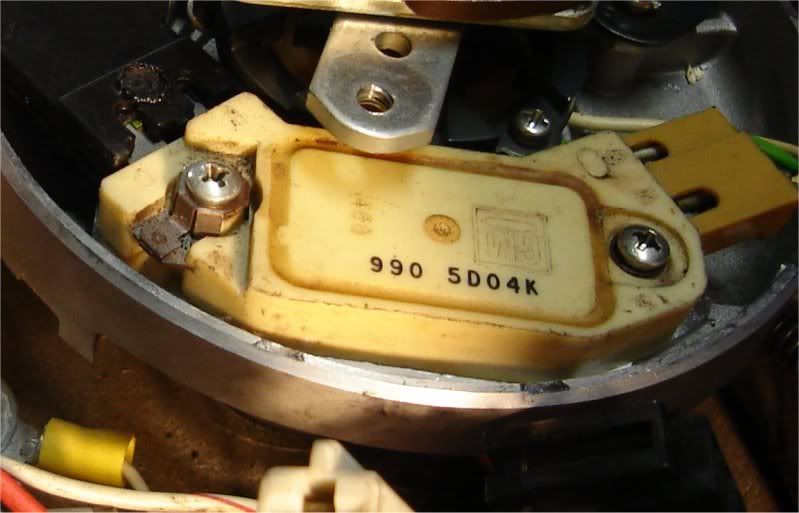
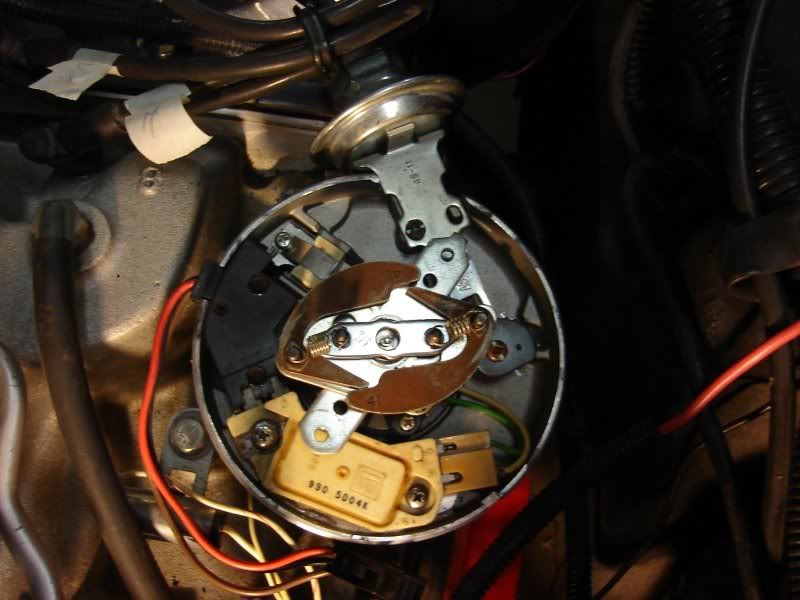
A couple of people mentioned the ground inside the cap, I pulled the one shown here off, checked the connection, reinstalled it, checked continuity from that metal shield all the way to the connector and found it to be good.
I'm unsure by the comments regarding the ground wire inside the distributor. The module is grounded by virtue of the screw at the end attaching it to the base. Is there supposed to be another ground? There is a "G" wire that comes off the end and travels under the weights, is that what you are referring to?
Gene, pulling that thing apart to change that pickup doesn't look like too much fun, think that really could be an issue?
2 - Rotor has burned through to the mechanical advance under it, overllading the coil and/or modules to failure.
3 - Carbon brush damaged and/or incorrectly installed in the cap, overloading modules to failure.
4 - Bad ground between coil and yoke, small black wire from the coil. Coil yoke to bus bar ground bad, dirty, causing coils and/or modules to overload and fail. Bad coil ground at distributor body will also cause coil/module overloading and failure.
Low voltage to the dist WILL NOT cause failures in an HEI. Resisted input sources have been maligned as the failure causes, but no, they aren't. OVERVVOLTING, as in a stuck regulator producing upwards of 18 volts will kill the coil/module in one quick hurry.
Mine was number 4 and that is what I was referring to. From your pictures, it looks like you may be number have # 2?

Thread Starter
Drifting


Joined: May 2005
Posts: 1,629
Likes: 4
From: Somers CT
Most have this ground
http://www.parts123.com/parts123/yb....5Z5Z50000050G#
http://www.parts123.com/parts123/yb....5Z5Z50000050G#
Thread Starter
Drifting
Joined: May 2005
Posts: 1,629
Likes: 4
From: Somers CT
the discount modules are white, the brand names are black and should have the brand molded into the surface of the part........Echlin has both the discount and the premium piece......and Wells is a low price discount short line ignition brand and usually imported......
Thread Starter
Drifting
Joined: May 2005
Posts: 1,629
Likes: 4
From: Somers CT
1 - Coil was starting to layer short, overloading the modules to failure.
2 - Rotor has burned through to the mechanical advance under it, overllading the coil and/or modules to failure.
3 - Carbon brush damaged and/or incorrectly installed in the cap, overloading modules to failure.
4 - Bad ground between coil and yoke, small black wire from the coil. Coil yoke to bus bar ground bad, dirty, causing coils and/or modules to overload and fail. Bad coil ground at distributor body will also cause coil/module overloading and failure.
Low voltage to the dist WILL NOT cause failures in an HEI. Resisted input sources have been maligned as the failure causes, but no, they aren't. OVERVVOLTING, as in a stuck regulator producing upwards of 18 volts will kill the coil/module in one quick hurry.
Mine was number 4 and that is what I was referring to. From your pictures, it looks like you may be number have # 2?
2 - Rotor has burned through to the mechanical advance under it, overllading the coil and/or modules to failure.
3 - Carbon brush damaged and/or incorrectly installed in the cap, overloading modules to failure.
4 - Bad ground between coil and yoke, small black wire from the coil. Coil yoke to bus bar ground bad, dirty, causing coils and/or modules to overload and fail. Bad coil ground at distributor body will also cause coil/module overloading and failure.
Low voltage to the dist WILL NOT cause failures in an HEI. Resisted input sources have been maligned as the failure causes, but no, they aren't. OVERVVOLTING, as in a stuck regulator producing upwards of 18 volts will kill the coil/module in one quick hurry.
Mine was number 4 and that is what I was referring to. From your pictures, it looks like you may be number have # 2?
Could you explain what you mean about the rotor burning thru the advance? You mean the discolorization of the weights? If so that's the camera flash making it look like that. It does have some slight surface rust but I don't think it's burned.
Someone else mentioned plug wires....these are Taylor 8mm Silicone, I measured about 1.2K ohm on a couple of them.

Team Owner


Joined: Jul 1999
Posts: 65,492
Likes: 230
From: Orange Park Florida
I'm unsure by the comments regarding the ground wire inside the distributor. The module is grounded by virtue of the screw at the end attaching it to the base. Is there supposed to be another ground? There is a "G" wire that comes off the end and travels under the weights, is that what you are referring to?
Gene, pulling that thing apart to change that pickup doesn't look like too much fun, think that really could be an issue?
Gene, pulling that thing apart to change that pickup doesn't look like too much fun, think that really could be an issue?
that yellow and black wired need scraped and cleaned then soldered to their tabs where that base wiring plugs into....you don't have to UNcrimp them, just scrape clean and solder with good electronic solder, I have caught one of them proven dead open on the circuit long time ago...not saying it's a very common failure, but when it's a mystery....there you go....
to prove it, just turn on the ignition, and measure if you have +12 at the TACH end of the coil, if not....it's a bad connection on those crimp tabs....CASE CLOSED....I have never seen the spark coil itself fail...not once...only been 40 years....

where that white/yellow with age and GREEN plug to the right is, that sending coil is a PIA, it CAN be replaced but typical guy will spend a afternoon doing it....BTDT several times so it's only a hour for me....
Corvette Stories
The Best of Corvette for Corvette Enthusiasts

5 Best & 5 Worst Corvette Daily Drivers
Joe Kucinski
The Headlights of Every Corvette Generation Explained
Joe Kucinski
5 Best & 5 Most Overrated Corvette Track Packages of All Time!
Joe Kucinski
Every 2027 Corvette Engine Explained
Joe Kucinski
Designer Imagines A Corvette That Looks More Like a Corvette Than the Corvette
Verdad Gallardo
10 Ugly Corvettes That We Still Kinda Love
Joe Kucinski
Top 10 Most Expensive Corvettes Ever Sold on Bring A Trailer
Brett Foote
10 Things Every Corvette Owner Needs (2026 Edition)
Michael S. Palmer
8 Most "Only Corvette Owners Understand" Quirks and Problems
Pouria Savadkouei
Thread Starter
Drifting
Joined: May 2005
Posts: 1,629
Likes: 4
From: Somers CT
Thread Starter
Drifting
Joined: May 2005
Posts: 1,629
Likes: 4
From: Somers CT
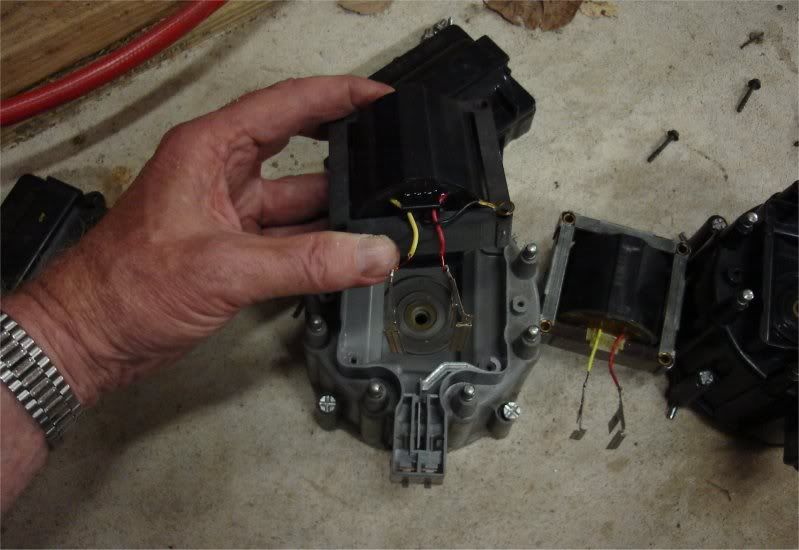
That middle black wire there is the ground from your coil - side from frame of the coil/hooked internally, to the 3 wire plug leading the black to a ground on the cast dizzy frame....
that yellow and black wired need scraped and cleaned then soldered to their tabs where that base wiring plugs into....you don't have to UNcrimp them, just scrape clean and solder with good electronic solder, I have caught one of them proven dead open on the circuit long time ago...not saying it's a very common failure, but when it's a mystery....there you go....
to prove it, just turn on the ignition, and measure if you have +12 at the TACH end of the coil, if not....it's a bad connection on those crimp tabs....CASE CLOSED....I have never seen the spark coil itself fail...not once...only been 40 years....
where that white/yellow with age and GREEN plug to the right is, that sending coil is a PIA, it CAN be replaced but typical guy will spend a afternoon doing it....BTDT several times so it's only a hour for me....
that yellow and black wired need scraped and cleaned then soldered to their tabs where that base wiring plugs into....you don't have to UNcrimp them, just scrape clean and solder with good electronic solder, I have caught one of them proven dead open on the circuit long time ago...not saying it's a very common failure, but when it's a mystery....there you go....
to prove it, just turn on the ignition, and measure if you have +12 at the TACH end of the coil, if not....it's a bad connection on those crimp tabs....CASE CLOSED....I have never seen the spark coil itself fail...not once...only been 40 years....
where that white/yellow with age and GREEN plug to the right is, that sending coil is a PIA, it CAN be replaced but typical guy will spend a afternoon doing it....BTDT several times so it's only a hour for me....
Team Owner
Joined: Jul 1999
Posts: 65,492
Likes: 230
From: Orange Park Florida
Can't rememer everything, sorry....
just flat out solder them yellow/white and red wires and fuggetaboutthem....
Race Director
Joined: May 2006
Posts: 16,528
Likes: 53
From: Dayton, Ohio
Yes,this appears to be a 3 wire coil and yours is 2 wire,not sure what the difference is.
Thread Starter
Drifting
Joined: May 2005
Posts: 1,629
Likes: 4
From: Somers CT
Roger's pix there is another variation of those coils...it goes to ground on the right or left, and there maybe a wire to the center tab or a molded metal tap bent to the coil frame...but always some connection from a center tab to the frame at any rate....
Can't rememer everything, sorry....
just flat out solder them yellow/white and red wires and fuggetaboutthem....
Can't rememer everything, sorry....
just flat out solder them yellow/white and red wires and fuggetaboutthem....
Yes you guys are correct there are two different styles.
Tomorrow...gotta go to bed. Thanks for the help guys......Stay tuned

Intermediate
Joined: Nov 2008
Posts: 26
Likes: 0
Interesting that you mention the 18v.......my alternator regulator crapped out and was fluctuating all over the place giving 18 + volts for a day or so until I could get home to change it out. Maybe that weakened it.
Could you explain what you mean about the rotor burning thru the advance? You mean the discolorization of the weights? If so that's the camera flash making it look like that. It does have some slight surface rust but I don't think it's burned.
Someone else mentioned plug wires....these are Taylor 8mm Silicone, I measured about 1.2K ohm on a couple of them.
Could you explain what you mean about the rotor burning thru the advance? You mean the discolorization of the weights? If so that's the camera flash making it look like that. It does have some slight surface rust but I don't think it's burned.
Someone else mentioned plug wires....these are Taylor 8mm Silicone, I measured about 1.2K ohm on a couple of them.
Last edited by RJ80; Aug 24, 2011 at 11:43 PM.

Burning Brakes


Joined: Oct 2009
Posts: 1,066
Likes: 57
A little off topic, but I'm planning on using an original Corvette distributor in my '71 350/270HP that has been converted to HEI by Daves Small Block HEI.
In my application, where should I mount the external module? Should heat be a consideration?
Can anyone comment on Dave's stuff?
Thanks
In my application, where should I mount the external module? Should heat be a consideration?
Can anyone comment on Dave's stuff?
Thanks
Thread Starter
Drifting
Joined: May 2005
Posts: 1,629
Likes: 4
From: Somers CT
Correct me if I'm mistaken but I don't believe the stuff that comes with the module is a thermal BARRIER grease but rather a thermal TRANSFER grease. A material that will conduct heat away from the module to the dist body to keep it from overheating.
Thanks



Racer
Joined: Nov 2004
Posts: 485
Likes: 1
From: Oakville ON
TopGun and 7T1 are correct. GM calls it 'silicone lubricant' it is a dielectric for transferring heat away from the module. It should be white and fairly thick.
The silicone base will thin out when it gets hot so it also contains a finely ground silica, hence why it is white. You can use it on electrical connectors and it is recommended for inside spark plug boots to keep out moisture.
I bought a tube of it at the dealer years ago. I have had 3 different cars go over 60 thousand miles w/o a module failure.
The silicone base will thin out when it gets hot so it also contains a finely ground silica, hence why it is white. You can use it on electrical connectors and it is recommended for inside spark plug boots to keep out moisture.
I bought a tube of it at the dealer years ago. I have had 3 different cars go over 60 thousand miles w/o a module failure.
Intermediate
Joined: Nov 2008
Posts: 26
Likes: 0
TopGun and 7T1 are correct. GM calls it 'silicone lubricant' it is a dielectric for transferring heat away from the module. It should be white and fairly thick.
The silicone base will thin out when it gets hot so it also contains a finely ground silica, hence why it is white. You can use it on electrical connectors and it is recommended for inside spark plug boots to keep out moisture.
I bought a tube of it at the dealer years ago. I have had 3 different cars go over 60 thousand miles w/o a module failure.
The silicone base will thin out when it gets hot so it also contains a finely ground silica, hence why it is white. You can use it on electrical connectors and it is recommended for inside spark plug boots to keep out moisture.
I bought a tube of it at the dealer years ago. I have had 3 different cars go over 60 thousand miles w/o a module failure.

Race Director

Joined: Mar 2006
Posts: 14,112
Likes: 28
From: Florida
A little off topic, but I'm planning on using an original Corvette distributor in my '71 350/270HP that has been converted to HEI by Daves Small Block HEI.
In my application, where should I mount the external module? Should heat be a consideration?
Can anyone comment on Dave's stuff?
Thanks
In my application, where should I mount the external module? Should heat be a consideration?
Can anyone comment on Dave's stuff?
Thanks
You can mount the module anywhere, but on the firewall behind the dist would be good. Try and salvage an aluminum finned heatsink out of a computer power supply to mount it on. Arctic Silver5 is about the best thermal compound out there, designed for cpu's, very high in silver content that is about the best for thermal conductivity. Good up to 400°F.
FYI, in years past, Jaguar sold their dist electronics box for close to 400 bucks, all it contained was an hei module.