






Help reading my A/F log

Thread Starter
Racer


Joined: Nov 2006
Posts: 495
Likes: 1
From: Lubbock TX

1. float level is good
2. acc. pump lever good
3. Timing is good at 14.7* initial and 36* all in around 2800 rpm. Got the correct vacuum can (AR21), so that is good now also.
Logged a few runs. These are from a dead stop at 600rpm, then flooring it. I get a hint of wheelspin, then the bog hits for a second, then it pulls great after that.
Here is a shot of a run: (idling at 5 seconds and punch it at 8 seconds on the graph)

Looks like a instant lean spike, then spikes really rich (maybe from unburnt fuel from the bog?), then it comes back lean until the secondaries kick in and richen it back to the 10 range. So what now? Are the primaries too lean? Secondaries a little rich? or start with the acc shot size?
2. acc. pump lever good
3. Timing is good at 14.7* initial and 36* all in around 2800 rpm. Got the correct vacuum can (AR21), so that is good now also.
Logged a few runs. These are from a dead stop at 600rpm, then flooring it. I get a hint of wheelspin, then the bog hits for a second, then it pulls great after that.
Here is a shot of a run: (idling at 5 seconds and punch it at 8 seconds on the graph)
Looks like a instant lean spike, then spikes really rich (maybe from unburnt fuel from the bog?), then it comes back lean until the secondaries kick in and richen it back to the 10 range. So what now? Are the primaries too lean? Secondaries a little rich? or start with the acc shot size?

Melting Slicks


Joined: May 2002
Posts: 2,717
Likes: 121
From: Sulphur LA
St. Jude Donor '05-'06,'11,'13-'14,'16,'18,'19,'24, '25
The first spike to lean (8 sec) is more than likely caused by an improper set t-slot. Pull the carb off and check that, if its not set right fix it.
than the pump shot drives the AF rich (8.25 sec), than the fuel from the pump runs out and you go lean (8.5 sec) until the main booster starts feeding (9.5 sec).
Start with pulling the carb and setting the throttle bled to the t-slot relationship to correct setting. This should fix the off line bog and the lean spike. You may need to use the secondary adjustment for the idle setting. Once the primary is set for T-slot adjustment don't move it.
Once that is fixed post back and we can move to the next issue.
I wouldn't try and set WOT until the idle, transition and cruise is right. This is just my experiance at tuning, its worked best for me to wait until last for WOT.
the fuel for WOT is a combination of all circuits.
I didn't look this carb up, does the secondary have a metering block or plate?
Neal
than the pump shot drives the AF rich (8.25 sec), than the fuel from the pump runs out and you go lean (8.5 sec) until the main booster starts feeding (9.5 sec).
Start with pulling the carb and setting the throttle bled to the t-slot relationship to correct setting. This should fix the off line bog and the lean spike. You may need to use the secondary adjustment for the idle setting. Once the primary is set for T-slot adjustment don't move it.
Once that is fixed post back and we can move to the next issue.
I wouldn't try and set WOT until the idle, transition and cruise is right. This is just my experiance at tuning, its worked best for me to wait until last for WOT.
the fuel for WOT is a combination of all circuits.
I didn't look this carb up, does the secondary have a metering block or plate?
Neal
Last edited by chevymans 77; Sep 26, 2011 at 09:42 PM.

Race Director


Joined: Apr 2000
Posts: 17,676
Likes: 201
From: Who says "Nothing is impossible" ? I've been doing nothing for years.
I don't want to get into it but that's the way it is. If you lean out your idle you will lean out your cruise below 2500RPM or when power valve opens. The idle circuit is in play even in WOT.
If you change your idle from 13:1 to 14:1 your cruise will also change dramatically leaner.

Here's what I had to do dial in my 825 Race Demon, you need pin drills blank air bleeds and so on:
I changed to annular boosters after the below was done.
Primary Jets: 76
Sec Jets : 82
Idle Feed Restrictor:.031" from stock .037"
High Speed Air Bleed : .026" from stock .039" big change
Low or Idle Air Bleed : .070"
Power Valve Channel Restrictor: drilled to .063" from stock .059"
Primary and Secondary Acc Pumps: 50cc
Squirter Size : Pri. 40, Sec 45
I get 24mpg on the highway and 15 in the city, the point I am trying to make is there are almost no people left that know exactly how a carb works and how to tune it beyond changing jets. I don't even want to get into emulsion bleeds

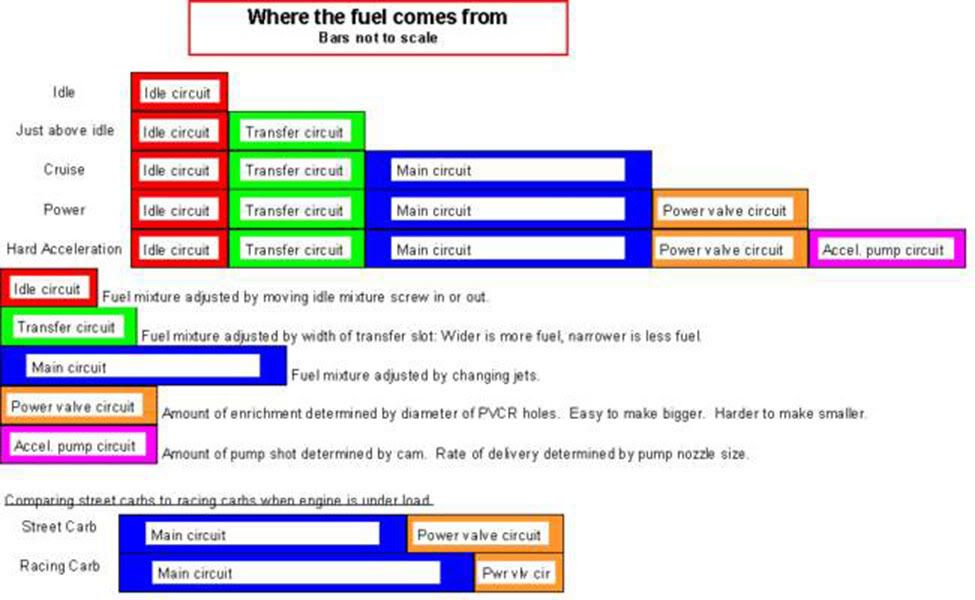
Here's a nice chart showing you what role each circuit plays:
Last edited by MotorHead; Sep 24, 2011 at 03:09 PM.
Thread Starter
Racer
Joined: Nov 2006
Posts: 495
Likes: 1
From: Lubbock TX
How much of a jet change do you think? I have 68/73 in there. So should I go back to the stock 65/68 first or wait until Monday to get something like 66/70?
As for the transfer slots...I wasn't sure what that was until I did some research just now. Looking at Lars' Holley papers, I might have messed these up. When I leaned out the mixture needles, I had to increase the idle. I did this with the idle screw right by the throttle linkage. Was I supposed to also turn the secondary screw? I didn't even know there was one.
I also saw that I should use a power valve that is 2" below my vacuum reading in drive. Mine is 11.5-12" in drive, so should I get a 8.5 power valve also?
Thanks
As for the transfer slots...I wasn't sure what that was until I did some research just now. Looking at Lars' Holley papers, I might have messed these up. When I leaned out the mixture needles, I had to increase the idle. I did this with the idle screw right by the throttle linkage. Was I supposed to also turn the secondary screw? I didn't even know there was one.
I also saw that I should use a power valve that is 2" below my vacuum reading in drive. Mine is 11.5-12" in drive, so should I get a 8.5 power valve also?
Thanks
Race Director
Joined: Apr 2000
Posts: 17,676
Likes: 201
From: Who says "Nothing is impossible" ? I've been doing nothing for years.
I will start you from the beginning, there's so much info out there that is confusing you.
I have never had an Avenger carb but this carb and plane Jane Holley 750 are the best as they are set up from the factory to be close for a warmed over engine like most of us have because you don't have many things you can screw up.
Unfortunately they are set a little on the fat side so they don't ruin a motor by being too lean when you first bolt it on. You have to understand how to fatten it up to be successful.
The Drag Race 825 Demon I have or the HP Holley's are for those that need all the screw in bleeds etc and know what they do and know what needs to be changed.
A 670 Avenger setup properly is going to give you the same HP as a twice as expensive Holley HP and like I posted above, the guys that unfortunately that really know what they are doing, most have passed on or don't frequent forums. I was lucky and found one guy who forgot more that I know about carbs.
Anyway put all the original parts back on. Turn the carb upside down and look at the transfer slots. To make it easy try and get then so when the throttle blades are closed the transfer slots look square on all four barrels.
Next you bolt it on and turn your idle mixture screws out 1 1/2 turns, all four of them.
Now comes the part I don't mind but hate when someone doesn't have a wideband A/F gauge. I have 2, just bought another one with a gauge and I am going to put it where the clock is.
You turn all 4 screws the same, all the time no matter what. You can know buy either a wideband or use a less accurate procedure using a vacuum gauge. They are 10 bucks, no reason not to have one. Hook it up to the base of the carb where you have your PCV or brakes connected to. Plug all the other lines including your vacuum advance.
Slowly turn the screws all four at a time either in or out until you get the highest vacuum reading. Now your idle may drop or go up. Use the main idle screw to keep the idle RPM's where you want them. 800RPM is fine.
If the RPM's don't go move when you do this check your timing, a too advanced timing will keep the RPM's up no matter what you do.
Now you should be OK to go. Don't worry too much about spikes, the spike I say in the first log looks like it is going lean when you nail it. Change your squirters 2 sizes at a time until the spike and hesitation go away
I have never had an Avenger carb but this carb and plane Jane Holley 750 are the best as they are set up from the factory to be close for a warmed over engine like most of us have because you don't have many things you can screw up.
Unfortunately they are set a little on the fat side so they don't ruin a motor by being too lean when you first bolt it on. You have to understand how to fatten it up to be successful.
The Drag Race 825 Demon I have or the HP Holley's are for those that need all the screw in bleeds etc and know what they do and know what needs to be changed.
A 670 Avenger setup properly is going to give you the same HP as a twice as expensive Holley HP and like I posted above, the guys that unfortunately that really know what they are doing, most have passed on or don't frequent forums. I was lucky and found one guy who forgot more that I know about carbs.
Anyway put all the original parts back on. Turn the carb upside down and look at the transfer slots. To make it easy try and get then so when the throttle blades are closed the transfer slots look square on all four barrels.
Next you bolt it on and turn your idle mixture screws out 1 1/2 turns, all four of them.
Now comes the part I don't mind but hate when someone doesn't have a wideband A/F gauge. I have 2, just bought another one with a gauge and I am going to put it where the clock is.
You turn all 4 screws the same, all the time no matter what. You can know buy either a wideband or use a less accurate procedure using a vacuum gauge. They are 10 bucks, no reason not to have one. Hook it up to the base of the carb where you have your PCV or brakes connected to. Plug all the other lines including your vacuum advance.
Slowly turn the screws all four at a time either in or out until you get the highest vacuum reading. Now your idle may drop or go up. Use the main idle screw to keep the idle RPM's where you want them. 800RPM is fine.
If the RPM's don't go move when you do this check your timing, a too advanced timing will keep the RPM's up no matter what you do.
Now you should be OK to go. Don't worry too much about spikes, the spike I say in the first log looks like it is going lean when you nail it. Change your squirters 2 sizes at a time until the spike and hesitation go away
Race Director
Joined: Apr 2000
Posts: 17,676
Likes: 201
From: Who says "Nothing is impossible" ? I've been doing nothing for years.
Your power valve should be changed about 6.5 - 8.5 to begin with, the high power valve from the factory is to cover Holley's azz
Melting Slicks
Joined: May 2002
Posts: 2,717
Likes: 121
From: Sulphur LA
St. Jude Donor '05-'06,'11,'13-'14,'16,'18,'19,'24, '25
How much of a jet change do you think? I have 68/73 in there. So should I go back to the stock 65/68 first or wait until Monday to get something like 66/70?
As for the transfer slots...I wasn't sure what that was until I did some research just now. Looking at Lars' Holley papers, I might have messed these up. When I leaned out the mixture needles, I had to increase the idle. I did this with the idle screw right by the throttle linkage. Was I supposed to also turn the secondary screw? I didn't even know there was one.
I also saw that I should use a power valve that is 2" below my vacuum reading in drive. Mine is 11.5-12" in drive, so should I get a 8.5 power valve also?
Thanks
As for the transfer slots...I wasn't sure what that was until I did some research just now. Looking at Lars' Holley papers, I might have messed these up. When I leaned out the mixture needles, I had to increase the idle. I did this with the idle screw right by the throttle linkage. Was I supposed to also turn the secondary screw? I didn't even know there was one.
I also saw that I should use a power valve that is 2" below my vacuum reading in drive. Mine is 11.5-12" in drive, so should I get a 8.5 power valve also?
Thanks
When setting the idle mixture and idle rpm you will need to set it rich while in neutral, so when you drop it in gear it will more than likely lean some when the rpm drops or just set the idle mixture while in drive.
You can make small adjustments to the primary idle screw but if you go to far it will change the t-slot setting to much and cause an off idle stumble.
The adjustment for the secondaries are underneath the carb so it will have to come off to set the idle with the secondary adjustment. Its right below the secondary throttle blade stop.
Its hard to trouble shoot a carb issue over the internet but it can be done.
Turn the carb over and take a look at the T-slots, see if there are about .020" showing. If not or if more than that you may need to use the secondaries to make the idle adjustment.
check it out and post what you find.
Neal
Corvette Stories
The Best of Corvette for Corvette Enthusiasts

Top 10 Most Expensive Corvettes Ever Sold on Bring A Trailer
Brett Foote
10 Things Every Corvette Owner Needs (2026 Edition)
Michael S. Palmer
8 Most "Only Corvette Owners Understand" Quirks and Problems
Pouria Savadkouei
10 Reasons the C6 Z06 is Still A Performance Benchmark After 20 Years
Joe Kucinski
How Much Horsepower Every Corvette Engine "LOST" in 1972
Joe Kucinski
Top 10 DOs and DON'Ts for Protecting Your Convertible Top!
Michael S. Palmer
Top 10 Most Explosive Corvettes Ever Made: Power-to-Weight Ratio Ranked!
Joe Kucinski
150 hp to 1,250 hp: Every Corvette Generation Compared by the Specs That Matter
Joe Kucinski
8 Coolest Corvette Pace Cars (and Replicas) of All Time
Verdad Gallardo
Le Mans Master


Joined: Mar 2008
Posts: 5,948
Likes: 72
From: Oxford MA-----You just lost the game!!!!
Jfyi do you have a wideband ? or are you doing allot of reading. The idle circuit plays a major role in cruise A/F, after actually tuning with a wideband for many years and seeing this myself.
I don't want to get into it but that's the way it is. If you lean out your idle you will lean out your cruise below 2500RPM or when power valve opens. The idle circuit is in play even in WOT.
If you change your idle from 13:1 to 14:1 your cruise will also change dramatically leaner.
Here's what I had to do dial in my 825 Race Demon, you need pin drills blank air bleeds and so on:
I changed to annular boosters after the below was done.
Primary Jets: 76
Sec Jets : 82
Idle Feed Restrictor:.031" from stock .037"
High Speed Air Bleed : .026" from stock .039" big change
Low or Idle Air Bleed : .070"
Power Valve Channel Restrictor: drilled to .063" from stock .059"
Primary and Secondary Acc Pumps: 50cc
Squirter Size : Pri. 40, Sec 45
I get 24mpg on the highway and 15 in the city, the point I am trying to make is there are almost no people left that know exactly how a carb works and how to tune it beyond changing jets. I don't even want to get into emulsion bleeds
Here's a nice chart showing you what role each circuit plays:
I don't want to get into it but that's the way it is. If you lean out your idle you will lean out your cruise below 2500RPM or when power valve opens. The idle circuit is in play even in WOT.
If you change your idle from 13:1 to 14:1 your cruise will also change dramatically leaner.
Here's what I had to do dial in my 825 Race Demon, you need pin drills blank air bleeds and so on:
I changed to annular boosters after the below was done.
Primary Jets: 76
Sec Jets : 82
Idle Feed Restrictor:.031" from stock .037"
High Speed Air Bleed : .026" from stock .039" big change
Low or Idle Air Bleed : .070"
Power Valve Channel Restrictor: drilled to .063" from stock .059"
Primary and Secondary Acc Pumps: 50cc
Squirter Size : Pri. 40, Sec 45
I get 24mpg on the highway and 15 in the city, the point I am trying to make is there are almost no people left that know exactly how a carb works and how to tune it beyond changing jets. I don't even want to get into emulsion bleeds
Here's a nice chart showing you what role each circuit plays:
OK, now, to the OP: Are you sure you are even getting an accellerator pump shot? If you haven't actually seen fuel squirt out of the acc pump nozzle, just humor me, and, with the engine off, hold your choke open, and give the throttle a little flick. You should see the fuel squirt out into the primaries.
Are you using Lars Grimsrud's paper called "how to tune a Holley carb"? Or the Street Avenger specific paper? If you don't already have it, search the web and find a copy of the "how to tune a holley carb" paper, it has a really good setup procedure.
I think it's a good idea to take the carb off the car, reinstall the stock jets, get the "how to tune a holley carb" paper from Lars Grimsrud, get it set up according to that paper, put it back on the car and start tuning from there.
I am wondering about something. You have increased jet size, but man, not enough to explain the engine running THAT fat. I can't wait to find out what is going on here.
One last thing, don't worry about the power valve right now, it's more of a fine tuning thing, and we aren't there yet. And you will definitely find people who will disagree with this, but the power valve doesn't have any effect at idle, it only effects the main circuit, so you should pick your power valve according to what your vacuum is at cruise on the highway.
Scott
Thread Starter
Racer
Joined: Nov 2006
Posts: 495
Likes: 1
From: Lubbock TX
Next you bolt it on and turn your idle mixture screws out 1 1/2 turns, all four of them.
After adjusting the mixture needles, the idle speed screw needed about a 1/4 turn to get the idle speed back up. Was I supposed to also turn the secondary screw 1/4 to match? (I should be able to get at it by moving the throttle linkage and using a small screwdriver??)
Either way, I will take it apart tomorrow and check the transfer slots. I'll also get some pics up to make sure its right.
Your power valve should be changed about 6.5 - 8.5 to begin with, the high power valve from the factory is to cover Holley's azz
Are you sure you are even getting an accellerator pump shot?
Tomorrow I will take the carb off and start over with the stock jets and make sure the transfer slots and mixture needles are good.
And I thought this would be a simple swap...haha, wheres the fun in that anyway
Thread Starter
Racer
Joined: Nov 2006
Posts: 495
Likes: 1
From: Lubbock TX
Alright, took the carb off and got it back to basic. I put the 65/68 (I actually had 75's in the primaries, not 73 like I thought) jets back in for now just to be sure. Adjusted the t-slots back to .020", made sure the secondaries matched. There are no mixture needles on the secondary side.
Here is a shot of where I currently was with the t-slots:

Here is where I adjusted it to:

Also, when changing the jets I saw that one of the ports on the secondary block was a little squished and not perfectly round:

Is that a problem?
So now here is the deal - I get everything back together, mixture needles are set 1 full turn out....I cannot get it to idle now. I tried everything from 2 turns out to 1/2 turn out with the mixture needles. It dies down pretty quick without constant work with the throttle.
Is it ok to bump up the idle with the main screw, and then match it with the secondary adjustment? How much, 1/2 turn at a time? or is my problem somewhere else right now? Where is the best place to start now
Here is a shot of where I currently was with the t-slots:
Here is where I adjusted it to:
Also, when changing the jets I saw that one of the ports on the secondary block was a little squished and not perfectly round:
Is that a problem?
So now here is the deal - I get everything back together, mixture needles are set 1 full turn out....I cannot get it to idle now. I tried everything from 2 turns out to 1/2 turn out with the mixture needles. It dies down pretty quick without constant work with the throttle.
Is it ok to bump up the idle with the main screw, and then match it with the secondary adjustment? How much, 1/2 turn at a time? or is my problem somewhere else right now? Where is the best place to start now
Last edited by smon; Sep 25, 2011 at 03:51 PM.
Melting Slicks
Joined: May 2002
Posts: 2,717
Likes: 121
From: Sulphur LA
St. Jude Donor '05-'06,'11,'13-'14,'16,'18,'19,'24, '25
You can use the pri to make it idle so you can get the mixture correct. than take it off and adjust the secondaries to give it the air it needs to idle.
Neal
Neal
Thread Starter
Racer
Joined: Nov 2006
Posts: 495
Likes: 1
From: Lubbock TX
Thanks. I have it idling now at 950 rpm in park. It took 1 1/4 turn with the idle screw and I had to lean the mixture screws out to a little over 1/2 turn from bottoming out. I have the AFR down to 13.2 or so now in Park. Does this sound right?
Now when I go to adjust the secondary screw, should I even it out? As in turn the idle screw back in about 2/3 and the secondary out 2/3 to match it...my logic is to keep the same amount of air entering as I do now. Or just bring the secondary to where my primary is?
Sorry for so many questions, I just don't want to miss a step and have to start over again.
Now when I go to adjust the secondary screw, should I even it out? As in turn the idle screw back in about 2/3 and the secondary out 2/3 to match it...my logic is to keep the same amount of air entering as I do now. Or just bring the secondary to where my primary is?
Sorry for so many questions, I just don't want to miss a step and have to start over again.
Last edited by smon; Sep 25, 2011 at 05:30 PM.
Melting Slicks
Joined: May 2002
Posts: 2,717
Likes: 121
From: Sulphur LA
St. Jude Donor '05-'06,'11,'13-'14,'16,'18,'19,'24, '25
Thanks. I have it idling now at 950 rpm in park. It took 1 1/4 turn with the idle screw and I had to lean the mixture screws out to a little over 1/2 turn from bottoming out. I have the AFR down to 13.2 or so now in Park. Does this sound right?
Now when I go to adjust the secondary screw, should I even it out? As in turn the idle screw back in about 2/3 and the secondary out 2/3 to match it...my logic is to keep the same amount of air entering as I do now. Or just bring the secondary to where my primary is?
Sorry for so many questions, I just don't want to miss a step and have to start over again.
Now when I go to adjust the secondary screw, should I even it out? As in turn the idle screw back in about 2/3 and the secondary out 2/3 to match it...my logic is to keep the same amount of air entering as I do now. Or just bring the secondary to where my primary is?
Sorry for so many questions, I just don't want to miss a step and have to start over again.
Set the Idle mixture with it in drive and fully warmed up. Once the t-slot is correct it should take care of the off idle stumble then you can set the idle mixture in gear to 13.5 to 14 AFR. When you put it back in park the mixture will normally go a little richer. Set it were it wants to be, were you get the least amount of rpm drop when you put it in gear.
Your settings sound close so just get the t-slot set up.
Keep asking questions, one of us will give you the answer.
Once you get the idle set up you will need to do some low rpm cruise for us so we can see if the t-slot is close on AFR. You will need to get some AFR readings at say 1800, 2000, 2200 and 2400 rpm so we can see how close it is.
Not sure on your gear ratio but if possible we will also need some readings at 2600, 2800 and 3000 rpm. This will tell us what the AFR is on the main jets.
Neal
Thread Starter
Racer
Joined: Nov 2006
Posts: 495
Likes: 1
From: Lubbock TX
Thanks for sticking with me. Hopefully I can get it sorted out quickly.
I was getting a pretty big drop in RPM (400 or so) when going into drive. I'll adjust the secondary and get the primaries back to "square" and see where my AFR ends up in P and D. Holley sure put that secondary screw in a crappy place...
I'll try and get those reading today after work.
I was getting a pretty big drop in RPM (400 or so) when going into drive. I'll adjust the secondary and get the primaries back to "square" and see where my AFR ends up in P and D. Holley sure put that secondary screw in a crappy place...
I'll try and get those reading today after work.
Melting Slicks
Joined: May 2002
Posts: 2,717
Likes: 121
From: Sulphur LA
St. Jude Donor '05-'06,'11,'13-'14,'16,'18,'19,'24, '25
Thanks for sticking with me. Hopefully I can get it sorted out quickly.
I was getting a pretty big drop in RPM (400 or so) when going into drive. I'll adjust the secondary and get the primaries back to "square" and see where my AFR ends up in P and D. Holley sure put that secondary screw in a crappy place...
I'll try and get those reading today after work.
I was getting a pretty big drop in RPM (400 or so) when going into drive. I'll adjust the secondary and get the primaries back to "square" and see where my AFR ends up in P and D. Holley sure put that secondary screw in a crappy place...
I'll try and get those reading today after work.
Neal
Thread Starter
Racer
Joined: Nov 2006
Posts: 495
Likes: 1
From: Lubbock TX
I was actually able to get to the screw with a small screwdriver and pliers. thanks.
So I put the primary t-slots back to .020". Had to turn the secondary screw about 1 1/2 (too much?) turns to get it to idle at 950 rpm. Mixture screws are at 1 1/2 turns out. Idle AFR is ~12.0. Vacuum is at 14.5" steady
Problem is when I go into drive, the rpm drop to about 550 and it sputters and almost dies. The afr jumps down to 14.5 and wanders from 13-15. Vacuum goes down to 10.
What now?
Note: I put in the AR12 vacuum can which has these specs - starts at 7-9hg - 7*@10-12 hg. Is the vacuum can not fully locking when I go to drive causing it to wander? I don't think that would cause the rpm's to drop so much.
So I put the primary t-slots back to .020". Had to turn the secondary screw about 1 1/2 (too much?) turns to get it to idle at 950 rpm. Mixture screws are at 1 1/2 turns out. Idle AFR is ~12.0. Vacuum is at 14.5" steady
Problem is when I go into drive, the rpm drop to about 550 and it sputters and almost dies. The afr jumps down to 14.5 and wanders from 13-15. Vacuum goes down to 10.
What now?
Note: I put in the AR12 vacuum can which has these specs - starts at 7-9hg - 7*@10-12 hg. Is the vacuum can not fully locking when I go to drive causing it to wander? I don't think that would cause the rpm's to drop so much.

Melting Slicks
Joined: May 2002
Posts: 2,717
Likes: 121
From: Sulphur LA
St. Jude Donor '05-'06,'11,'13-'14,'16,'18,'19,'24, '25
I was actually able to get to the screw with a small screwdriver and pliers. thanks.
So I put the primary t-slots back to .020". Had to turn the secondary screw about 1 1/2 (too much?) turns to get it to idle at 950 rpm. Mixture screws are at 1 1/2 turns out. Idle AFR is ~12.0. Vacuum is at 14.5" steady
Problem is when I go into drive, the rpm drop to about 550 and it sputters and almost dies. The afr jumps down to 14.5 and wanders from 13-15. Vacuum goes down to 10.
What now?
Note: I put in the AR12 vacuum can which has these specs - starts at 7-9hg - 7*@10-12 hg. Is the vacuum can not fully locking when I go to drive causing it to wander? I don't think that would cause the rpm's to drop so much.
So I put the primary t-slots back to .020". Had to turn the secondary screw about 1 1/2 (too much?) turns to get it to idle at 950 rpm. Mixture screws are at 1 1/2 turns out. Idle AFR is ~12.0. Vacuum is at 14.5" steady
Problem is when I go into drive, the rpm drop to about 550 and it sputters and almost dies. The afr jumps down to 14.5 and wanders from 13-15. Vacuum goes down to 10.
What now?
Note: I put in the AR12 vacuum can which has these specs - starts at 7-9hg - 7*@10-12 hg. Is the vacuum can not fully locking when I go to drive causing it to wander? I don't think that would cause the rpm's to drop so much.
The secondaries shouldn't have a T-slot so the position of the blades shouldn't matter.
Neal