






Engine Code?

Thread Starter
Pro


Joined: Jan 2006
Posts: 739
Likes: 5
From: Albuquerque NM
 Engine Code?
Does anyone know how to "decode" the numbers on an engine block?
The engine in my '71 had the following markings stamped on the block:
Drivers side: 3970010
Passenger side: B292
kind of in the middle , top of block the letters "T" "H" "D" with a tear shaped symbol pointing towards the "T"
Thanks for any info y'all can share!
Rich
The engine in my '71 had the following markings stamped on the block:
Drivers side: 3970010
Passenger side: B292
kind of in the middle , top of block the letters "T" "H" "D" with a tear shaped symbol pointing towards the "T"
Thanks for any info y'all can share!
Rich

Race Director


Joined: Oct 2000
Posts: 12,652
Likes: 3,110
From: Shamong, NJ
 The numbers you posted are the block casting number and date. The numbers that really matter, the ones that tie the engine to your car, are stamped on the pad in front of the right side cylinder head.

Team Owner


Joined: Sep 2006
Posts: 31,200
Likes: 4,287
From: Westminster Maryland
Hi Rich,
The 'casting clock' allowed Chevrolet to track which shift the block was cast during the date indicated on the block. Day, Twi-light, Night.
You can see the slot for the screw which allowed the pointer to be moved.
I think it's pretty cool.
My 71, 350 was cast on Dec. 31, 1970, Twilight shift. So they were working New Year's Eve!
Regards,
Alan
The 'casting clock' allowed Chevrolet to track which shift the block was cast during the date indicated on the block. Day, Twi-light, Night.
You can see the slot for the screw which allowed the pointer to be moved.
I think it's pretty cool.
My 71, 350 was cast on Dec. 31, 1970, Twilight shift. So they were working New Year's Eve!
Regards,
Alan

Race Director

Joined: Jul 2001
Posts: 15,892
Likes: 42

Pro

Joined: Dec 2004
Posts: 710
Likes: 2
From: Raynham MA
"The numbers that really matter, the ones that tie the engine to your car, are stamped on the pad in front of the right side cylinder head."
I'm having trouble finding this. Can someone shoot me a picture if they have one accessible?
I'm having trouble finding this. Can someone shoot me a picture if they have one accessible?
Corvette Stories
The Best of Corvette for Corvette Enthusiasts

150 hp to 1,250 hp: Every Corvette Generation Compared by the Specs That Matter
Joe Kucinski
8 Coolest Corvette Pace Cars (and Replicas) of All Time
Verdad Gallardo
Top 10 Corvette Engines RANKED by Peak Torque (70+ Years of Muscle!)
Joe Kucinski
Corvette ZR1X Will Be Pacing the Indy 500, And Could Probably Race, Too!
Verdad Gallardo
Top 10 Corvettes Coming to Mecum Indy 2026!
Brett Foote
Top 10 C9 Corvette MUST-HAVES to Fix These C8 Generation Flaws!
Michael S. Palmer
10 Revolutionary 'Corvette Firsts' Most People Don't Know
Joe Kucinski
5 Reasons to Upgrade to an LS6-Powered Corvette; 5 Reasons to Stay LT2
Michael S. Palmer
2027 Corvette vs The World: Every C8 vs Its Closest Competitor
Joe Kucinski
Melting Slicks

Joined: Feb 2007
Posts: 2,136
Likes: 62
From: West Kingston RI
If you look at the right side (passenger) in front of the bottom of the head you will see a pad sticking out of the block. You may have to wash it down a bit but there are numbers stamped on there, unless the block has been machined and they machined them off.
Team Owner
Joined: Sep 2006
Posts: 31,200
Likes: 4,287
From: Westminster Maryland
Hi s,
Here's a picture of the 'stamp pad' with the engine plant stamp, with the 3 letter broadcast code, (starting for the 70 model year), and build date; and the VIN derivative stamp.
Hope this helps!
Regards,
Alan
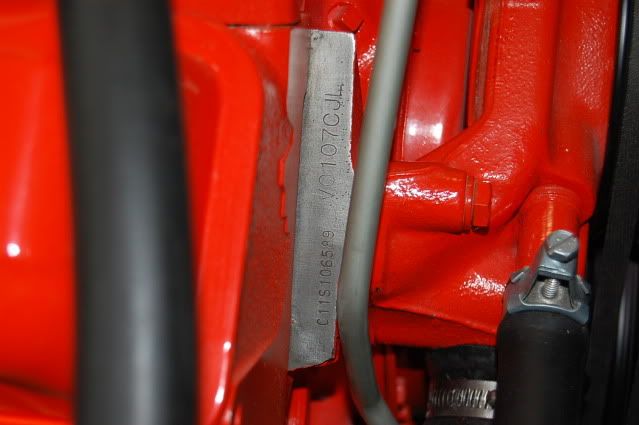
Here's a picture of the 'stamp pad' with the engine plant stamp, with the 3 letter broadcast code, (starting for the 70 model year), and build date; and the VIN derivative stamp.
Hope this helps!
Regards,
Alan


Le Mans Master

Joined: Mar 2008
Posts: 5,948
Likes: 72
From: Oxford MA-----You just lost the game!!!!

Scott
Race Director
Joined: Jul 2001
Posts: 15,892
Likes: 42
I'll give you a good answer why- because not all cars have the steering wheel on the same side. Common to the aviation and marine industries any reference to one side or the other is always with the commanding officer facing forward. Forward is defined as the prevalent design direction of travel.
My daily beater was built in Engerland but has left hand drive. The overhaul and repair manual makes all sorts of references to 'driver's side' which I have to remember they mean the 'right hand side'.
My daily beater was built in Engerland but has left hand drive. The overhaul and repair manual makes all sorts of references to 'driver's side' which I have to remember they mean the 'right hand side'.

Melting Slicks
Joined: Aug 2008
Posts: 2,200
Likes: 3
From: Lehigh county Pennsylvania
It has been the convention for as long as I can remember, that when referring to right or left anything, it is as you are sitting in the driver's seat. Of course you do have to know your right from your left for it to make sense. Try port and starboard on for size if you think right and left is too confusing.
No, you're other left!
No, you're other left!