



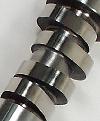

How do I build this?

Thread Starter
Melting Slicks


Joined: Mar 2002
Posts: 3,193
Likes: 0
From: Pittsburgh PA
 How do I build this?
Let's say I want to build a 383 stroker out of my 350... I would use a 400 crank, right? Then what from there, do I use 350 rods or a special length? If anyone knows where I can find good instructions on doing this, I'd apreciate it! :)
Thanks,
Jerry
Thanks,
Jerry

Le Mans Master

Joined: Aug 2000
Posts: 6,362
Likes: 7
From: Brazos TX
Cruise-In IV Veteran
Cruise-In V Veteran
Re: How do I build this? (jerryjfunk)
Go to http://www.speedomotive.com they specialize in stroker kits (only $460 for a crank kit). Basically, you need a 400 crank and rods. You can get a new stroker crank for about $160 that you don't have to do anything to (a 400 crank will require machining). You will also need stroker pistons but they are quite common. A 400 crank requires an externally balanced flywheel/flex plate and harmonic balancer.

Race Director


Joined: Aug 2000
Posts: 18,478
Likes: 3
From: Quincy IL
Re: How do I build this? (burners)
I'm no expert, but doesn't part of the block have to be machined to that the rods clear???? pull up American Speed in Moline,IL. they advertise a 383 with close to 500hp on pump gas, a streetable engine. someday i'm gonna give'm a call,drive up the river and pick one up!!! til then i'll be happy with my souped up, rebuilt L-48.
Thread Starter
Melting Slicks
Joined: Mar 2002
Posts: 3,193
Likes: 0
From: Pittsburgh PA
Re: How do I build this? (Gary79)
As usual, the forum is the absolute best place to get information! Thanks everyone, I really appreciate your help! :cheers:
For anyone else interested in building a stroker, Lars emailed me with some helpful info; I'll post it here.
---------------
You can build the 383 in one of 2 ways. You are correct that you run the
350 block with a 400 crank. You have also realized that if you hang a set
of stock rods and pistons on this combo, your pistons will get pushed up
above your deck height.
The first option, and the least desireable, is to run the 400 rods (5.565
length) with a 350 piston. This does not produce optimum crank angles,
and I've seen a lot of premature bearing wear on engines constructed like this.
The better option is to run the 350 rods (5.700 length) with a custom
piston. Every major piston manufacturer makes a piston for this application
due to its popularity. I've been using Speed Pro. With this combination,
you must clearance the block a little to keep the rods from hitting the
block in the lower cylinder areas and in the cam area. This combination
of parts has proven to be reliable, with excellent longevity.
Lars
CorvetteForum.com
Denver
----------------
Thanks,
Jerry
For anyone else interested in building a stroker, Lars emailed me with some helpful info; I'll post it here.
---------------
You can build the 383 in one of 2 ways. You are correct that you run the
350 block with a 400 crank. You have also realized that if you hang a set
of stock rods and pistons on this combo, your pistons will get pushed up
above your deck height.
The first option, and the least desireable, is to run the 400 rods (5.565
length) with a 350 piston. This does not produce optimum crank angles,
and I've seen a lot of premature bearing wear on engines constructed like this.
The better option is to run the 350 rods (5.700 length) with a custom
piston. Every major piston manufacturer makes a piston for this application
due to its popularity. I've been using Speed Pro. With this combination,
you must clearance the block a little to keep the rods from hitting the
block in the lower cylinder areas and in the cam area. This combination
of parts has proven to be reliable, with excellent longevity.
Lars
CorvetteForum.com
Denver
----------------
Thanks,
Jerry

Le Mans Master
Joined: Sep 2001
Posts: 7,739
Likes: 630
From: Unreconstructed, South Carolina
Re: How do I build this? (jerryjfunk)
Jerry's info from Lars mirrors my experience. Whatever combo you chose, and AFTER you've fitted it into block & clearanced everything, you must have the rotating assembly balanced at machine shop ... cost $100 to $200 for balancing. Also, if using GM 5.7" (350) rods ... expect to grind (cam-clearance) rods to prevent rod-to-cam interferance. Don't bother with an old 400 crank ... get an aftermarket one. Most CAST 383/400 cranks are Externally balanced and require a 400-type damper & flexplate. Many FORGED 383/400 cranks are Internally balanced and require 350-type damper & flexplate. Also, forged/internally balanced cranks often require less machine work when time to balance ... so the higher purchase-price of a forged-internal balance crank MAY be offset by NOT requiring purchase of 400-type damper & flexplate. Don't bother paying for a PRE-balanced rotating assembly ... pull it outa block after you've fitted it and then balance. Also, you must verify if you block/heads have been decked/surfaced ... BEFORE you order parts ... so you can calculate compression ratio ... and acquire pistons w/ proper CR. See links for pics of cam-clearanced 5.7" GM rods.
http://www.imagestation.com/picture/...0/fdbd8628.jpg
http://www.imagestation.com/picture/...5/fdbd8621.jpg
http://www.imagestation.com/picture/...d/fdbd861b.jpg
http://www.imagestation.com/picture/...0/fdbd8628.jpg
http://www.imagestation.com/picture/...5/fdbd8621.jpg
http://www.imagestation.com/picture/...d/fdbd861b.jpg
Thread Starter
Melting Slicks
Joined: Mar 2002
Posts: 3,193
Likes: 0
From: Pittsburgh PA
Re: How do I build this? (jackson)
Thanks for the additional info.
There isn't any way of getting around grinding the rods? Doesn't that make them weaker?
So, are you happy with your engine? What kind of CR do you have, and what kind of hp/torque are you making, roughly?
Thanks,
Jerry
There isn't any way of getting around grinding the rods? Doesn't that make them weaker?
So, are you happy with your engine? What kind of CR do you have, and what kind of hp/torque are you making, roughly?
Thanks,
Jerry

Race Director

Joined: Nov 2000
Posts: 16,416
Likes: 1
From: NC,USA
Re: How do I build this? (jerryjfunk)
i think the pan rails also have to be ground a little... i think one rod bolt hits, forget tho... been awhile since i have used this part of the old brain :jester
Corvette Stories
The Best of Corvette for Corvette Enthusiasts

Top 10 Most Expensive Corvettes Ever Sold on Bring A Trailer
Brett Foote
10 Things Every Corvette Owner Needs (2026 Edition)
Michael S. Palmer
8 Most "Only Corvette Owners Understand" Quirks and Problems
Pouria Savadkouei
10 Reasons the C6 Z06 is Still A Performance Benchmark After 20 Years
Joe Kucinski
How Much Horsepower Every Corvette Engine "LOST" in 1972
Joe Kucinski
Top 10 DOs and DON'Ts for Protecting Your Convertible Top!
Michael S. Palmer
Top 10 Most Explosive Corvettes Ever Made: Power-to-Weight Ratio Ranked!
Joe Kucinski
150 hp to 1,250 hp: Every Corvette Generation Compared by the Specs That Matter
Joe Kucinski
8 Coolest Corvette Pace Cars (and Replicas) of All Time
Verdad Gallardo
Race Director
Joined: Mar 1999
Posts: 10,258
Likes: 1
From: Calif.
Re: How do I build this? (jerryjfunk)
There isn't any way of getting around grinding the rods? Doesn't that make them weaker?

