



New engine wants too much initial timing

Thread Starter
Instructor

Joined: Aug 2011
Posts: 153
Likes: 2

I don't think that's my issue because I am running the carb gasket that came with my holley carb. I assume you are talking about exhaust gas flowing over from one bank of the dual plane intake to the other due to intake/exhaust pulse waves during the cycle? But wouldn't running a carb riser or a single plane intake cause the same issue? And wouldn't the larger overlap of a cam like mine cause some of that anyway regardless of a single/dual plane intake or carb gasket? The concept you are proposing seems to make sense just wondering if I am understanding you 100%.

Race Director


Joined: Oct 2000
Posts: 15,009
Likes: 79
From: central FL, near the beach.
Good Q.
Exhaust doesn't necessarily flow over the divider, it would turn black if it did.
The vacuum flows over, and pulls a little exhaust in by the intake valve. Then on the next intake stroke, it gets sucked in. How much comes in, depends on the amount of overlap. Is your dual plane fully divided? A single plane would offer no barrier! An open spacer/riser is almost the same bad effect under 3000 rpm. Is the carb gasket a 4 holer, or an open center?
Exhaust doesn't necessarily flow over the divider, it would turn black if it did.
The vacuum flows over, and pulls a little exhaust in by the intake valve. Then on the next intake stroke, it gets sucked in. How much comes in, depends on the amount of overlap. Is your dual plane fully divided? A single plane would offer no barrier! An open spacer/riser is almost the same bad effect under 3000 rpm. Is the carb gasket a 4 holer, or an open center?
Last edited by Matt Gruber; Sep 28, 2012 at 07:44 AM.
Thread Starter
Instructor
Joined: Aug 2011
Posts: 153
Likes: 2
Good Q.
Exhaust doesn't necessarily flow over the divider, it would turn black if it did.
The vacuum flows over, and pulls a little exhaust in by the intake valve. Then on the next intake stroke, it gets sucked in. How much comes in, depends on the amount of overlap. Is your dual plane fully divided? A single plane would offer no barrier! An open spacer/riser is almost the same bad effect under 3000 rpm. Is the carb gasket a 4 holer, or an open center?
Exhaust doesn't necessarily flow over the divider, it would turn black if it did.
The vacuum flows over, and pulls a little exhaust in by the intake valve. Then on the next intake stroke, it gets sucked in. How much comes in, depends on the amount of overlap. Is your dual plane fully divided? A single plane would offer no barrier! An open spacer/riser is almost the same bad effect under 3000 rpm. Is the carb gasket a 4 holer, or an open center?
Race Director
Joined: Oct 2000
Posts: 15,009
Likes: 79
From: central FL, near the beach.
The divider in the middle gasket works unless it is too thin and gets ripped apart by the violent pulses.(which it often does) the center often will disappear(eaten) causing no damage.
The thicker the better.
The Mr. Gasket #97 heat isolator kit has 2 aluminum 4 holers, even using just 1 with the supplied gasket on top would be much much stronger.
Might want to check and see if that gasket is still all there!(since 27* sounds very high)
The thicker the better.
The Mr. Gasket #97 heat isolator kit has 2 aluminum 4 holers, even using just 1 with the supplied gasket on top would be much much stronger.
Might want to check and see if that gasket is still all there!(since 27* sounds very high)

Melting Slicks


Joined: Oct 2002
Posts: 2,317
Likes: 111
From: St Louis MO
I proposed a very simple test, requiring only removal of one valve cover, in post #15 to discover if you have a cam timing error - in fact, you don't have to even measure it - if you see at TDC-overlap that the exhaust valve is more open than the intake valve (it will be obvious), your cam timing is very retarded and that would cause your discrepancy.

BTW, this check will also include the possibility of a damper slip if it fails so you would need to check TDC afterwards to determine which is the cause.
Last edited by larrywalk; Sep 28, 2012 at 10:08 AM. Reason: Added TDC comment.

Instructor

Joined: May 2011
Posts: 191
Likes: 1
From: Orange Ca
if it requires more than 15 degrees base to run right, that is a clue. even EFI can't compensate for exhaust dilution. Look up Beejay, his c3 could not climb a hill without unlocking the converter, until he filled in the cut down divider that was allowing the contamination. How much is your base timing 68thumper?
Thread Starter
Instructor
Joined: Aug 2011
Posts: 153
Likes: 2
Don't over think this - your cam's overlap at .050 is only 13 degrees which is relatively small for a performance cam. Even the stock 30-30 cam had twice this. Something is amiss if you need radically more timing than others with similar combinations.
I proposed a very simple test, requiring only removal of one valve cover, in post #15 to discover if you have a cam timing error - in fact, you don't have to even measure it - if you see at TDC-overlap that the exhaust valve is more open than the intake valve (it will be obvious), your cam timing is very retarded and that would cause your discrepancy.
BTW, this check will also include the possibility of a damper slip if it fails so you would need to check TDC afterwards to determine which is the cause.
I proposed a very simple test, requiring only removal of one valve cover, in post #15 to discover if you have a cam timing error - in fact, you don't have to even measure it - if you see at TDC-overlap that the exhaust valve is more open than the intake valve (it will be obvious), your cam timing is very retarded and that would cause your discrepancy.
BTW, this check will also include the possibility of a damper slip if it fails so you would need to check TDC afterwards to determine which is the cause.
As far as the damper, it could be off somewhat. It's brand new, Powerbond model PB1046SS, so I doubt it spun the marks. I called their tech line and did verify that it does read with a 2 o'clock timing marker and not a 12 o'clock. I've got a piston stop so I can roll the motor and check TDC.
Corvette Stories
The Best of Corvette for Corvette Enthusiasts

150 hp to 1,250 hp: Every Corvette Generation Compared by the Specs That Matter
Joe Kucinski
8 Coolest Corvette Pace Cars (and Replicas) of All Time
Verdad Gallardo
Top 10 Corvette Engines RANKED by Peak Torque (70+ Years of Muscle!)
Joe Kucinski
Corvette ZR1X Will Be Pacing the Indy 500, And Could Probably Race, Too!
Verdad Gallardo
Top 10 Corvettes Coming to Mecum Indy 2026!
Brett Foote
Top 10 C9 Corvette MUST-HAVES to Fix These C8 Generation Flaws!
Michael S. Palmer
10 Revolutionary 'Corvette Firsts' Most People Don't Know
Joe Kucinski
5 Reasons to Upgrade to an LS6-Powered Corvette; 5 Reasons to Stay LT2
Michael S. Palmer
2027 Corvette vs The World: Every C8 vs Its Closest Competitor
Joe Kucinski
Supporting Vendor
Joined: Nov 2011
Posts: 124
Likes: 0
Thread Starter
Instructor
Joined: Aug 2011
Posts: 153
Likes: 2
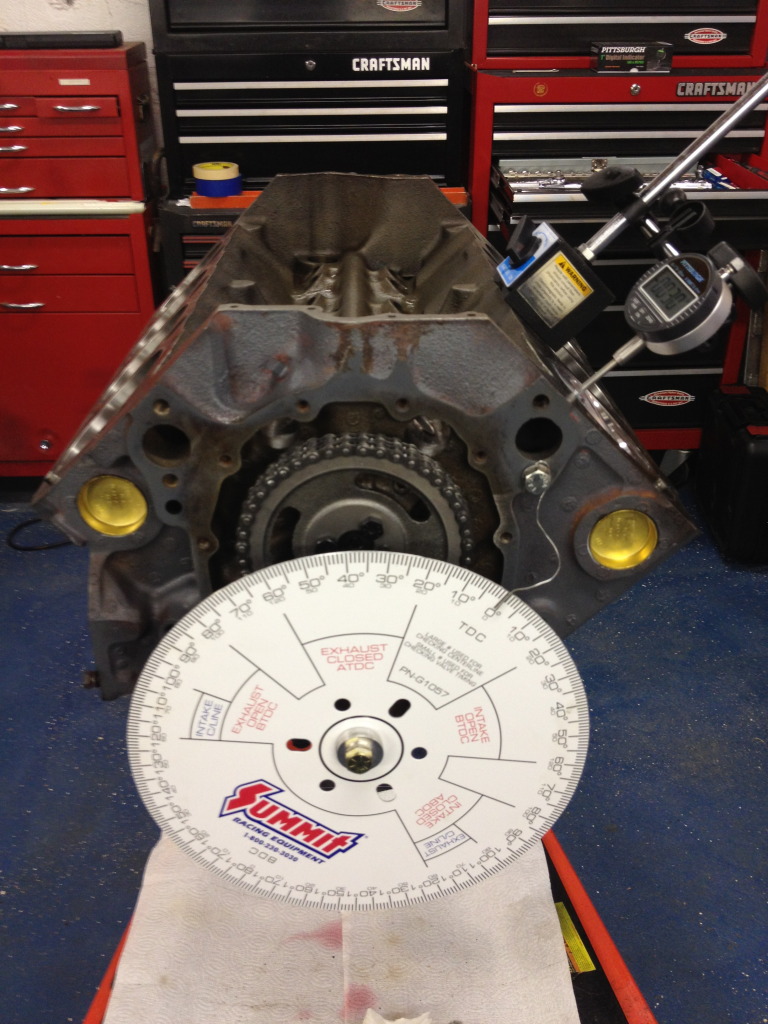
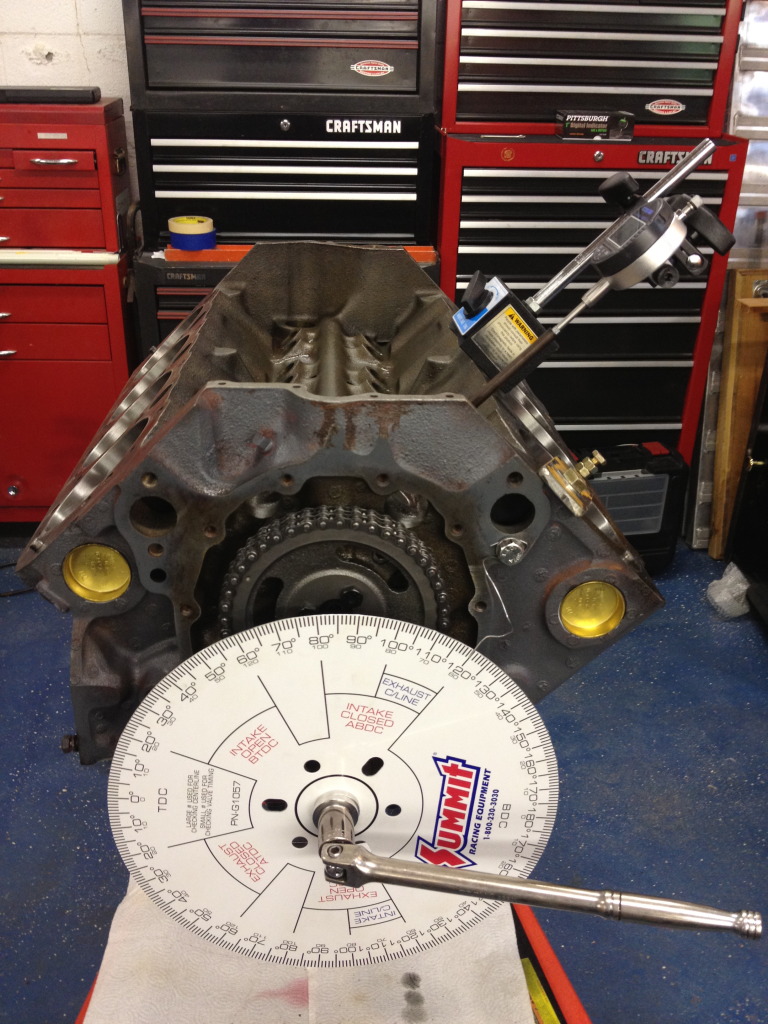
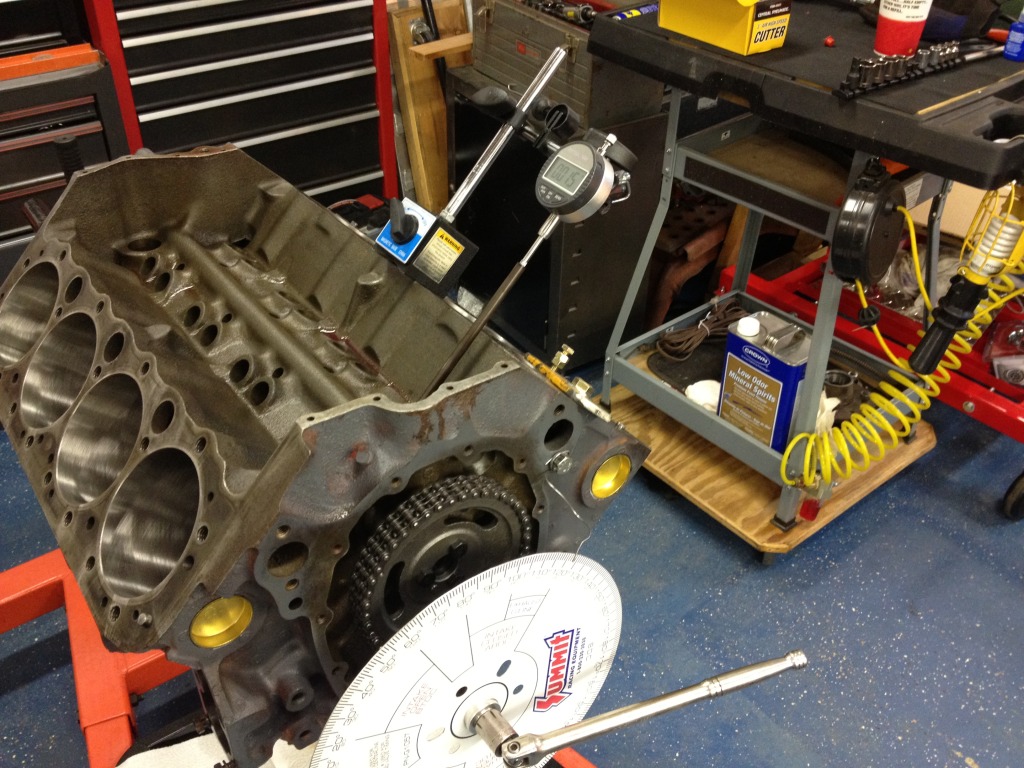
Okay, so I dug back through old photos of my engine build. I knew I took some shots of the degree process and sure enough, I've got a few that show the intake timing at .015 spot on 60* ABDC. This should rule out cam issues, correct? Here are the specs on the cam again http://www.compcams.com/Company/CC/c...?csid=225&sb=2
Le Mans Master


Joined: May 2006
Posts: 9,993
Likes: 1,136
From: League City Tx
DKarr,
If the engine runs well at 20* initial, why worry about it? You guys are WAYYYYY over thinking this stuff...
Give it the initial it wants, modify your mechanical to match the initial and yield the desired total... (Aka 36* at 3000), add your vacuum advance but limit its travel to say 8-10* , thus giving you a cruise advance of 44-46*....or less if it pings. Call it good!
I just did this on Monday on my dads 66' L79. I had the distributor recurved on a Sun machine. On his, it ran best with 15* initial+mechanical at 750 rpms without the vac advance. That combo got me 32-33*@3100 rpms and 36* @4100. I added the vacuum advance but made a limiter plate to restrict it to only 5* of advance.
Now at idle I have 20* (initial+mechanical+vac advance), at 3000 rpms it is right at 39-40* (initial+mechanical+vac advance)... WOT timing is 36* from about 3800 rpms and up.
Car runs perfect, I drove it around all day on Monday...
.030" 327, 9.5-1, ported 461 double humps, Crane 224/230 .475.495 on a 110 lsa. Car drives like an absolute dream...
I'll post up some pics of the limiter plate in a few mins.
Give it what it wants and don't worry about the theories... If it runs great, run it!
If the engine runs well at 20* initial, why worry about it? You guys are WAYYYYY over thinking this stuff...
Give it the initial it wants, modify your mechanical to match the initial and yield the desired total... (Aka 36* at 3000), add your vacuum advance but limit its travel to say 8-10* , thus giving you a cruise advance of 44-46*....or less if it pings. Call it good!
I just did this on Monday on my dads 66' L79. I had the distributor recurved on a Sun machine. On his, it ran best with 15* initial+mechanical at 750 rpms without the vac advance. That combo got me 32-33*@3100 rpms and 36* @4100. I added the vacuum advance but made a limiter plate to restrict it to only 5* of advance.
Now at idle I have 20* (initial+mechanical+vac advance), at 3000 rpms it is right at 39-40* (initial+mechanical+vac advance)... WOT timing is 36* from about 3800 rpms and up.
Car runs perfect, I drove it around all day on Monday...
.030" 327, 9.5-1, ported 461 double humps, Crane 224/230 .475.495 on a 110 lsa. Car drives like an absolute dream...
I'll post up some pics of the limiter plate in a few mins.
Give it what it wants and don't worry about the theories... If it runs great, run it!
Last edited by ajrothm; Sep 28, 2012 at 04:07 PM.
Le Mans Master
Joined: May 2006
Posts: 9,993
Likes: 1,136
From: League City Tx
I made this:

And I put it here:

That limits the amount of advance I get from the vac advance. Without it I was getting 16* of advance and the car was missing/surging at light cruise..1600-2500 rpms. Now I only get 5* of vac advance and the car runs perfect. In reality, I could have just plugged it and not ran any vac advance at all and the car ran great at 32-33* at light cruise but... I figured another 5* may help the fuel mileage a bit so...
Works good for us. This is a brand new motor so I am still dialing it in but it's pretty much perfect now.
And I put it here:
That limits the amount of advance I get from the vac advance. Without it I was getting 16* of advance and the car was missing/surging at light cruise..1600-2500 rpms. Now I only get 5* of vac advance and the car runs perfect. In reality, I could have just plugged it and not ran any vac advance at all and the car ran great at 32-33* at light cruise but... I figured another 5* may help the fuel mileage a bit so...
Works good for us. This is a brand new motor so I am still dialing it in but it's pretty much perfect now.

Burning Brakes

Joined: Sep 2012
Posts: 818
Likes: 0
From: coon rapids mn
you can buy adjustable vacuum advance canisters and install them in 1 hr.at WOT you loose vacuum and only have mechanical advance to add to the initial timing.stiffer springs can prevent too much timing at partial throttle.get a spring kit to customize you mech advance curve.
Race Director
Joined: Oct 2000
Posts: 15,009
Likes: 79
From: central FL, near the beach.
I often start out with "too much" advance on a new build. Mainly i want to break in the cam so "too much" doesn't matter,it helps. Any cold engine likes way more advance than normal. i've locked the vac advance at full, +15, on a cold day, and it pulls out instantly at 38F, not even 2 seconds to warm up! and no choke! Got that idea from the chrysler lean burn from the 70's. Timing is substituted for fuel! It works, lean burn.
Back on topic, on a hot summer day is when i find the true year round maximium base timing. and it is always way less than a winter max. I doubt there is anything seriously wrong with the OP's car.
after 50 miles i always re-set the valves and a few usually need it. then they stay good for a LONG time.
My 72 has 9.7:1 and 12* base timing and uses 87 octane. Base would be MUCH higher on Hi-test. Race gas would be even higher as higher octane burns slower. I'd guess some cars are using hi-test that really don't need it.
Back on topic, on a hot summer day is when i find the true year round maximium base timing. and it is always way less than a winter max. I doubt there is anything seriously wrong with the OP's car.
after 50 miles i always re-set the valves and a few usually need it. then they stay good for a LONG time.
My 72 has 9.7:1 and 12* base timing and uses 87 octane. Base would be MUCH higher on Hi-test. Race gas would be even higher as higher octane burns slower. I'd guess some cars are using hi-test that really don't need it.
Last edited by Matt Gruber; Sep 29, 2012 at 08:03 AM.
Thread Starter
Instructor
Joined: Aug 2011
Posts: 153
Likes: 2
Okay. Got this worked out. Lars was spot on. I trashed the stock vacuum can and went with the "B28" vacumm can from dura last, part number DV1810. It provides 16 degree advance coming in around 8" of vacuum. With this I was able to get my initial down to 18 and still have the car crank nice and easy and run well at partial throttle cruising. With the new can I'm around 34* at idle with vacuum connected on FULL manifold vacuum, not ported.
I read 33-34 degrees at 3000 and I plan on playing with my new distributor advance spring kit to fine tune this even more. Thanks to all those that chimed in.
I read 33-34 degrees at 3000 and I plan on playing with my new distributor advance spring kit to fine tune this even more. Thanks to all those that chimed in.



Le Mans Master


Joined: Oct 2000
Posts: 8,897
Likes: 1,353
From: Santa Ana CA

Duration is always measured at some given lift (e.g., 0.05") and that lift will always be achieved earlier and held later using a higher ratio rocker assuming nothing else changes. The change in duration may be small, but it is there.