







VIN numbers / matching numbers.

Thread Starter
6th Gear

Joined: Dec 2012
Posts: 6
Likes: 0
 VIN numbers / matching numbers.
Hi
I just bought a 72 454 convertible, auto transmission, and I have a question about this issue with matching numbers. The car I bought was sold as a "matching numbers" car, wich for me is the correct numbers on the frame, engine and gearbox. But the thing is, how can I check its actually the original numbers? Are the numbers identical or are they linked to eachother somehowe, so I can tell by looking at them? Maybe I have to look into some kind of a register from the time the car left the factory?
I just bought a 72 454 convertible, auto transmission, and I have a question about this issue with matching numbers. The car I bought was sold as a "matching numbers" car, wich for me is the correct numbers on the frame, engine and gearbox. But the thing is, how can I check its actually the original numbers? Are the numbers identical or are they linked to eachother somehowe, so I can tell by looking at them? Maybe I have to look into some kind of a register from the time the car left the factory?

Race Director


Joined: May 2006
Posts: 18,737
Likes: 2,583
the engine pad on the passenger side should have the last 6 digits of your vin plus the engine code should be appropriate for the engine size/options/year. I believe the trani also has the partial vin on it. If you do a search within this forum you will find the complete criteria.

Team Owner


Joined: Jun 2000
Posts: 38,923
Likes: 1,482
From: Southbound
Cruise-In II Veteran
No disrespect, but checking numbers after purchase is risky behaviour.
The engine code and VIN derivitive are stamped on a pad on the block at the front of the passenger's head. Jot down both stampings. This is a small block, but big blocks are similar.

A VIN derivitive is stamped on the frame at two locations. The first is on top of the frame rail about where your left hip will be if you are sitting in the car. You cannot see this stamp with the body on the frame.

The second location is on the also on the top of the frame rail, also driver's side just in front of the #4 body mount. Some people can see this number; others cannot.
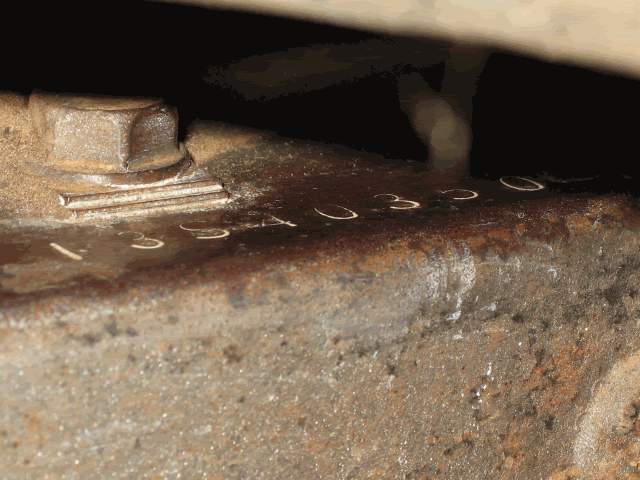
If memory serves, the VIN derivitive is stamped on the tag for TH400s.

The engine code and VIN derivitive are stamped on a pad on the block at the front of the passenger's head. Jot down both stampings. This is a small block, but big blocks are similar.
A VIN derivitive is stamped on the frame at two locations. The first is on top of the frame rail about where your left hip will be if you are sitting in the car. You cannot see this stamp with the body on the frame.
The second location is on the also on the top of the frame rail, also driver's side just in front of the #4 body mount. Some people can see this number; others cannot.
If memory serves, the VIN derivitive is stamped on the tag for TH400s.
Last edited by Easy Mike; Dec 3, 2012 at 04:45 PM.

Team Owner


Joined: Sep 2006
Posts: 31,278
Likes: 4,372
From: Westminster Maryland
Hi G,
I'll just add that the vin derivative stamp on the transmission case was usually done with the same stamp and by the same person as the stamp on the engine pad. So the 2 should show the same characteristics. Such as the shape of the digits (6s and 0s often varied in shape).
Regards,
Alan
I'll just add that the vin derivative stamp on the transmission case was usually done with the same stamp and by the same person as the stamp on the engine pad. So the 2 should show the same characteristics. Such as the shape of the digits (6s and 0s often varied in shape).
Regards,
Alan

Burning Brakes


Joined: Jan 2009
Posts: 766
Likes: 97
From: Lake Norman, NC
Hi Glarsen. You've gotten some very good and informative responses here.
Don't forget that the VIN is also on your "A" pillar and in the blue certification label, which should be on the trailing edge of your LH door.
"Numbers matching" for me extends well beyond the VIN. Key components such as your diff case, starter motor, carb, alternator, distributor, etc all have car-specific part numbers and dates of manufacture that are critical if you plan to have you car judged by NCRS or Bloomington Gold.
If you don't have these references already, I urge you to invest in the NCRS Judging Guide, a Corvette Assembly Instruction Manual and a Chassis Service Manual for your year car. These are extremely valuable resources and will help you learn all the details of your new Corvette.
Don't forget that the VIN is also on your "A" pillar and in the blue certification label, which should be on the trailing edge of your LH door.
"Numbers matching" for me extends well beyond the VIN. Key components such as your diff case, starter motor, carb, alternator, distributor, etc all have car-specific part numbers and dates of manufacture that are critical if you plan to have you car judged by NCRS or Bloomington Gold.
If you don't have these references already, I urge you to invest in the NCRS Judging Guide, a Corvette Assembly Instruction Manual and a Chassis Service Manual for your year car. These are extremely valuable resources and will help you learn all the details of your new Corvette.
Corvette Stories
The Best of Corvette for Corvette Enthusiasts

Top 10 Most Expensive Corvettes Ever Sold on Bring A Trailer
Brett Foote
10 Things Every Corvette Owner Needs (2026 Edition)
Michael S. Palmer
8 Most "Only Corvette Owners Understand" Quirks and Problems
Pouria Savadkouei
10 Reasons the C6 Z06 is Still A Performance Benchmark After 20 Years
Joe Kucinski
How Much Horsepower Every Corvette Engine "LOST" in 1972
Joe Kucinski
Top 10 DOs and DON'Ts for Protecting Your Convertible Top!
Michael S. Palmer
Top 10 Most Explosive Corvettes Ever Made: Power-to-Weight Ratio Ranked!
Joe Kucinski
150 hp to 1,250 hp: Every Corvette Generation Compared by the Specs That Matter
Joe Kucinski
8 Coolest Corvette Pace Cars (and Replicas) of All Time
Verdad Gallardo
Team Owner
Joined: Sep 2006
Posts: 31,278
Likes: 4,372
From: Westminster Maryland
Hi,
I agree with rr72 that 'checking the numbers' can go far beyond the VIN tag, engine stamp pad, and transmission stamp.
Many, many, mechanical, chassis, exterior, and interior parts, had part numbers and dates that while not tying them to a particular car, can make them appropriate for a particular car.
I found it interesting to see that sometimes these date coded parts arrived at St.Louis just in the nick of time. So it seems there were not large amounts of stock at the plant. Many parts on my 71 are dated with-in just a few days or weeks of it's build date.
Even 'major' parts seem to have moved quickly. The cylinder case of the base engine in my car was cast on December 31st.; the engine was assembled on January 7th.; and was in the car on about January 15th.
Regards,
Alan
I agree with rr72 that 'checking the numbers' can go far beyond the VIN tag, engine stamp pad, and transmission stamp.
Many, many, mechanical, chassis, exterior, and interior parts, had part numbers and dates that while not tying them to a particular car, can make them appropriate for a particular car.
I found it interesting to see that sometimes these date coded parts arrived at St.Louis just in the nick of time. So it seems there were not large amounts of stock at the plant. Many parts on my 71 are dated with-in just a few days or weeks of it's build date.
Even 'major' parts seem to have moved quickly. The cylinder case of the base engine in my car was cast on December 31st.; the engine was assembled on January 7th.; and was in the car on about January 15th.
Regards,
Alan
Burning Brakes
Joined: Jan 2009
Posts: 766
Likes: 97
From: Lake Norman, NC
Alan's right on the money. Interestingly, my Flint Michigan-built engine was cast on August 11, 1971. It was built up and shipped to St. Louis in time for the August 23, 1971 vehicle assembly date. A total of just 7 work days before it went into the car.
I may have been a little misleading in my earlier post. By "car-specific", I meant part number and date "correct" for a particular vehicle type (small vs big block, AC, PS, PB, PW, etc). For example, an auto trans uses a different carb than a manual trans. An AC car uses a different alt than a non AC car. I hope this didn't cause any confusion or concern.
I may have been a little misleading in my earlier post. By "car-specific", I meant part number and date "correct" for a particular vehicle type (small vs big block, AC, PS, PB, PW, etc). For example, an auto trans uses a different carb than a manual trans. An AC car uses a different alt than a non AC car. I hope this didn't cause any confusion or concern.

Team Owner
Joined: Jun 2000
Posts: 38,923
Likes: 1,482
From: Southbound
Cruise-In II Veteran
