





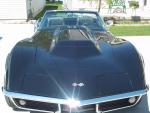





70' Distributor upgrade

Thread Starter
Pro


Joined: Nov 2012
Posts: 585
Likes: 39
From: FL
 70' Distributor upgrade
Asking for some advise, suggestions. I'm looking to upgrade my stock distributor on my 70' 350/300. Is there a conversion kit on the market to make it electronic, eliminating the points & condenser? Would it be best to replace the distributor entirely and if so what is the proven replacement? Additionally, my current distributor is fine, so should I leave well enough alone?
Thanks in advance for any and all input.
Thanks in advance for any and all input.

Le Mans Master


Joined: Aug 2006
Posts: 7,425
Likes: 1,559
From: mount holly NC
2025 c3 ('74-'82) of the Year Finalist - Unmodified
2019 C3 of Year Finalist (appearance mods)
If it ain't broke ...
Interesting story how you came to own the same Vette twice.
You stock distributor uses a cable to run the tachometer, so if you change it out keep that in mind.
HEI will need different wires. Not that easy if you have the boomerang shielding but not that bad a task.
There are points eliminator kits, I used a Pertronix kit for 6 years and had no trouble with it, but now I'm back to points.
With a stock engine you won't gain any HP so if it were me I'd take the dizzy money and buy the top shielding.
That's my 2 cents worth.
You stock distributor uses a cable to run the tachometer, so if you change it out keep that in mind.
HEI will need different wires. Not that easy if you have the boomerang shielding but not that bad a task.
There are points eliminator kits, I used a Pertronix kit for 6 years and had no trouble with it, but now I'm back to points.
With a stock engine you won't gain any HP so if it were me I'd take the dizzy money and buy the top shielding.
That's my 2 cents worth.

Tech Contributor


Joined: Aug 1999
Posts: 14,377
Likes: 6,377
From: At my Bar drinking and wrenching in Lafayette Colorado
 Mike is right: You will gain nothing at all with a distributor swap. The best thing you can do is to set your existing distributor up with a good advance curve, fix the slop in the shaft and breaker plate, and install a good set of points. You don't even need to do an electronic conversion: good points will run at least 20,000 miles with no reliability issues. You can e-mail me for my timing papers on how to set the thing up:
Lars
V8FastCars@msn.com
I've posted this a few times here on the Forum, but here is my documented testing of the ignition systems that I did with Hot Rod Magazine:
The "best" distributor and ignition system to use is the one you're comfortable with setting up and tuning. Any two systems, set up with the same timing curve, will perform virtually the same on a mild street car. For a mild performance street-driven car, I also highly recommend getting one with vacuum advance, and there are many to choose from.
To demonstrate the equivalent performance from one system to another, I actually did dyno testing at Westech with Hot Rod Magazine several years ago. Here are the results that I've published here on the Forum before:
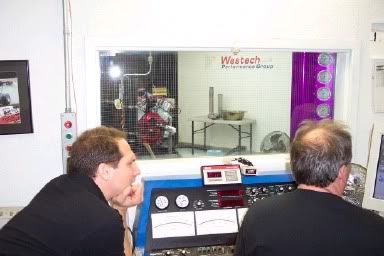
A few years ago, I did a bit of dyno testing at Westech Performance with Matt King, former Editor of Hot Rod Magazine. We tested several of the aftermarket capacitive discharge systems and top-end distributors against a plain ol' points-type distributor. The engine was a nice street-type 302 Ford putting out 370 horsepower. We tested ignition systems and distributors from Crane, MSD, and Mallory, making sure that each distributor had exactly the same centrifugal advance curve in it with the same total timing. Once these nice aftermarket systems were tested, we went out in the parking lot and pulled the stock points distributor out of Matt King's crap Falcon: We set it up with the same advance curve on Westech's distributor machine and dropped it in the 302 test engine. Results: There was no change in the engine's performance whatsoever at any point on the rpm curve. Absolutely none.
So here's the recommendation: Run whatever distributor you're comfortable with tuning and curving, and set it up with a good performance curve to match the needs of your engine. Whether this is a tach-drive points-type distributor, an HEI, or an MSD ProBillet is completely irrelevant as long as you can get it set up right. Buy something of good quality that is easily tunable, and make sure you run vacuum advance on any street-driven engine. Trigger boxes, amplifiers, huge coils, and fancy systems will not gain you anything on a moderate performance street engine - spend your time getting the curve and total timing set up right on whatever system you use - that's where the power is.
Here's Matt King (black shirt) and me setting up the points distributor from his Falcon in the 302 test engine to run head-to-head against the top-end capacitive discharge systems:
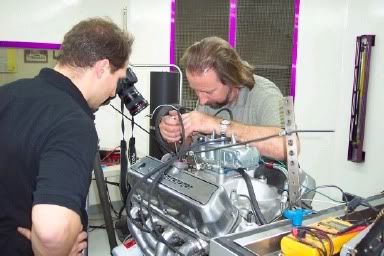
Notice that we even used the old crap wires out of Matt's Falcon for the testing:
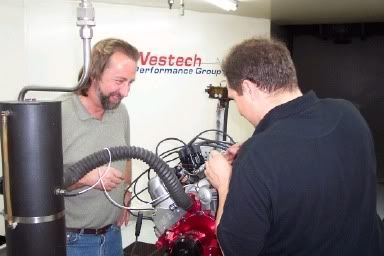
Here's the same engine with one of the fancy aftermarket systems in it and some really nice red plug wires:

Famed Westech Dyno Operator Steve Brule (left) overseeing the testing:
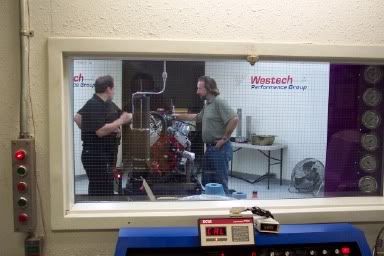
Results: Absolutely no change in power whatsoever from one system to another, as long as the advance curve remained the same (note Matt King's astounded "I can't freakin believe it" expression):
 [/QUOTE]
Thread Starter
Pro
Joined: Nov 2012
Posts: 585
Likes: 39
From: FL
Thanks for the feedback. I'm going to stay with the OEM distributor for now as it's working just fine. My current upgrades in the process of being installed next week is a new Holley and Exhaust system.
After having my car back a few month now I'm starting to relax while driving it. I'd forgotten just how much fun the car is to drive. Although evidently my wife had not forgotten. Anytime I say 'hey let's go for a cruise' she's standing in the garage on dead ready. Not - I have to fix my hair, I have to change my clothes, etc. etc. I'm not sure now if she actually bought the car be for me or her. Doesn't really matter as we're both having a great time with it.
I agree with the others 'Save the wave'!
After having my car back a few month now I'm starting to relax while driving it. I'd forgotten just how much fun the car is to drive. Although evidently my wife had not forgotten. Anytime I say 'hey let's go for a cruise' she's standing in the garage on dead ready. Not - I have to fix my hair, I have to change my clothes, etc. etc. I'm not sure now if she actually bought the car be for me or her. Doesn't really matter as we're both having a great time with it.
I agree with the others 'Save the wave'!
Corvette Stories
The Best of Corvette for Corvette Enthusiasts

10 Reasons the C6 Z06 is Still A Performance Benchmark After 20 Years
Joe Kucinski
How Much Horsepower Every Corvette Engine "LOST" in 1972
Joe Kucinski
Top 10 DOs and DON'Ts for Protecting Your Convertible Top!
Michael S. Palmer
Top 10 Most Explosive Corvettes Ever Made: Power-to-Weight Ratio Ranked!
Joe Kucinski
150 hp to 1,250 hp: Every Corvette Generation Compared by the Specs That Matter
Joe Kucinski
8 Coolest Corvette Pace Cars (and Replicas) of All Time
Verdad Gallardo
Top 10 Corvette Engines RANKED by Peak Torque (70+ Years of Muscle!)
Joe Kucinski
Corvette ZR1X Will Be Pacing the Indy 500, And Could Probably Race, Too!
Verdad Gallardo
Top 10 Corvettes Coming to Mecum Indy 2026!
Brett Foote
Tech Contributor
Joined: Aug 1999
Posts: 14,377
Likes: 6,377
From: At my Bar drinking and wrenching in Lafayette Colorado
If you need an upgrade on the distributor, you can send it out to me for repair and setup with a very nice curve - this will make its performance match or beat anything you can buy aftermarket. E-mail me for info.
Lars
V8Fastcars@msn.com
Lars
V8Fastcars@msn.com
Thread Starter
Pro
Joined: Nov 2012
Posts: 585
Likes: 39
From: FL
Thanks Lars I'll keep you in mind. Currently the car scheduled for the shop next week. The timing, and vacuum advance will adjusted / repaired as required, in addition with the installation of a new carburetor & exhaust. I offered to help but I don't want them to charge me more!
Tech Contributor
Joined: Aug 1999
Posts: 14,377
Likes: 6,377
From: At my Bar drinking and wrenching in Lafayette Colorado
Lars

Le Mans Master
Joined: Dec 2003
Posts: 5,727
Likes: 38
From: Fremont CA
I don't really agree with this conclusion. How low of an RPM did you start loading the motor on the dyno brake? My Corvette starts loading the motor at 1200RPM when I'm releasing the clutch and an automatic trans would be under 1000RPM. I think there is CONSIDERABLE benefits to fitting a Pertronix Ignitor unit into a properly functioning GM Delco distributor on any street driven Corvette. I have used this product since it was first released in the late 1970's and have had good results in every application I installed a Pertronix in. There was always a increase in fuel mileage and smoother idle in all vehicles I installed them into. You do have to make sure your distributor is properly functioning and if the points plate grounding wire is broken the Ignitor will not cure that problem.
I am shocked at the prices at NAPA for Echlin points sets and now they are made in Mexico running $17. My old Z/28 Camaro used to burn through points sets in under 5000 miles because they have a specially ground high RPM breaker cam in that distributor and the soft opening caused the points to burn and pit pretty quickly after trying Mallory Unilites and having them die without warning I finally installed a Perlux Ignitor and the problem was solved! (Perlux made most of their $$ selling lighting for trucks in the 90's the ignition division was sold off and became Pertronix.) I guess it depends on what your driving.
When my wife goes off on a C3 Corvette drive by herself when I have to stay at home she is depending on a Pertronix Ignitor III ignition set-up, the latest generation of the SAME ignition system that got her through 4 years of college driving a 66 Mustang (which sometimes entailed going to do study in her field of education and driving over 70 miles 4 times a week for 2 years.)
The 70 LT-1 she drives now can be particular about the gasoline running through it's factory Holley 4bbl carb and with an Ignitor III in it it always starts and runs like a champ (yes I'll admit, I carry a spare set of ignition points in my roadside breakdown kit but, have yet to have had to used them.)
Everyone has an opinion but, on ignitions I don't agree that a "Kettering Ignition" developed in the early 1900's belongs on my Hi-Performance Corvette (or even the Delco K-66 system.)
I am shocked at the prices at NAPA for Echlin points sets and now they are made in Mexico running $17. My old Z/28 Camaro used to burn through points sets in under 5000 miles because they have a specially ground high RPM breaker cam in that distributor and the soft opening caused the points to burn and pit pretty quickly after trying Mallory Unilites and having them die without warning I finally installed a Perlux Ignitor and the problem was solved! (Perlux made most of their $$ selling lighting for trucks in the 90's the ignition division was sold off and became Pertronix.) I guess it depends on what your driving.
When my wife goes off on a C3 Corvette drive by herself when I have to stay at home she is depending on a Pertronix Ignitor III ignition set-up, the latest generation of the SAME ignition system that got her through 4 years of college driving a 66 Mustang (which sometimes entailed going to do study in her field of education and driving over 70 miles 4 times a week for 2 years.)
The 70 LT-1 she drives now can be particular about the gasoline running through it's factory Holley 4bbl carb and with an Ignitor III in it it always starts and runs like a champ (yes I'll admit, I carry a spare set of ignition points in my roadside breakdown kit but, have yet to have had to used them.)
Everyone has an opinion but, on ignitions I don't agree that a "Kettering Ignition" developed in the early 1900's belongs on my Hi-Performance Corvette (or even the Delco K-66 system.)
Tech Contributor
Joined: Aug 1999
Posts: 14,377
Likes: 6,377
From: At my Bar drinking and wrenching in Lafayette Colorado
Eric -
I'm not sure how you can disagree with factual info: The purpose of running stuff on the dyno is to obtain facts without opinion affecting the results...
We were braking the engine down to 2000 rpm for the start of each dyno run and running up through 6,000 rpm - this is the standard starting point and range for the lower torque engines. Facts are in the numbers: There is no difference at all on the dyno. None. I didn't make up these photos or the results. Really.
Lars
I'm not sure how you can disagree with factual info: The purpose of running stuff on the dyno is to obtain facts without opinion affecting the results...
We were braking the engine down to 2000 rpm for the start of each dyno run and running up through 6,000 rpm - this is the standard starting point and range for the lower torque engines. Facts are in the numbers: There is no difference at all on the dyno. None. I didn't make up these photos or the results. Really.
Lars
Drifting

Joined: Jan 2012
Posts: 1,908
Likes: 129
From: Fredericksburg Virginia
I don't disagree with Mr. Lars one bit. Not a single negative or exception to a single statement made. An engine is an air pump. If you're running the exact same curve on different distributors and they are in servicable running condition, it makes sense that you wouldn't get very, very, very near identical (within 1% being identical) dyno pulls.
I'm one of those idiots that felt more comfortable yanking the TI system and putting in a full MSD Pro-Billet setup. And yes, I did feel a difference. Part of that difference was because of a failing component in my TI system...could have been in the box...could have been a failing coil. Part of that difference was better tuning of my MSD. I concede that none of that difference is attributed to the system itself IF I WAS RUNNING IDENTICAL CURVES.
And that's just it. A new system has the little color springs and collars that tell you EXACTLY what your advance is and where it is in the RPM band. No testing or tinkering required to even find out what you have. Want full advance 400 RPM sooner? No problem. Replace the little blue thing with a little silver thing. EASY! Want more overall advance? Switch the yellow thing with the red thing. BAM!
For Village Idiots like myself, that simplicity is worth a lot.
Secondly, mine being a 4-speed car, I very much wanted a Rev Limiter. The Pertronix systems have a Limiter on some of their units, but the TI dizzy wouldn't take one of those directly, so I would have had to get another anyway.
To the OP, the more you spend, the more you get. Not in horsepower...not directly anyway. You get more flexibility for more definite changes to known conditions without as much effort or testing. That clears the path to your maximizing your horsepower and driveability quicker and with more system stability (no degredation of points, for example).
That may mean that you don't make A SINGLE MORE HORSEPOWER than your current distributor with new points. That also means you won't LOSE a single horsepower because of the natural degradation of the points, for example.
I guess I'm saying that just because the old stuff is awesome, that doesn't mean the new stuff is junk. There are reasons why it is manufactured and why people like me choose to purchase it.
I'm one of those idiots that felt more comfortable yanking the TI system and putting in a full MSD Pro-Billet setup. And yes, I did feel a difference. Part of that difference was because of a failing component in my TI system...could have been in the box...could have been a failing coil. Part of that difference was better tuning of my MSD. I concede that none of that difference is attributed to the system itself IF I WAS RUNNING IDENTICAL CURVES.
And that's just it. A new system has the little color springs and collars that tell you EXACTLY what your advance is and where it is in the RPM band. No testing or tinkering required to even find out what you have. Want full advance 400 RPM sooner? No problem. Replace the little blue thing with a little silver thing. EASY! Want more overall advance? Switch the yellow thing with the red thing. BAM!
For Village Idiots like myself, that simplicity is worth a lot.
Secondly, mine being a 4-speed car, I very much wanted a Rev Limiter. The Pertronix systems have a Limiter on some of their units, but the TI dizzy wouldn't take one of those directly, so I would have had to get another anyway.
To the OP, the more you spend, the more you get. Not in horsepower...not directly anyway. You get more flexibility for more definite changes to known conditions without as much effort or testing. That clears the path to your maximizing your horsepower and driveability quicker and with more system stability (no degredation of points, for example).
That may mean that you don't make A SINGLE MORE HORSEPOWER than your current distributor with new points. That also means you won't LOSE a single horsepower because of the natural degradation of the points, for example.
I guess I'm saying that just because the old stuff is awesome, that doesn't mean the new stuff is junk. There are reasons why it is manufactured and why people like me choose to purchase it.
Drifting
Joined: Jan 2012
Posts: 1,908
Likes: 129
From: Fredericksburg Virginia
Hate to 'reawaken' a thread, but there was a very interesting tid-bit that I came across recently that I wanted to discuss for prosperity:
I'm currently rebuilding my LT-1 engine into a bit of a monster. I'm installing a 0.590 lift cam with ~290 duration/110 separation into my car. Like I said...just a little on the extreme side.
My question to my engine builder: "How stinky is this thing going to be?"
His answer: "Well, that's why we got that MSD system last year."
Why? At low RPM's, a multiple-discharge capacitance-based system fires the plugs bunches and bunches of times over numerous degrees of timing. This helps to burn off more of the fuel before it bypasses into my exhaust system...a consequence of the large amount of valve overlap. This is something that a stock system does not do.
I understand that the OP stated that the engine is otherwise stock, so this type of system, as Mr. Lars pointed out, would be of nearly zero benefit to him.
I just wanted to clarify, though, that this type of system DOES HAVE BENEFIT to some engines. Again, as Mr. Lars pointed out, this is NOT to the benefit of horsepower. Rather to the benefit of not having your eyes water (as much) while idling at a stoplight.
So...in a way...it DOES benefit horsepower. It can help to make an extreme cam otherwise 'livable' by taking away some of the negative consequence.
I'm currently rebuilding my LT-1 engine into a bit of a monster. I'm installing a 0.590 lift cam with ~290 duration/110 separation into my car. Like I said...just a little on the extreme side.
My question to my engine builder: "How stinky is this thing going to be?"
His answer: "Well, that's why we got that MSD system last year."
Why? At low RPM's, a multiple-discharge capacitance-based system fires the plugs bunches and bunches of times over numerous degrees of timing. This helps to burn off more of the fuel before it bypasses into my exhaust system...a consequence of the large amount of valve overlap. This is something that a stock system does not do.
I understand that the OP stated that the engine is otherwise stock, so this type of system, as Mr. Lars pointed out, would be of nearly zero benefit to him.
I just wanted to clarify, though, that this type of system DOES HAVE BENEFIT to some engines. Again, as Mr. Lars pointed out, this is NOT to the benefit of horsepower. Rather to the benefit of not having your eyes water (as much) while idling at a stoplight.
So...in a way...it DOES benefit horsepower. It can help to make an extreme cam otherwise 'livable' by taking away some of the negative consequence.
Last edited by keithinspace; Feb 20, 2013 at 11:55 AM.
Thread Starter
Pro
Joined: Nov 2012
Posts: 585
Likes: 39
From: FL
Thanks for the additional information Keith. The car is schedule to go into the shop next week for header installation and fine tuning. Last week I installed a new Holley so once everything is installed and tuned I'll see about a replacement distributor. This is the first time the car will be in the air since I got it back. I'm looking forward to checking everything out and writing down numbers. I don't think I'll fine any real surprises but you never know.