




Cam, CR, compression testing lbs

Thread Starter
Team Owner


Joined: Jan 2007
Posts: 53,648
Likes: 878
From: Southern Cal Ca
St. Jude Donor '22
 Cam, CR, compression testing lbs
Curious how a 10 to 1 motor will give 210 220 lbs
of pressure on a guage.
14.7 lbs of atmos so, 10 (14.7) to 1 =147 lbs?

of pressure on a guage.
14.7 lbs of atmos so, 10 (14.7) to 1 =147 lbs?

Race Director


Joined: May 2005
Posts: 10,674
Likes: 122
From: Millington Illinois
St. Jude Donor '08-'09
A 10 to 1 motor could show #140 or #220. It all depends on the cam specs specifically intake valve closing point. A 10 to 1 engine that has a compression test of #220 likely won't run on pump gas.

Melting Slicks


Joined: Oct 2002
Posts: 2,317
Likes: 111
From: St Louis MO

Thread Starter
Team Owner
Joined: Jan 2007
Posts: 53,648
Likes: 878
From: Southern Cal Ca
St. Jude Donor '22
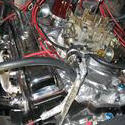
built a 302 ford
10.5 to 1
210 lbs
282 duration, 480 lift, 113 lobe, polished iron heads.
took some effort to jet the carb and curve the dist.

did similar with a couple LT1s
1st a flat tappet one then a roller.
all done years ago before the interwebs and info about cam science.
after reading the dyn CR threads, made me wonder about
cyl pressures and what if any the ideal pressures would be.
10.5 to 1
210 lbs
282 duration, 480 lift, 113 lobe, polished iron heads.
took some effort to jet the carb and curve the dist.
did similar with a couple LT1s
1st a flat tappet one then a roller.
all done years ago before the interwebs and info about cam science.
after reading the dyn CR threads, made me wonder about
cyl pressures and what if any the ideal pressures would be.
Le Mans Master

Joined: Oct 2002
Posts: 7,098
Likes: 378
From: Las Vegas - Just stop perpetuating myths please.
Wrong science.
Compression test should be done with engine warm or hot (good luck removing the plugs hot) to maximize ring seal. Per D. Vizard for a good performance engine should be close to 200 psi (gauge press) and no less than 180psi. Max press for street engine should be <220psi.
Good luck cal,
cardo0
Thread Starter
Team Owner
Joined: Jan 2007
Posts: 53,648
Likes: 878
From: Southern Cal Ca
St. Jude Donor '22
1 atmosphere = 14.7 lbs/in2 at standard temp (68*F) and at standard density (0.0765 lb/cu ft). Gauge press is press above/greater than atmospheric press. Compression ratio is change in volume meaning if static volume at TDC = say 4.27 cubic inches (or 70cc) then swept volume plus static volume for 10 to 1 is 42.7in3 (700cc). Pressure follows the ideal gas law: PV=nRT where P = press, V = volume, n = amount of substance in moles, R = gas constant, T = temp.
Compression test should be done with engine warm or hot (good luck removing the plugs hot) to maximize ring seal. Per D. Vizard for a good performance engine should be close to 200 psi (gauge press) and no less than 180psi. Max press for street engine should be <220psi.
Good luck cal,
cardo0
Compression test should be done with engine warm or hot (good luck removing the plugs hot) to maximize ring seal. Per D. Vizard for a good performance engine should be close to 200 psi (gauge press) and no less than 180psi. Max press for street engine should be <220psi.
Good luck cal,
cardo0


Race Director
Joined: May 2005
Posts: 10,674
Likes: 122
From: Millington Illinois
St. Jude Donor '08-'09
You are not just compressing air. It has gasoline mixed in. Liquids don't compress. As I said #220 likely won't run on pump gas. Might if everything is perfect. Quench, Al heads, Fast burn chamber design, A/F ratio, Cool thermostat, CAI, Right timing curve, Ect.
Corvette Stories
The Best of Corvette for Corvette Enthusiasts

Top 10 Most Expensive Corvettes Ever Sold on Bring A Trailer
Brett Foote
10 Things Every Corvette Owner Needs (2026 Edition)
Michael S. Palmer
8 Most "Only Corvette Owners Understand" Quirks and Problems
Pouria Savadkouei
10 Reasons the C6 Z06 is Still A Performance Benchmark After 20 Years
Joe Kucinski
How Much Horsepower Every Corvette Engine "LOST" in 1972
Joe Kucinski
Top 10 DOs and DON'Ts for Protecting Your Convertible Top!
Michael S. Palmer
Top 10 Most Explosive Corvettes Ever Made: Power-to-Weight Ratio Ranked!
Joe Kucinski
150 hp to 1,250 hp: Every Corvette Generation Compared by the Specs That Matter
Joe Kucinski